Spiritual Body
A spiritual body is the form a person is believed to inhabit beyond physical life. Compare Dante’s shades, Swedenborg and Spiritualist books.
In this article
What is a spiritual body?
A spiritual body is a form in which a person is believed to act and sense things apart from the physical body. A figure who has died can speak, recognise a friend or travel in such an account. Some books imagine that form as ordinary after death. Others describe a change of body as part of spiritual development. [1][5][6][18]
Each account has to explain what stays recognisable. A face, a voice or a shared memory can give continuity to a person whose appearance and surroundings have changed. [1][5][15][31][32]
See references (7)
- The Angels’ Diary and Celestion Study of Man, Reader page 26
- The Angels’ Diary and Celestion Study of Man, Reader page 29
- The Angels’ Diary and Celestion Study of Man, Reader page 34
- The Angels’ Diary and Celestion Study of Man, Reader page 153
- The Angels’ Diary and Celestion Study of Man, Reader page 37
- A Subaltern in Spirit Land, printed p. 34, Reader page 49
- A Subaltern in Spirit Land, printed p. 35, Reader page 50
Death, resurrection and the body
The Other World, edited by Frederick George Lee
In The Other World, Frederick George Lee quotes William Howitt describing death as the soul’s departure from the visible body. Lee disputes what Howitt infers about resurrection. Their exchange asks how continued embodiment after death relates to the fate of the earthly body. [120][121]
Howitt’s quoted account says the spiritual body emerging at death is sufficient for the life to come. It denies that receiving an earthly body again would add to that condition. Progress is instead described through the casting off of subtler particles. This gives continued embodiment a changing character, while refusing the later restoration Lee regards as part of Christian belief. [121]
A reproduced review of Alfred Russel Wallace’s essays presents another model. It summarises a spiritual form developing with and permeating the physical body, separation at death without an immediate improvement of character, and subsequent moral and intellectual progress. The review then argues against Wallace from its own religious principles. Its summary and criticism should be read as distinct voices within Lee’s appendix. [122][123][124][125][126]
These passages make the body more than a picture of a person continuing to look familiar. They ask how form relates to sensation, character and development, and whether survival requires a future return of earthly matter. Lee’s purpose is to expose disagreement with his theology. The quoted sources remain useful precisely because their accounts of continued life are not interchangeable with his. [120][121][123][124]
The Angels’ Diary
The narrator of the diary attributed to Effie M. Shirey discovers her spiritual body through sensation. Leaving the physical body feels like being lifted out of a case. She notices long hair, white clothing and a buoyancy associated with childhood. Meeting her brother, she recognises someone who died young and has since grown. [4][1][5]
Its capacities become apparent during visits. The traveller floats above the ground, walks through a lake without becoming wet and enters a mansion through its walls. Spiritual food is said to heighten her condition rather than rebuild bodily tissue. Familiar acts acquire different purposes under the book’s imagined conditions of embodiment. [6][7][8][9]
The explanatory section Celestion Study of Man is attributed to Charles Samson. It treats the person as the inhabitant of a physical and a spiritual body, each made from a different principle. It calls the spiritual principle electrical and the physical magnetic. Those words belong to its esoteric account of how the two can remain connected. [10][11][12][13]
The book distinguishes a form leaving the body from that form becoming visible to friends. It proposes that visibility requires taking on material elements. After death the physical particles return to nature, while the spiritual form continues to develop. Through those changes, the author insists, a distinctive individuality remains recognisable. [14][2][15]
The spiritual body is later described through life-cells supplied from a divine centre. A further passage imagines a developed being dispersing and regathering particles around an enduring ego. These are attempts within the book to explain why a person could change in substance and appearance while remaining the same individual. [16][17][3]
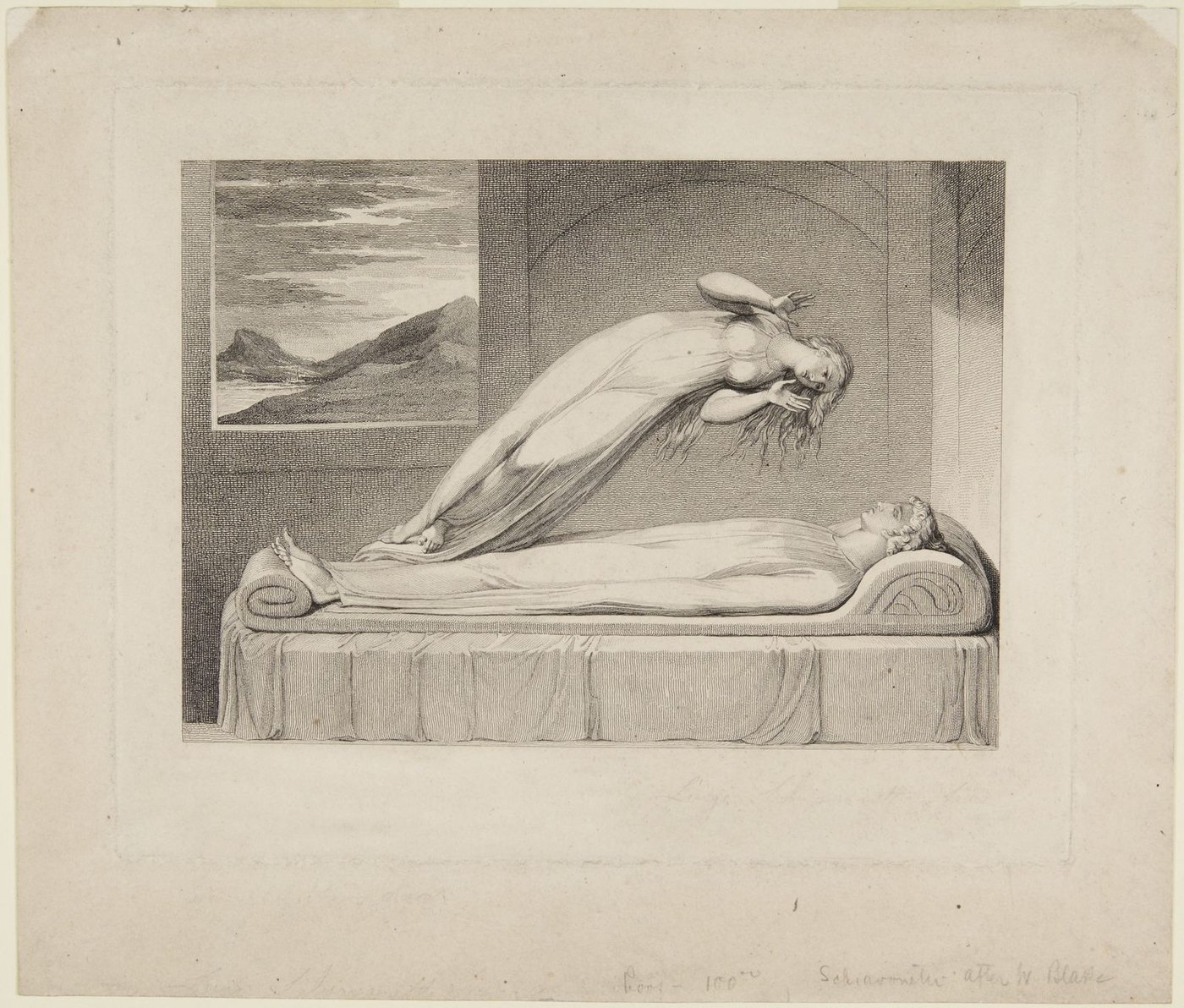
Luigi Schiavonetti after William Blake, The Soul Hovering over the Body Reluctantly Parting with Life, 1805–08. Created for Robert Blair’s poem The Grave, the image gives the separation of soul and body a human form.
Princeton University Art Museum. Gift of Frank Jewett Mather Jr., x1947-85. Public Domain. · Image source ↗ · Public Domain
See references (17)
- The Angels’ Diary and Celestion Study of Man, Reader page 26
- The Angels’ Diary and Celestion Study of Man, Reader page 151
- The Angels’ Diary and Celestion Study of Man, Reader page 200
- The Angels’ Diary and Celestion Study of Man, Reader page 25
- The Angels’ Diary and Celestion Study of Man, Reader page 29
- The Angels’ Diary and Celestion Study of Man, Reader page 34
- The Angels’ Diary and Celestion Study of Man, Reader page 35
- The Angels’ Diary and Celestion Study of Man, Reader page 40
- The Angels’ Diary and Celestion Study of Man, Reader page 41
- The Angels’ Diary and Celestion Study of Man, Reader page 114
- The Angels’ Diary and Celestion Study of Man, Reader page 134
- The Angels’ Diary and Celestion Study of Man, Reader page 146
- The Angels’ Diary and Celestion Study of Man, Reader page 147
- The Angels’ Diary and Celestion Study of Man, Reader page 150
- The Angels’ Diary and Celestion Study of Man, Reader page 153
- The Angels’ Diary and Celestion Study of Man, Reader page 165
- The Angels’ Diary and Celestion Study of Man, Reader page 166
Gone West by J. S. M. Ward
The first account of death in J. S. M. Ward’s Gone West begins with a sensation of sliding out of a heavy covering, compared with withdrawing a hand from a wet glove. H. J. L., one of Ward’s reported spirit contributors, then sees his body and a cord of light breaking away. He next describes himself as a naked soul exposed to intense cold before a luminous guide appears. [20][21]
A later scene makes him ask why a spirit should have a body at all. Ward sees him in white robes that seem in some way part of him. In a classroom, other pupils resemble miniature adults, while the teacher is large and luminous. Visible form expresses differing spiritual conditions within the story. [22][23]
The teacher’s answer distinguishes matter, force and form. H. J. L. is asked to compare the form of a person with the forms of thoughts. Because he is a form among forms, his surroundings can appear as substantial to him as earthly objects once did. This is the lesson’s proposed explanation for the solidity of the spirit world. [23][24][25]
The book also imagines a further passage beyond the form currently known. The introduction describes a messenger assuming an angelic appearance by will, and the schoolteacher admits limits to his knowledge of what comes beyond the Wall of Fire. The surviving person and the form taken by that person are treated as related questions with different possible futures. [26][27][24]
The account uses bodily sensation first and an explanatory dialogue later. Its imagery differs from the electrical life-cells described in Celestion Study of Man. Preserving each vocabulary allows a reader to compare how the two books try to make personal continuity intelligible. [20][23][16]
The later narratives make the difference between astral and spiritual embodiment explicit. The Officer loses a psychic body before entering hell, while W. A. leaves an astral shell before reaching the country familiar from H. J. L.’s account. W. A.’s spiritual body then appears child-sized and grows as he learns. Survival, a change of covering and the development of capacities are separate stages within Ward’s explanation. [28][29]
See references (11)
- The Angels’ Diary and Celestion Study of Man, Reader page 165
- Gone West, printed p. 15, Reader page 28
- Gone West, printed p. 16, Reader page 29
- Gone West, printed p. 23, Reader page 36
- Gone West, printed p. 24, Reader page 37
- Gone West, printed p. 25, Reader page 38
- Gone West, printed p. 26, Reader page 39
- Gone West, Introduction, Reader page 9
- Gone West, printed p. 18, Reader page 31
- Gone West, printed p. 97, Reader page 110
- Gone West, printed p. 176, Reader page 189
A Subaltern in Spirit Land by J. S. M. Ward
In J. S. M. Ward’s A Subaltern in Spirit Land, a reunion makes different forms visible together. Rex, Ward’s deceased brother, notices a silver cord trailing from his living brother, while H. J. L.’s covering appears temporary and requires renewal. The older relative explains that his own astral body dissolved long before and that he has made another for the visit. [30][31][32]
H. J. L. describes the soul as enclosed in a spiritual form within the astral body. A person can remain in that intermediate covering for some time after physical death. Leaving it later allows entry to the spirit plane. The book uses successive coverings to distinguish several stages within continuing life. [33][34]
After the spiritual form has departed, an astral shell may persist for a while. H. J. L. compares it with a corpse and says it can retain familiar patterns of behaviour. The continued appearance of a shape therefore does not, in his account, always mean that the person still inhabits it. [34][35]
The spiritual form has a further history of its own. The guide imagines a distant passage beyond fixed form, while saying he does not know what follows. At a nearer stage, bodily size is said to express spiritual development rather than earthly age. The sequel keeps a distinction between the surviving person, a temporary covering and the capacities expressed through a form. [35][36]
The accounts of Ward’s mother and Captain B. describe a luminous cord linking an emerging form with the physical body. Their experiences differ: she remains unconscious, while the captain reports moving and speaking before understanding what has happened. Rex says the cord’s breaking does not always coincide with the bodily event that observers call death. This is the book’s account of an unseen transition, rather than an established physiological description of dying. [37][38][39][40][41][42]
See references (13)
- A Subaltern in Spirit Land, printed p. 6, Reader page 21
- A Subaltern in Spirit Land, printed p. 34, Reader page 49
- A Subaltern in Spirit Land, printed p. 35, Reader page 50
- A Subaltern in Spirit Land, printed p. 42, Reader page 57
- A Subaltern in Spirit Land, printed p. 43, Reader page 58
- A Subaltern in Spirit Land, printed p. 44, Reader page 59
- A Subaltern in Spirit Land, printed p. 55, Reader page 70
- A Subaltern in Spirit Land, printed p. 123, Reader page 138
- A Subaltern in Spirit Land, printed p. 124, Reader page 139
- A Subaltern in Spirit Land, printed p. 223, Reader page 238
- A Subaltern in Spirit Land, printed p. 224, Reader page 239
- A Subaltern in Spirit Land, printed p. 226, Reader page 241
- A Subaltern in Spirit Land, printed p. 227, Reader page 242
The Encyclopaedia of Death and Life in Spirit-World, Volume I
J. R. Francis’s The Encyclopaedia of Death and Life in Spirit-World, Volume I, collects several explanations of the spiritual body. In ‘The Passage to the Spirit Side of Life’, a communication from a recipient’s elder brother describes awakening with hands, feet and a recognisable human body. The surprise matters: he had expected a prolonged sleep before a general resurrection, and instead reports immediate personal continuity. [43][44]
‘Phenomena of Death’, given through the medium J. J. Morse, supplies a more systematic account. It describes an inner organising principle withdrawing from the physical body. A seer is said to perceive a point of light leaving near the brain and gathering spiritual elements into a human form. The form expresses continuing intelligence and personality. This is the discourse’s claimed clairvoyant explanation, rather than an observed anatomical process. [45][46]
The first passage approaches embodiment through a newcomer’s recognition of himself; the Morse discourse proposes a mechanism for how the new form emerges. It also claims that the spiritual person retains capacities which bodily decline appears to remove and that bodily differences gradually change after death. These assertions belong to the book’s religious model of survival. They do not establish medical explanations of memory, illness or disability. [44][45][46][47]
Francis also prints Andrew Jackson Davis’s clairvoyant account, identified as drawn from The Great Harmonia, Volume I. Davis describes vital electrical and magnetic elements gathering towards a dying woman’s head. Within the luminous atmosphere he reports seeing another head form, followed by neck, shoulders and a complete spiritual organisation. [90][91][92]
For Davis, affinity explains why the emerging elements gather into a person. He describes a current between the two bodies, followed by separation, breathing in a new medium and a recognisable form. The text compares this transition with birth while preserving the woman’s identity. [92][93]
Davis gives the observation a duration of about two and a half hours, then explicitly says that this supplies no universal timing rule. His further claims about pain, organs and bodily differences belong to his proposed clairvoyant explanation. They are not established physiology or a measure of another person’s experience of dying. [91][92][93][94]
Davis’s sequence gives a proposed mechanism for the emergence of the spiritual body. Griffen’s report elsewhere in the anthology instead approaches a partly separated body through sensation and an embrace. A supposed observer’s account and an experiencer’s remembered sensations should not be made interchangeable. [90][91][92][95][96][97]
Celestion Study of Man, attributed to Charles Samson, calls the spiritual principle electrical and the physical magnetic. Davis instead describes both vital electricity and magnetism gathering during the emergence of a spiritual form. The shared vocabulary does not supply identical roles for those forces. [10][11][12][13][91][92][93]
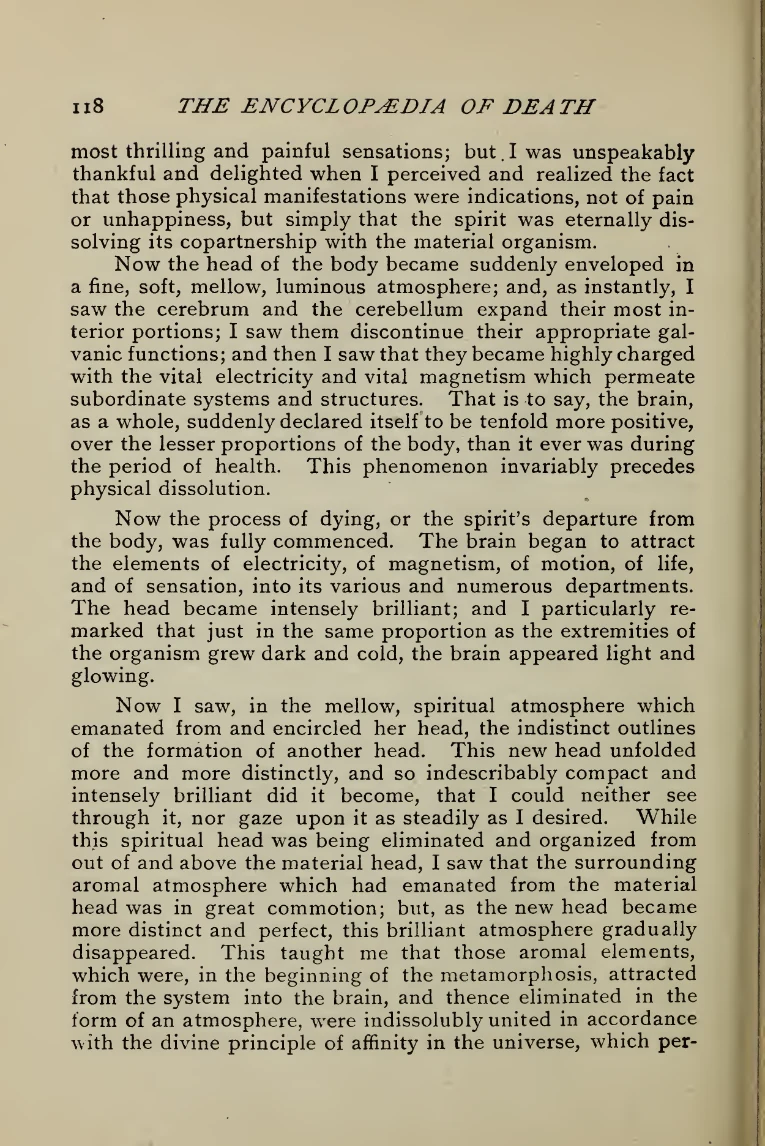
Source facsimile: The Encyclopaedia of Death and Life in the Spirit-World, Volume I (1903), printed p. 118, Reader page 117.
The Encyclopaedia of Death and Life in the Spirit-World, Volume I, fourth edition, 1903. Public-domain historical page extracted from the checksum-verified Library PDF. · Image source ↗ · Public Domain
See references (17)
- The Angels’ Diary and Celestion Study of Man, Reader page 114
- The Angels’ Diary and Celestion Study of Man, Reader page 134
- The Angels’ Diary and Celestion Study of Man, Reader page 146
- The Angels’ Diary and Celestion Study of Man, Reader page 147
- The Encyclopaedia of Death and Life in Spirit-World, Volume I, printed p. 46, Reader page 45
- The Encyclopaedia of Death and Life in Spirit-World, Volume I, printed p. 47, Reader page 46
- The Encyclopaedia of Death and Life in Spirit-World, Volume I, printed p. 56, Reader page 55
- The Encyclopaedia of Death and Life in Spirit-World, Volume I, printed p. 57, Reader page 56
- The Encyclopaedia of Death and Life in Spirit-World, Volume I, printed p. 59, Reader page 58
- The Encyclopaedia of Death and Life in the Spirit-World, Volume I, printed p. 117, Reader page 116
- The Encyclopaedia of Death and Life in the Spirit-World, Volume I, printed p. 118, Reader page 117
- The Encyclopaedia of Death and Life in the Spirit-World, Volume I, printed p. 119, Reader page 118
- The Encyclopaedia of Death and Life in the Spirit-World, Volume I, printed p. 120, Reader page 119
- The Encyclopaedia of Death and Life in the Spirit-World, Volume I, printed p. 121, Reader page 120
- The Encyclopaedia of Death and Life in the Spirit-World, Volume I, printed p. 158, Reader page 157
- The Encyclopaedia of Death and Life in the Spirit-World, Volume I, printed p. 159, Reader page 158
- The Encyclopaedia of Death and Life in the Spirit-World, Volume I, printed p. 160, Reader page 159
Shades, change and perception
The Divine Comedy by Dante Alighieri
In Dante Alighieri’s Divine Comedy, a shade can speak, recognise a friend and show emotion. Yet the lean souls on the mountain pose a puzzle: how can someone without a body that needs food grow thin? In Purgatory XXV, Virgil asks Statius for an explanation. [51]
Statius distinguishes the departed soul from the visible form it subsequently takes. At death, he says, memory, intelligence and will remain active with greater force. When the soul reaches its allotted place, its formative power impresses a shape on the surrounding air, corresponding to the form of its earlier limbs. The resulting appearance follows the soul as a flame follows the fire that produces it. [52]
This shade has the senses and expressions through which the pilgrim encounters it: speech, laughter, tears and sighs. It responds to the passions within, which explains the changes Dante has observed. Statius presents this within the poem’s account of soul and embodiment. It is a literary and theological explanation, not a description established through observation of air or human anatomy. [52][53]
Other meetings show the limits of this appearance. Dante tries three times to embrace Casella and closes his arms on nothing. Later Statius attempts to embrace Virgil, who reminds him that they are both shades. Affection and recognition remain vivid, while familiar gestures encounter a form that cannot simply be treated as earthly flesh. [48][50]
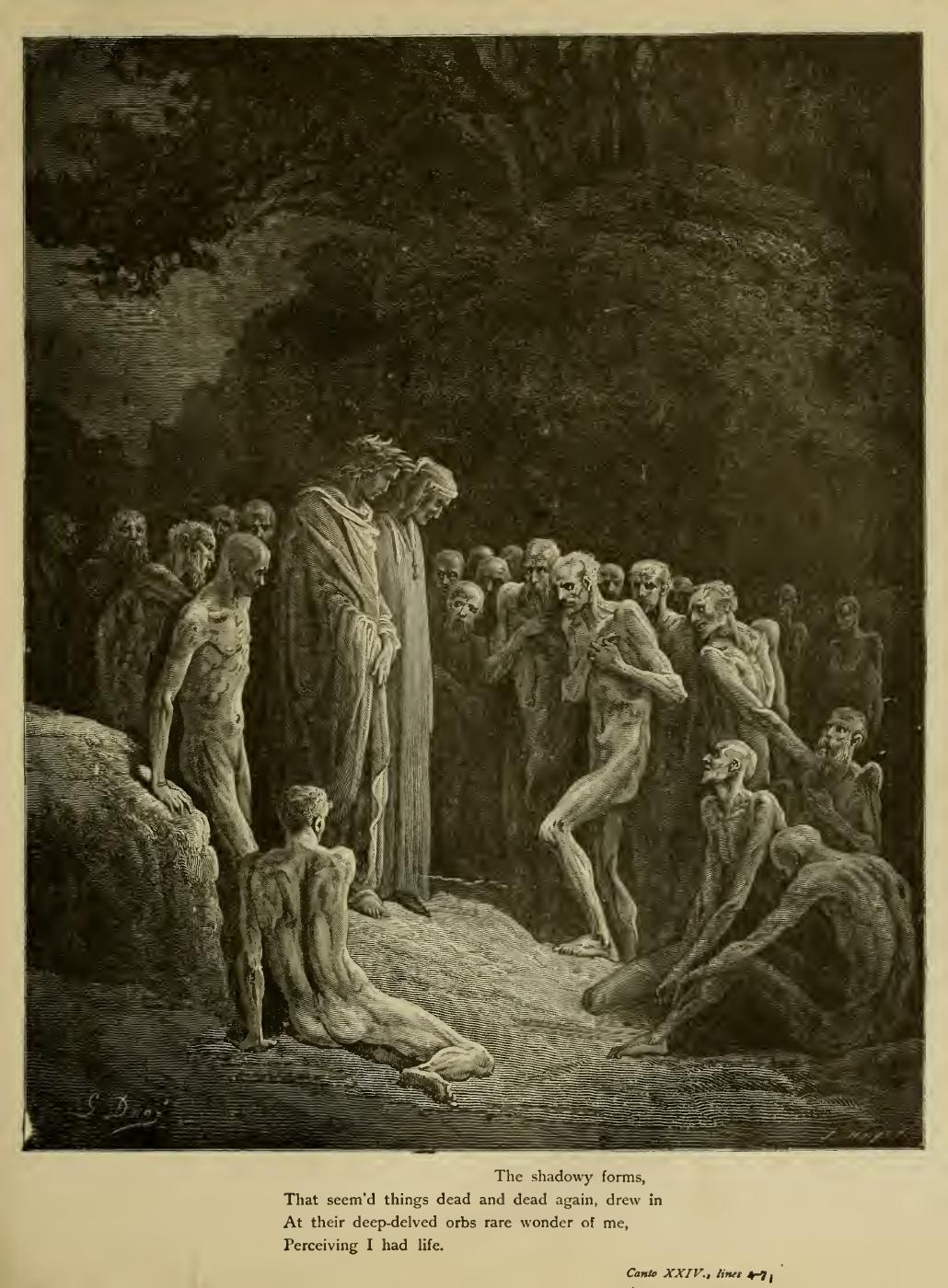
Doré’s design for Purgatory XXIV shows the lean shades observing the living Dante. Their appearance prompts the question about a shade’s form addressed in the following canto. This is an illustration of the poem, not a record of an observed afterlife.
Design by Gustave Doré. Purgatory and Paradise, translated by Henry Francis Cary, Thompson & Thomas, Chicago, 1901. Public Domain. · Image source ↗ · Public Domain
See references (5)
- Purgatory and Paradise, Purgatory II, Reader page 14
- Purgatory and Paradise, Purgatory XXI, printed p. 97, Reader page 131
- Purgatory and Paradise, Purgatory XXV, Reader page 148
- Purgatory and Paradise, Purgatory XXV, printed p. 114, Reader page 152
- Purgatory and Paradise, Purgatory XXV, printed p. 115, Reader page 153
A Wanderer in the Spirit Lands
In A Wanderer in the Spirit Lands, attributed to Franchezzo and transcribed by A. Farnese, a surviving person does not keep one unchanging envelope. Franchezzo describes a deep sleep at his passage into the second sphere, followed by awakening in a renewed form. The old astral covering dissolves. He calls this transition a Second Death and a resurrection of the higher self. [54][55][56]
His body also changes in relation to a task. Before entering Hell, the rescuers take on some of that sphere’s denser conditions. They become more visible to its inhabitants but lose some freedom of movement. A sailor’s weight can strain a rope made from spiritual plants because body and materials have a solidity relative to one another within the scene. [57][58][59][62][63]
Two rescue episodes describe a further release: a mist rises from a motionless dark form, takes the shape of the person and is carried upwards by helpers. The individual survives while the former covering is left behind. These episodes support the book’s distinction between a soul and the successive forms through which it acts. [61][64]
The narrative often represents moral condition through bodily beauty, injury or distortion. That symbolism belongs to its imagined world. It provides no basis for judging a living person’s character from disability, illness or appearance, or for treating the book’s envelopes as established human anatomy. [60][61][63]
See references (11)
- A Wanderer in the Spirit Lands, Reader page 88
- A Wanderer in the Spirit Lands, Reader page 89
- A Wanderer in the Spirit Lands, Reader page 90
- A Wanderer in the Spirit Lands, Reader page 134
- A Wanderer in the Spirit Lands, Reader page 140
- A Wanderer in the Spirit Lands, Reader page 141
- A Wanderer in the Spirit Lands, Reader page 150
- A Wanderer in the Spirit Lands, Reader page 154
- A Wanderer in the Spirit Lands, Reader page 179
- A Wanderer in the Spirit Lands, Reader page 180
- A Wanderer in the Spirit Lands, Reader page 227
Evolution of Immortality
Freeman Benjamin Dowd, writing as Rosicruciæ in Evolution of Immortality, calls one form an invisible or astral body. It reproduces the visible figure and develops through thought and action. Its ability to move more freely is only one stage in his account of spiritual embodiment. [69][70]
A more complete transformation supposedly produces a fire body. Rosicruciæ connects it with the union of mind and soul, love and truth, and ultimately two spiritual counterparts. A sphere represents freedom from the limitations he attributes to an angular human form. Every person is also described through masculine and feminine principles, using the book’s gendered model of creative activity. [65][66][67][68][71][72][73]
The completed being is said to project or withdraw an outward body at will. Jesus’ appearances and disappearance are read as examples of this power. These passages set out an esoteric theory of transformation and scriptural meaning, rather than an established anatomy or a demonstration that human tissue can be made incorruptible. [74][75][76][77]
Rosicruciæ, the name used by Freeman Benjamin Dowd, also proposes a form that precedes material embodiment in Evolution of Immortality. In his account of an egg, a chick exists as a silent, intangible phantom before the material organism develops around it. This is a proposed formative presence, not a deceased human apparition. [98]
Attraction supposedly brings the form into the egg. The mother’s warmth then kindles activity at the centre, and matter clothes what was already present in an invisible state. The cell’s spirit atmosphere extends the argument: spiritual motions allegedly precede the corresponding movements of its atoms. [98][99]
This earlier phantom should not be confused with the later mobile astral counterpart or perfected fire body. The three claims concern different stages and functions: an anticipated living form, a subtle reproduction of an embodied person and a proposed transformation of the whole being. [98][100][101][102][103]
The source supplies a metaphysical model of formation, not evidence that embryological development requires a pre-existing phantom. Its egg example also differs from the book’s later phantom image of a desired partner, which belongs to the language of spiritual affinity. [98][104][105][106]
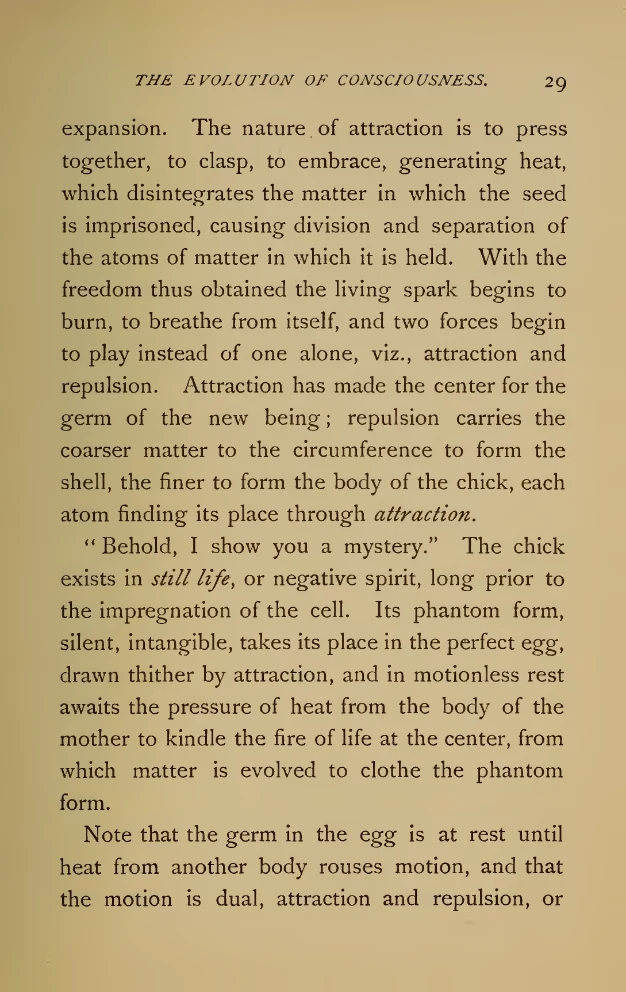
Source facsimile: Evolution of Immortality (1900), printed p. 29, Reader page 26.
Rosicruciæ (catalogued as Freeman Benjamin Dowd), Evolution of Immortality, copyright 1900. Public-domain historical page from the checksum-verified Library PDF. · Image source ↗ · Public Domain
See references (22)
- Evolution of Immortality, printed p. 18, Reader page 15
- Evolution of Immortality, printed p. 19, Reader page 16
- Evolution of Immortality, printed p. 20, Reader page 17
- Evolution of Immortality, printed p. 21, Reader page 18
- Evolution of Immortality, printed p. 37, Reader page 34
- Evolution of Immortality, printed p. 38, Reader page 35
- Evolution of Immortality, printed p. 60, Reader page 57
- Evolution of Immortality, printed p. 74, Reader page 71
- Evolution of Immortality, printed p. 75, Reader page 72
- Evolution of Immortality, printed p. 125, Reader page 124
- Evolution of Immortality, printed p. 126, Reader page 125
- Evolution of Immortality, printed p. 127, Reader page 126
- Evolution of Immortality, printed p. 128, Reader page 127
- Evolution of Immortality, printed p. 29, Reader page 26
- Evolution of Immortality, printed p. 30, Reader page 27
- Evolution of Immortality, printed p. 37, Reader page 34
- Evolution of Immortality, printed p. 38, Reader page 35
- Evolution of Immortality, printed p. 74, Reader page 71
- Evolution of Immortality, printed p. 75, Reader page 72
- Evolution of Immortality, printed p. 65, Reader page 62
- Evolution of Immortality, printed p. 66, Reader page 63
- Evolution of Immortality, printed p. 67, Reader page 64
Heaven and Its Wonders and Hell
Emanuel Swedenborg’s Heaven and Its Wonders and Hell describes a spirit as a complete human being. Thought and affection belong to this spiritual person, while the earthly body serves as an instrument for action in the natural world. After death the spirit retains form and sensation. Swedenborg argues that seeing, hearing and touch require a substantial subject, so surviving life cannot be explained as an uncontained wisp of thought. [80][81][82]
The spiritual body can initially seem indistinguishable from the earthly one. A newly arrived person may be surprised to learn that death has occurred, because the senses and familiar activities continue. Yet Swedenborg distinguishes the worlds by what their senses perceive: spiritual eyes see spiritual objects, while natural eyes see natural ones. Continuity of experience does not make the two bodies materially identical. [83][84][88][89]
Appearance subsequently discloses character. The face and voice at first resemble those known on earth, but change as the ruling affection becomes visible. Someone recognised on arrival may therefore later look unfamiliar. Swedenborg explicitly distinguishes the inherited earthly face from this spiritual expression, so the account cannot be used to judge a living person’s moral worth by physical appearance. [85][86][87]
This body belongs to ordinary continued human life in his account. It is not presented as a rare achievement reserved for someone who has perfected a special vehicle. Its eventual form and surroundings reveal how the person has lived, while the capacity to sense and act remains integral to the surviving self. [78][79][88]
See references (12)
- Heaven and Its Wonders and Hell, printed p. 250, Reader page 257
- Heaven and Its Wonders and Hell, printed p. 255, Reader page 262
- Heaven and Its Wonders and Hell, printed p. 372, Reader page 379
- Heaven and Its Wonders and Hell, printed p. 373, Reader page 380
- Heaven and Its Wonders and Hell, printed p. 374, Reader page 381
- Heaven and Its Wonders and Hell, printed p. 388, Reader page 395
- Heaven and Its Wonders and Hell, printed p. 391, Reader page 398
- Heaven and Its Wonders and Hell, printed p. 393, Reader page 400
- Heaven and Its Wonders and Hell, printed p. 394, Reader page 401
- Heaven and Its Wonders and Hell, printed p. 395, Reader page 402
- Heaven and Its Wonders and Hell, printed p. 397, Reader page 404
- Heaven and Its Wonders and Hell, printed p. 398, Reader page 405
Life and Labor in the Spirit World: Shelhamer’s spirit-band
The collection credited to the medium M. T. Shelhamer’s spirit-band gives awakening several forms. In the first part, Spirit Violet describes a young woman recovering after death in a bower of roses. Attendants help her rest before taking her to a home. Recognition of a changed body and a changed life develops through care, rather than arriving as complete knowledge at the moment of death. [107][108][109][110][111]
The third part, attributed to John Critchley Prince, begins more painfully. The narrator finds himself outside his dead physical body, still clothed in a form that resembles it and appears scarcely healthier. He can hear people near his remains, while failing to see the helpers later said to have been present. The surrounding mist is eventually explained as coming from his own spiritual condition. [112][113][114]
Later encounters bring cleansing and clearer perception. Rest, washing and a guide’s explanation of self-examination help the narrator towards another condition. A later passage describes a mist through which he passes before seeing and hearing more clearly. The narrative makes the spiritual body responsive to development; possessing a body after death does not by itself remove fatigue, confusion or the effects of a former life. [115][116][117][118][119]
See references (13)
- Life and Labor in the Spirit World, printed p. 48, Reader page 49
- Life and Labor in the Spirit World, printed p. 49, Reader page 50
- Life and Labor in the Spirit World, printed p. 50, Reader page 51
- Life and Labor in the Spirit World, printed p. 51, Reader page 52
- Life and Labor in the Spirit World, printed p. 53, Reader page 54
- Life and Labor in the Spirit World, printed p. 351, Reader page 352
- Life and Labor in the Spirit World, printed p. 352, Reader page 353
- Life and Labor in the Spirit World, printed p. 353, Reader page 354
- Life and Labor in the Spirit World, printed p. 358, Reader page 359
- Life and Labor in the Spirit World, printed p. 361, Reader page 362
- Life and Labor in the Spirit World, printed p. 362, Reader page 363
- Life and Labor in the Spirit World, printed p. 379, Reader page 380
- Life and Labor in the Spirit World, printed p. 380, Reader page 381
A continuing person, with different kinds of embodiment
Dante’s shade can speak and be recognised without an ordinary embrace. Swedenborg gives a spirit a complete human form with senses capable of perceiving its surroundings. The accounts give different force to the word body. [51][48][50][80][81][82][78][79][88]
Ward and Franchezzo describe coverings a person can leave behind. Dowd goes further, distinguishing an invisible body from the transformation he associates with spiritual freedom. In each account, a change of body has consequences for what someone can do. [28][29][54][55][56][69][70][74][75][76][77]
Ward distinguishes an astral covering from an inner spiritual form. In Shelhamer’s collection, the newcomer comes to understand a changed condition through rest and care. One passage explains a sequence of forms, and the other follows what a person experiences. [30][31][32][33][34][35][113][114][116][117]
Howitt, as quoted by Lee, describes a spiritual body that continues without recovering earthly matter. Swedenborg also describes ordinary life after death with senses and form. Lee’s objections make it possible to see where the agreement ends, especially on resurrection. [80][81][82][83][84][121][123][124]
See references (35)
- Gone West, printed p. 97, Reader page 110
- Gone West, printed p. 176, Reader page 189
- A Subaltern in Spirit Land, printed p. 6, Reader page 21
- A Subaltern in Spirit Land, printed p. 34, Reader page 49
- A Subaltern in Spirit Land, printed p. 35, Reader page 50
- A Subaltern in Spirit Land, printed p. 42, Reader page 57
- A Subaltern in Spirit Land, printed p. 43, Reader page 58
- A Subaltern in Spirit Land, printed p. 44, Reader page 59
- Purgatory and Paradise, Purgatory II, Reader page 14
- Purgatory and Paradise, Purgatory XXI, printed p. 97, Reader page 131
- Purgatory and Paradise, Purgatory XXV, Reader page 148
- A Wanderer in the Spirit Lands, Reader page 88
- A Wanderer in the Spirit Lands, Reader page 89
- A Wanderer in the Spirit Lands, Reader page 90
- Evolution of Immortality, printed p. 37, Reader page 34
- Evolution of Immortality, printed p. 38, Reader page 35
- Evolution of Immortality, printed p. 125, Reader page 124
- Evolution of Immortality, printed p. 126, Reader page 125
- Evolution of Immortality, printed p. 127, Reader page 126
- Evolution of Immortality, printed p. 128, Reader page 127
- Heaven and Its Wonders and Hell, printed p. 250, Reader page 257
- Heaven and Its Wonders and Hell, printed p. 255, Reader page 262
- Heaven and Its Wonders and Hell, printed p. 372, Reader page 379
- Heaven and Its Wonders and Hell, printed p. 373, Reader page 380
- Heaven and Its Wonders and Hell, printed p. 374, Reader page 381
- Heaven and Its Wonders and Hell, printed p. 388, Reader page 395
- Heaven and Its Wonders and Hell, printed p. 391, Reader page 398
- Heaven and Its Wonders and Hell, printed p. 397, Reader page 404
- Life and Labor in the Spirit World, printed p. 352, Reader page 353
- Life and Labor in the Spirit World, printed p. 353, Reader page 354
- Life and Labor in the Spirit World, printed p. 361, Reader page 362
- Life and Labor in the Spirit World, printed p. 362, Reader page 363
- The Other World, Reader page 488
- The Other World, Reader page 498
- The Other World, Reader page 499
Read further in the library
The Angels’ Diary and Celestion Study of Man
Reading note
Stepping out of the case. Read the original passage in the 1903 edition.

Gone West
Reading note
Ward’s communicated accounts supply the separately cited comparison in this entry.
A Subaltern in Spirit Land: A Sequel to Gone West
Reading note
Ward’s sequel adds the separately cited account of this subject.

The Encyclopaedia of Death and Life in the Spirit-World, Volume I
Reading note
Distinct accounts from the 1903 fourth edition, with each contributor and exact printed page identified.
Purgatory and Paradise: The Vision of Dante
Reading note
A distinct account from Dante’s poem, cited to exact leaves of Cary’s 1901 illustrated edition.

A Wanderer in the Spirit Lands
Reading note
Successive envelopes change the narrator’s appearance, perception and freedom of movement while the person continues.
Evolution of Immortality
Reading note
The astral counterpart and the perfected fire body have different capacities in this esoteric account.

Heaven and Its Wonders and Hell
Reading note
Swedenborg describes a complete human spiritual form, with senses and an appearance expressing character.
Life and Labour in the Spirit World
Reading note
The separately titled account draws on exact passages in the consulted Library edition.
The Other World
Reading note
The separately titled account draws on exact passages in the consulted Library edition.
Sources
See references (126)
- The Angels’ Diary and Celestion Study of Man, Reader page 26Effie M. Shirey and Charles Samson, The Angels’ Diary and Celestion Study of Man (1903).Read this page in The Angels’ Diary and Celestion Study of Man ↗Return to text ↑
- The Angels’ Diary and Celestion Study of Man, Reader page 151Charles Samson, Celestion Study of Man, in the 1903 volume.Read this page in The Angels’ Diary and Celestion Study of Man ↗Return to text ↑
- The Angels’ Diary and Celestion Study of Man, Reader page 200Effie M. Shirey and Charles Samson, The Angels’ Diary and Celestion Study of Man (1903).Read this page in The Angels’ Diary and Celestion Study of Man ↗Return to text ↑
- The Angels’ Diary and Celestion Study of Man, Reader page 25Effie M. Shirey and Charles Samson, The Angels’ Diary and Celestion Study of Man (1903).Read this page in The Angels’ Diary and Celestion Study of Man ↗Return to text ↑
- The Angels’ Diary and Celestion Study of Man, Reader page 29Effie M. Shirey and Charles Samson, The Angels’ Diary and Celestion Study of Man (1903).Read this page in The Angels’ Diary and Celestion Study of Man ↗Return to text ↑
- The Angels’ Diary and Celestion Study of Man, Reader page 34Effie M. Shirey and Charles Samson, The Angels’ Diary and Celestion Study of Man (1903).Read this page in The Angels’ Diary and Celestion Study of Man ↗Return to text ↑
- The Angels’ Diary and Celestion Study of Man, Reader page 35Effie M. Shirey and Charles Samson, The Angels’ Diary and Celestion Study of Man (1903).Read this page in The Angels’ Diary and Celestion Study of Man ↗Return to text ↑
- The Angels’ Diary and Celestion Study of Man, Reader page 40Effie M. Shirey and Charles Samson, The Angels’ Diary and Celestion Study of Man (1903).Read this page in The Angels’ Diary and Celestion Study of Man ↗Return to text ↑
- The Angels’ Diary and Celestion Study of Man, Reader page 41Effie M. Shirey and Charles Samson, The Angels’ Diary and Celestion Study of Man (1903).Read this page in The Angels’ Diary and Celestion Study of Man ↗Return to text ↑
- The Angels’ Diary and Celestion Study of Man, Reader page 114Charles Samson, Celestion Study of Man, in the 1903 volume.Read this page in The Angels’ Diary and Celestion Study of Man ↗Return to text ↑
- The Angels’ Diary and Celestion Study of Man, Reader page 134Charles Samson, Celestion Study of Man, in the 1903 volume.Read this page in The Angels’ Diary and Celestion Study of Man ↗Return to text ↑
- The Angels’ Diary and Celestion Study of Man, Reader page 146Charles Samson, Celestion Study of Man, in the 1903 volume.Read this page in The Angels’ Diary and Celestion Study of Man ↗Return to text ↑
- The Angels’ Diary and Celestion Study of Man, Reader page 147Charles Samson, Celestion Study of Man, in the 1903 volume.Read this page in The Angels’ Diary and Celestion Study of Man ↗Return to text ↑
- The Angels’ Diary and Celestion Study of Man, Reader page 150Charles Samson, Celestion Study of Man, in the 1903 volume.Read this page in The Angels’ Diary and Celestion Study of Man ↗Return to text ↑
- The Angels’ Diary and Celestion Study of Man, Reader page 153Charles Samson, Celestion Study of Man, in the 1903 volume.Read this page in The Angels’ Diary and Celestion Study of Man ↗Return to text ↑
- The Angels’ Diary and Celestion Study of Man, Reader page 165Charles Samson, Celestion Study of Man, in the 1903 volume.Read this page in The Angels’ Diary and Celestion Study of Man ↗Return to text ↑
- The Angels’ Diary and Celestion Study of Man, Reader page 166Charles Samson, Celestion Study of Man, in the 1903 volume.Read this page in The Angels’ Diary and Celestion Study of Man ↗Return to text ↑
- The Angels’ Diary and Celestion Study of Man, Reader page 37Effie M. Shirey and Charles Samson, The Angels’ Diary and Celestion Study of Man (1903).Read this page in The Angels’ Diary and Celestion Study of Man ↗Return to text ↑
- Luigi Schiavonetti after William Blake, The Soul Hovering over the Body Reluctantly Parting with Life, 1805–08. ↗Princeton University Art Museum. Gift of Frank Jewett Mather Jr., x1947-85. Public Domain.
- Gone West, printed p. 15, Reader page 28J. S. M. Ward, Gone West, 1920 third impression as reproduced in the 2009 Geoff Cutler digital transcription.Read this page in Gone West ↗Return to text ↑
- Gone West, printed p. 16, Reader page 29J. S. M. Ward, Gone West, 1920 third impression as reproduced in the 2009 Geoff Cutler digital transcription.Read this page in Gone West ↗Return to text ↑
- Gone West, printed p. 23, Reader page 36J. S. M. Ward, Gone West, 1920 third impression as reproduced in the 2009 Geoff Cutler digital transcription.Read this page in Gone West ↗Return to text ↑
- Gone West, printed p. 24, Reader page 37J. S. M. Ward, Gone West, 1920 third impression as reproduced in the 2009 Geoff Cutler digital transcription.Read this page in Gone West ↗Return to text ↑
- Gone West, printed p. 25, Reader page 38J. S. M. Ward, Gone West, 1920 third impression as reproduced in the 2009 Geoff Cutler digital transcription.Read this page in Gone West ↗Return to text ↑
- Gone West, printed p. 26, Reader page 39J. S. M. Ward, Gone West, 1920 third impression as reproduced in the 2009 Geoff Cutler digital transcription.Read this page in Gone West ↗Return to text ↑
- Gone West, Introduction, Reader page 9J. S. M. Ward, Gone West, 1920 third impression as reproduced in the 2009 Geoff Cutler digital transcription.Read this page in Gone West ↗Return to text ↑
- Gone West, printed p. 18, Reader page 31J. S. M. Ward, Gone West, 1920 third impression as reproduced in the 2009 Geoff Cutler digital transcription.Read this page in Gone West ↗Return to text ↑
- Gone West, printed p. 97, Reader page 110J. S. M. Ward, Gone West, 1920 third impression in the 2009 Geoff Cutler digital transcription.Read this page in Gone West ↗Return to text ↑
- Gone West, printed p. 176, Reader page 189J. S. M. Ward, Gone West, 1920 third impression in the 2009 Geoff Cutler digital transcription.Read this page in Gone West ↗Return to text ↑
- A Subaltern in Spirit Land, printed p. 6, Reader page 21J. S. M. Ward, A Subaltern in Spirit Land: A Sequel to Gone West, William Rider & Son, 1920.Read this page in A Subaltern in Spirit Land: A Sequel to Gone West ↗Return to text ↑
- A Subaltern in Spirit Land, printed p. 34, Reader page 49J. S. M. Ward, A Subaltern in Spirit Land: A Sequel to Gone West, William Rider & Son, 1920.Read this page in A Subaltern in Spirit Land: A Sequel to Gone West ↗Return to text ↑
- A Subaltern in Spirit Land, printed p. 35, Reader page 50J. S. M. Ward, A Subaltern in Spirit Land: A Sequel to Gone West, William Rider & Son, 1920.Read this page in A Subaltern in Spirit Land: A Sequel to Gone West ↗Return to text ↑
- A Subaltern in Spirit Land, printed p. 42, Reader page 57J. S. M. Ward, A Subaltern in Spirit Land: A Sequel to Gone West, William Rider & Son, 1920.Read this page in A Subaltern in Spirit Land: A Sequel to Gone West ↗Return to text ↑
- A Subaltern in Spirit Land, printed p. 43, Reader page 58J. S. M. Ward, A Subaltern in Spirit Land: A Sequel to Gone West, William Rider & Son, 1920.Read this page in A Subaltern in Spirit Land: A Sequel to Gone West ↗Return to text ↑
- A Subaltern in Spirit Land, printed p. 44, Reader page 59J. S. M. Ward, A Subaltern in Spirit Land: A Sequel to Gone West, William Rider & Son, 1920.Read this page in A Subaltern in Spirit Land: A Sequel to Gone West ↗Return to text ↑
- A Subaltern in Spirit Land, printed p. 55, Reader page 70J. S. M. Ward, A Subaltern in Spirit Land: A Sequel to Gone West, William Rider & Son, 1920.Read this page in A Subaltern in Spirit Land: A Sequel to Gone West ↗Return to text ↑
- A Subaltern in Spirit Land, printed p. 123, Reader page 138J. S. M. Ward, A Subaltern in Spirit Land: A Sequel to Gone West, William Rider & Son, 1920.Read this page in A Subaltern in Spirit Land: A Sequel to Gone West ↗Return to text ↑
- A Subaltern in Spirit Land, printed p. 124, Reader page 139J. S. M. Ward, A Subaltern in Spirit Land: A Sequel to Gone West, William Rider & Son, 1920.Read this page in A Subaltern in Spirit Land: A Sequel to Gone West ↗Return to text ↑
- A Subaltern in Spirit Land, printed p. 223, Reader page 238J. S. M. Ward, A Subaltern in Spirit Land: A Sequel to Gone West, William Rider & Son, 1920.Read this page in A Subaltern in Spirit Land: A Sequel to Gone West ↗Return to text ↑
- A Subaltern in Spirit Land, printed p. 224, Reader page 239J. S. M. Ward, A Subaltern in Spirit Land: A Sequel to Gone West, William Rider & Son, 1920.Read this page in A Subaltern in Spirit Land: A Sequel to Gone West ↗Return to text ↑
- A Subaltern in Spirit Land, printed p. 226, Reader page 241J. S. M. Ward, A Subaltern in Spirit Land: A Sequel to Gone West, William Rider & Son, 1920.Read this page in A Subaltern in Spirit Land: A Sequel to Gone West ↗Return to text ↑
- A Subaltern in Spirit Land, printed p. 227, Reader page 242J. S. M. Ward, A Subaltern in Spirit Land: A Sequel to Gone West, William Rider & Son, 1920.Read this page in A Subaltern in Spirit Land: A Sequel to Gone West ↗Return to text ↑
- The Encyclopaedia of Death and Life in Spirit-World, Volume I, printed p. 46, Reader page 45J. R. Francis (compiler), The Encyclopaedia of Death and Life in Spirit-World, Volume I, fourth edition, Progressive Thinker Publishing House, Chicago, 1903. Individual contributors identified in the text.Read this page in The Encyclopaedia of Death and Life in the Spirit-World, Volume I ↗Return to text ↑
- The Encyclopaedia of Death and Life in Spirit-World, Volume I, printed p. 47, Reader page 46J. R. Francis (compiler), The Encyclopaedia of Death and Life in Spirit-World, Volume I, fourth edition, Progressive Thinker Publishing House, Chicago, 1903. Individual contributors identified in the text.Read this page in The Encyclopaedia of Death and Life in the Spirit-World, Volume I ↗Return to text ↑
- The Encyclopaedia of Death and Life in Spirit-World, Volume I, printed p. 56, Reader page 55J. R. Francis (compiler), The Encyclopaedia of Death and Life in Spirit-World, Volume I, fourth edition, Progressive Thinker Publishing House, Chicago, 1903. Individual contributors identified in the text.Read this page in The Encyclopaedia of Death and Life in the Spirit-World, Volume I ↗Return to text ↑
- The Encyclopaedia of Death and Life in Spirit-World, Volume I, printed p. 57, Reader page 56J. R. Francis (compiler), The Encyclopaedia of Death and Life in Spirit-World, Volume I, fourth edition, Progressive Thinker Publishing House, Chicago, 1903. Individual contributors identified in the text.Read this page in The Encyclopaedia of Death and Life in the Spirit-World, Volume I ↗Return to text ↑
- The Encyclopaedia of Death and Life in Spirit-World, Volume I, printed p. 59, Reader page 58J. R. Francis (compiler), The Encyclopaedia of Death and Life in Spirit-World, Volume I, fourth edition, Progressive Thinker Publishing House, Chicago, 1903. Individual contributors identified in the text.Read this page in The Encyclopaedia of Death and Life in the Spirit-World, Volume I ↗Return to text ↑
- Purgatory and Paradise, Purgatory II, Reader page 14Dante Alighieri, Purgatory and Paradise, translated by Henry Francis Cary, designs by Gustave Doré, New Edition, Thompson & Thomas, Chicago, 1901. Literary accounts attributed to the poem and its speakers.Read this page in Purgatory and Paradise: The Vision of Dante ↗Return to text ↑
- Purgatory and Paradise, Purgatory XXIV, Doré illustration, Reader page 129Dante Alighieri, Purgatory and Paradise, translated by Henry Francis Cary, designs by Gustave Doré, New Edition, Thompson & Thomas, Chicago, 1901. Literary accounts attributed to the poem and its speakers.Read this page in Purgatory and Paradise: The Vision of Dante ↗
- Purgatory and Paradise, Purgatory XXI, printed p. 97, Reader page 131Dante Alighieri, Purgatory and Paradise, translated by Henry Francis Cary, designs by Gustave Doré, New Edition, Thompson & Thomas, Chicago, 1901. Literary accounts attributed to the poem and its speakers.Read this page in Purgatory and Paradise: The Vision of Dante ↗Return to text ↑
- Purgatory and Paradise, Purgatory XXV, Reader page 148Dante Alighieri, Purgatory and Paradise, translated by Henry Francis Cary, designs by Gustave Doré, New Edition, Thompson & Thomas, Chicago, 1901. Literary accounts attributed to the poem and its speakers.Read this page in Purgatory and Paradise: The Vision of Dante ↗Return to text ↑
- Purgatory and Paradise, Purgatory XXV, printed p. 114, Reader page 152Dante Alighieri, Purgatory and Paradise, translated by Henry Francis Cary, designs by Gustave Doré, New Edition, Thompson & Thomas, Chicago, 1901. Literary accounts attributed to the poem and its speakers.Read this page in Purgatory and Paradise: The Vision of Dante ↗Return to text ↑
- Purgatory and Paradise, Purgatory XXV, printed p. 115, Reader page 153Dante Alighieri, Purgatory and Paradise, translated by Henry Francis Cary, designs by Gustave Doré, New Edition, Thompson & Thomas, Chicago, 1901. Literary accounts attributed to the poem and its speakers.Read this page in Purgatory and Paradise: The Vision of Dante ↗Return to text ↑
- A Wanderer in the Spirit Lands, Reader page 88Franchezzo (source attribution), A Wanderer in the Spirit Lands, transcribed by A. Farnese. W. J. Sinkins, London, 1896. Date confirmed on the consulted title-page facsimile.Read this page in A Wanderer in the Spirit Lands ↗Return to text ↑
- A Wanderer in the Spirit Lands, Reader page 89Franchezzo (source attribution), A Wanderer in the Spirit Lands, transcribed by A. Farnese. W. J. Sinkins, London, 1896. Date confirmed on the consulted title-page facsimile.Read this page in A Wanderer in the Spirit Lands ↗Return to text ↑
- A Wanderer in the Spirit Lands, Reader page 90Franchezzo (source attribution), A Wanderer in the Spirit Lands, transcribed by A. Farnese. W. J. Sinkins, London, 1896. Date confirmed on the consulted title-page facsimile.Read this page in A Wanderer in the Spirit Lands ↗Return to text ↑
- A Wanderer in the Spirit Lands, Reader page 134Franchezzo (source attribution), A Wanderer in the Spirit Lands, transcribed by A. Farnese. W. J. Sinkins, London, 1896. Date confirmed on the consulted title-page facsimile.Read this page in A Wanderer in the Spirit Lands ↗Return to text ↑
- A Wanderer in the Spirit Lands, Reader page 140Franchezzo (source attribution), A Wanderer in the Spirit Lands, transcribed by A. Farnese. W. J. Sinkins, London, 1896. Date confirmed on the consulted title-page facsimile.Read this page in A Wanderer in the Spirit Lands ↗Return to text ↑
- A Wanderer in the Spirit Lands, Reader page 141Franchezzo (source attribution), A Wanderer in the Spirit Lands, transcribed by A. Farnese. W. J. Sinkins, London, 1896. Date confirmed on the consulted title-page facsimile.Read this page in A Wanderer in the Spirit Lands ↗Return to text ↑
- A Wanderer in the Spirit Lands, Reader page 150Franchezzo (source attribution), A Wanderer in the Spirit Lands, transcribed by A. Farnese. W. J. Sinkins, London, 1896. Date confirmed on the consulted title-page facsimile.Read this page in A Wanderer in the Spirit Lands ↗Return to text ↑
- A Wanderer in the Spirit Lands, Reader page 154Franchezzo (source attribution), A Wanderer in the Spirit Lands, transcribed by A. Farnese. W. J. Sinkins, London, 1896. Date confirmed on the consulted title-page facsimile.Read this page in A Wanderer in the Spirit Lands ↗Return to text ↑
- A Wanderer in the Spirit Lands, Reader page 179Franchezzo (source attribution), A Wanderer in the Spirit Lands, transcribed by A. Farnese. W. J. Sinkins, London, 1896. Date confirmed on the consulted title-page facsimile.Read this page in A Wanderer in the Spirit Lands ↗Return to text ↑
- A Wanderer in the Spirit Lands, Reader page 180Franchezzo (source attribution), A Wanderer in the Spirit Lands, transcribed by A. Farnese. W. J. Sinkins, London, 1896. Date confirmed on the consulted title-page facsimile.Read this page in A Wanderer in the Spirit Lands ↗Return to text ↑
- A Wanderer in the Spirit Lands, Reader page 227Franchezzo (source attribution), A Wanderer in the Spirit Lands, transcribed by A. Farnese. W. J. Sinkins, London, 1896. Date confirmed on the consulted title-page facsimile.Read this page in A Wanderer in the Spirit Lands ↗Return to text ↑
- Evolution of Immortality, printed p. 18, Reader page 15Rosicruciæ (catalogued as Freeman Benjamin Dowd), Evolution of Immortality. Eulian Publishing Company, Salem, 1900.Read this page in Evolution of Immortality ↗Return to text ↑
- Evolution of Immortality, printed p. 19, Reader page 16Rosicruciæ (catalogued as Freeman Benjamin Dowd), Evolution of Immortality. Eulian Publishing Company, Salem, 1900.Read this page in Evolution of Immortality ↗Return to text ↑
- Evolution of Immortality, printed p. 20, Reader page 17Rosicruciæ (catalogued as Freeman Benjamin Dowd), Evolution of Immortality. Eulian Publishing Company, Salem, 1900.Read this page in Evolution of Immortality ↗Return to text ↑
- Evolution of Immortality, printed p. 21, Reader page 18Rosicruciæ (catalogued as Freeman Benjamin Dowd), Evolution of Immortality. Eulian Publishing Company, Salem, 1900.Read this page in Evolution of Immortality ↗Return to text ↑
- Evolution of Immortality, printed p. 37, Reader page 34Rosicruciæ (catalogued as Freeman Benjamin Dowd), Evolution of Immortality. Eulian Publishing Company, Salem, 1900.Read this page in Evolution of Immortality ↗Return to text ↑
- Evolution of Immortality, printed p. 38, Reader page 35Rosicruciæ (catalogued as Freeman Benjamin Dowd), Evolution of Immortality. Eulian Publishing Company, Salem, 1900.Read this page in Evolution of Immortality ↗Return to text ↑
- Evolution of Immortality, printed p. 60, Reader page 57Rosicruciæ (catalogued as Freeman Benjamin Dowd), Evolution of Immortality. Eulian Publishing Company, Salem, 1900.Read this page in Evolution of Immortality ↗Return to text ↑
- Evolution of Immortality, printed p. 74, Reader page 71Rosicruciæ (catalogued as Freeman Benjamin Dowd), Evolution of Immortality. Eulian Publishing Company, Salem, 1900.Read this page in Evolution of Immortality ↗Return to text ↑
- Evolution of Immortality, printed p. 75, Reader page 72Rosicruciæ (catalogued as Freeman Benjamin Dowd), Evolution of Immortality. Eulian Publishing Company, Salem, 1900.Read this page in Evolution of Immortality ↗Return to text ↑
- Evolution of Immortality, printed p. 125, Reader page 124Rosicruciæ (catalogued as Freeman Benjamin Dowd), Evolution of Immortality. Eulian Publishing Company, Salem, 1900.Read this page in Evolution of Immortality ↗Return to text ↑
- Evolution of Immortality, printed p. 126, Reader page 125Rosicruciæ (catalogued as Freeman Benjamin Dowd), Evolution of Immortality. Eulian Publishing Company, Salem, 1900.Read this page in Evolution of Immortality ↗Return to text ↑
- Evolution of Immortality, printed p. 127, Reader page 126Rosicruciæ (catalogued as Freeman Benjamin Dowd), Evolution of Immortality. Eulian Publishing Company, Salem, 1900.Read this page in Evolution of Immortality ↗Return to text ↑
- Evolution of Immortality, printed p. 128, Reader page 127Rosicruciæ (catalogued as Freeman Benjamin Dowd), Evolution of Immortality. Eulian Publishing Company, Salem, 1900.Read this page in Evolution of Immortality ↗Return to text ↑
- Heaven and Its Wonders and Hell, printed p. 250, Reader page 257Emanuel Swedenborg, Heaven and Its Wonders and Hell, translated by J. C. Ager. The American Swedenborg Printing and Publishing Society, New York, 1916. Original Latin work first published in 1758.Read this page in Heaven and Its Wonders and Hell ↗Return to text ↑
- Heaven and Its Wonders and Hell, printed p. 255, Reader page 262Emanuel Swedenborg, Heaven and Its Wonders and Hell, translated by J. C. Ager. The American Swedenborg Printing and Publishing Society, New York, 1916. Original Latin work first published in 1758.Read this page in Heaven and Its Wonders and Hell ↗Return to text ↑
- Heaven and Its Wonders and Hell, printed p. 372, Reader page 379Emanuel Swedenborg, Heaven and Its Wonders and Hell, translated by J. C. Ager. The American Swedenborg Printing and Publishing Society, New York, 1916. Original Latin work first published in 1758.Read this page in Heaven and Its Wonders and Hell ↗Return to text ↑
- Heaven and Its Wonders and Hell, printed p. 373, Reader page 380Emanuel Swedenborg, Heaven and Its Wonders and Hell, translated by J. C. Ager. The American Swedenborg Printing and Publishing Society, New York, 1916. Original Latin work first published in 1758.Read this page in Heaven and Its Wonders and Hell ↗Return to text ↑
- Heaven and Its Wonders and Hell, printed p. 374, Reader page 381Emanuel Swedenborg, Heaven and Its Wonders and Hell, translated by J. C. Ager. The American Swedenborg Printing and Publishing Society, New York, 1916. Original Latin work first published in 1758.Read this page in Heaven and Its Wonders and Hell ↗Return to text ↑
- Heaven and Its Wonders and Hell, printed p. 388, Reader page 395Emanuel Swedenborg, Heaven and Its Wonders and Hell, translated by J. C. Ager. The American Swedenborg Printing and Publishing Society, New York, 1916. Original Latin work first published in 1758.Read this page in Heaven and Its Wonders and Hell ↗Return to text ↑
- Heaven and Its Wonders and Hell, printed p. 391, Reader page 398Emanuel Swedenborg, Heaven and Its Wonders and Hell, translated by J. C. Ager. The American Swedenborg Printing and Publishing Society, New York, 1916. Original Latin work first published in 1758.Read this page in Heaven and Its Wonders and Hell ↗Return to text ↑
- Heaven and Its Wonders and Hell, printed p. 393, Reader page 400Emanuel Swedenborg, Heaven and Its Wonders and Hell, translated by J. C. Ager. The American Swedenborg Printing and Publishing Society, New York, 1916. Original Latin work first published in 1758.Read this page in Heaven and Its Wonders and Hell ↗Return to text ↑
- Heaven and Its Wonders and Hell, printed p. 394, Reader page 401Emanuel Swedenborg, Heaven and Its Wonders and Hell, translated by J. C. Ager. The American Swedenborg Printing and Publishing Society, New York, 1916. Original Latin work first published in 1758.Read this page in Heaven and Its Wonders and Hell ↗Return to text ↑
- Heaven and Its Wonders and Hell, printed p. 395, Reader page 402Emanuel Swedenborg, Heaven and Its Wonders and Hell, translated by J. C. Ager. The American Swedenborg Printing and Publishing Society, New York, 1916. Original Latin work first published in 1758.Read this page in Heaven and Its Wonders and Hell ↗Return to text ↑
- Heaven and Its Wonders and Hell, printed p. 397, Reader page 404Emanuel Swedenborg, Heaven and Its Wonders and Hell, translated by J. C. Ager. The American Swedenborg Printing and Publishing Society, New York, 1916. Original Latin work first published in 1758.Read this page in Heaven and Its Wonders and Hell ↗Return to text ↑
- Heaven and Its Wonders and Hell, printed p. 398, Reader page 405Emanuel Swedenborg, Heaven and Its Wonders and Hell, translated by J. C. Ager. The American Swedenborg Printing and Publishing Society, New York, 1916. Original Latin work first published in 1758.Read this page in Heaven and Its Wonders and Hell ↗Return to text ↑
- The Encyclopaedia of Death and Life in the Spirit-World, Volume I, printed p. 117, Reader page 116J. R. Francis (compiler), The Encyclopaedia of Death and Life in the Spirit-World, Volume I, fourth edition. The Progressive Thinker Publishing House, Chicago, 1903. Individual authors, communicators and quoted sources identified in each account.Read this page in The Encyclopaedia of Death and Life in the Spirit-World, Volume I ↗Return to text ↑
- The Encyclopaedia of Death and Life in the Spirit-World, Volume I, printed p. 118, Reader page 117J. R. Francis (compiler), The Encyclopaedia of Death and Life in the Spirit-World, Volume I, fourth edition. The Progressive Thinker Publishing House, Chicago, 1903. Individual authors, communicators and quoted sources identified in each account.Read this page in The Encyclopaedia of Death and Life in the Spirit-World, Volume I ↗Return to text ↑
- The Encyclopaedia of Death and Life in the Spirit-World, Volume I, printed p. 119, Reader page 118J. R. Francis (compiler), The Encyclopaedia of Death and Life in the Spirit-World, Volume I, fourth edition. The Progressive Thinker Publishing House, Chicago, 1903. Individual authors, communicators and quoted sources identified in each account.Read this page in The Encyclopaedia of Death and Life in the Spirit-World, Volume I ↗Return to text ↑
- The Encyclopaedia of Death and Life in the Spirit-World, Volume I, printed p. 120, Reader page 119J. R. Francis (compiler), The Encyclopaedia of Death and Life in the Spirit-World, Volume I, fourth edition. The Progressive Thinker Publishing House, Chicago, 1903. Individual authors, communicators and quoted sources identified in each account.Read this page in The Encyclopaedia of Death and Life in the Spirit-World, Volume I ↗Return to text ↑
- The Encyclopaedia of Death and Life in the Spirit-World, Volume I, printed p. 121, Reader page 120J. R. Francis (compiler), The Encyclopaedia of Death and Life in the Spirit-World, Volume I, fourth edition. The Progressive Thinker Publishing House, Chicago, 1903. Individual authors, communicators and quoted sources identified in each account.Read this page in The Encyclopaedia of Death and Life in the Spirit-World, Volume I ↗Return to text ↑
- The Encyclopaedia of Death and Life in the Spirit-World, Volume I, printed p. 158, Reader page 157J. R. Francis (compiler), The Encyclopaedia of Death and Life in the Spirit-World, Volume I, fourth edition. The Progressive Thinker Publishing House, Chicago, 1903. Individual authors, communicators and quoted sources identified in each account.Read this page in The Encyclopaedia of Death and Life in the Spirit-World, Volume I ↗Return to text ↑
- The Encyclopaedia of Death and Life in the Spirit-World, Volume I, printed p. 159, Reader page 158J. R. Francis (compiler), The Encyclopaedia of Death and Life in the Spirit-World, Volume I, fourth edition. The Progressive Thinker Publishing House, Chicago, 1903. Individual authors, communicators and quoted sources identified in each account.Read this page in The Encyclopaedia of Death and Life in the Spirit-World, Volume I ↗Return to text ↑
- The Encyclopaedia of Death and Life in the Spirit-World, Volume I, printed p. 160, Reader page 159J. R. Francis (compiler), The Encyclopaedia of Death and Life in the Spirit-World, Volume I, fourth edition. The Progressive Thinker Publishing House, Chicago, 1903. Individual authors, communicators and quoted sources identified in each account.Read this page in The Encyclopaedia of Death and Life in the Spirit-World, Volume I ↗Return to text ↑
- Evolution of Immortality, printed p. 29, Reader page 26Rosicruciæ, catalogued as Freeman Benjamin Dowd, Evolution of Immortality. Eulian Publishing Company, Salem, Mass., copyright 1900; title page undated. The book’s metaphysical and scientific assertions remain attributed. The separately reproduced Higher Thought of Sex address has no speaker named in this edition.Read this page in Evolution of Immortality ↗Return to text ↑
- Evolution of Immortality, printed p. 30, Reader page 27Rosicruciæ, catalogued as Freeman Benjamin Dowd, Evolution of Immortality. Eulian Publishing Company, Salem, Mass., copyright 1900; title page undated. The book’s metaphysical and scientific assertions remain attributed. The separately reproduced Higher Thought of Sex address has no speaker named in this edition.Read this page in Evolution of Immortality ↗Return to text ↑
- Evolution of Immortality, printed p. 37, Reader page 34Rosicruciæ, catalogued as Freeman Benjamin Dowd, Evolution of Immortality. Eulian Publishing Company, Salem, Mass., copyright 1900; title page undated. The book’s metaphysical and scientific assertions remain attributed. The separately reproduced Higher Thought of Sex address has no speaker named in this edition.Read this page in Evolution of Immortality ↗Return to text ↑
- Evolution of Immortality, printed p. 38, Reader page 35Rosicruciæ, catalogued as Freeman Benjamin Dowd, Evolution of Immortality. Eulian Publishing Company, Salem, Mass., copyright 1900; title page undated. The book’s metaphysical and scientific assertions remain attributed. The separately reproduced Higher Thought of Sex address has no speaker named in this edition.Read this page in Evolution of Immortality ↗Return to text ↑
- Evolution of Immortality, printed p. 74, Reader page 71Rosicruciæ, catalogued as Freeman Benjamin Dowd, Evolution of Immortality. Eulian Publishing Company, Salem, Mass., copyright 1900; title page undated. The book’s metaphysical and scientific assertions remain attributed. The separately reproduced Higher Thought of Sex address has no speaker named in this edition.Read this page in Evolution of Immortality ↗Return to text ↑
- Evolution of Immortality, printed p. 75, Reader page 72Rosicruciæ, catalogued as Freeman Benjamin Dowd, Evolution of Immortality. Eulian Publishing Company, Salem, Mass., copyright 1900; title page undated. The book’s metaphysical and scientific assertions remain attributed. The separately reproduced Higher Thought of Sex address has no speaker named in this edition.Read this page in Evolution of Immortality ↗Return to text ↑
- Evolution of Immortality, printed p. 65, Reader page 62Rosicruciæ, catalogued as Freeman Benjamin Dowd, Evolution of Immortality. Eulian Publishing Company, Salem, Mass., copyright 1900; title page undated. The book’s metaphysical and scientific assertions remain attributed. The separately reproduced Higher Thought of Sex address has no speaker named in this edition.Read this page in Evolution of Immortality ↗Return to text ↑
- Evolution of Immortality, printed p. 66, Reader page 63Rosicruciæ, catalogued as Freeman Benjamin Dowd, Evolution of Immortality. Eulian Publishing Company, Salem, Mass., copyright 1900; title page undated. The book’s metaphysical and scientific assertions remain attributed. The separately reproduced Higher Thought of Sex address has no speaker named in this edition.Read this page in Evolution of Immortality ↗Return to text ↑
- Evolution of Immortality, printed p. 67, Reader page 64Rosicruciæ, catalogued as Freeman Benjamin Dowd, Evolution of Immortality. Eulian Publishing Company, Salem, Mass., copyright 1900; title page undated. The book’s metaphysical and scientific assertions remain attributed. The separately reproduced Higher Thought of Sex address has no speaker named in this edition.Read this page in Evolution of Immortality ↗Return to text ↑
- Life and Labor in the Spirit World, printed p. 48, Reader page 49Members of the Spirit-Band of Miss M. T. Shelhamer, Life and Labor in the Spirit World, Second Thousand, Boston: Colby & Rich, 1885. Exact Library edition IMJ-0202-E001. Parts I, II and III are respectively attributed to Spirit Violet, Spirit May and John Critchley Prince. Original metadata and retained Library PageRefs verified; consequential passages checked against actual Library facsimiles. Original Library PDF bytes remain unavailable.Read this page in Life and Labour in the Spirit World ↗Return to text ↑
- Life and Labor in the Spirit World, printed p. 49, Reader page 50Members of the Spirit-Band of Miss M. T. Shelhamer, Life and Labor in the Spirit World, Second Thousand, Boston: Colby & Rich, 1885. Exact Library edition IMJ-0202-E001. Parts I, II and III are respectively attributed to Spirit Violet, Spirit May and John Critchley Prince. Original metadata and retained Library PageRefs verified; consequential passages checked against actual Library facsimiles. Original Library PDF bytes remain unavailable.Read this page in Life and Labour in the Spirit World ↗Return to text ↑
- Life and Labor in the Spirit World, printed p. 50, Reader page 51Members of the Spirit-Band of Miss M. T. Shelhamer, Life and Labor in the Spirit World, Second Thousand, Boston: Colby & Rich, 1885. Exact Library edition IMJ-0202-E001. Parts I, II and III are respectively attributed to Spirit Violet, Spirit May and John Critchley Prince. Original metadata and retained Library PageRefs verified; consequential passages checked against actual Library facsimiles. Original Library PDF bytes remain unavailable.Read this page in Life and Labour in the Spirit World ↗Return to text ↑
- Life and Labor in the Spirit World, printed p. 51, Reader page 52Members of the Spirit-Band of Miss M. T. Shelhamer, Life and Labor in the Spirit World, Second Thousand, Boston: Colby & Rich, 1885. Exact Library edition IMJ-0202-E001. Parts I, II and III are respectively attributed to Spirit Violet, Spirit May and John Critchley Prince. Original metadata and retained Library PageRefs verified; consequential passages checked against actual Library facsimiles. Original Library PDF bytes remain unavailable.Read this page in Life and Labour in the Spirit World ↗Return to text ↑
- Life and Labor in the Spirit World, printed p. 53, Reader page 54Members of the Spirit-Band of Miss M. T. Shelhamer, Life and Labor in the Spirit World, Second Thousand, Boston: Colby & Rich, 1885. Exact Library edition IMJ-0202-E001. Parts I, II and III are respectively attributed to Spirit Violet, Spirit May and John Critchley Prince. Original metadata and retained Library PageRefs verified; consequential passages checked against actual Library facsimiles. Original Library PDF bytes remain unavailable.Read this page in Life and Labour in the Spirit World ↗Return to text ↑
- Life and Labor in the Spirit World, printed p. 351, Reader page 352Members of the Spirit-Band of Miss M. T. Shelhamer, Life and Labor in the Spirit World, Second Thousand, Boston: Colby & Rich, 1885. Exact Library edition IMJ-0202-E001. Parts I, II and III are respectively attributed to Spirit Violet, Spirit May and John Critchley Prince. Original metadata and retained Library PageRefs verified; consequential passages checked against actual Library facsimiles. Original Library PDF bytes remain unavailable.Read this page in Life and Labour in the Spirit World ↗Return to text ↑
- Life and Labor in the Spirit World, printed p. 352, Reader page 353Members of the Spirit-Band of Miss M. T. Shelhamer, Life and Labor in the Spirit World, Second Thousand, Boston: Colby & Rich, 1885. Exact Library edition IMJ-0202-E001. Parts I, II and III are respectively attributed to Spirit Violet, Spirit May and John Critchley Prince. Original metadata and retained Library PageRefs verified; consequential passages checked against actual Library facsimiles. Original Library PDF bytes remain unavailable.Read this page in Life and Labour in the Spirit World ↗Return to text ↑
- Life and Labor in the Spirit World, printed p. 353, Reader page 354Members of the Spirit-Band of Miss M. T. Shelhamer, Life and Labor in the Spirit World, Second Thousand, Boston: Colby & Rich, 1885. Exact Library edition IMJ-0202-E001. Parts I, II and III are respectively attributed to Spirit Violet, Spirit May and John Critchley Prince. Original metadata and retained Library PageRefs verified; consequential passages checked against actual Library facsimiles. Original Library PDF bytes remain unavailable.Read this page in Life and Labour in the Spirit World ↗Return to text ↑
- Life and Labor in the Spirit World, printed p. 358, Reader page 359Members of the Spirit-Band of Miss M. T. Shelhamer, Life and Labor in the Spirit World, Second Thousand, Boston: Colby & Rich, 1885. Exact Library edition IMJ-0202-E001. Parts I, II and III are respectively attributed to Spirit Violet, Spirit May and John Critchley Prince. Original metadata and retained Library PageRefs verified; consequential passages checked against actual Library facsimiles. Original Library PDF bytes remain unavailable.Read this page in Life and Labour in the Spirit World ↗Return to text ↑
- Life and Labor in the Spirit World, printed p. 361, Reader page 362Members of the Spirit-Band of Miss M. T. Shelhamer, Life and Labor in the Spirit World, Second Thousand, Boston: Colby & Rich, 1885. Exact Library edition IMJ-0202-E001. Parts I, II and III are respectively attributed to Spirit Violet, Spirit May and John Critchley Prince. Original metadata and retained Library PageRefs verified; consequential passages checked against actual Library facsimiles. Original Library PDF bytes remain unavailable.Read this page in Life and Labour in the Spirit World ↗Return to text ↑
- Life and Labor in the Spirit World, printed p. 362, Reader page 363Members of the Spirit-Band of Miss M. T. Shelhamer, Life and Labor in the Spirit World, Second Thousand, Boston: Colby & Rich, 1885. Exact Library edition IMJ-0202-E001. Parts I, II and III are respectively attributed to Spirit Violet, Spirit May and John Critchley Prince. Original metadata and retained Library PageRefs verified; consequential passages checked against actual Library facsimiles. Original Library PDF bytes remain unavailable.Read this page in Life and Labour in the Spirit World ↗Return to text ↑
- Life and Labor in the Spirit World, printed p. 379, Reader page 380Members of the Spirit-Band of Miss M. T. Shelhamer, Life and Labor in the Spirit World, Second Thousand, Boston: Colby & Rich, 1885. Exact Library edition IMJ-0202-E001. Parts I, II and III are respectively attributed to Spirit Violet, Spirit May and John Critchley Prince. Original metadata and retained Library PageRefs verified; consequential passages checked against actual Library facsimiles. Original Library PDF bytes remain unavailable.Read this page in Life and Labour in the Spirit World ↗Return to text ↑
- Life and Labor in the Spirit World, printed p. 380, Reader page 381Members of the Spirit-Band of Miss M. T. Shelhamer, Life and Labor in the Spirit World, Second Thousand, Boston: Colby & Rich, 1885. Exact Library edition IMJ-0202-E001. Parts I, II and III are respectively attributed to Spirit Violet, Spirit May and John Critchley Prince. Original metadata and retained Library PageRefs verified; consequential passages checked against actual Library facsimiles. Original Library PDF bytes remain unavailable.Read this page in Life and Labour in the Spirit World ↗Return to text ↑
- The Other World, Reader page 487Frederick George Lee, editor, The Other World; or, Glimpses of the Supernatural, two volumes, Henry S. King and Co., London, 1875. Exact consulted Library edition IMJ-0657-E001. Narratives and embedded quotations are attributed to this compilation; an original author is not represented as independently consulted merely because Lee quotes them. Reader positions are verified separately from printed pagination.Read this page in The Other World ↗Return to text ↑
- The Other World, Reader page 488Frederick George Lee, editor, The Other World; or, Glimpses of the Supernatural, two volumes, Henry S. King and Co., London, 1875. Exact consulted Library edition IMJ-0657-E001. Narratives and embedded quotations are attributed to this compilation; an original author is not represented as independently consulted merely because Lee quotes them. Reader positions are verified separately from printed pagination.Read this page in The Other World ↗Return to text ↑
- The Other World, Reader page 497Frederick George Lee, editor, The Other World; or, Glimpses of the Supernatural, two volumes, Henry S. King and Co., London, 1875. Exact consulted Library edition IMJ-0657-E001. Narratives and embedded quotations are attributed to this compilation; an original author is not represented as independently consulted merely because Lee quotes them. Reader positions are verified separately from printed pagination.Read this page in The Other World ↗Return to text ↑
- The Other World, Reader page 498Frederick George Lee, editor, The Other World; or, Glimpses of the Supernatural, two volumes, Henry S. King and Co., London, 1875. Exact consulted Library edition IMJ-0657-E001. Narratives and embedded quotations are attributed to this compilation; an original author is not represented as independently consulted merely because Lee quotes them. Reader positions are verified separately from printed pagination.Read this page in The Other World ↗Return to text ↑
- The Other World, Reader page 499Frederick George Lee, editor, The Other World; or, Glimpses of the Supernatural, two volumes, Henry S. King and Co., London, 1875. Exact consulted Library edition IMJ-0657-E001. Narratives and embedded quotations are attributed to this compilation; an original author is not represented as independently consulted merely because Lee quotes them. Reader positions are verified separately from printed pagination.Read this page in The Other World ↗Return to text ↑
- The Other World, Reader page 500Frederick George Lee, editor, The Other World; or, Glimpses of the Supernatural, two volumes, Henry S. King and Co., London, 1875. Exact consulted Library edition IMJ-0657-E001. Narratives and embedded quotations are attributed to this compilation; an original author is not represented as independently consulted merely because Lee quotes them. Reader positions are verified separately from printed pagination.Read this page in The Other World ↗Return to text ↑
- The Other World, Reader page 501Frederick George Lee, editor, The Other World; or, Glimpses of the Supernatural, two volumes, Henry S. King and Co., London, 1875. Exact consulted Library edition IMJ-0657-E001. Narratives and embedded quotations are attributed to this compilation; an original author is not represented as independently consulted merely because Lee quotes them. Reader positions are verified separately from printed pagination.Read this page in The Other World ↗Return to text ↑