Purgatory
Understand Purgatory as Catholic final purification, its relationship with prayer for the dead, Reformation disagreement and Dante’s literary mountain.
In this article
What is Purgatory?
Purgatory is the final purification of people who die in God’s grace but are not yet fully purified, according to Catholic teaching. Their salvation is assured. The process prepares them for the joy of Heaven and differs from the punishment of the damned. This distinction is essential: Purgatory concerns the completion of a relationship with God, rather than a destination competing with salvation. [1]
The Catechism connects the teaching with prayer for the dead, especially the Eucharist, and also mentions almsgiving and works of penance offered on their behalf. It identifies the Councils of Florence and Trent as important moments in the doctrine’s formulation. These statements bring together belief and practice: the living remember the departed as people who remain within the community of faith. [1]
Purification and prayer
Purification as a condition of existence
John Paul II’s 1999 explanation describes Purgatory as a condition of existence rather than a place. Those undergoing purification are already within Christ’s love. What remains is the removal of attachment to evil and imperfection, so that communion with God becomes complete. [2]
He also rejects the idea that this extends earthly life into another opportunity to reverse one’s final choice. The assurance of salvation and the need for purification belong together. This makes the usual image of a waiting room incomplete: the teaching concerns transformation, rather than the mere passage of time before admission elsewhere. The account is a papal explanation of Catholic belief. It does not make the purification an observable physical process or specify a duration that could be measured by an earthly calendar. [2]
Why the living pray for the dead
In John Paul II’s account, purification is lived within communion between the departed, the blessed and believers on earth. Prayer expresses continuing solidarity in Christ. The emphasis is therefore communal as well as individual: death does not simply sever the bonds through which believers understand themselves as belonging to one body. [2]
Intercession in a devotional painting
Juan Francisco de Aguilera’s small painting on copper shows the Virgin of Carmen above souls in purgatory. Made in Mexico around 1720 for individual devotion, it places intercession at the centre of the scene. Figures in the lower part look upwards from flames, while the Virgin holds the Christ Child above them. [6]
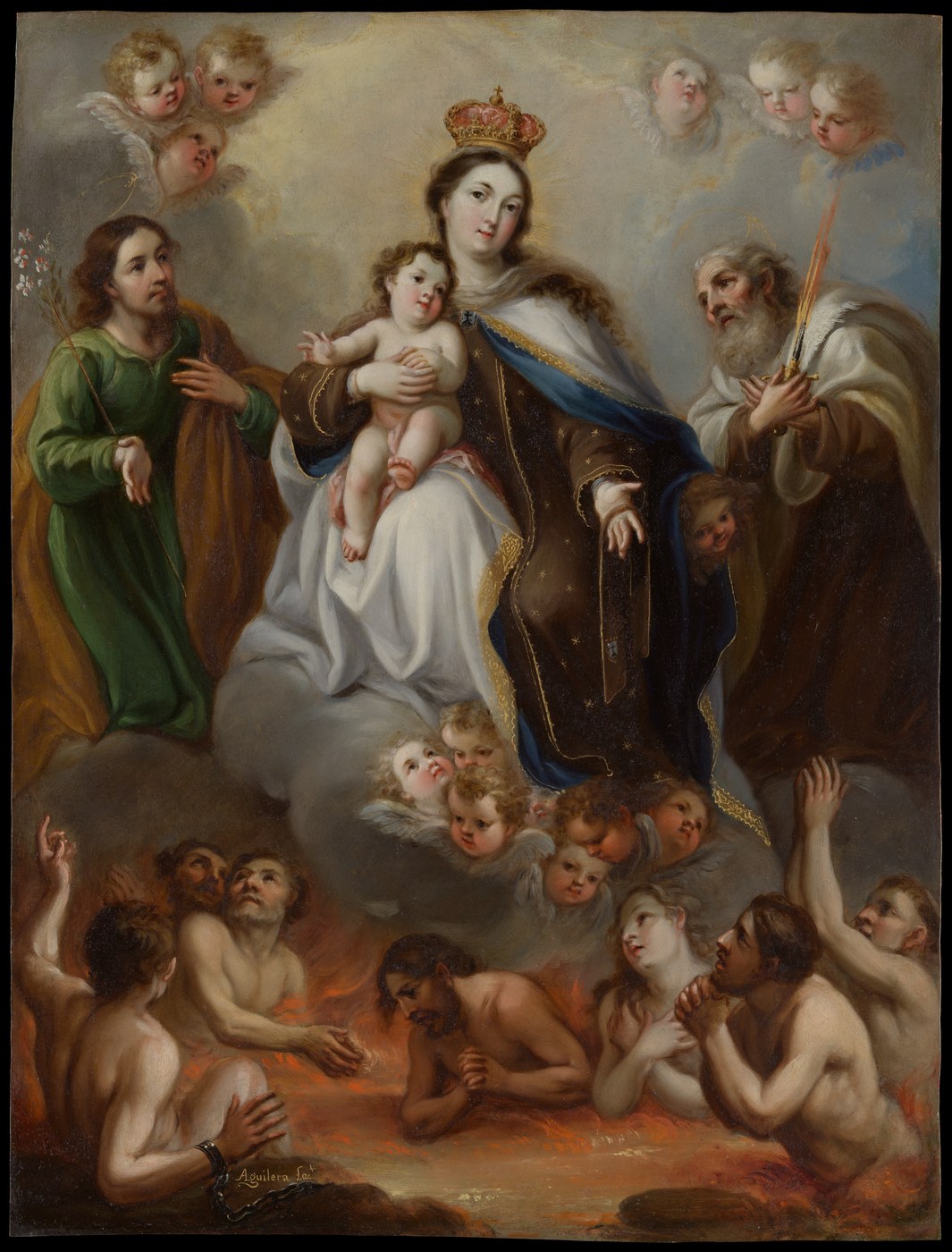
Juan Francisco de Aguilera, The Virgin of Carmen and the Souls of Purgatory with St. Joseph and the Prophet Elijah, ca. 1720. Oil and gold on copper.
The Metropolitan Museum of Art. Purchase, Nancy Dunn Revocable Trust Gift, 2017. Accession 2017.234. Public Domain (CC0). · Museum record ↗ · CC0
Trent and Christian disagreement
What the Council of Trent actually required
Trent’s decree of December 1563 affirmed Purgatory and assistance offered by the faithful, particularly the sacrifice of the Mass. It directed bishops to teach the doctrine. Yet the decree also placed limits on popular explanation: difficult speculation, uncertain stories, superstition and practices motivated by profit were to be excluded or prohibited. [3]
Those cautions are a useful historical counterweight to the assumption that every elaborate tale of the afterlife carried equal authority. The council distinguished its doctrinal claim from the material that could gather around it. The decree also called for the diligent performance of Masses, prayers, alms and other provisions made for the dead. Its concern joined religious teaching to responsibilities within the church, including the handling of endowed obligations. [3]
The Reformation disagreement
Purgatory is not a doctrine held by all Christians. Article XXII of the Church of England’s Articles of Religion rejects the Roman doctrine of Purgatory, placing its objection alongside related questions about pardons, relics and the invocation of saints. The article grounds its rejection in an assessment of scriptural authority. [4]
The disagreement involves what can be required as Christian belief and how a doctrine is justified. The Catholic appeal to scripture, inherited prayer and ecclesial tradition is evaluated differently in this historic Anglican text. Quoting its rejection establishes a particular doctrinal position; it does not mean every contemporary Anglican describes the subject in identical language, or that all Protestant traditions share one complete account of the intermediate state. A useful comparison identifies the church and the source being discussed. [4]
Dante’s mountain of transformation
Dante gives purification a memorable landscape in Purgatorio. The mountain rises towards the earthly paradise, with an approach region and seven terraces associated with the capital vices. The Yale ISM Review’s reading emphasizes the music, prayer, scriptural language and moral transformation that accompany the ascent. The souls are learning to love differently. [5]
The mountain’s order gives a literary form to change. Its geography, characters and successive encounters belong to the poem’s imaginative argument. They should be read beside Catholic doctrinal sources without being substituted for them. The existing Codex entry on Dante’s Mountain of Purgatory follows that particular literary setting. The Library’s illustrated Purgatory and Paradise offers a route into the poem itself, including Gustave Doré’s influential visual interpretation. [5]
Read further in the library
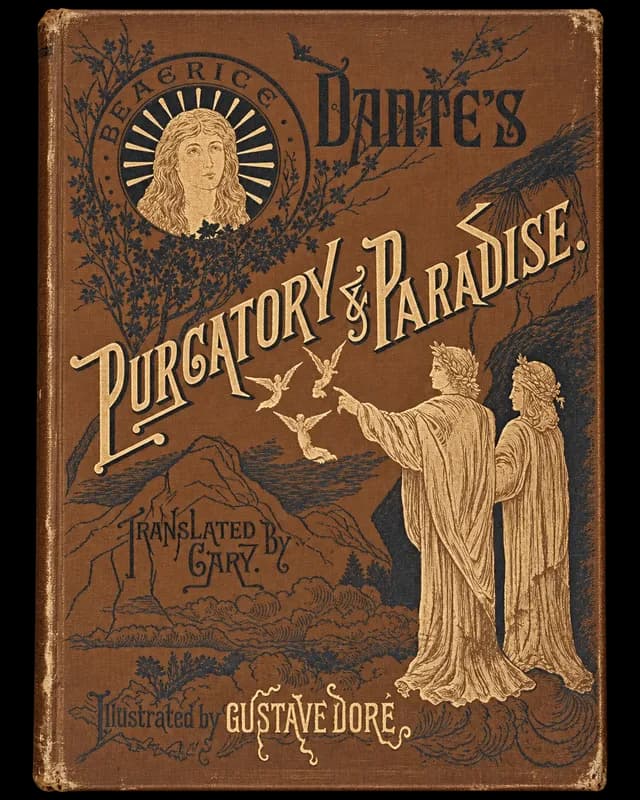
Purgatory and Paradise: The Vision of Dante
Reading note
Read Dante’s Purgatorio and Paradiso with Gustave Doré’s illustrations. The poem offers a particular literary vision of purification and blessedness alongside, rather than in place of, doctrinal sources.
Sources
- Catechism of the Catholic Church: Purgatory, 1030–1032 ↗Catholic doctrinal definition and practiceReturn to text ↑
- John Paul II: General Audience, 4 August 1999 ↗Papal explanation of purification, salvation and communionReturn to text ↑
- Council of Trent: Decree Concerning Purgatory ↗Session 25, December 1563; Waterworth translation hosted by Hanover Historical Texts ProjectReturn to text ↑
- Articles of Religion: Article XXII ↗Church of England’s historic doctrinal textReturn to text ↑
- Climbing the Mountain of the Beatitudes ↗The Yale ISM Review; literary and scriptural reading of Dante’s PurgatorioReturn to text ↑
- The Virgin of Carmen and the Souls of Purgatory with St. Joseph and the Prophet Elijah ↗The Metropolitan Museum of Art; object record 2017.234Return to text ↑
About this article & its sources
Catholic doctrinal definition and selected historical primary sources, with an explicitly literary account of Dante. Purgatory is not presented as universal Christian belief, a second chance at salvation or a physically verified location.
Passage attributions
What is Purgatory?
Passage 1: Catholic doctrinal definition and practice.
Passage 2: Catholic doctrinal definition and practice.
Purification as a condition of existence
Passage 1: Papal explanation of purification, salvation and communion.
Passage 2: Papal explanation of purification, salvation and communion.
What the Council of Trent actually required
Passage 1: Session 25, December 1563; Waterworth translation hosted by Hanover Historical Texts Project.
Passage 2: Session 25, December 1563; Waterworth translation hosted by Hanover Historical Texts Project.
Why the living pray for the dead
Passage 1: Papal explanation of purification, salvation and communion.
Intercession in a devotional painting
Passage 1: The Metropolitan Museum of Art; historical object and visual description.