Resurrection
Resurrection is being raised from death to embodied life. Compare Catholic teaching, Dante’s risen bodies and the accounts of Swedenborg and Dowd.
In this article
Macrina on the restoration of human nature
Read Gregory of Nyssa’s dialogue alongside a Buddhist account of release, with a comparison of how the two texts understand continuity.
What does resurrection mean?
Resurrection means being raised from death to embodied life. In Christianity, Jesus’ resurrection is the central example and the basis of hope for the raising of the dead. The Christian claim includes the body. An account of a soul remaining conscious after death answers a different question. [1]
The body belongs to the hope
The Catholic Catechism §§988–991 links the resurrection of the dead with the risen Christ. It speaks both of the soul’s continuing life and of the mortal body being given life again. The two belong to one hope for the person. [1]
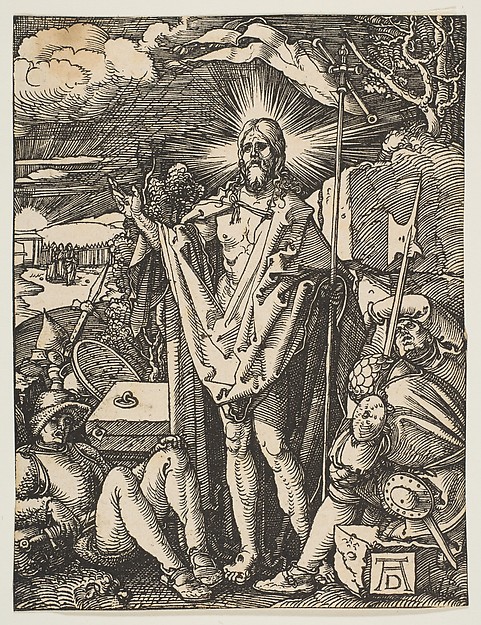
Albrecht Dürer, The Resurrection, from The Small Passion, ca. 1510. Christ’s rising is shown through the embodied figure, tomb and surrounding guards. This Christian print supplies an artistic setting for the belief, not an illustration of Dante’s future resurrection scene.
The Metropolitan Museum of Art. The George Khuner Collection, Gift of Mrs. George Khuner, 1975. Accession 1975.653.51. Public Domain. · Image source ↗ · Public Domain
The Divine Comedy by Dante Alighieri
In Dante Alighieri’s Paradise VII, Beatrice connects resurrection to divine creation. The pilgrim can already speak with people who have died, but the rising she describes still lies ahead for most of them. The encounter with a shade and the promise of a risen body are two stages in the poem. [2][5]
Paradise XIV asks what the change will mean for blessed experience. Beatrice voices Dante’s question: will the souls keep their present radiance, and how could restored eyes endure it? The answer explains that reunion with glorified flesh will make the person more complete. An increased gift of light will deepen vision, love and outward radiance. The bodily organs will be strengthened to bear the joy. [3][4]
The circles answer with an Amen. Dante hears a longing for their bodies and wonders whether the souls long also for the parents and other people they loved. The doctrine takes on a personal shape through the people the blessed hope to see again. [4]
When John later appears, Dante strains to discover a body within the brilliance. John corrects him: his body remains earth on earth until the final company is complete. The two already bearing the double vesture are distinguished from the rest. The correction makes the poem’s temporal distinction explicit. Spiritual radiance, personal presence and bodily resurrection should be read as related features that are not interchangeable. [5]
Evolution of Immortality
In Evolution of Immortality, Freeman Benjamin Dowd, writing as Rosicruciæ, disputes the expectation of one future day when everyone is raised and judged. He reads Paul’s language of putting on immortality as a transformation he believes a spiritually developed person can undergo. [9][10][11]
The concluding chapter retains Jesus’ death and subsequent appearances while explaining them through the relation between the human body and the Christ spirit. The Christ is said to take up the body again, display it to the disciples and eventually cause its disappearance. Earlier passages describe the perfected spiritual body as capable of becoming perceptible and withdrawing from perception. [7][8][14][15]
The author then makes the transformation a possibility for other people, connecting it with love, will and the unity of the entire being. His use of resurrection language belongs to a particular esoteric reading of the Christian texts, with the hoped-for result extending to freedom from bodily death. [12][13][16]
See references (10)
- Evolution of Immortality, printed p. 20, Reader page 17
- Evolution of Immortality, printed p. 21, Reader page 18
- Evolution of Immortality, printed p. 74, Reader page 71
- Evolution of Immortality, printed p. 75, Reader page 72
- Evolution of Immortality, printed p. 76, Reader page 73
- Evolution of Immortality, printed p. 125, Reader page 124
- Evolution of Immortality, printed p. 126, Reader page 125
- Evolution of Immortality, printed p. 127, Reader page 126
- Evolution of Immortality, printed p. 128, Reader page 127
- Evolution of Immortality, printed p. 129, Reader page 128
Heaven and Its Wonders and Hell
In Heaven and Its Wonders and Hell, Emanuel Swedenborg uses resurrection and resuscitation for the person’s awakening into spiritual life. He opposes the expectation that the dead remain without a fully human existence until a distant reunion with their material bodies. The surviving person already has a spiritual form, senses and the capacity to meet others. [17][18][21][22]
He describes a granted experience in which bodily sensation became almost inactive while thought and perception remained. Celestial angels first sat near his head and shared thought silently; spiritual angels then brought an awareness of light. Something like a covering being rolled from the eye or face represented the opening of spiritual sight and thought. Swedenborg identifies these movements as appearances, so they should not be read as literal operations on a corpse. [23][24][25]
The angels offer help without forcing the awakened spirit to remain with them. The person can withdraw towards companions whose lives are more congenial. Swedenborg says this opening condition lasts only a few days and reports conversations with people on the third day after their deaths. These are his claims about reception into another life, rather than a description of medical resuscitation. [25][26]
He treats the Lord’s resurrection separately. The Lord, he says, rose with the body because His Human had become Divine; ordinary human survival leaves the earthly body behind. Preserving this distinction prevents the book’s two uses of resurrection from being reduced to one account of what happens to every body. [19][20][22]
See references (10)
- Heaven and Its Wonders and Hell, printed p. 251, Reader page 258
- Heaven and Its Wonders and Hell, printed p. 252, Reader page 259
- Heaven and Its Wonders and Hell, printed p. 256, Reader page 263
- Heaven and Its Wonders and Hell, printed p. 257, Reader page 264
- Heaven and Its Wonders and Hell, printed p. 380, Reader page 387
- Heaven and Its Wonders and Hell, printed p. 381, Reader page 388
- Heaven and Its Wonders and Hell, printed p. 382, Reader page 389
- Heaven and Its Wonders and Hell, printed p. 383, Reader page 390
- Heaven and Its Wonders and Hell, printed p. 384, Reader page 391
- Heaven and Its Wonders and Hell, printed p. 385, Reader page 392
The same word, different events
Dante gives the dead a conscious life before the future raising of the body. Swedenborg uses resurrection for awakening into an already embodied spiritual life and treats Christ’s resurrection separately. Dowd gives the term to a transformation that can happen through development. The accounts differ over what rises and when. [2][5][17][18][21][22][19][20][9][10][11][12][13][16]
See references (14)
- Purgatory and Paradise, Paradise VII, Reader page 238
- Purgatory and Paradise, Paradise XXV, Reader page 328
- Evolution of Immortality, printed p. 74, Reader page 71
- Evolution of Immortality, printed p. 75, Reader page 72
- Evolution of Immortality, printed p. 76, Reader page 73
- Evolution of Immortality, printed p. 125, Reader page 124
- Evolution of Immortality, printed p. 126, Reader page 125
- Evolution of Immortality, printed p. 129, Reader page 128
- Heaven and Its Wonders and Hell, printed p. 251, Reader page 258
- Heaven and Its Wonders and Hell, printed p. 252, Reader page 259
- Heaven and Its Wonders and Hell, printed p. 256, Reader page 263
- Heaven and Its Wonders and Hell, printed p. 257, Reader page 264
- Heaven and Its Wonders and Hell, printed p. 380, Reader page 387
- Heaven and Its Wonders and Hell, printed p. 381, Reader page 388
Read further in the library
Purgatory and Paradise: The Vision of Dante
Reading note
A separately attributed account in the consulted Cary translation, with exact current Library Reader leaves.
Evolution of Immortality
Reading note
A Rosicrucian interpretation connects resurrection with the Christ spirit and transformed embodiment.

Heaven and Its Wonders and Hell
Reading note
Awakening into spiritual life is distinguished from the Lord’s uniquely Divine bodily resurrection.
Sources
See references (26)
- Catechism of the Catholic Church, 988–991: resurrection of the body ↗Catholic Church, official doctrinal formulation distinguishing the soul’s endurance and bodily resurrection.Return to text ↑
- Purgatory and Paradise, Paradise VII, Reader page 238Dante Alighieri, The Divine Comedy, translated by Henry Francis Cary. Inferno: undated New Edition, Thompson & Thomas, Chicago. Purgatory and Paradise: New Edition, Thompson & Thomas, Chicago, 1901. Designs by Gustave Doré.Read this page in Purgatory and Paradise: The Vision of Dante ↗Return to text ↑
- Purgatory and Paradise, Paradise XIV, Reader page 268Dante Alighieri, The Divine Comedy, translated by Henry Francis Cary. Inferno: undated New Edition, Thompson & Thomas, Chicago. Purgatory and Paradise: New Edition, Thompson & Thomas, Chicago, 1901. Designs by Gustave Doré.Read this page in Purgatory and Paradise: The Vision of Dante ↗Return to text ↑
- Purgatory and Paradise, Paradise XIV, Reader page 269Dante Alighieri, The Divine Comedy, translated by Henry Francis Cary. Inferno: undated New Edition, Thompson & Thomas, Chicago. Purgatory and Paradise: New Edition, Thompson & Thomas, Chicago, 1901. Designs by Gustave Doré.Read this page in Purgatory and Paradise: The Vision of Dante ↗Return to text ↑
- Purgatory and Paradise, Paradise XXV, Reader page 328Dante Alighieri, The Divine Comedy, translated by Henry Francis Cary. Inferno: undated New Edition, Thompson & Thomas, Chicago. Purgatory and Paradise: New Edition, Thompson & Thomas, Chicago, 1901. Designs by Gustave Doré.Read this page in Purgatory and Paradise: The Vision of Dante ↗Return to text ↑
- The Metropolitan Museum of Art: The Resurrection, from The Small Passion, ca. 1510 ↗The Metropolitan Museum of Art. Albrecht Dürer, woodcut, accession1975.653.51. Official record marks Public Domain; official API isPublicDomain=true.
- Evolution of Immortality, printed p. 20, Reader page 17Rosicruciæ (catalogued as Freeman Benjamin Dowd), Evolution of Immortality. Eulian Publishing Company, Salem, 1900.Read this page in Evolution of Immortality ↗Return to text ↑
- Evolution of Immortality, printed p. 21, Reader page 18Rosicruciæ (catalogued as Freeman Benjamin Dowd), Evolution of Immortality. Eulian Publishing Company, Salem, 1900.Read this page in Evolution of Immortality ↗Return to text ↑
- Evolution of Immortality, printed p. 74, Reader page 71Rosicruciæ (catalogued as Freeman Benjamin Dowd), Evolution of Immortality. Eulian Publishing Company, Salem, 1900.Read this page in Evolution of Immortality ↗Return to text ↑
- Evolution of Immortality, printed p. 75, Reader page 72Rosicruciæ (catalogued as Freeman Benjamin Dowd), Evolution of Immortality. Eulian Publishing Company, Salem, 1900.Read this page in Evolution of Immortality ↗Return to text ↑
- Evolution of Immortality, printed p. 76, Reader page 73Rosicruciæ (catalogued as Freeman Benjamin Dowd), Evolution of Immortality. Eulian Publishing Company, Salem, 1900.Read this page in Evolution of Immortality ↗Return to text ↑
- Evolution of Immortality, printed p. 125, Reader page 124Rosicruciæ (catalogued as Freeman Benjamin Dowd), Evolution of Immortality. Eulian Publishing Company, Salem, 1900.Read this page in Evolution of Immortality ↗Return to text ↑
- Evolution of Immortality, printed p. 126, Reader page 125Rosicruciæ (catalogued as Freeman Benjamin Dowd), Evolution of Immortality. Eulian Publishing Company, Salem, 1900.Read this page in Evolution of Immortality ↗Return to text ↑
- Evolution of Immortality, printed p. 127, Reader page 126Rosicruciæ (catalogued as Freeman Benjamin Dowd), Evolution of Immortality. Eulian Publishing Company, Salem, 1900.Read this page in Evolution of Immortality ↗Return to text ↑
- Evolution of Immortality, printed p. 128, Reader page 127Rosicruciæ (catalogued as Freeman Benjamin Dowd), Evolution of Immortality. Eulian Publishing Company, Salem, 1900.Read this page in Evolution of Immortality ↗Return to text ↑
- Evolution of Immortality, printed p. 129, Reader page 128Rosicruciæ (catalogued as Freeman Benjamin Dowd), Evolution of Immortality. Eulian Publishing Company, Salem, 1900.Read this page in Evolution of Immortality ↗Return to text ↑
- Heaven and Its Wonders and Hell, printed p. 251, Reader page 258Emanuel Swedenborg, Heaven and Its Wonders and Hell, translated by J. C. Ager. The American Swedenborg Printing and Publishing Society, New York, 1916. Original Latin work first published in 1758.Read this page in Heaven and Its Wonders and Hell ↗Return to text ↑
- Heaven and Its Wonders and Hell, printed p. 252, Reader page 259Emanuel Swedenborg, Heaven and Its Wonders and Hell, translated by J. C. Ager. The American Swedenborg Printing and Publishing Society, New York, 1916. Original Latin work first published in 1758.Read this page in Heaven and Its Wonders and Hell ↗Return to text ↑
- Heaven and Its Wonders and Hell, printed p. 256, Reader page 263Emanuel Swedenborg, Heaven and Its Wonders and Hell, translated by J. C. Ager. The American Swedenborg Printing and Publishing Society, New York, 1916. Original Latin work first published in 1758.Read this page in Heaven and Its Wonders and Hell ↗Return to text ↑
- Heaven and Its Wonders and Hell, printed p. 257, Reader page 264Emanuel Swedenborg, Heaven and Its Wonders and Hell, translated by J. C. Ager. The American Swedenborg Printing and Publishing Society, New York, 1916. Original Latin work first published in 1758.Read this page in Heaven and Its Wonders and Hell ↗Return to text ↑
- Heaven and Its Wonders and Hell, printed p. 380, Reader page 387Emanuel Swedenborg, Heaven and Its Wonders and Hell, translated by J. C. Ager. The American Swedenborg Printing and Publishing Society, New York, 1916. Original Latin work first published in 1758.Read this page in Heaven and Its Wonders and Hell ↗Return to text ↑
- Heaven and Its Wonders and Hell, printed p. 381, Reader page 388Emanuel Swedenborg, Heaven and Its Wonders and Hell, translated by J. C. Ager. The American Swedenborg Printing and Publishing Society, New York, 1916. Original Latin work first published in 1758.Read this page in Heaven and Its Wonders and Hell ↗Return to text ↑
- Heaven and Its Wonders and Hell, printed p. 382, Reader page 389Emanuel Swedenborg, Heaven and Its Wonders and Hell, translated by J. C. Ager. The American Swedenborg Printing and Publishing Society, New York, 1916. Original Latin work first published in 1758.Read this page in Heaven and Its Wonders and Hell ↗Return to text ↑
- Heaven and Its Wonders and Hell, printed p. 383, Reader page 390Emanuel Swedenborg, Heaven and Its Wonders and Hell, translated by J. C. Ager. The American Swedenborg Printing and Publishing Society, New York, 1916. Original Latin work first published in 1758.Read this page in Heaven and Its Wonders and Hell ↗Return to text ↑
- Heaven and Its Wonders and Hell, printed p. 384, Reader page 391Emanuel Swedenborg, Heaven and Its Wonders and Hell, translated by J. C. Ager. The American Swedenborg Printing and Publishing Society, New York, 1916. Original Latin work first published in 1758.Read this page in Heaven and Its Wonders and Hell ↗Return to text ↑
- Heaven and Its Wonders and Hell, printed p. 385, Reader page 392Emanuel Swedenborg, Heaven and Its Wonders and Hell, translated by J. C. Ager. The American Swedenborg Printing and Publishing Society, New York, 1916. Original Latin work first published in 1758.Read this page in Heaven and Its Wonders and Hell ↗Return to text ↑