Jesus
Explore Jesus’ life, teaching and crucifixion, the Gospel accounts, Christian beliefs about resurrection and incarnation, and his place in Islam.
In this article
Who was Jesus?
Jesus of Nazareth was the first-century Jewish teacher at the centre of Christianity. Christians identify him as the Christ, or Messiah, and understand his life through his teaching, death and resurrection. [1][2]
History, sources and birth narratives
Jesus in his Jewish and Roman setting
Historians study Jesus within the Jewish world of Roman-ruled Palestine. In Dale Martin’s Yale account, he appears as a Jewish prophetic figure announcing God’s coming kingdom. His connection with John the Baptist and his execution by Roman authority are important points in that reconstruction. [2]
The title attached to his execution, king of the Jews, gives the death a political setting: Roman power could treat a royal claim as a threat. Determining exactly what Jesus understood his own role to be is harder than identifying the accusation made against him. [2]
Historical study works with surviving texts and compares their accounts. It can investigate a person, a movement and an execution while leaving theological questions open. Claims about incarnation or divine action require a different kind of argument from establishing that Jesus lived. [2]
Why there are four Gospel accounts
Matthew, Mark, Luke and John are the principal Christian narratives of Jesus’ life. Harvard’s Pluralism Project dates their composition approximately to 70–100 CE, after accounts had circulated among his followers. [1]
Matthew, Mark and Luke share much material and are called the Synoptic Gospels. John has a distinctive theological voice. Reading them separately preserves the ways their authors arrange stories and interpret Jesus, rather than assuming every difference can be fitted into a single chronology. [1]
The birth stories
Matthew and Luke locate Jesus’ birth in Bethlehem, with different surrounding narratives. Luke includes shepherds; Matthew includes visitors from the East. Mark and John begin elsewhere. These differences matter when reading later Nativity imagery. [1]
Light around the infant in El Greco
El Greco’s Adoration of the Shepherds, painted around 1605–10, makes the infant Christ the source of light within a dark scene. Faces and gestures gather around the child. The Met describes the shepherds’ animated movements as expressions of excitement at the birth. [12]
The painter leaves an opening in the tightly grouped figures that invites the viewer into the scene. Light becomes a way of interpreting the child’s significance, linking a recognizable birth narrative with an act of devotional attention. This is early modern Christian painting, centuries later than the Gospel accounts. [12]
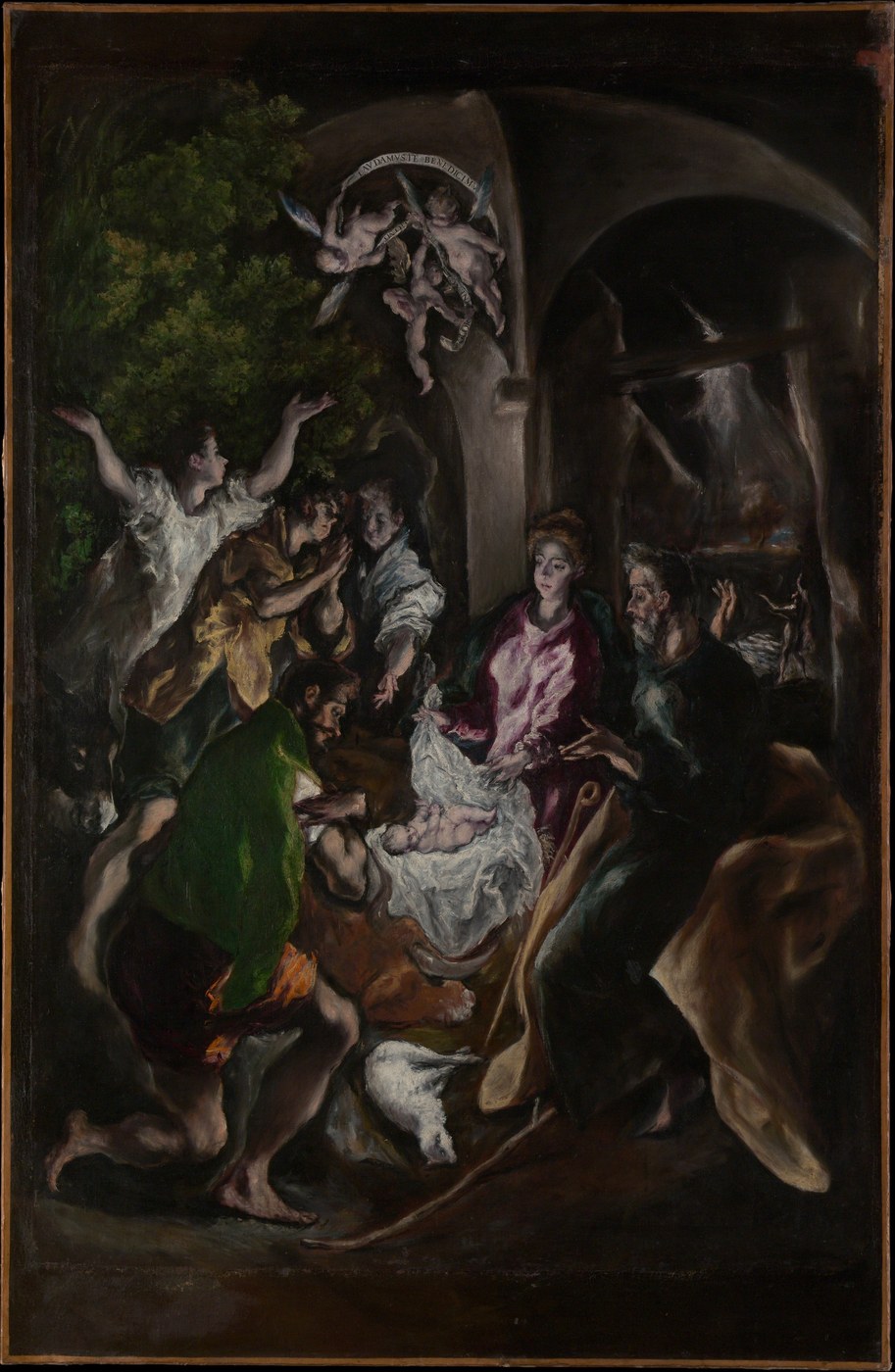
El Greco, The Adoration of the Shepherds, ca. 1605–10. Oil on canvas.
The Metropolitan Museum of Art. Rogers Fund, 1905. Accession 05.42. Public Domain (CC0). · Museum record ↗ · CC0
Teaching and followers
The kingdom of God and the call to follow
Mark introduces Jesus’ Galilean preaching with an announcement that God’s kingdom has drawn near and a call to repentance and belief. The next scene moves to working people beside the lake: Simon, Andrew, James and John leave their fishing to follow him. [3]
The sequence connects God’s reign with a change in ordinary life. Following Jesus takes shape through a relationship and a decision. [3]
What the Good Samaritan asks of its hearer
In Luke’s account, a legal expert’s question about eternal life leads to a discussion of love for God and neighbour. Jesus answers the question about who counts as a neighbour through a story of a wounded traveller. A priest and a Levite pass by; a Samaritan stops to care for him. [4]
The conclusion asks which traveller acted as a neighbour. Attention moves from defining the limits of obligation to recognizing mercy in action. The helper attends to wounds, transport, shelter and the cost of continuing care. The story gives compassion an unmistakably practical form. [4]
The people around Jesus
The Gospel movement included disciples who left occupations to travel with Jesus and women whose presence continues through his ministry. The stories also place him among people facing sickness, poverty and social exclusion. These relationships are central to the picture of his public work. [1]
Death and resurrection
Jerusalem, crucifixion and the Easter accounts
The Gospel narratives bring Jesus to Jerusalem around Passover. They describe a final meal with his followers, betrayal, arrest and proceedings that end with Pontius Pilate authorizing crucifixion. Roman execution brings the teaching career to a violent close. [5]
The narratives then turn to the tomb and the experiences of his followers. Women who visit the burial place find it empty; accounts of encounters with the risen Jesus differ in their characters and details. In John, Mary Magdalene recognizes Jesus when he addresses her personally. [5]
For Christians, these stories concern the living Christ and the possibility of salvation. Reading their religious meaning alongside the circumstances of the execution keeps two questions visible: what happened to Jesus under Roman power, and how his followers came to understand his death and continuing presence. [5]
Grief and witness in Fra Angelico
Fra Angelico’s Crucifixion, painted around 1420–23, surrounds the cross with soldiers, mounted figures and mourners. In the foreground Mary collapses, supported by other women. The Met connects the composition’s drama with convincing human emotion and an interest in spatial effects. [13]
The painting was probably made for private devotion. Its invitation is therefore also personal: the viewer encounters grief and witness gathered around Christ’s suffering. The work belongs to the history of Christian response to the crucifixion, with its own fifteenth-century Italian visual language. [13]
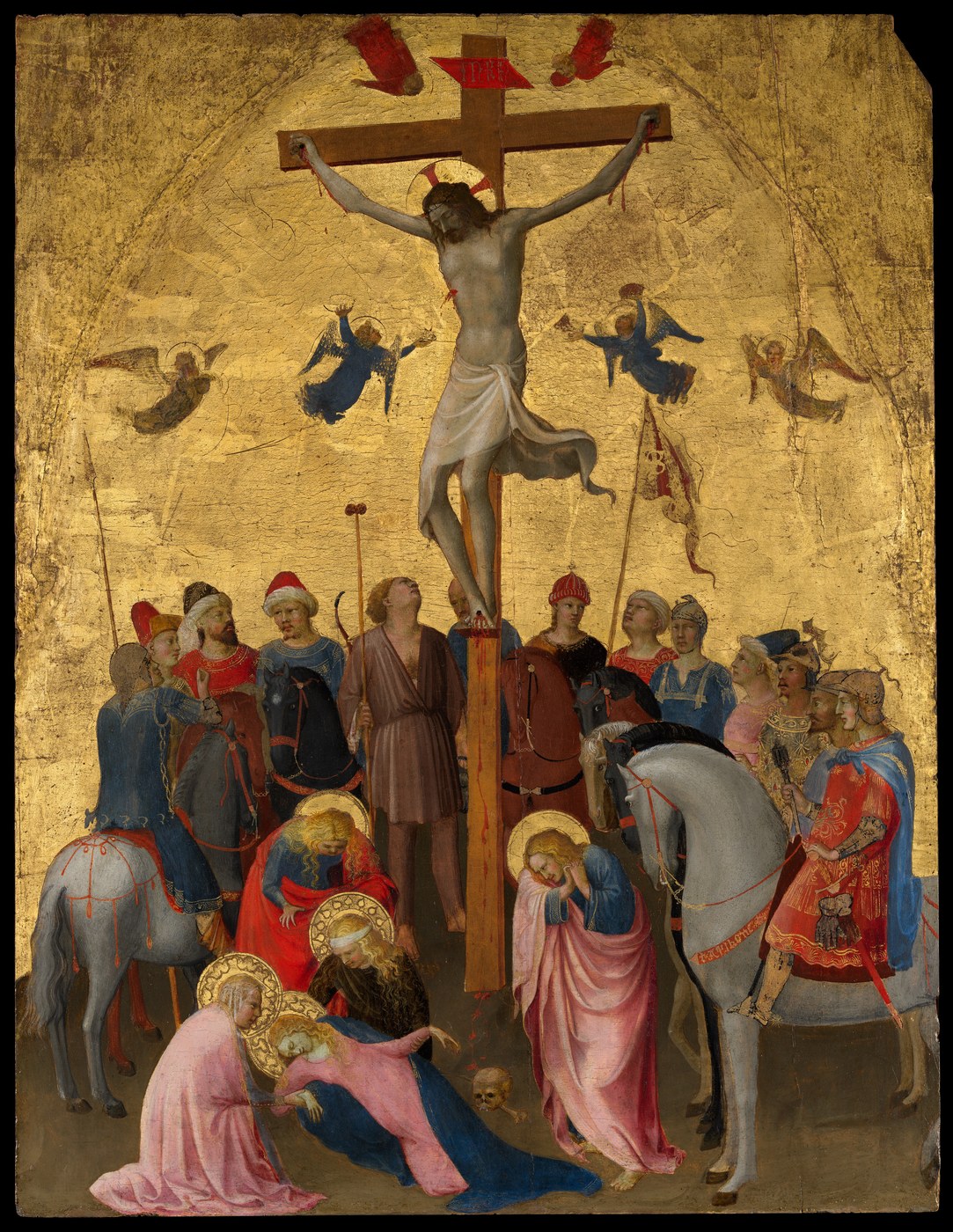
Fra Angelico, The Crucifixion, ca. 1420–23. Tempera on wood with a gold ground.
The Metropolitan Museum of Art. Maitland F. Griggs Collection, Bequest of Maitland F. Griggs, 1943. Accession 43.98.5. Public Domain (CC0). · Museum record ↗ · CC0
Resurrection in Paul’s testimony
In 1 Corinthians 15, Paul passes on a received proclamation of Christ’s death, burial and resurrection. He lists appearances to Cephas, the Twelve, other followers and finally himself. [6]
Paul places his experience within a chain of witnesses, presenting resurrection as shared testimony. [6]
Identity and interpretation
What Christians mean by Christ
Christian creeds turn identification of Jesus into a confession of faith. The Apostles’ Creed and the Nicene Creed connect his identity with the Father and Holy Spirit, and with a story of incarnation, suffering and resurrection. The title Christ carries the claim that he is the Messiah. [7]
Harvard’s account places creeds within baptism and the work of early church councils. Confession is both a statement about Jesus and a commitment to his way. This helps explain why Christian worship addresses him through titles such as Lord and Son of God, rather than treating his importance as confined to a completed biography. [7]
Humanity and divinity in Catholic teaching
The Catholic Catechism describes incarnation as the Son of God assuming human nature for human salvation. It insists on genuine humanity as well as genuine divinity: Jesus’ life, suffering and death belong to the one whom Christians worship. [8]
Its account of the Council of Chalcedon, held in 451, explains the language of two natures united in one person. This is a named doctrinal formulation within Christian history. It answers a question about who Jesus is for believers, beyond the biographical questions historians can investigate. [8]
The Catechism also connects incarnation with divine love, a model of holiness and participation in divine life. In this interpretation, salvation involves God’s relation to human existence, including its vulnerability and capacity for transformation. [8]
The passion and relations with Judaism
Nostra Aetate, the Second Vatican Council’s declaration on relations with other religions, explicitly rejects charging the passion against Jews indiscriminately, whether in Jesus’ time or in the present. It also condemns antisemitism. [9]
The declaration matters to how Christians tell the story. Jesus’ execution is not a warrant for collective blame. This Catholic teaching places interpretation of the passion within a continuing responsibility towards Jewish people and towards the shared religious history of Jews and Christians. [9]
Jesus in Islam
The Quran honours Jesus while interpreting his identity differently from Nicene Christianity. Quran 4:171 identifies Jesus, son of Mary, as God’s messenger and speaks of God’s word communicated through Mary. It rejects the claim that God has a son and warns against a trinitarian formulation. [11]
Quran 3:45 likewise calls him the Messiah and describes him as honoured in this world and the hereafter. The shared names belong within a different theological account. Respect for Jesus in Islam therefore does not imply acceptance of the Christian doctrine of incarnation. [10][11]
Read further in the library
The Bible Gallery
Reading note
Gustave Doré’s nineteenth-century biblical illustrations, with Talbot W. Chambers’s narratives, offer a historical visual retelling of selected scriptural scenes.
Sources
- Life and Teachings of Jesus ↗The Pluralism Project, Harvard UniversityReturn to text ↑
- The Historical Jesus, RLST 152, Lecture 13 ↗Dale B. Martin, Open Yale Courses; historical scholarshipReturn to text ↑
- Mark 1:14–20 ↗New Revised Standard Version Updated Edition, National Council of Churches; Bible GatewayReturn to text ↑
- Luke 10:25–37 ↗New Revised Standard Version Updated Edition, National Council of Churches; Bible GatewayReturn to text ↑
- Death and Resurrection of Jesus ↗The Pluralism Project, Harvard UniversityReturn to text ↑
- 1 Corinthians 15:3–8 ↗New Revised Standard Version Updated Edition, National Council of Churches; Bible GatewayReturn to text ↑
- Credo: I Believe ↗The Pluralism Project, Harvard UniversityReturn to text ↑
- Catechism of the Catholic Church, 456–469: Incarnation, true God and true man ↗The Holy See; Catholic doctrinal teachingReturn to text ↑
- Nostra Aetate, section 4 ↗Second Vatican Council, 28 October 1965; Catholic teaching on relations with JudaismReturn to text ↑
- Quran 3:45 ↗The Clear Quran, Mustafa Khattab; Quran.comReturn to text ↑
- Quran 4:171 ↗The Clear Quran, Mustafa Khattab; Quran.comReturn to text ↑
- The Adoration of the Shepherds ↗The Metropolitan Museum of Art; accession 05.42Return to text ↑
- The Crucifixion ↗The Metropolitan Museum of Art; accession 43.98.5Return to text ↑
About this article & its sources
A biographical reference entry separating historical reconstruction, Gospel narrative, Christian theology, Islamic interpretation and later devotional art. Jesus’ Jewish setting and Roman execution remain explicit. Named doctrinal sources describe particular traditions; their claims are not presented as scientific findings.
Passage attributions
Who was Jesus?
Passage 1: The Pluralism Project, Harvard University.
Jesus in his Jewish and Roman setting
Passage 1: Dale B. Martin, Open Yale Courses; historical scholarship.
Passage 2: Dale B. Martin, Open Yale Courses; historical scholarship.
Passage 3: Dale B. Martin, Open Yale Courses; historical scholarship.
Why there are four Gospel accounts
Passage 1: The Pluralism Project, Harvard University.
Passage 2: The Pluralism Project, Harvard University.
The birth stories
Passage 1: The Pluralism Project, Harvard University.
Light around the infant in El Greco
Passage 1: The Metropolitan Museum of Art; accession 05.42.
Passage 2: The Metropolitan Museum of Art; accession 05.42.
The kingdom of God and the call to follow
Passage 1: New Revised Standard Version Updated Edition, National Council of Churches; Bible Gateway.
Passage 2: New Revised Standard Version Updated Edition, National Council of Churches; Bible Gateway.
What the Good Samaritan asks of its hearer
Passage 1: New Revised Standard Version Updated Edition, National Council of Churches; Bible Gateway.
Passage 2: New Revised Standard Version Updated Edition, National Council of Churches; Bible Gateway.
The people around Jesus
Passage 1: The Pluralism Project, Harvard University.
Jerusalem, crucifixion and the Easter accounts
Passage 1: The Pluralism Project, Harvard University.
Passage 2: The Pluralism Project, Harvard University.
Passage 3: The Pluralism Project, Harvard University.
Grief and witness in Fra Angelico
Passage 1: The Metropolitan Museum of Art; accession 43.98.5.
Passage 2: The Metropolitan Museum of Art; accession 43.98.5.
Resurrection in Paul’s testimony
Passage 1: New Revised Standard Version Updated Edition, National Council of Churches; Bible Gateway.
Passage 2: New Revised Standard Version Updated Edition, National Council of Churches; Bible Gateway.
What Christians mean by Christ
Passage 1: The Pluralism Project, Harvard University.
Passage 2: The Pluralism Project, Harvard University.
Humanity and divinity in Catholic teaching
Passage 1: The Holy See; Catholic doctrinal teaching.
Passage 2: The Holy See; Catholic doctrinal teaching.
Passage 3: The Holy See; Catholic doctrinal teaching.