Judaism
Explore Judaism through covenant, Torah, rabbinic interpretation, Shabbat, festivals, Jewish communities and the relationship between religion and peoplehood.
In this article
What is Judaism?
Judaism is the religious tradition of the Jewish people, shaped by covenant with God, the study of Torah and the practices of Jewish communal life. Its roots lie in ancient Israel, but its history also belongs to communities across the Middle East, Europe, Africa and beyond. A synagogue service, a family meal on Shabbat and an argument over a passage of Talmud are different settings in which this inheritance lives. [1]
Jewish identity is broader than a statement of faith. Jews may understand their belonging through religion, family, culture, language, history or a combination of these. Secular and atheist Jews remain part of Jewish life. The recurring language of God, Torah and Israel therefore joins theological ideas to a people and its shared responsibilities. In this context, Israel can mean the Jewish people or their ancestral land; it does not always mean the modern state. [1]
God, Torah and interpretation
God, covenant and responsibility
The Hebrew Bible presents a relationship between one God and a people called to live within a covenant. Covenant gives religious significance to conduct: treatment of neighbours, the use of power and obligations to vulnerable people become matters of faithfulness. The prophetic books repeatedly connect worship with justice, rather than allowing ceremonies to excuse exploitation. [2]
Jewish reflection on God includes questions as well as affirmations. How can human freedom coexist with divine authority? How should suffering be understood? What does a community owe to a covenant when its circumstances change? Biblical monotheism supplies a shared language for these questions, while later interpreters offer different answers. The covenant is thus both an inherited account of relationship and a continuing demand on the way a life is lived. [2]
Torah and the Hebrew Bible
Torah most specifically names the five books of Moses: Genesis, Exodus, Leviticus, Numbers and Deuteronomy. These combine creation narratives, ancestral stories, the Exodus from Egypt, the covenant at Sinai and extensive laws. Their stories function as sacred memory; identifying their religious importance does not require treating every narrative detail as independently established history. [3]
The broader Jewish Bible is the Tanakh, named from its three divisions: Torah, Neviim, or Prophets, and Ketuvim, or Writings. Torah can also mean Jewish teaching more widely, including the interpretation that makes these writings relevant to changing circumstances. In synagogue worship, portions are read from a handwritten Torah scroll through a yearly cycle. Study returns readers to familiar passages with new questions, so repetition and interpretation work together. [3]
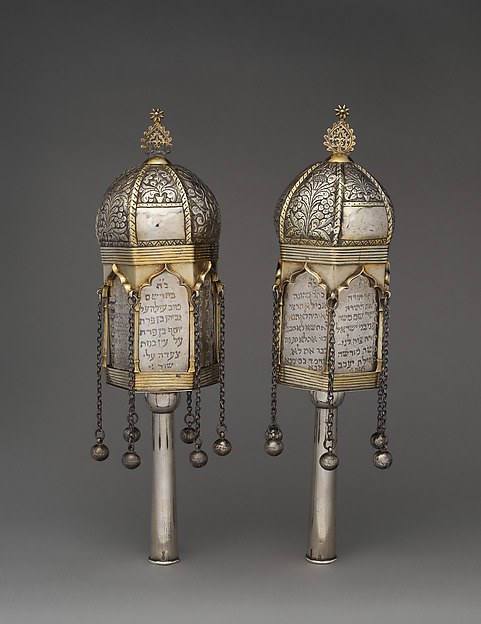
A pair of Torah finials, or rimonim, made by A.M. in 1895. These decorated objects honour the Torah scroll through metalwork and inscriptions, showing how the written teaching is also encountered as a carefully adorned sacred object.
The Metropolitan Museum of Art. Purchase, Mortimer B. Zuckerman Gift and Fletcher Fund, 2013. Accession 2013.444.1, .2. Public Domain (CC0). · Museum record ↗ · CC0
Mishnah, Talmud and the practice of interpretation
Rabbinic Judaism understands written teaching alongside an interpretive inheritance often called Oral Torah. The Mishnah, compiled around 200 CE, arranges teachings on subjects including agriculture, festivals, marriage, civil disputes and ritual purity. Later discussion of the Mishnah forms the Gemara. Mishnah and Gemara together make up the Talmud, preserved in Palestinian and Babylonian compilations. [4]
A Talmudic page can preserve disagreements instead of presenting a single uninterrupted verdict. Halakhah concerns the ordering of religious life and conduct; aggadah includes narrative, ethical reflection and other non-legal teaching. Midrash interprets scripture through close reading, argument and storytelling. Subsequent legal codes and responsa, answers to particular questions, extend this process. Jewish learning therefore involves following how an interpretation is reached, including the alternatives that remain visible along the way. [4]
From the Temple to home and synagogue
The Roman destruction of the Second Temple in Jerusalem in 70 CE transformed Jewish religious life. Sacrificial worship at that Temple could no longer continue. Rabbinic teaching, prayer, study and the observance of commandments became central ways of sustaining a sacred life without it. This was a long historical development, not the invention of every Jewish institution at a single moment. [5]
The synagogue provides a place for prayer, reading and communal gathering, while many observances belong in the home. Mitzvot, commandments, encompass both ritual and ethical responsibilities. Dietary practice, charitable giving and care for other people can belong to the same religious framework. The division between a religious ceremony and an ordinary weekday is consequently less sharp than it may appear: earning, eating, speaking and giving can all become occasions for obligation. [5]
The rhythm of Jewish life
Shabbat: a weekly change of pace
Shabbat begins on Friday evening and ends after nightfall on Saturday. Its weekly rhythm creates a sustained interval for rest, worship, family and friendship. Candles, blessings over wine and bread, shared meals, synagogue prayer and Torah reading mark that interval in many households. Havdalah, with wine, fragrant spices and a candle, distinguishes the end of Shabbat from the working week. [6]
How rest is observed varies considerably. Traditionally observant Jews refrain from defined categories of work; other Jews maintain a family meal, attend a service or set aside part of the day in a different way. These variations should not obscure the organising idea: time itself is given a religious shape. Shabbat returns every week, making renewal a recurring practice rather than something reserved for a rare pilgrimage or major festival. [6]
Passover and the telling of freedom
Passover, or Pesach, recalls the Exodus from Egypt. At a seder, participants follow a Haggadah that combines a ritual meal, biblical interpretation, questions and songs. Matzah, bitter herbs and other foods make the story tangible. Children’s questions and adults’ responses help turn remembrance into a conversation between generations. [7]
The seder does more than describe an event at a distance. Its language asks participants to locate themselves within the passage from oppression to freedom. Households and communities bring different melodies, languages and inherited customs to that shared task. The number of festival days and some ritual details vary by community and location. The durable centre is the combination of narrative, food, questioning and a responsibility to remember what enslavement means. [7]
Repentance and the High Holy Days
Rosh Hashanah begins the Jewish year and the period of reflection that leads to Yom Kippur. The shofar, a ram’s-horn instrument, is closely associated with Rosh Hashanah. Prayer and self-examination direct attention towards how the coming year might be lived differently. [8]
Teshuvah, usually translated as repentance or return, includes taking responsibility for wrongs. Reconciliation with another person cannot simply be replaced by a request for divine forgiveness. Yom Kippur concentrates these concerns through communal prayer, confession and fasting for those who observe it. The calendar thus gives ethical repair a public setting. Its seriousness belongs alongside the more celebratory occasions of Jewish life, rather than defining Judaism solely through guilt or restraint. [8]
Communities and modern movements
Jewish communities across the diaspora
Jewish life outside the ancestral land has included forced exile, migration and communities established by choice. Across these settings, people preserved Jewish learning and worship while developing distinctive languages, music, food and local institutions. Diaspora is therefore a history of creativity as well as displacement. [9]
Ashkenazi traditions developed in medieval northern and central Europe and later eastern Europe; Sephardi traditions are associated with the Jews of the Iberian Peninsula and the communities shaped by their dispersal. Yiddish and Ladino became important vehicles of these respective cultures. These labels describe historical formations, not denominations or two exhaustive kinds of Jew. A person’s community of origin and their approach to religious observance answer different questions, even when both influence the same family’s customs. [9]
Medieval Sephardi culture developed in close contact with Muslim and Christian societies, placing Jewish life within the histories of Islam and Christianity as well as its own. [9]
Modernity and religious change
The Haskalah, or Jewish Enlightenment, brought new arguments about secular learning, citizenship and participation in wider society. In nineteenth-century Europe, Reform Judaism reconsidered worship and religious authority in changing political and cultural conditions. Orthodox responses defended the authority of inherited practice while differing over engagement with modern education and society. [10]
Conservative Judaism developed an approach that joined commitment to Jewish law with attention to historical change. These movements did not replace every older community or settle the meaning of Jewish identity. They made questions of interpretation, adaptation and continuity newly explicit. Modern Jewish culture also includes secular literary, political and intellectual lives, so a history organised only around religious denominations would leave much out. [10]
Denominations and individual belonging
In North America, Orthodox, Conservative, Reform and Reconstructionist communities provide familiar institutional frameworks, alongside independent and non-denominational congregations. Their approaches to law, worship and religious authority differ, and variation exists within each. A label can help identify an institution without predicting every member’s beliefs or daily observance. [11]
Some Jews seek community through study groups, cultural organisations or gatherings outside a conventional synagogue. Others participate in more than one setting over a lifetime. These patterns make a single ranking from strict to relaxed inadequate: different communities may emphasise different commitments. Asking how a particular congregation understands obligation, belonging and interpretation is more informative than assuming that one movement stands for all contemporary Judaism. [11]
Mysticism and historical memory
Kabbalah and the Zohar
Kabbalah is a major current of Jewish mystical interpretation. The Zohar, its best-known body of literature, appeared in medieval Spain and became an influential way of reading scripture and reflecting on divine reality. Traditional attribution connects it with the ancient sage Shimon bar Yohai; historical scholarship locates its emergence in thirteenth-century circles associated with Moses de León. [14]
Those are different kinds of claim about a text’s authority and history. Keeping them visible allows the Zohar to be read as a sacred work within Jewish tradition and as literature with a historical setting. Kabbalah subsequently travelled through communities and took new forms. It belongs within the larger history of Jewish learning, rather than serving as a replacement for Torah, commandments or communal life. [14]
Hasidism and devotional life
Early modern Kabbalah developed influential teachings about creation, rupture and restoration, particularly in the work associated with Isaac Luria in sixteenth-century Safed. In eighteenth-century eastern Europe, Hasidism brought mystical devotion into new forms of communal life. The movement is associated with Israel Baal Shem Tov and the teachers who followed him. [13]
Prayer, spiritual intention, joy and the relationship with a rebbe became important features of Hasidic communities. This emphasis did not make Hasidism separate from Jewish law. Different Hasidic groups developed their own leadership lines and practices within an observant Jewish life. Hasidism is one powerful expression of Jewish spirituality, while many other Jews find religious depth through study, ethical commitment, liturgy or combinations of these. [13]
Antisemitism, remembrance and continuity
Jewish history includes recurring persecution, expulsions and violence. Modern racial antisemitism treated Jews as an inherent biological threat, extending hostility to people regardless of their religious beliefs. Nazi Germany and its collaborators murdered six million Jews in the Holocaust, or Shoah. This destruction is indispensable to understanding modern Jewish memory. [12]
It is equally necessary to see the lives that persecution targeted: families, schools, communities, languages, religious traditions and secular cultures. A history consisting only of catastrophe would erase much of that life a second time. Remembrance stands alongside continuing study, worship, cultural creation and community-building. Judaism remains a living inheritance whose future is shaped by Jews themselves, through the varied commitments described throughout this article. [12]
Sources
- God, Torah, and Israel ↗Harvard University, The Pluralism ProjectReturn to text ↑
- God: Biblical Monotheism ↗Harvard University, The Pluralism ProjectReturn to text ↑
- Torah: Covenant and Constitution ↗Harvard University, The Pluralism ProjectReturn to text ↑
- Rabbinic Text ↗Harvard University, The Pluralism ProjectReturn to text ↑
- Post-Biblical Religion ↗Harvard University, The Pluralism ProjectReturn to text ↑
- Keeping Shabbat ↗Harvard University, The Pluralism ProjectReturn to text ↑
- Passover ↗Harvard University, The Pluralism ProjectReturn to text ↑
- Rosh Hashanah and Yom Kippur ↗Harvard University, The Pluralism ProjectReturn to text ↑
- Diaspora Community ↗Harvard University, The Pluralism ProjectReturn to text ↑
- Modern Jewish Culture ↗Harvard University, The Pluralism ProjectReturn to text ↑
- Jewish Pluralism ↗Harvard University, The Pluralism ProjectReturn to text ↑
- Antisemitism and the Holocaust ↗Harvard University, The Pluralism ProjectReturn to text ↑
- Kabbalah and Hasidism ↗Harvard University, The Pluralism ProjectReturn to text ↑
- The Rise of Kabbalah ↗The Posen Library of Jewish Culture and CivilizationReturn to text ↑
- Pair of Torah finials (rimonim) ↗The Metropolitan Museum of Art, Open Access collection
About this article & its sources
A historical and lived-religion introduction to Judaism. Jewish identities and communities extend beyond religious belief; no denomination represents them all.
Passage attributions
What is Judaism?
Passage 1: Harvard University, The Pluralism Project.
Passage 2: Harvard University, The Pluralism Project.
God, covenant and responsibility
Passage 1: Harvard University, The Pluralism Project.
Passage 2: Harvard University, The Pluralism Project.
Torah and the Hebrew Bible
Passage 1: Harvard University, The Pluralism Project.
Passage 2: Harvard University, The Pluralism Project.
Mishnah, Talmud and the practice of interpretation
Passage 1: Harvard University, The Pluralism Project.
Passage 2: Harvard University, The Pluralism Project.
From the Temple to home and synagogue
Passage 1: Harvard University, The Pluralism Project.
Passage 2: Harvard University, The Pluralism Project.
Shabbat: a weekly change of pace
Passage 1: Harvard University, The Pluralism Project.
Passage 2: Harvard University, The Pluralism Project.
Passover and the telling of freedom
Passage 1: Harvard University, The Pluralism Project.
Passage 2: Harvard University, The Pluralism Project.
Repentance and the High Holy Days
Passage 1: Harvard University, The Pluralism Project.
Passage 2: Harvard University, The Pluralism Project.
Jewish communities across the diaspora
Passage 1: Harvard University, The Pluralism Project.
Passage 2: Harvard University, The Pluralism Project.
Passage 3: Harvard University, The Pluralism Project.
Modernity and religious change
Passage 1: Harvard University, The Pluralism Project.
Passage 2: Harvard University, The Pluralism Project.
Denominations and individual belonging
Passage 1: Harvard University, The Pluralism Project.
Passage 2: Harvard University, The Pluralism Project.
Kabbalah and the Zohar
Passage 1: The Posen Library of Jewish Culture and Civilization.
Passage 2: The Posen Library of Jewish Culture and Civilization.