Islam
An introduction to Islam’s beliefs, Qur’an, history, worship and major traditions, with clear distinctions between communities and examples of historical art.
In this article
God, Muhammad and the first community
What is Islam?
Islam is a monotheistic religious tradition centred on worship of one God, the Qur’an and the prophetic example of Muhammad. A Muslim is a person who follows Islam. The Arabic name connects submission to God with a way of living: belief, prayer, conduct and responsibility to others belong together. Muslims understand Muhammad as the final prophet in a history of divine guidance that includes earlier messengers. [1]
Islam began in seventh-century Arabia and became a worldwide religion. Its communities speak many languages and inherit different legal, theological and devotional traditions. The word ummah names the community of believers, but belonging to that community does not make every Muslim’s interpretation or religious life identical. This article follows shared foundations alongside the particular histories that give them different expressions. Christianity and Judaism also began in the Middle East and developed worldwide communities. [1]
One God: tawḥīd
Tawḥīd names the oneness and uniqueness of God. In the short chapter Al-Ikhlāṣ, Qur’an 112, God is described as one, the one on whom others depend, neither begotten nor begetting, with no equivalent. The chapter gives unusually concentrated expression to a central conviction: the creator cannot be placed alongside other beings as one member of a larger divine family. [21]
The Arabic word Allah means God. The Qur’an’s opening chapter addresses God through mercy, sovereignty and guidance, and forms part of daily prayer. Arabic-speaking Christians also use Allah in their religious vocabulary. The word itself therefore does not name a different deity simply because it is Arabic; what distinguishes a religious account is what its scriptures and interpreters say about God. [2]
Muhammad and the first community
Muslim tradition locates Muhammad’s first revelations near Mecca, in a cave on Mount Hira, around 610 CE. The account describes Gabriel commanding him to recite. Muhammad proclaimed the oneness of God, accountability and care for the vulnerable in a society in which the Kaʿbah was already a pilgrimage centre. His followers encountered persecution. [3]
In 622, Muhammad and his followers migrated to Medina. This hijrah became the reference point for the Islamic calendar and a decisive event in the formation of a religious and political community. After conflict and negotiation, Muhammad returned to Mecca in 630 and rededicated the Kaʿbah to worship of one God. He died in 632. Muslims honour him as a messenger and exemplar, rather than worshipping him as divine. [3]
From Arabia to interconnected societies
Early Muslim rulers expanded their territories through conquest; Islam’s spread as a religion also involved merchants, scholars, teachers and devotional networks over long periods. Political rule and conversion did not occur at the same speed. Under the Umayyads and Abbasids, and in later regional societies, Arabic and other languages carried law, theology, philosophy, poetry and learning across large distances. Persian, African, South Asian and other cultures contributed to these histories. [9]
- 622
The hijrah
Migration from Mecca to Medina establishes a new community setting. [3]
- 661–750
Umayyad rule
A dynasty based in Damascus extends Muslim political rule. [9]
- From 750
Abbasid period
Baghdad becomes a major centre of political and intellectual life. [9]
- Medieval and early modern centuries
Regional traditions
Trade, scholarship and religious networks connect diverse societies. [9]
- Modern centuries
Reform and migration
Colonialism, new states and migration reshape institutions and debates. [20]
Scripture, faith and the unseen
The Qur’an as scripture and recitation
The Qur’an is Islam’s central scripture, understood by Muslims as revelation given to Muhammad in Arabic. Its name is connected with recitation. Its 114 surahs contain prayers, narratives of prophets, ethical exhortations, legal passages and images of judgment and creation. Al-Fātiḥah, the opening surah, asks for guidance and is recited in ritual prayer. [2]
Reading therefore includes sound as well as the printed page. Recitation is cultivated through rules of pronunciation and delivery known as tajwīd. Translation makes meanings available in other languages, while remaining an interpretation of the Arabic. Readers encounter the text through teachers, commentary and memorization as well as private study. Different translations may resolve a phrase differently; identifying the translation helps make that interpretive work visible. [2]
Hadith, Sunnah and the quality of worship
The Sunnah is the prophetic example: Muhammad’s words and practices as preserved and interpreted in the tradition. Hadith are transmitted reports through which that example is studied. In the well-known Gabriel report in Ṣaḥīḥ Muslim 8a, a visitor asks Muhammad about Islam, faith and iḥsān. The answers move from religious practices to beliefs and finally to worship conducted in awareness of God’s presence. [22]
The narrative distinguishes these dimensions while bringing them together. Islam is described through testimony, prayer, almsgiving, fasting and pilgrimage; faith through God, angels, scriptures, messengers, judgment and decree; excellence through the quality of one’s worship. A hadith is a transmitted account with its own collection and history of interpretation. Naming this Sunni collection keeps the example specific rather than assigning every Muslim the same corpus of reports. [22]
Faith, angels and the world to come
Sunni introductions commonly summarize faith through six articles: God, angels, revealed scriptures, prophets, the Day of Judgment and divine decree. Angels belong to an unseen creation and carry out divine commands; Gabriel is associated with revelation. Earlier prophets include Abraham, Moses and Jesus. Muslim teaching honours them as recipients of divine guidance while distinguishing them from God. [8]
Resurrection and judgment give earthly conduct an ultimate horizon. Paradise, jannah, and hell, jahannam, belong to accounts of the life to come. Divine mercy is central to these teachings alongside accountability. The relation between God’s knowledge, decree and human responsibility has generated sustained theological argument. These are religious understandings of existence and moral life, rather than empirical descriptions of an observed afterlife. The wording and organization of faith statements differ among Muslim traditions. [8]
Repentance and hope
Qur’an 39:53 addresses people who have wronged themselves and calls them away from despair of divine mercy. The following verse calls for a return to God. Read together, the invitation to hope and the demand for repentance connect: mercy does not make the response to wrongdoing meaningless. The passage is a concrete example of the movement between warning, forgiveness and renewed responsibility within the Qur’an. [23]
Translation also shapes how an English reader hears that movement. The Clear Quran version by Mustafa Khattab makes the address and its appeal to forgiveness especially explicit. The page’s surrounding verses keep the promise within a larger summons to turn back and follow guidance. Reading beyond an isolated line helps preserve that relationship between compassion and accountability. [23]
Worship and sacred time
The Five Pillars
The Five Pillars offer a familiar Sunni framework for religious practice. Testimony of faith, shahādah, affirms one God and Muhammad’s messengership. Ṣalāt orders the day through prayer. Zakāt directs a portion of qualifying wealth towards specified recipients. Ṣawm is the Ramadan fast. Hajj is pilgrimage to Mecca for those able to undertake it. Together they connect profession, bodily discipline, material responsibility and shared sacred places. [7]
Other Muslim traditions share many of these practices while organizing or interpreting religious obligations differently. In Twelver Shia teaching, for example, allegiance to the Imams and obligations such as khums have distinctive importance. The fivefold list is a useful starting point, rather than a complete account of Muslim religious life. Nor does it imply that every individual’s observance is identical. [7]
Prayer through the day
Ṣalāt gives religious life a repeated physical form. Worshippers prepare through ritual purification, face the qiblah towards Mecca, and move through standing, bowing, prostration and sitting. Qur’anic recitation and formulas of praise accompany these movements. Prayer draws the body, speech and attention into worship at different points of the day. [10]
The five daily prayers are associated with dawn, midday, afternoon, sunset and night. They can be performed in a suitable clean place as well as in a mosque. Details of timing, gestures and the combining of prayers vary across legal traditions. Learning prayer often happens through family and teachers, with timetables and digital tools helping people observe it amid work, study and travel. The practice makes sacred time part of an ordinary schedule. [10]
Friday assembly and the mosque
Friday congregational prayer, jumʿah, gathers a community around prayer and a sermon, the khuṭbah. The sermon may join scriptural teaching with concerns in the congregation’s life. An imam leads the prayer; in many communities the role also involves teaching and pastoral responsibility. The meaning of imam here should be distinguished from the particular theological authority of the Imams in Shia traditions. [11]
A mosque, or masjid, is a place of prostration. A mihrab marks the prayer direction, while a minbar provides a place for the sermon. Buildings range from adapted rooms and shops to large architectural complexes. Some centres also provide education, food distribution or other community services. A dome or minaret may be a prominent local feature, but the architecture of one region does not define every Muslim place of worship. [12]
Ramadan and Eid al-Fitr
Ramadan is the ninth month of the Islamic lunar calendar. Its fast extends from dawn to sunset for those obliged to observe it, with exemptions recognized in the tradition. Fasting is connected with self-restraint, awareness of God and concern for others. Qur’an 2:185, cited in the Pluralism Project’s account, explicitly addresses illness and travel, showing why an introduction should not describe the obligation without its qualifications. [13]
Suḥūr is the meal before dawn; ifṭār breaks the fast after sunset. Communal meals, recitation and night worship give the month its social rhythm. Laylat al-Qadr commemorates revelation, and Eid al-Fitr marks the end of the fasting month with prayer and celebration. Food, visiting and local customs vary, while the calendar connects communities far apart. The fast belongs within this larger pattern of worship and shared life. [13]
Hajj and Eid al-Adha
Hajj brings pilgrims to Mecca during Dhū al-Ḥijjah. Its obligation is qualified by physical and financial ability. The rites include circling the Kaʿbah, movement between Ṣafā and Marwah and the gathering at ʿArafāt. They connect pilgrims with sacred history, including traditions about Abraham, Hagar and Ishmael. Their shared setting also makes the worldwide ummah visible in an unusually concentrated form. [14]
Eid al-Adha, associated with the pilgrimage season, commemorates Abraham’s willingness to sacrifice in obedience to God. Muslims beyond Mecca also mark the festival, and the distribution of meat connects households with other people’s needs. Hajj is a particular pilgrimage with appointed rites and times; it should not be used as a generic term for every journey to a Muslim sacred place. [14]
Sufism and devotional life
Sufism and spiritual cultivation
Sufism, or taṣawwuf, concerns the cultivation of the inner religious life: remembrance, love of God, ethical transformation and the discipline of the self. It is not simply a third denomination parallel to Sunni and Shia Islam. Sufi teachers and communities have existed across different Muslim settings, and devotional affiliation can overlap with legal and theological commitments. [5]
Orders, ṭarīqahs, organize teaching around spiritual lineages and practices. Names such as Qadiri, Chishti, Naqshbandi and Mevlevi identify particular histories. Sufi literature describes stages and states of the spiritual journey, but its language and interpretation differ. Poetry, commentary and manuals have carried these teachings through Arabic, Persian and other languages. It is misleading to reduce this broad field to a single ceremony, or detach its historical forms from Islam altogether. [5]
Remembrance in sound and movement
Dhikr means remembrance of God. It can take quiet or vocal forms, including repetition of divine names and devotional formulas. Collective ceremonies may involve poetry, music or movement in particular communities; other practitioners emphasize silent remembrance. The Pluralism Project describes American gatherings whose practices connect participants with teachers and inherited lineages. [16]
The Mevlevi ceremony associated with Rumi is a well-known example, while South Asian qawwali offers another devotional form. The Pluralism Project discusses Nusrat Fateh Ali Khan’s performances and the wider audiences reached by Sufi-influenced music. These examples connect inherited devotion with new public settings. A whirling ceremony, a sung poem and silent remembrance belong to distinct practices whose meanings depend on their communities. [16]
Everyday life and community
Ethics in everyday life
Ḥalāl means permitted and ḥarām forbidden. The terms apply beyond food, although dietary practice makes them especially visible. Avoidance of pork and intoxicants, concern about ingredients and questions about slaughter are familiar examples. Observance differs, and people may seek guidance from teachers, certification bodies or their legal tradition. The vocabulary connects ordinary choices with a larger account of responsibility before God. [17]
Food also makes interpretation practical. The Pluralism Project describes differences over which products are acceptable and how people respond where suitable food is hard to obtain. A label, a shared meal or a school dining arrangement can become a place where religious commitments meet institutions and neighbours. A general article can explain those questions without pretending to issue a ruling for a reader’s particular circumstances. [17]
Muslim histories beyond a single region
Muslim histories include forced migration as well as travel and settlement by choice. Enslaved African Muslims brought religious knowledge to the Americas under conditions that violently constrained its transmission. The Pluralism Project discusses Bilali and Omar ibn Said as examples preserved through records and memory. Omar’s Arabic autobiography, written in 1831, recalls a life of religious learning before enslavement. Such sources challenge the assumption that Islam in the Americas began only with recent immigration. [19]
Modern Muslim communities have also been shaped by colonial rule, reform movements, migration and the formation of new institutions. Debates about inherited scholarship, education and political authority have produced differing responses. In diaspora settings, mosques, schools and organizations create new contexts for religious life. Shared scripture and prayer travel with people, while language, local history and relations with neighbours shape how a community lives them. [20]
Writing and sacred space
Calligraphy, sacred space and historical art
The Blue Qur’an folio below presents scripture through gold writing on indigo-dyed parchment. The museum dates it from the second half of the ninth to the middle of the tenth century and associates it with North Africa, possibly Qairawan. Its missing distinguishing marks and extended letterforms can make the script difficult to read. This luxurious manuscript reminds the viewer that a written Qur’an is also a material object with a particular artistic history. [26]
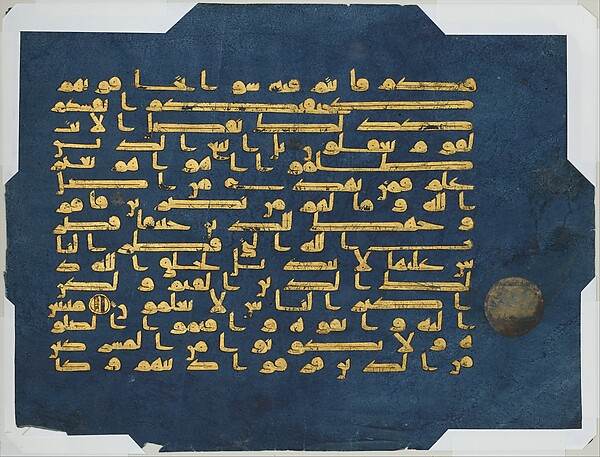
Folio from the Blue Qur’an, second half of the ninth–mid-tenth century, probably North Africa; the museum lists Tunisia, possibly Qairawan. Gold and silver on indigo-dyed parchment, 2004.88.
The Metropolitan Museum of Art. Purchase, Lila Acheson Wallace Gift, 2004. Public Domain, The Met Open Access. · Museum record ↗ · CC0
A prayer niche in detail
This mihrab comes from the Madrasa Imami in Isfahan and is dated 755 AH, or 1354–55 CE. Small pieces of glazed tile form the floral patterns, geometry and inscriptions. The outer frame carries Qur’anic verses; another inscription includes a report about the Five Pillars. The object makes the connection between sacred writing and the orientation of prayer visible in architectural form. [25]
Its original setting was a religious school, rather than a modern museum. Looking at it alongside the account of mosque worship restores some of that function: the niche locates a shared direction for the congregation. The Qur’an folio and mihrab are particular examples of religious art. They should not be turned into a claim that every artwork made in Muslim societies has the same purpose or visual form. [25]
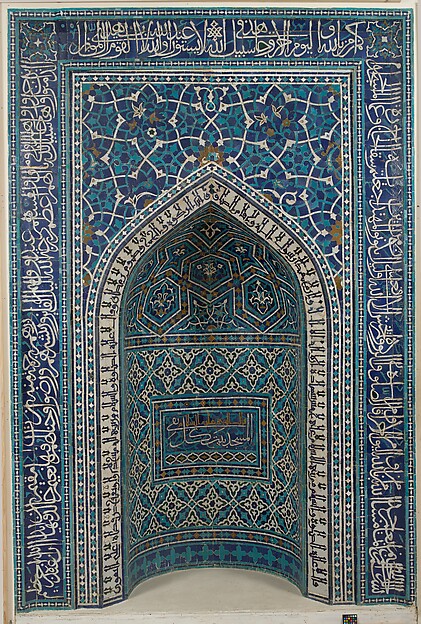
Mihrab from the Madrasa Imami, Isfahan, Iran, dated 755 AH/1354–55 CE. Mosaic of glazed cut tiles, The Metropolitan Museum of Art, 39.20.
Harris Brisbane Dick Fund, 1939. Public Domain, The Met Open Access. · Museum record ↗ · CC0
Sources
- Islam Means Being Muslim ↗The Pluralism Project, Harvard UniversityReturn to text ↑
- Qur’an: The Word of God ↗The Pluralism Project, Harvard UniversityReturn to text ↑
- Muhammad: The Messenger of God ↗The Pluralism Project, Harvard UniversityReturn to text ↑
- Sunni and Shi’i Interpretations ↗The Pluralism Project, Harvard UniversityReturn to text ↑
- Sufism: Seeking God ↗The Pluralism Project, Harvard UniversityReturn to text ↑
- Shari’ah: Following the Straight Path ↗The Pluralism Project, Harvard UniversityReturn to text ↑
- Islamic Practices ↗The Pluralism Project, Harvard UniversityReturn to text ↑
- Islamic Beliefs ↗The Pluralism Project, Harvard UniversityReturn to text ↑
- Expansion of Islamic Civilization ↗The Pluralism Project, Harvard UniversityReturn to text ↑
- Salat: Daily Prayers ↗The Pluralism Project, Harvard UniversityReturn to text ↑
- Jum’ah: The Friday Prayer ↗The Pluralism Project, Harvard UniversityReturn to text ↑
- Mosque, Minaret and Mihrab ↗The Pluralism Project, Harvard UniversityReturn to text ↑
- Ramadan and Eid al-Fitr ↗The Pluralism Project, Harvard UniversityReturn to text ↑
- Pilgrimage and Eid al-Adha ↗The Pluralism Project, Harvard UniversityReturn to text ↑
- Shi’i Remembrance of Husayn ↗The Pluralism Project, Harvard UniversityReturn to text ↑
- Remembrance of God: The Sufi Circle ↗The Pluralism Project, Harvard UniversityReturn to text ↑
- Halal Food ↗The Pluralism Project, Harvard UniversityReturn to text ↑
- Women in Islam ↗The Pluralism Project, Harvard UniversityReturn to text ↑
- The First American Muslims ↗The Pluralism Project, Harvard UniversityReturn to text ↑
- Resurgence and Migration: The Muslim World Today ↗The Pluralism Project, Harvard UniversityReturn to text ↑
- Qur’an 112: Al-Ikhlāṣ ↗Quran.com, The Clear Quran translation by Mustafa KhattabReturn to text ↑
- Ṣaḥīḥ Muslim 8a: Islam, faith and excellence ↗Sunnah.com, English translation of Ṣaḥīḥ MuslimReturn to text ↑
- Qur’an 39:53–54: Mercy and repentance ↗Quran.com, The Clear Quran translation by Mustafa KhattabReturn to text ↑
- The Ismaili Imamat ↗The Ismaili Imamat, official institutional accountReturn to text ↑
- Mihrab (Prayer Niche), 39.20 ↗The Metropolitan Museum of ArtReturn to text ↑
- Folio from the Blue Qur’an, 2004.88 ↗The Metropolitan Museum of ArtReturn to text ↑
About this article & its sources
A sourced introduction to diverse Muslim traditions. Revelatory and afterlife claims are presented as religious teachings. Sunni, Shia, Ismaili and Sufi examples are identified rather than treated as interchangeable.
Passage attributions
What is Islam?
Passage 1: The Pluralism Project, Harvard University.
Passage 2: The Pluralism Project, Harvard University.
One God: tawḥīd
Passage 1: Quran.com, The Clear Quran translation by Mustafa Khattab.
Passage 2: The Pluralism Project, Harvard University.
Muhammad and the first community
Passage 1: Harvard Pluralism Project; traditional account of revelation and early biography.
Passage 2: Harvard Pluralism Project; early community history and Muslim understanding of prophethood.
From Arabia to interconnected societies
Passage 1: The Pluralism Project, Harvard University.
The Qur’an as scripture and recitation
Passage 1: The Pluralism Project, Harvard University.
Passage 2: The Pluralism Project, Harvard University.
Hadith, Sunnah and the quality of worship
Passage 1: Ṣaḥīḥ Muslim 8a, a Sunni hadith source.
Passage 2: Ṣaḥīḥ Muslim 8a; final distinction is editorial context.
Faith, angels and the world to come
Passage 1: The Pluralism Project, Harvard University.
Passage 2: The Pluralism Project, Harvard University.
Repentance and hope
Passage 1: Quran.com, The Clear Quran translation by Mustafa Khattab.
Passage 2: Qur’an 39:53–54, Mustafa Khattab translation; reading context.
The Five Pillars
Passage 1: The Pluralism Project, Harvard University.
Passage 2: The Pluralism Project, Harvard University.
Prayer through the day
Passage 1: The Pluralism Project, Harvard University.
Passage 2: The Pluralism Project, Harvard University.
Friday assembly and the mosque
Passage 1: The Pluralism Project, Harvard University.
Passage 2: The Pluralism Project, Harvard University.
Ramadan and Eid al-Fitr
Passage 1: The Pluralism Project, Harvard University.
Passage 2: The Pluralism Project, Harvard University.
Hajj and Eid al-Adha
Passage 1: The Pluralism Project, Harvard University.
Passage 2: The Pluralism Project, Harvard University.
Sunni and Shia traditions
Passage 1: The Pluralism Project, Harvard University.
Passage 2: Harvard Pluralism Project on Twelver belief; official Ismaili Imamat account on continuing hereditary leadership.
Karbala and the remembrance of Husayn
Passage 1: The Pluralism Project, Harvard University.
Passage 2: Harvard Pluralism Project; Detroit-area examples.
Sharīʿah, law and interpretation
Passage 1: The Pluralism Project, Harvard University.
Passage 2: The Pluralism Project, Harvard University.
Sufism and spiritual cultivation
Passage 1: The Pluralism Project, Harvard University.
Passage 2: The Pluralism Project, Harvard University.
Remembrance in sound and movement
Passage 1: The Pluralism Project, Harvard University.
Passage 2: Harvard Pluralism Project; Mevlevi and qawwali examples.
Ethics in everyday life
Passage 1: The Pluralism Project, Harvard University.
Passage 2: The Pluralism Project, Harvard University.
Women, learning and religious authority
Passage 1: The Pluralism Project, Harvard University.
Passage 2: Harvard Pluralism Project; al-Hibri and KARAMAH example.
Muslim histories beyond a single region
Passage 1: Harvard Pluralism Project; enslaved African Muslim histories.
Passage 2: The Pluralism Project, Harvard University.
Calligraphy, sacred space and historical art
Passage 1: The Metropolitan Museum of Art.