Can Hell End? Punishment, Purification and Release
Compare Gregory of Nyssa and the Devadūta Sutta on why suffering after death persists, how it ends and what each text means by release.
In this article
Follow both accounts from suffering to release
Read each column in order. The rows bring comparable questions together and show where the two accounts diverge.
Two sequences, from attachment to release
Selected wording appears in quotation marks. The rest of the chart paraphrases each version. Open either source for its full translation.
What starts the account?
- Gregory of Nyssa and Macrina
- Habits and desires can cling after the body dies.
- The Buddha’s discourse
- Yama asks whether the person took heed of signs encountered during human life.
What sustains the suffering?
- Gregory of Nyssa and Macrina
- The gold remains in the fire while the alloy is consumed. The rope strains until the clay is removed.
- The Buddha’s discourse
- The discourse repeats that the person does not die before the harmful kamma is exhausted.
What changes along the way?
- Gregory of Nyssa and Macrina
- Macrina describes the removal of vice and the soul being drawn toward God.
- The Buddha’s discourse
- The eastern gate opens, yet more suffering lies beyond it. Later the wardens bring the person back.
Where does the text end?
- Gregory of Nyssa and Macrina
- The argument turns toward the end of evil and the restoration of human nature in resurrection.
- The Buddha’s discourse
- The closing verses speak of release from birth and death through the ending of grasping.
What ends in the two texts?
In Gregory of Nyssa’s On the Soul and the Resurrection, Macrina compares the soul’s pain to the refining of gold. The gold remains when the alloy is consumed. In the Devadūta Sutta, suffering in hell is repeatedly tied to the unexhausted result of harmful action. Both passages describe a condition that can end. The dialogue and the discourse give different accounts of what brings it to an end. [2][8]
Gregory writes a conversation in which Macrina, whom he calls the Teacher, answers his objections. The Buddhist text is a discourse in the Majjhima Nikāya, with King Yama appearing inside a narrative told by the Buddha. Attend to who is speaking when you compare an explanation or warning in one text with a claim in the other. [1][7][10]
Macrina on what survives death
Macrina describes how habits centred on bodily desires can persist even after bodily death. She compares this lingering attachment to a smell coming with someone who has left the place where it clung to them. This earlier analogy helps explain why physical death alone does not complete the work of separation in the dialogue. [1]
The image of a refiner develops the point. The gold and alloy go into the fire together. The fire consumes the alloy and the gold remains. In the second analogy, clay coating a rope is scraped away when the rope is drawn through a narrow opening. Read the two images together. Both make suffering the cost of separating what has become joined. [2][3]
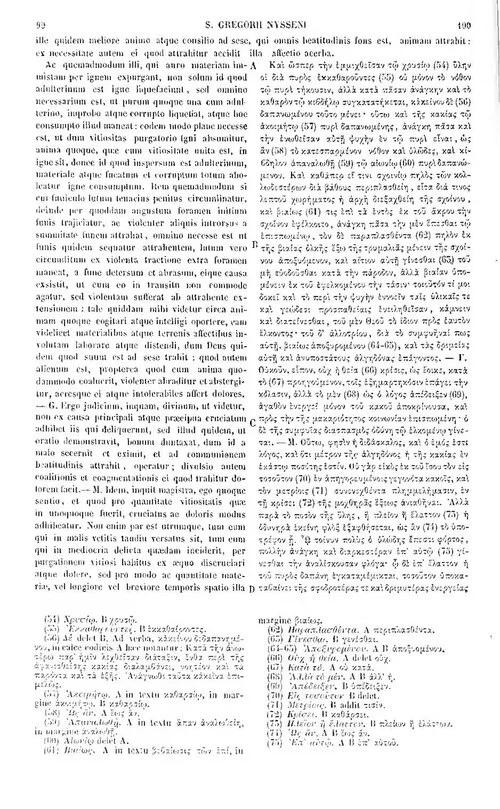
In the Migne edition, the Greek gold and rope analogies begin at column 100. The facing Latin translation on the same printed page is numbered separately.
Gregory of Nyssa, De anima et resurrectione, Patrologia Graeca 46, cols. 99–100, edited by J.-P. Migne. University of Toronto copy digitised by the Internet Archive. Public domain. · Image source ↗ · Public Domain
The purpose and duration of judgment
Gregory asks whether punishment is the primary aim of divine judgment. Macrina confirms the distinction he draws. Divine judgment separates evil from good and draws the soul toward blessedness. The distress varies with the amount of evil to which a person has become attached. The gold analogy allows the fire to be described as enduring while the material it consumes has a limit. [2][3]
The dialogue then raises a harder objection. A long period of pain can make eventual hope hard to imagine. Macrina turns to Gospel images of debt and develops her claim that evil will disappear. Later she describes resurrection as the restoration of human nature. Together these passages give a reason why readers discuss Gregory in debates over universal restoration, while the two discussions answer distinct questions within the dialogue. [5][6]
Yama’s questions and the consequences of action
Within the discourse, Yama asks the person whether they noticed five messengers among human beings. These include an infant, old age, sickness, punishment and a corpse. The scenes lead back to the same question about conduct. What did this person do in body, speech and mind when such reminders were available? [7][11]
Yama repeatedly traces responsibility to the person’s own actions. In the next part of the story, the wardens carry out the punishments. The narration gives a repeated condition. The sufferer does not die before the relevant harmful kamma is exhausted. The condition is essential to understanding the passage alongside its dramatic descriptions of heat and duration. [7][8]
The Great Hell and what lies past the gate
The gates of the Great Hell open and shut in the narrative. The person eventually gets through the eastern gate and falls into further places of suffering. The wardens later return the person to the Great Hell. The open gate is a change of place within the episode. The recurring statement about harmful action gives the condition for the experience to end. [9][8][11]
The Met scroll can help a reader see how the figure of a judge developed in another Buddhist context. It belongs to a Chinese Ten Kings series, with separate judges and its own schedule of hearings. The Pali discourse has a single Yama asking questions and tells the gate episode in a different order. Keep the painting’s date and regional setting alongside it when comparing the two accounts. [12][7][9]
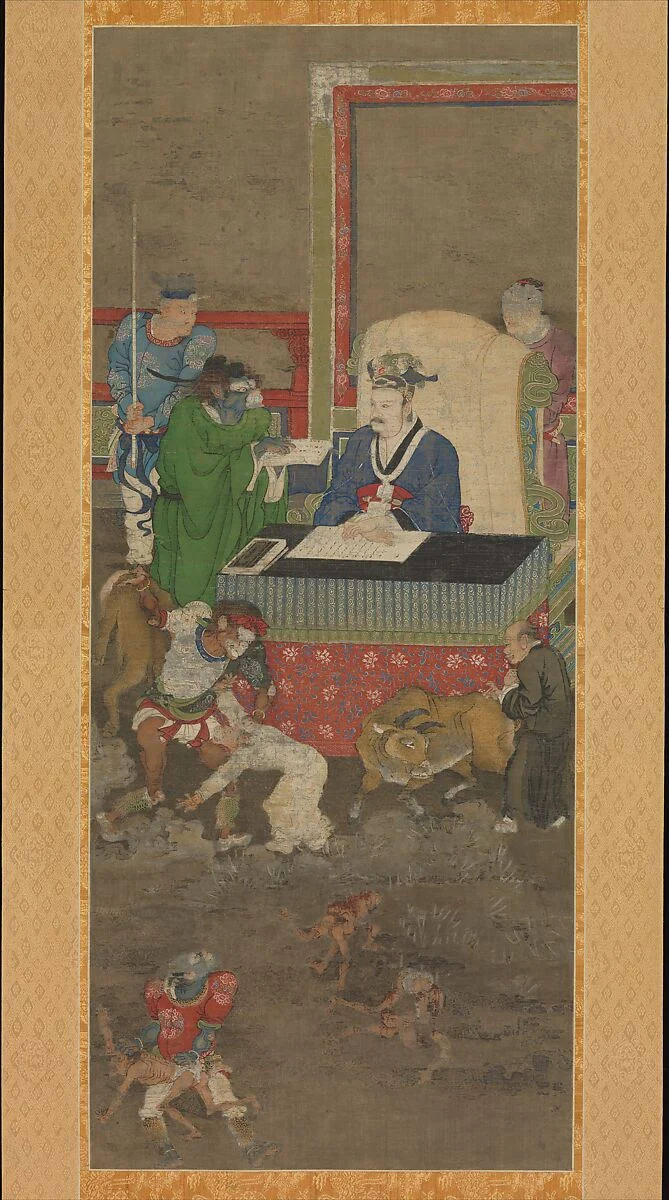
Jin Chushi’s scroll locates judgment in a court of officials. It represents the later Chinese Ten Kings tradition, with its own account of the afterlife.
Jin Chushi, Ten Kings of Hell, China, before 1195. The Metropolitan Museum of Art, Rogers Fund, 1930, 30.76.290. Public domain. · Image source ↗ · Public Domain
What release means in each account
The Buddhist discourse closes with Yama’s wish to be born human and hear a Buddha teach. The final verses turn to the hearers and link release from birth and death to seeing the danger of grasping. That release has a wider scope than the exhaustion of the result of a particular deed. The translation note about rebirth after such exhaustion draws on commentary. The final verses belong to the discourse itself. [10][11]
For Macrina the final horizon involves the soul’s relationship to God and the restoration of human nature in resurrection. For the Pali discourse the closing horizon is the end of grasping and of birth and death. Neither change can be reduced to moving through a doorway. Reading the two conclusions side by side brings the differences in agency, continuity and purpose into view. [6][5][10]
Read another account of resurrection
Cary’s Reader edition of Dante’s Paradise XIV offers a separate Christian literary comparison. The voices there speak about what changes when the glorified body is restored. Read that page after Macrina’s later definition and compare the two authors’ attention to bodily restoration. [13][6]
Read further in the library
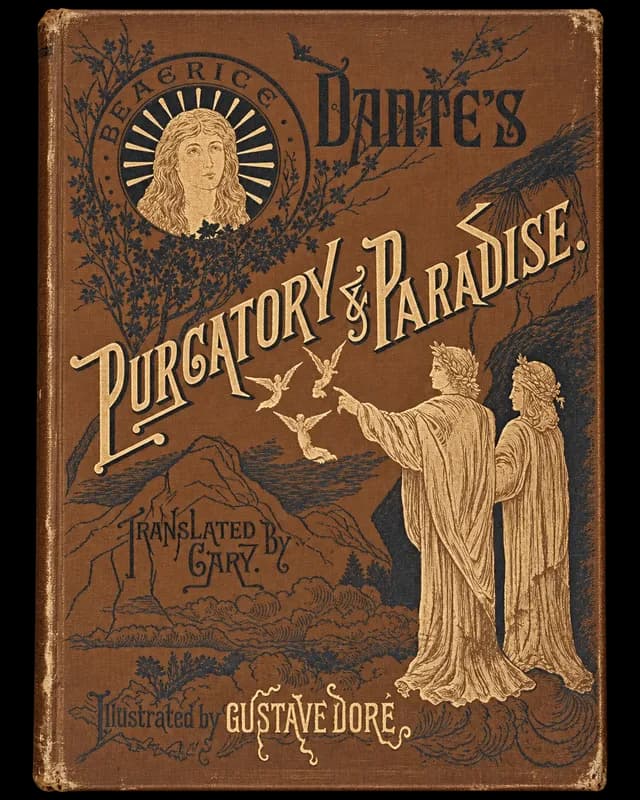
Purgatory and Paradise: The Vision of Dante
Reading note
Read a different Christian literary treatment of resurrection in Cary’s Dante, Paradise XIV.
Sources
See references (13)
- Macrina on attachment after death ↗Gregory of Nyssa, On the Soul and the Resurrection, translated by William Moore and Henry Austin Wilson. Nicene and Post-Nicene Fathers, second series, vol. 5.Return to text ↑
- Macrina’s gold and rope analogies ↗Gregory of Nyssa, On the Soul and the Resurrection, translated by William Moore and Henry Austin Wilson. Nicene and Post-Nicene Fathers, second series, vol. 5.Return to text ↑
- Greek text and column numbers for the analogies ↗Patrologia Graeca 46, col. 100. Migne Reading Room transcription and original column locator.Return to text ↑
- Public-domain Greek and Latin facsimile ↗Gregory of Nyssa, De anima et resurrectione, Patrologia Graeca 46, cols. 99–100, edited by J.-P. Migne. University of Toronto copy digitised by the Internet Archive. Public domain.
- Macrina on the disappearance of evil ↗Patrologia Graeca 46, cols. 101 and 104. Migne Reading Room.Return to text ↑
- Macrina’s definition of resurrection ↗Gregory of Nyssa, On the Soul and the Resurrection, translated by William Moore and Henry Austin Wilson. Nicene and Post-Nicene Fathers, second series, vol. 5.Return to text ↑
- Five messengers and the responsibility for action ↗Devadūta Sutta (Majjhima Nikāya 130), translated by Ṭhānissaro Bhikkhu. Compare MN 130.4–9 in Sujato’s numbering.Return to text ↑
- Kamma and the repeated condition on the suffering ↗Devadūta Sutta (Majjhima Nikāya 130), translated by Ṭhānissaro Bhikkhu. Compare MN 130.10.3 and 17.2.Return to text ↑
- The gates of the Great Hell and the return ↗Devadūta Sutta (Majjhima Nikāya 130), translated by Ṭhānissaro Bhikkhu. Compare MN 130.18–27.Return to text ↑
- Yama’s wish and the closing verses ↗Devadūta Sutta (Majjhima Nikāya 130), translated by Ṭhānissaro Bhikkhu. Compare MN 130.28–30.Return to text ↑
- Numbered English translation segments for MN 130 ↗Bhikkhu Sujato, SuttaCentral translation, Bilara published data.Return to text ↑
- Ten Kings of Hell · Song dynasty hanging scroll ↗Jin Chushi, Ten Kings of Hell, China, before 1195. The Metropolitan Museum of Art, Rogers Fund, 1930, 30.76.290. Public domain.Return to text ↑
- Purgatory and Paradise, Paradise XIV, Reader page 268Dante Alighieri, The Divine Comedy, translated by Henry Francis Cary. Inferno: undated New Edition, Thompson & Thomas, Chicago. Purgatory and Paradise: New Edition, Thompson & Thomas, Chicago, 1901. Designs by Gustave Doré.Read this page in Purgatory and Paradise: The Vision of Dante ↗Return to text ↑