Naraka
Explore Naraka and Niraya through Hindu, Buddhist and Jain sources, with distinct accounts of karma, suffering, judgment and rebirth.
In this article
What is Naraka?
Naraka names suffering realms in several Indian religious traditions. In Buddhist sources, the related Pali term niraya is also common. English translations often use Hell, but the framework differs from a final, everlasting separation from God. In the Himalayan Buddhist account summarized by the Rubin Museum, beings enter these realms through harmful karma and eventually leave through death and rebirth. Hindu and Jain sources supply their own accounts, which need to be read separately. [1]
Buddhist narrative and cosmology
Yama and the reminders of mortality
The Devaduta Sutta presents a different narrative setting. In this Pali Buddhist discourse, Yama asks a person whether the visible reminders of vulnerability prompted reflection. Birth, aging, sickness, punishment and death appear as messages that should have interrupted heedlessness. The person admits having failed to respond, and the narrative locates responsibility in that person’s own conduct. [3]
Severe punishments follow, repeatedly described as continuing while the relevant harmful karma remains unexhausted. That repeated condition is crucial to the account. The suffering is presented within a chain of action and result, rather than a sentence pronounced by an eternal creator. The discourse also gives Yama his own wish for human birth and access to the Buddha’s teaching. Within the story, even the figure associated with judgment looks towards the possibility of release. [3]
Many Buddhist hells within samsara
The Theravada overview on Access to Insight places niraya among adverse destinations within a thirty-one-plane cosmology. Hungry ghosts, animals and suffering realms are distinct kinds of existence. Pleasant celestial worlds also remain within the same continuing cycle. The question is therefore larger than whether the next life is comfortable or painful. [4]
A favourable destination can provide an advantage without completing the path to liberation. Conversely, an adverse rebirth does not establish an everlasting essence of evil in the being who suffers it. The overview links destinations with karma and describes existence in every realm as temporary. Nirvana belongs to the discussion of ending the cycle, rather than becoming the permanent resident of its most agreeable level. This is a Theravada presentation; its chart should not be silently substituted for every Buddhist cosmology. [4]
Hot and cold realms
Himalayan Buddhist descriptions commonly distinguish eight hot and eight cold hells, alongside further classifications in particular texts. The Rubin Museum’s glossary explicitly notes that the accounts vary. Their immense durations remain within samsara: beings eventually die there and are reborn elsewhere. The combination of heat and extreme cold also shows why a single image of an underground furnace does not capture the full range of Buddhist descriptions. [1]
Judgment in a Chinese Buddhist scroll
A scroll attributed to Jin Chushi, made before 1195, presents judgment through a Chinese court: a king sits at a desk with a scribe nearby, while demons and suffering figures occupy the lower register. The Met explains the Ten Kings theme as a transformation of Indian Buddhist judgment into a Chinese bureaucratic process. The image belongs to that regional development, alongside the distinct Hindu, Pali and Jain accounts discussed here. [7]
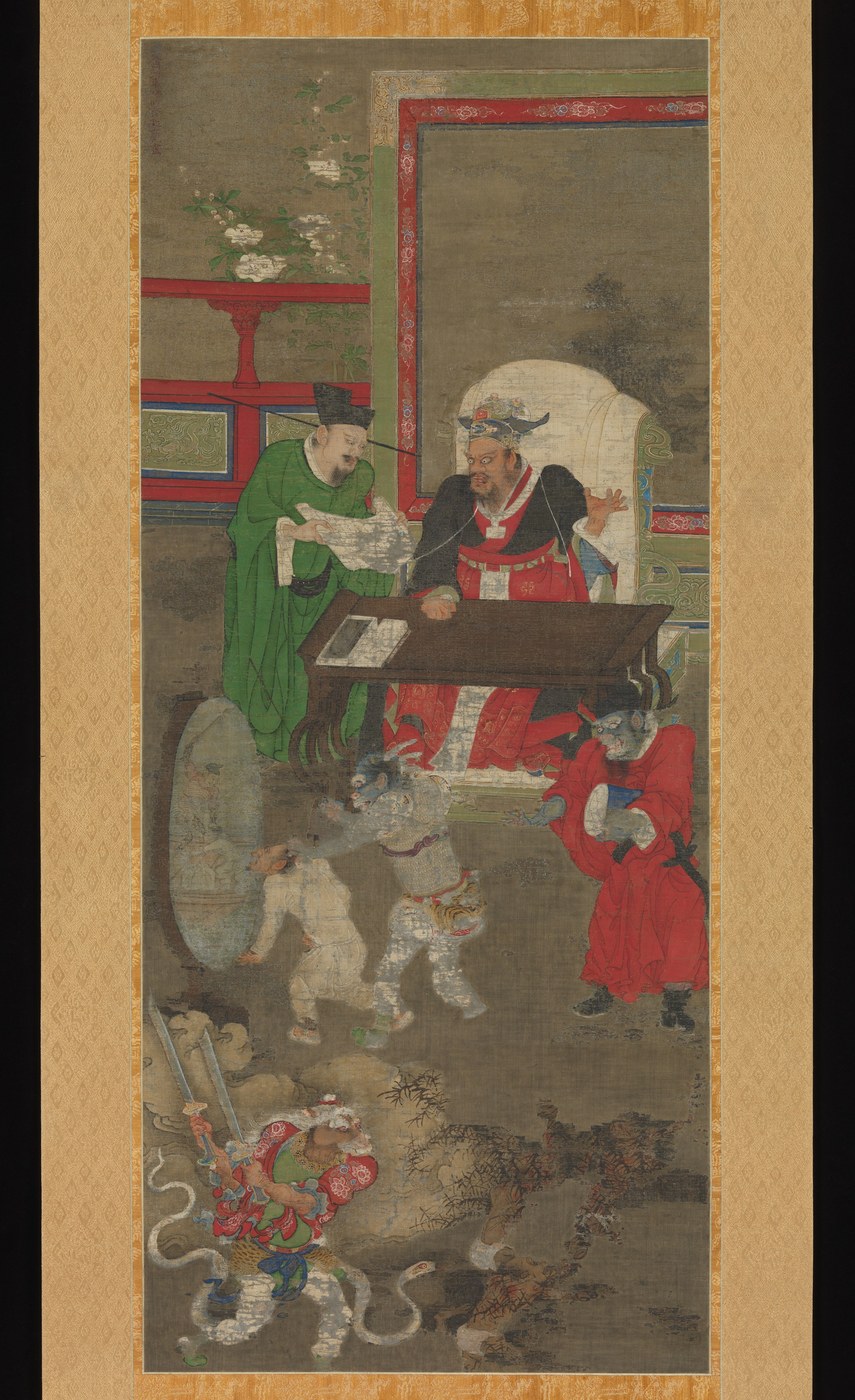
Jin Chushi, Ten Kings of Hell, before 1195. China, Song dynasty. Ink and colour on silk.
The Metropolitan Museum of Art. Rogers Fund, 1930. Accession 30.76.293. Public Domain (CC0). · Museum record ↗ · CC0
Jain cosmology and Nichiren interpretation
The seven hells in Jain cosmology
Jain cosmology places seven hells in the lower world. Nalini Balbir’s account distinguishes this region from the middle and upper worlds, with the liberated souls’ realm above them. Souls move through the worlds according to karma, while the universe itself is understood as everlasting and without a creator. [5]
This setting gives Naraka a specifically Jain meaning. The lower world is part of an ordered cosmos through which the soul journeys; liberation concerns the soul’s release from bondage. Jain cosmological pictures often represent the whole structure through a human-shaped figure, the cosmic man. Such an image teaches relationships between regions. It should be identified as a representation of Jain doctrine, rather than read as evidence that a human-shaped structure has been physically observed in space. The lasting existence of the universe and the changing destination of a soul are different claims. [5]
A condition within life in Nichiren teaching
The Soka Gakkai Dictionary of Buddhism preserves both cosmological descriptions and an interpretation associated with Tiantai and Nichiren. In the latter, Hell is one of the Ten Worlds understood as conditions inherent within life and capable of appearing at any moment. Its character is overwhelming suffering and despair. [6]
This approach changes how the subject is encountered. The reader may consider a condition arising within present experience, as well as accounts of rebirth after death. It remains an interpretation within a particular Buddhist lineage. Recognizing it should expand the account of Buddhist thought without erasing traditions that treat postmortem realms as real destinations. Across these examples, the shared term opens several different religious arguments about action, suffering and the possibility of freedom. [6]
Sources
- Hell realms ↗Rubin Museum, Project Himalayan Art; Buddhist cosmological contextReturn to text ↑
- Srimad-Bhagavatam 5.26 ↗Bhagavata Purana in A. C. Bhaktivedanta Swami Prabhupada’s Vaishnava translation and expositionReturn to text ↑
- MN 130: Devaduta Sutta ↗Pali Buddhist discourse translated by Thanissaro BhikkhuReturn to text ↑
- The Thirty-one Planes of Existence ↗Access to Insight’s Theravada cosmological overviewReturn to text ↑
- Jain universe ↗Nalini Balbir, Jainpedia; Jain cosmology and its visual teachingReturn to text ↑
- Hell: Dictionary of Buddhism ↗Soka Gakkai Dictionary of Buddhism; Nichiren interpretationReturn to text ↑
- Ten Kings of Hell ↗The Metropolitan Museum of Art; object 30.76.293Return to text ↑
About this article & its sources
An orientation to a shared term across different Indian religious traditions. Selected Vaishnava, Pali Buddhist, Himalayan Buddhist, Nichiren and Jain accounts retain their own sources and meanings. Their classifications are not combined into a universal map.
Passage attributions
What is Naraka?
Passage 1: Rubin Museum, Project Himalayan Art; Buddhist cosmological context.
A Vaishnava account in the Bhagavata Purana
Passage 1: Bhagavata Purana in A. C. Bhaktivedanta Swami Prabhupada’s Vaishnava translation and exposition.
Passage 2: Bhagavata Purana in A. C. Bhaktivedanta Swami Prabhupada’s Vaishnava translation and exposition.
Yama and the reminders of mortality
Passage 1: Pali Buddhist discourse translated by Thanissaro Bhikkhu.
Passage 2: Pali Buddhist discourse translated by Thanissaro Bhikkhu.
Many Buddhist hells within samsara
Passage 1: Access to Insight’s Theravada cosmological overview.
Passage 2: Access to Insight’s Theravada cosmological overview.
Hot and cold realms
Passage 1: Rubin Museum, Project Himalayan Art; Buddhist cosmological context.
Judgment in a Chinese Buddhist scroll
Passage 1: The Metropolitan Museum of Art; curatorial interpretation and inspected historical image.