Buddhism
Explore Buddhism’s teachings, history, traditions and practices, with sacred art, Buddhist scriptures and original passages from the Lumitheca Library.
In this article
What is Buddhism?
Buddhism is a family of religious traditions that grew from the Buddha’s teachings in ancient India. Buddha means awakened one. His teaching asks why we suffer and explores the possibility of awakening from the ignorance and craving that sustain suffering. Ethical conduct, meditation and insight belong to that undertaking. [1]
From its beginnings, Buddhism has included monks, nuns and householders. As it spread, communities developed different scriptures, rituals and philosophies. Theravāda, Mahāyāna and Vajrayāna are useful names for navigating this diversity, with Vajrayāna developing within Mahāyāna. [1]
A recurring point of orientation is taking refuge in the Three Jewels: Buddha, Dharma and Sangha. These are the awakened teacher, the teaching and the community. Refuge expresses where a person turns for guidance and what they trust as a way towards awakening. These three words connect a vast range of Buddhist lives, even where their meanings and devotional expressions differ. [2]
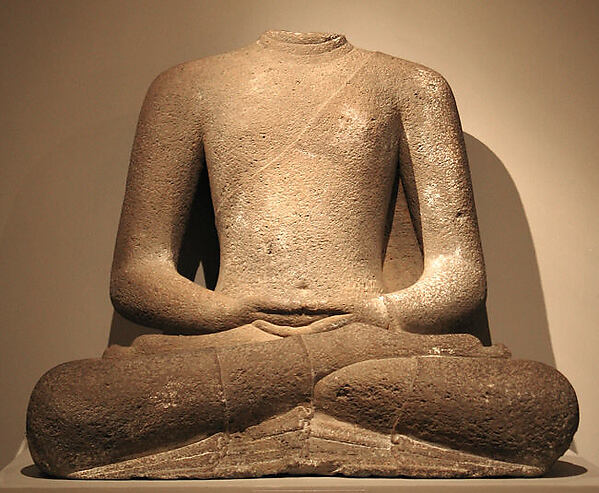
Seated Buddha Amitabha. Indonesia (Java), ca. first half of the 9th century.
The Metropolitan Museum of Art, Gift of Alexander Götz, 1995 · Museum record ↗ · CC0
The Buddha and Buddhist history
The Buddha and his teaching
Siddhārtha Gautama, the historical Buddha, taught in ancient India around the fifth century BCE. Traditional accounts describe encounters with ageing, illness and death that prompt him to leave home and seek liberation. His eventual awakening becomes the starting point of a teaching that others can follow. [4][1]
The traditional life story gives this search a memorable shape. The Four Sights include an old person, a sick person, a corpse and a wandering ascetic. The last encounter suggests a response to the suffering revealed by the first three. Siddhārtha leaves the protected life of the palace, studies with teachers and undertakes severe austerities. When self-denial fails to bring the understanding he seeks, he accepts food and regains his strength. The narrative makes the middle way a discovery reached through lived extremes. [5]
His awakening is traditionally placed beneath the Bodhi Tree. Māra’s assault gives desire and fear a dramatic form, while the Buddha’s gesture of touching the earth affirms his resolve. At dawn he becomes the awakened one. The account connects liberation with insight into the conditions of suffering; it also supplies images that recur in painting and sculpture. Its power as a religious narrative can be appreciated while keeping it distinct from a historically recoverable sequence of events. [6]
Our access to his words comes through communities that preserved and transmitted them. Discourses circulated orally before being written down; surviving collections include Pāli texts and parallel material in Chinese translation. Scholars compare these witnesses, but reconstructing early teaching remains difficult. The discourses are religious texts shaped by transmission, rather than transcripts of the Buddha’s conversations. [4]
Buddhist scripture presents Gautama as an awakened teacher; historical scholarship asks what can be established about his life and teaching. Keeping these approaches in view helps when reading accounts of his extraordinary knowledge, previous lives and final liberation. [4]
How Buddhism spread
Buddhism travelled through people and institutions: monks, translators, patrons and communities along routes linking South, Central and East Asia. The Pluralism Project traces an early movement into Sri Lanka, associated in traditional accounts with the third-century BCE ruler Aśoka. It also describes monks carrying Buddhism along the Silk Road to China from around the first century CE. These movements created new centres of Buddhist life rather than a single uniform religious culture. [7]
Translation mattered as much as travel. In China, Buddhist teaching encountered established Confucian and Daoist traditions. From China, Buddhism reached Korea and Japan; its introduction to Japan is conventionally placed in the sixth century. Reading this history as a succession of exchanges helps explain why a Chinese monastery, a Sri Lankan temple and a Japanese household shrine can belong to the same broad religious inheritance while looking and sounding different. [7]
Tibet’s history followed another course. Buddhism was present there by the seventh century and received state support by the end of the eighth. A renewed period of transmission began in the late tenth century, with Tibetan monks studying in India and Indian scholars teaching in Tibet. This later diffusion helped shape the textual and artistic worlds of Tibetan Buddhism. It also reminds us that transmission can involve revival and reconstruction, rather than uninterrupted expansion. [8]
- 3rd century BCE
Sri Lanka and the Aśokan tradition
Traditional accounts connect the establishment of Buddhism in Sri Lanka with Aśoka’s period. [7]
- 1st century CE
Routes into China
Monks carry Buddhist teaching along the Silk Road into China. [7]
- 6th century
Buddhism reaches Japan
Transmission through East Asia brings Buddhism to Japan. [7]
- 7th–8th centuries
Buddhism in Tibet
Early transmission is followed by royal sponsorship. [8]
- Late 10th century onward
Tibet’s later diffusion
Renewed exchanges with Indian teachers support a major revival. [8]
The core teachings
The Four Noble Truths
The Four Noble Truths begin with dukkha, often translated as suffering or unsatisfactoriness. It includes pain and grief, but also the insecurity of relying on things that change. A happy experience can be real and precious while still being unable to guarantee lasting satisfaction. The teaching asks us to understand this vulnerability and the habits that deepen it. [9]
- Suffering. Life involves ageing, loss, separation and frustrated wishes. The first task is to understand suffering clearly. [10]
- Its arising. Craving sustains suffering: grasping at pleasure, insisting on continued existence, or longing for annihilation. This craving is to be relinquished. [10]
- Its cessation. Freedom becomes possible through the ending of that craving. Cessation is something to realize, rather than simply an idea to accept. [10]
- The path. The Noble Eightfold Path develops the understanding, conduct and mental discipline directed towards that freedom. [10]
Each truth carries a task: understand, relinquish, realize and develop. Together they turn an account of suffering into a path of transformation. The discourse presenting them also describes a middle way between indulgence in sensual pleasure and self-torment; awakening is pursued through the Eightfold Path. [10]
The Noble Eightfold Path
The path links how a person understands the world with how they speak, act and train attention. Meditation sits within a way of life. An early discourse, SN 45:8, explains its eight factors as follows: [9]
- Right view. Understanding suffering, its causes, its ending and the path to its ending. [11]
- Right intention. Cultivating intentions of renunciation, goodwill and harmlessness. [11]
- Right speech. Refraining from lies, divisive words, abusive language and idle chatter. [11]
- Right action. Refraining from killing, stealing and sexual misconduct. [9]
- Right livelihood. Earning a living honestly, in keeping with the path’s ethical commitments. [11]
- Right effort. Preventing and abandoning unwholesome qualities, while developing and sustaining wholesome ones. [11]
- Right mindfulness. Attending carefully to body, feelings, mind and mental qualities, with awareness and diligence. [11]
- Right concentration. Developing collectedness through meditative absorption; the discourse describes four absorptions, called jhānas. [11]
Mindfulness and concentration have related but distinct roles in this account. Mindfulness attends to the body, feelings and mind; concentration develops meditative collectedness. The description of the jhānas traces changes in pleasure, equanimity and awareness, giving concentration a more specific meaning than simply focusing hard on a task. [11]
The connection between these factors matters. A person’s speech can ease a conflict or inflame it; their livelihood can support or undermine their ethical commitments. Training attention belongs alongside these choices. Mindfulness, in this setting, serves a larger purpose of understanding and liberation. [9]
In MN 44, the nun Dhammadinnā groups the path into three kinds of training. Ethical life, collected attention and understanding support one another. This makes the eight factors easier to follow as a connected undertaking. [12]
- Ethical conduct
- Right speech · Right action · Right livelihood
- Concentration
- Right effort · Right mindfulness · Right concentration
- Wisdom
- Right view · Right intention
Impermanence and not-self
Impermanence means that conditioned things change. Buddhist reflection brings that fact close to home: the body ages, feelings arise and pass, perceptions shift, and states of mind cannot simply be commanded to remain as we wish. What seems most intimately ours is also unstable. [13]
In SN 22:59, the Buddha examines five aggregates, or groupings of experience: bodily form, feeling, perception, mental formations and consciousness. He asks whether each is constant, whether it is satisfactory, and whether it can rightly be regarded as self. The argument is experiential as well as philosophical: if the body were wholly under one’s control, why could one not prevent it from becoming afflicted? [13]
Not-self, or anattā, directs attention away from identifying these changing processes as a permanent possession or identity. The discourse moves from that investigation towards disenchantment, dispassion and release. Its question is practical and searching: what happens to attachment when we stop asking a changing body or state of mind to provide an unchanging foundation? [13]
Dependent origination
Dependent origination explains experience through conditions: when supporting conditions arise, particular experiences arise; when those conditions cease, the process can cease. In SN 12:2, this teaching takes the form of twelve links, from ignorance through mental formations and consciousness to birth, ageing, death and suffering. [14]
One part of the sequence is especially helpful for a first reading: contact conditions feeling; feeling conditions craving; craving conditions clinging. Imagine hearing a compliment, enjoying the feeling it brings, and then becoming preoccupied with receiving the same approval again. This everyday illustration shows how a pleasant feeling can become something grasped at. It illustrates only part of a teaching whose full sequence also addresses becoming, birth and death. [14]
The discourse also traces cessation. Understanding the conditions of suffering opens the possibility of bringing it to an end. Dependent origination therefore joins explanation with liberation: it asks how suffering is sustained and where its conditions can cease. [14]
Karma, rebirth and sacred worlds
Karma, rebirth and liberation
Karma, or Pāli kamma, concerns intentional action. In AN 6:63, intention is expressed through body, speech and mind, and actions have consequences. The emphasis on intention makes motivation central to ethical life: what someone deliberately does matters, as does the purpose from which the action proceeds. [15]
The discourse places these consequences within a religious horizon that includes future lives and different realms of existence. Rebirth belongs to the teaching described here, alongside consequences experienced in the present. These are Buddhist accounts of action and its results; citing the discourse establishes what it teaches, rather than demonstrating rebirth as an independently verified fact. [15]
How can rebirth fit with not-self? In the interpretation examined by philosopher Mark Siderits, continuity does not require a permanent soul travelling between bodies. A sequence of conditioned events connects actions with later consequences. This is one reason Buddhist discussions distinguish causal continuity from an unchanging identity: what continues need not be a thing that remains exactly the same. [4]
Nirvāṇa, or Pāli nibbāna, names the liberative goal. Ṭhānissaro Bhikkhu renders it as unbinding in his translation of Ud 8:3. That short discourse describes an escape from what is born, made and conditioned through an unconditioned possibility of release. The claim reaches beyond temporary relief or a pleasant meditative state. [16]
Seen together, these teachings connect conduct, the continuity of suffering and the possibility of freedom. The path matters because the predicament it addresses is far larger than a passing bad mood: its horizon includes repeated birth and the ending of the conditions that sustain it. [15][16]
Realms, rebirth and sacred worlds
The world imagined in Buddhist accounts extends beyond human life. A common Tibetan classification names six types of rebirth: gods, demigods or asuras, humans, animals, hungry ghosts and hell-beings. These are forms of existence within saṃsāra, the wandering of repeated birth. The classification gives a religious setting to teachings about conduct and its consequences. It should be read as an account of Buddhist cosmology, with terminology and arrangements that require attention to their particular sources. [17]
Longchenpa’s Precious Garland gives these realms a more vivid texture. Hell-beings suffer extremes of heat and cold; hungry ghosts endure hunger and thirst; animals face predation. Asuras struggle in conflict, while even the pleasures of gods end in death and another birth. The contrast is deliberate: comfort within saṃsāra still leaves a being vulnerable to change. In this Tibetan teaching, no worldly height provides the security of liberation. The cosmos becomes a way of reflecting on how suffering persists across radically different conditions. [18]
The Tibetan Wheel of Life brings this cosmology into a single picture. In the example described by the Library of Congress, the Lord of Death holds the wheel; a cock, snake and pig represent desire, hatred and ignorance at its centre. The outer rim depicts the twelve links of dependent origination. The image joins different scales of the teaching: the forces that sustain suffering, the kinds of life bound within it and the possibility of a path beyond the cycle. [19]
A Pure Land image offers a different sacred landscape. The Tibetan painting reproduced here presents Amitābha at the centre of Sukhāvatī, the Western Pure Land. Its many surrounding figures and carefully ordered spaces place the Buddha within an extensive religious world. The work is dated to around 1700. It is a Tibetan representation of Amitābha, rather than a portrait of the historical Gautama or an illustration made in ancient India. [20]
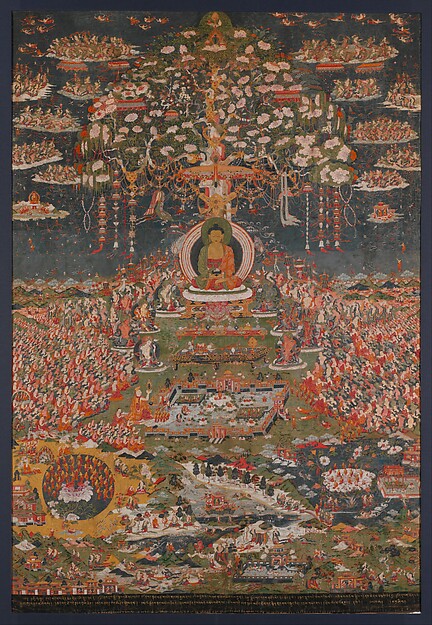
Amitabha, the Buddha of the Western Pure Land (Sukhavati). Central Tibet, ca. 1700.
The Metropolitan Museum of Art, Purchase, Barbara and William Karatz Gift and funds from various donors, 2004 · Museum record ↗ · CC0
Traditions and philosophy
The main Buddhist traditions
Buddhist traditions share important teachings, but differ in their scriptures, ideals and methods. Three broad headings provide a starting map: [1]
Theravāda is especially associated with Sri Lanka and Southeast Asia. Its textual inheritance centres on the Pāli canon and its commentaries. The historical Buddha provides the central example of awakening, and the arahant (a practitioner who has attained liberation) is an important ideal. Monastic discipline, generosity, devotion and meditation all belong to this religious world. Contemporary Theravāda also includes immigrant temple communities and insight-meditation communities whose ways of participating can differ considerably. Its communities carry teachings through languages, teachers and institutions, as well as through books. Reading a meditation manual alone reveals only one part of this wider religious life. [21]
Mahāyāna developed in India during the early centuries of the Common Era and became influential across East Asia. The bodhisattva ideal gives special prominence to awakening for the benefit of living beings. Wisdom and compassion belong together in this undertaking. Mahāyāna scriptures include the Lotus and Pure Land sūtras, alongside a wide range of other texts. Zen and Pure Land show how different forms of contemplation and devotion can flourish within the same broad family. [22]
Buddhists also encounter different accounts of buddhahood. A historical teacher can serve as an exemplar; Amitābha, the Buddha of Infinite Light, becomes the focus of Pure Land devotion. These understandings help explain why Buddhist practice includes both contemplative inquiry and religious trust. [2]
Vajrayāna developed within Mahāyāna and is especially associated with Tibetan and Himalayan Buddhism, with related esoteric forms in East Asia. It brings mantra, maṇḍala and mudrā into ritual and contemplative practice: recited formulas, sacred configurations and meaningful gestures. These forms carry teachings about awakening through their particular ritual settings. Vajrayāna traditions present them as powerful methods of the path; their significance depends on the teaching and transmission in which they are used. A maṇḍala, for example, represents a sacred world of buddhas and bodhisattvas. Its role is both symbolic and practical, placing a visual form within a particular religious understanding of awakening. [23]
Zen and Pure Land in practice
A closer look at Zen makes one part of this broad map tangible. The Association Zen Internationale describes sesshin retreats in its Sōtō tradition as days structured around zazen, seated meditation. Ceremonies, shared meals and samu (work for the community) belong to the same schedule. Questions can be brought to teachers. This is a particular community’s account, but it shows why Zen practice cannot be understood through a meditation posture alone: a whole pattern of communal life supports it. [24]
Pure Land shifts attention towards Amitābha and the aspiration for rebirth in his Pure Land. Shin Buddhism, as described by the Buddhist Churches of America, places particular emphasis on entrusting and gratitude. The contrast with a Zen retreat makes the range within Mahāyāna easier to grasp. Listening, recitation, trust and disciplined contemplation can receive different weight without ceasing to belong to Buddhist religious life. [25]
Emptiness and compassion
Emptiness, or śūnyatā, is a central concern in Mahāyāna philosophy. In a 2021 teaching on the Heart Sūtra, the Fourteenth Dalai Lama explained the Middle Way through dependence: things exist and affect us, but they lack an independent, intrinsic nature. Emptiness, in this account, means the absence of that self-sufficient existence. It does not mean that nothing happens or that our actions have no effects. [26]
He paired this understanding with bodhicitta, the aspiration to attain awakening for the sake of living beings. Wisdom and compassion work together: insight into reality is developed alongside concern for others. His example of generosity makes the relationship concrete. Giving becomes part of the path, and the motivation to benefit beings gives that act a wider purpose. [26]
This gives philosophical inquiry a humane direction. The question of how things exist is pursued within a path concerned with suffering, care and liberation. A reader following emptiness into its philosophical arguments should keep that relationship in view. [26]
Questions of self and reality
Nāgārjuna’s Middle Way philosophy asks what would follow if things possessed svabhāva, an intrinsic nature independent of conditions. His arguments examine causation, change and personal identity. Jan Westerhoff’s account places Nāgārjuna around 150–250 CE, while emphasizing how little can securely be said about his life. The philosophical legacy is clearer than the biography: his work became central to Madhyamaka, a major current within Mahāyāna thought. [27]
This inquiry presses a question raised earlier by dependent origination. If something changes through causes, relationships and circumstances, in what sense can it exist entirely from its own side? Madhyamaka investigates the assumptions behind such independence. Its arguments require care because ordinary functioning and ultimate analysis are not interchangeable questions. Reading a philosophical passage slowly can reveal why a familiar word such as existence becomes difficult: the issue is what kind of existence is being asserted. [27]
Buddhist life and practice
Buddhism in everyday life
Sangha can mean the ordained community of monks and nuns, and it is also used more broadly for Buddhist communities. Religious life is sustained through relationships: monastics offer teaching and guidance, while householders help provide food, clothing and shelter. Giving can be understood as merit-making. Supporting a temple or bringing food to a community is therefore part of Buddhist practice, alongside time spent in formal meditation. [28]
The five precepts give ethical life a concrete shape: abstaining from taking life, stealing, sexual misconduct, lying and intoxicants. AN 8:39 presents these commitments as gifts of safety to other beings. That framing turns restraint into a form of care. Choosing not to harm someone, deceive them or take what belongs to them changes what they can expect from one’s presence. These commitments also give practical substance to the path’s concern with speech, action and livelihood. [29]
Devotion also takes different forms. For a Pure Land Buddhist, reciting the name of Amitābha, the Buddha of Infinite Light, can express the hope of rebirth in the Pure Land. This widens the picture beyond a single historical teacher: the Three Jewels can be encountered through different accounts of buddhahood, scripture and religious trust. [2]
Plum Village’s Five Mindfulness Trainings bring ethical reflection into relationships, speech, consumption and responsibility for other lives. Its account of careful speech, for example, connects truthfulness with listening, reconciliation and awareness of anger. The training concerns what words do between people, including whether they deepen division or make understanding possible. Here mindfulness is woven into shared life. [30]
The Buddhist Churches of America offers a different emphasis through Shin Buddhism. It describes a non-monastic path in which work, raising children and caring for relatives become the setting of practice. Listening to the Dharma and reciting Namu Amida Butsu are associated with gratitude, wisdom and compassion. Its account of Shinran stresses receiving awakening rather than achieving it through personal striving. These examples bring Buddhism back to lived questions: how to act, what to trust, and how understanding changes a life. [25]
Meditation, attention and goodwill
Meditation encompasses different kinds of cultivation. In the Theravāda setting described by the Pluralism Project, samatha develops tranquillity by steadying attention on a focus such as the breath. Vipassanā, or insight, attends to the changing activity of body and mind. Sitting and walking can both become settings for such practice. These terms help distinguish calming attention from investigating experience, while leaving room for the ways teachers bring them together. [31]
Mindfulness also concerns ordinary movement and perception. Walking, for example, can become an occasion to notice what is usually done automatically. In this account, the purpose is a more attentive relationship with experience. A description of a method cannot convey the whole of its teaching context: a retreat, a monastic setting and a household practice each give attention a different place in daily life. [31]
The cultivation of goodwill, mettā, makes another dimension of practice explicit. In Sn 1:8, goodwill extends to living beings without excluding the weak, the strong, the near or the distant. The discourse places this expansive concern alongside upright conduct, gentleness and freedom from hostility. Meditation here includes deliberately developing a way of relating to others. Its ethical character matters as much as the stillness with which it might be practised. [32]
Chanting and devotion
Buddhist texts are heard and recited as well as studied. Chanting can focus attention, preserve a teaching and give a community a shared religious activity. The Pluralism Project describes examples ranging from Pāli recitation in Theravāda communities to Tibetan chanting and the Heart Sūtra in Korean Sŏn. The language, sound and setting change, while repetition allows a text to inhabit the rhythm of practice. [33]
The words chanted also carry different religious meanings. Recitation of Amitābha’s name belongs to Pure Land practice; in Shin Buddhism, Namu Amida Butsu can express gratitude. Nichiren traditions give a central place to reciting the title of the Lotus Sūtra. These examples should not be folded into a single claim that all Buddhists use chants in the same way. Listening to the words, and asking what the community understands them to do, opens a more precise view of devotion. [33]
Buddhist communities beyond Asia
Modern transmission also depends on migration and the rebuilding of community. In the United States, immigration after the 1965 Immigration Act and refugee movements from Southeast Asia contributed to a growth of Buddhist temples. The Pluralism Project describes Vietnamese monks’ homes becoming places of worship, with living rooms serving as Buddha halls before larger temples were built. Such histories add another dimension to the spread of Buddhism: the need to make a religious home after displacement. [34]
These temples can also preserve languages, celebrate festivals and pass cultural practices to children. Their communities include people who inherit Buddhist traditions through family and people drawn to Buddhist teaching and meditation later in life. The same temple may serve both. This gives a fuller picture of Buddhism beyond Asia than a story concerned only with the popularity of meditation: religion travels through families, memory, institutions and shared care. [34]
Which scriptures do Buddhists read?
Buddhist scripture is a collection of many collections. The Pāli canon, central to Theravāda, is commonly called the Tipiṭaka, or Three Baskets. The Vinaya concerns monastic discipline; the Sutta collection preserves discourses; the Abhidhamma develops systematic analyses of the teaching. These divisions distinguish forms of religious writing that a reader might otherwise encounter simply under the heading of Buddhist scripture. A rule for communal life and a discourse on suffering ask different things of their readers. [35]
The Dhammapada offers a more compact encounter with this literature: an anthology of verses attributed to the Buddha. In his introduction, Ṭhānissaro Bhikkhu emphasizes its place in both Buddhist teaching and Indian poetry. Its contrasts between heedfulness and heedlessness invite readers to consider how their conduct shapes experience. The literary form matters. A short verse can be remembered, repeated and returned to, allowing ethical reflection to continue beyond the moment of reading. [36]
Mahāyāna communities also transmit sūtras such as the Lotus and Perfection of Wisdom texts. Chinese-language collections preserve translated Indian works alongside writings composed in East Asia. Commentaries are part of this inheritance too: Buddhist readers have continually explained, debated and reorganized the texts they received. A scripture’s title is therefore only a beginning. Its language, translator, collection and interpretation help locate the teaching being read. [35]
In the Tibetan tradition, two large collections are especially important. The Kangyur gathers works regarded as the Buddha’s words, including sūtras, discipline texts and tantras; the Tengyur contains translated treatises and commentaries. The translation project 84000 explains that the Tibetan canon preserves an especially extensive range of tantric literature. Its overlap with Chinese collections and its differences from the Pāli canon show why one book cannot stand for every Buddhist tradition. [37]
Art and sacred places
Art, symbols and sacred places
Buddhist art gives teaching a material and public form. Stupas house relics and provide a focus for veneration; paths around them allow ritual circumambulation. Reliefs can recount episodes in the Buddha’s life and Jātaka stories of previous births. Vidya Dehejia’s museum account also describes early Indian representations that evoke the Buddha through signs such as footprints or an empty seat. The image invites attention to a presence or event without always taking the form of a human figure. [38]
Later images of the Buddha developed in several artistic centres, including Gandhāra and Mathura. Their forms reflect different regional choices in the treatment of robes, bodies and faces. Such variation helps explain the range of Buddhist images that survive. A sculpture’s posture and appearance belong to a particular history of making and worship; a single supposedly universal Buddhist style would conceal that history. [38]
Images also participate in religious relationships. Kathryn Selig Brown describes Tibetan paintings and sculptures made as supports for meditation, as well as commissions marking births and deaths. Donating an image can be understood as an act that brings merit. Monks and lay artists both contributed to this visual culture. An image on a shrine can therefore be a focus of contemplation, an offering and a reminder of awakening, with meanings that exceed its appearance as an artwork. [8]
The seated Amitābha from ninth-century Java reproduced near the beginning of this article survives without its head. Its folded legs and hands remain visible, giving a concrete example of how an image can retain expressive form despite damage. The museum identifies the figure as Amitābha. Keeping that identification beside the object’s place and date allows comparison with the much later Tibetan painting without treating them as interchangeable illustrations. [3]
The wheel as a symbol
The dharma wheel represents the Buddha’s teaching. The Japanese ritual object reproduced here dates to the late thirteenth century. Its eight spokes refer to the Noble Eightfold Path; a central lotus contributes to the design. An object used within esoteric Buddhist ritual thus carries a symbol recognizable across a much wider Buddhist world. The Wheel of Law should be distinguished from the Wheel of Life described earlier: one evokes teaching, while the other depicts the cycle from which liberation is sought. [39][19]
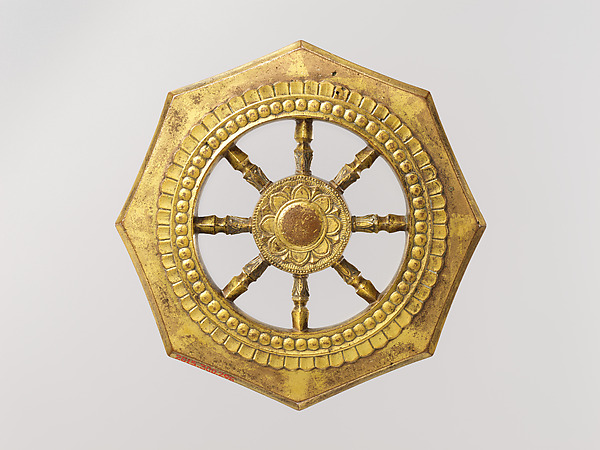
Wheel of the Buddhist Law (Rinpō). Japan, late 13th century.
The Metropolitan Museum of Art, Mary Griggs Burke Collection, Gift of the Mary and Jackson Burke Foundation, 2015 · Museum record ↗ · CC0
Reading Buddhism in the Library
Lumitheca’s historical books allow these subjects to be followed into particular passages. In Myths of the Hindus and Buddhists, the account of the Buddha’s first teaching describes his journey to the five hermits at Benares. The passage belongs to a literary retelling of the traditional narrative. Its original page is available below, so the phrasing can be checked directly and compared with the translated discourse on the Four Noble Truths. [40]
F. Hadland Davis’s Myths and Legends of Japan offers a different encounter through Jizō, associated in his account with children and bereavement. The passage makes compassion emotionally immediate, but its generalizations about Japanese women and its language of gods and souls need historical context. Such books are valuable witnesses to how Buddhism was presented to their readers. They are most useful when their voices remain identifiable and can be read beside current scholarship and Buddhist community accounts. [41]
Read further in the library
The Light of Asia: The Great Renunciation
Reading note
Edwin Arnold’s nineteenth-century poem retells the life of the Buddha for a literary audience. Its narrative can be read beside the historical and community sources cited in this introduction.
The Buddhist Catechism
Reading note
Henry Steel Olcott’s question-and-answer presentation is a historical encounter with Buddhism. Read it as an authored catechism with its own audience and period.
The Gods of Northern Buddhism
Reading note
Alice Getty’s historical account presents Buddhist deities and iconography. Its plates offer a route into visual representations and the terminology used to describe them.
Myths of the Hindus and Buddhists
Reading note
Read the original passage on the Buddha’s first teaching, then follow the wider literary retelling. The authorial narrative remains distinct from the translated discourse cited in this article.
Myths and Legends of Japan
Reading note
Explore Davis’s account of Jizō and Japanese Buddhist legends with attention to the author’s historical vocabulary and interpretation.
Sources
- The Path of Awakening ↗The Pluralism Project, Harvard UniversityReturn to text ↑
- The Three Treasures ↗The Pluralism Project, Harvard UniversityReturn to text ↑
- Seated Buddha Amitabha, ca. first half of the 9th century ↗The Metropolitan Museum of Art, accession 1995.256; CC0 imageReturn to text ↑
- Buddha ↗Mark Siderits, Stanford Encyclopedia of PhilosophyReturn to text ↑
- Prince Siddhartha: Renouncing the World ↗The Pluralism Project, Harvard UniversityReturn to text ↑
- Becoming the “Buddha”: The Way of Meditation ↗The Pluralism Project, Harvard UniversityReturn to text ↑
- The Expansion of Buddhism ↗The Pluralism Project, Harvard UniversityReturn to text ↑
- Tibetan Buddhist Art ↗Kathryn Selig Brown, The Metropolitan Museum of ArtReturn to text ↑
- The Dharma: The Teachings of the Buddha ↗The Pluralism Project, Harvard UniversityReturn to text ↑
- SN 56:11: Setting the Wheel of Dhamma in Motion ↗Pāli discourse, translated by Ṭhānissaro Bhikkhu; Access to InsightReturn to text ↑
- SN 45:8: An Analysis of the Path ↗Pāli discourse, translated by Ṭhānissaro Bhikkhu; Access to InsightReturn to text ↑
- MN 44: The Shorter Set of Questions-and-Answers ↗Pāli discourse translated by Ṭhānissaro BhikkhuReturn to text ↑
- SN 22:59, The Five (Brethren), also known as the Discourse on the Not-self Characteristic ↗Pāli discourse translated by Ṭhānissaro BhikkhuReturn to text ↑
- SN 12:2, An Analysis of Dependent Co-arising ↗Pāli discourse translated by Ṭhānissaro BhikkhuReturn to text ↑
- AN 6:63, Penetrative ↗Pāli discourse translated by Ṭhānissaro BhikkhuReturn to text ↑
- Ud 8:3, Unbinding (3) ↗Pāli discourse translated by Ṭhānissaro BhikkhuReturn to text ↑
- Six realms of existence ↗Study Buddhism, Berzin Archives; Tibetan Buddhist terminologyReturn to text ↑
- A Precious Garland for the Four Themes (of Gampopa), verses 9–16 ↗Longchenpa, translated by Alexander Berzin and Matthew Kapstein; Study BuddhismReturn to text ↑
- Wheel of Life: The Heavens and the Earth ↗Library of Congress, Tibetan CollectionReturn to text ↑
- Amitabha, the Buddha of the Western Pure Land (Sukhavati), ca. 1700 ↗The Metropolitan Museum of Art, accession 2004.139; CC0 imageReturn to text ↑
- Theravada: The Way of the Elders ↗The Pluralism Project, Harvard UniversityReturn to text ↑
- Mahayana: The Great Vehicle ↗The Pluralism Project, Harvard UniversityReturn to text ↑
- Vajrayana: The Diamond Vehicle ↗The Pluralism Project, Harvard UniversityReturn to text ↑
- Sesshin or intensive retreats ↗Association Zen Internationale; account of its Sōtō Zen retreat practiceReturn to text ↑
- Shin Buddhism: An Introduction ↗Buddhist Churches of AmericaReturn to text ↑
- The Heart Sutra: Second Day, 6 January 2021 ↗Teaching report, Office of the Fourteenth Dalai LamaReturn to text ↑
- Nāgārjuna ↗Jan Westerhoff, Stanford Encyclopedia of PhilosophyReturn to text ↑
- The Sangha: The Buddhist Community ↗The Pluralism Project, Harvard UniversityReturn to text ↑
- AN 8:39: Bonanzas ↗Pāli discourse translated by Ṭhānissaro BhikkhuReturn to text ↑
- The Five Mindfulness Trainings ↗Plum Village community; teachings of Thich Nhat HanhReturn to text ↑
- The Practice of Mindfulness ↗The Pluralism Project, Harvard UniversityReturn to text ↑
- Sn 1:8: Goodwill ↗Pāli discourse translated by Ṭhānissaro BhikkhuReturn to text ↑
- Chanting the Sutras ↗The Pluralism Project, Harvard UniversityReturn to text ↑
- New Asian Immigration and the Temple Boom ↗The Pluralism Project, Harvard UniversityReturn to text ↑
- Scriptures & Texts ↗The Buddhist Society; introductory account of Buddhist textual collectionsReturn to text ↑
- Introduction to the Dhammapada ↗Ṭhānissaro Bhikkhu, translator’s introductionReturn to text ↑
- FAQs: The Tibetan Buddhist Canon ↗84000: Translating the Words of the BuddhaReturn to text ↑
- Buddhism and Buddhist Art ↗Vidya Dehejia, The Metropolitan Museum of ArtReturn to text ↑
- Wheel of the Buddhist Law (Rinpō), late 13th century ↗The Metropolitan Museum of Art, accession 2015.300.296; CC0 imageReturn to text ↑
- Myths of the Hindus and Buddhists: The Hermits of BenaresAnanda K. Coomaraswamy and Sister Nivedita; historical literary retelling, printed page 273Return to text ↑
Examine the original Library page
This historical retelling describes the Buddha travelling to teach his former companions. The visible page confirms the cited words. Read it as a literary reception of the traditional narrative, alongside the translated discourse cited above.
intending to instruct the five hermits
Open the original page in Myths of the Hindus and Buddhists ↗Scan leaf 331 · Sister Nivedita and Ananda K. Coomaraswamy
- Myths and Legends of Japan: The Significance of JizōF. Hadland Davis; historical literary retelling, printed page 104Return to text ↑
Examine the original Library page
Davis’s page connects Jizō with children and bereavement. Its sweeping claims about Japanese women, and its language of gods and souls, belong to the author’s historical framing. They are not presented here as a contemporary scholarly definition of Jizō or of Buddhist teachings.
the divine playmate and protector of Japanese children
Open the original page in Myths and Legends of Japan ↗Scan leaf 136 · F. Hadland Davis; illustrated by Evelyn Paul
About this article & its sources
This reference article brings together historical scholarship, translated discourses, museum research and accounts from named Buddhist communities. Karma, rebirth, celestial realms and liberation are described as Buddhist religious teachings. Historical dating and textual transmission remain distinct from traditional narratives. The Middle Way discussion identifies its sources rather than treating one philosophical school as the whole of Buddhism. Historical Library retellings illustrate reception and storytelling; their period language is not adopted as a modern description of all Buddhists. Images are authentic museum objects released under CC0. This is AI-assisted editorial work; no independent specialist or practitioner peer review is claimed.
Passage attributions
What is Buddhism?
Passage 1: Historical and introductory account: Harvard Pluralism Project.
Passage 2: Historical and geographical overview: Harvard Pluralism Project.
Passage 3: Introduction to refuge and its differing interpretations: Harvard Pluralism Project.
The Buddha and his teaching
Passage 1: Historical dating: Mark Siderits; traditional life narrative: Harvard Pluralism Project.
Passage 2: Traditional narrative as presented by Harvard Pluralism Project.
Passage 3: Traditional awakening narrative: Harvard Pluralism Project.
Passage 4: Historical source criticism: Mark Siderits.
Passage 5: Editorial synthesis of the historical and philosophical scope in Mark Siderits.
How Buddhism spread
Passage 1: Historical overview: Harvard Pluralism Project.
Passage 2: Historical overview and editorial synthesis: Harvard Pluralism Project.
Passage 3: Historical account: Kathryn Selig Brown, The Metropolitan Museum of Art.
The Four Noble Truths
Passage 1: Introduction to dukkha: Harvard Pluralism Project.
Passage 2: The first truth and its task in SN 56:11.
Passage 3: The second truth and its task in SN 56:11.
Passage 4: The third truth and its task in SN 56:11.
Passage 5: The fourth truth and its task in SN 56:11.
Passage 6: Summary of the tasks and middle way in SN 56:11.
The Noble Eightfold Path
Passage 1: Editorial introduction to the path; Harvard Pluralism Project.
Passage 2: Summary of right view in SN 45:8.
Passage 3: Summary of right resolve in SN 45:8.
Passage 4: Summary of right speech in SN 45:8.
Passage 5: Introductory account of ethical conduct: Harvard Pluralism Project.
Passage 6: Summary of right livelihood in SN 45:8.
Passage 7: Summary of the four efforts in SN 45:8.
Passage 8: Summary of the four applications of mindfulness in SN 45:8.
Passage 9: Summary of right concentration in SN 45:8.
Passage 10: Editorial explanation of mindfulness and the four jhānas in SN 45:8.
Passage 11: Editorial illustration of the ethical and contemplative structure of the path.
Passage 12: Dhammadinnā’s grouping of the path in MN 44; editorial explanation.
Impermanence and not-self
Passage 1: Introductory synthesis of impermanence and control in SN 22:59.
Passage 2: Teaching and argument in SN 22:59, translated by Ṭhānissaro Bhikkhu.
Passage 3: Editorial explanation of the movement towards release in SN 22:59.
Dependent origination
Passage 1: Introductory summary of the arising and cessation sequences in SN 12:2.
Passage 2: Lumitheca example illustrating contact, feeling, craving and clinging in SN 12:2; the example is not a quotation or a complete interpretation of the twelve links.
Passage 3: Editorial explanation of the cessation sequence in SN 12:2.
Karma, rebirth and liberation
Passage 1: Teaching about intention and action in AN 6:63; final sentence is editorial explanation.
Passage 2: Religious scope and evidential distinction for AN 6:63.
Passage 3: Editorial summary of the karma, rebirth and non-self discussion in Mark Siderits’s Buddha entry.
Passage 4: Summary of Ud 8:3 and the translator’s terminology.
Passage 5: Editorial synthesis of the liberative horizon in AN 6:63 and Ud 8:3.
Realms, rebirth and sacred worlds
Passage 1: Six realms in the Tibetan Buddhist glossary of Study Buddhism.
Passage 2: Paraphrase of Longchenpa, verses 9–16, in the Berzin–Kapstein translation.
Passage 3: Explanation of a Tibetan Wheel of Life in the Library of Congress collection.
Passage 4: Object identification and visual description of the reproduced museum image.
The main Buddhist traditions
Passage 1: Introductory map of Buddhist traditions: Harvard Pluralism Project.
Passage 2: Tradition and community overview: Harvard Pluralism Project.
Passage 3: Historical and doctrinal overview: Harvard Pluralism Project.
Passage 4: Examples of differing understandings of the Buddha: Harvard Pluralism Project.
Passage 5: Introductory account of Vajrayāna ritual and its attributed purpose: Harvard Pluralism Project.
Zen and Pure Land in practice
Passage 1: The Association Zen Internationale’s description of its own retreats.
Passage 2: Shin account: Buddhist Churches of America; editorial comparison with the preceding community example.
Emptiness and compassion
Passage 1: Middle Way explanation in the Fourteenth Dalai Lama’s Heart Sūtra teaching, 6 January 2021.
Passage 2: Bodhicitta, wisdom and the example of giving in the same teaching.
Passage 3: Editorial synthesis of the relationship between view and compassionate motivation in the named teaching.
Questions of self and reality
Passage 1: Historical and philosophical account: Jan Westerhoff.
Passage 2: Editorial introduction to the problem of intrinsic nature in Westerhoff’s account.
Buddhism in everyday life
Passage 1: Community life, reciprocal support and merit-making: Harvard Pluralism Project.
Passage 2: The five forms of restraint in AN 8:39; editorial explanation.
Passage 3: Pure Land example and diversity within the Three Treasures: Harvard Pluralism Project.
Passage 4: Named community perspective: Plum Village’s Five Mindfulness Trainings.
Passage 5: Named community perspective: Buddhist Churches of America; final sentence is editorial synthesis.
Meditation, attention and goodwill
Passage 1: Introductory account of Theravāda meditation: Harvard Pluralism Project.
Passage 2: Mindfulness and walking meditation: Harvard Pluralism Project; editorial explanation.
Passage 3: Paraphrase of the ethical and contemplative teaching in Sn 1:8.
Chanting and devotion
Passage 1: Community examples: Harvard Pluralism Project.
Passage 2: Pure Land, Shin and Nichiren examples: Harvard Pluralism Project.
Buddhist communities beyond Asia
Passage 1: Historical examples of Buddhist community formation: Harvard Pluralism Project.
Passage 2: Community roles and parallel congregations: Harvard Pluralism Project; editorial synthesis.
Which scriptures do Buddhists read?
Passage 1: Basic divisions of the Pāli canon: The Buddhist Society.
Passage 2: The translator’s explanation of the Dhammapada’s literary and ethical character.
Passage 3: Mahāyāna texts, Chinese collections and commentaries: The Buddhist Society.
Passage 4: Explanation of Tibetan canonical collections: 84000.
Art, symbols and sacred places
Passage 1: Stupas, narrative reliefs and early imagery: Vidya Dehejia.
Passage 2: Regional development of Buddha images: Vidya Dehejia; editorial explanation.
Passage 3: Religious uses and commissioning of Tibetan images: Kathryn Selig Brown.
Passage 4: Museum identification, dating and visual inspection of the reproduced object.
The wheel as a symbol
Passage 1: Object interpretation: The Metropolitan Museum of Art; Wheel of Life distinction: Library of Congress.