Mara
Explore Mara through Buddhist discourses, the challenge beneath the Bodhi tree, the nun Vajira’s reply and the meaning of the earth-touching gesture in sacred art.
In this article
Who is Mara?
Mara belongs to Buddhist accounts of the obstacles to awakening. The name can appear in a narrative encounter, but it also carries a connection with mortality. In SN 23.1, Radha asks the Buddha what is meant by Mara. The answer turns attention to form, feeling, perception, mental formations and consciousness: the changing constituents of experience are to be understood in relation to death. [1]
The purpose of this teaching is release. Seeing experience clearly leads towards disenchantment, dispassion and freedom. Mara here helps name what holds a person within a condition subject to death. The discourse does not pause to describe a supernatural body, a weapon or a kingdom. It directs the question towards how experience is understood. [1]
Mara in Pali discourses
Mara’s armies in the poem of exertion
Sutta Nipata 3.2 presents an encounter beside the Neranjara river. Mara approaches the striving seeker with words that sound compassionate, urging him to live and pursue more conventional merit. The reply exposes the challenge as an effort to turn him away from his purpose. [2]
The poem names Mara’s armies through recognizable obstacles: sensual desire, discontent, hunger and thirst, craving, sluggishness, fear, uncertainty and hypocrisy. Wrongly gained status and praising oneself while disparaging others also belong to the force. The battle image gives those impediments a dramatic form. Resolve, mindfulness and discernment answer them. [2]
This is why Mara can be read both as a figure within the story and through the obstacles the story names. Its imagery connects an adversarial encounter with the work of religious understanding. Neither aspect needs to erase the other. [2]
Vajira answers the question differently
Mara’s encounters extend beyond the Buddha’s awakening story. In SN 5.10, he approaches the nun Vajira while she is meditating, hoping to frighten her and disturb her concentration. He asks who created the being, where its maker is and where it ceases. [3]
Vajira recognizes the speaker and questions the assumptions in the language. Her reply compares a being with a chariot: an assemblage of parts receives a conventional name. Likewise, the term being is used where the aggregates are present. The reply turns attention from an imagined fixed entity towards the arising and passing of suffering. [3]
Mara leaves, disappointed at being recognized. The victory in this encounter is an act of understanding. Vajira does not need a stronger threat or an elaborate account of Mara’s origins. She sees how the question works and refuses the terms that would draw her away from concentration. [3]
Awakening and sacred art
The challenge beneath the Bodhi tree
The awakening narrative has another memorable form in Buddhist art. A tenth-century Pala sculpture at Emory’s Carlos Museum shows Shakyamuni seated beneath the Bodhi tree. Its accompanying account describes Mara’s attack, the missiles becoming flowers and the Bodhisattva’s appeal to the earth as witness to the virtues cultivated across former lives. [4]
The lowered right hand is central to the image. The gesture makes accumulated conduct answer the challenge to the awakening seat. In the museum’s interpretation, Bhumi, the earth goddess, has witnessed the long cultivation of wisdom and virtue. The sculpted figure’s composure gives the surrounding conflict its scale: he remains steady while the attack fails. [4]
This account and the Pali encounters belong beside one another as different ways the subject is developed. The earth-witness scene emphasizes preparation and legitimacy; Vajira’s encounter turns on recognizing the assumptions in a question. [4]
Mara’s defeat on a devotional plaque
A twelfth-century mudstone plaque at the Met places the Buddha’s victory over Mara at the centre of a wider life narrative. The right hand touches the earth. Smaller scenes surround the seated figure, although part of the plaque is missing. The museum suggests that objects of this kind may have travelled with pilgrims. [7]
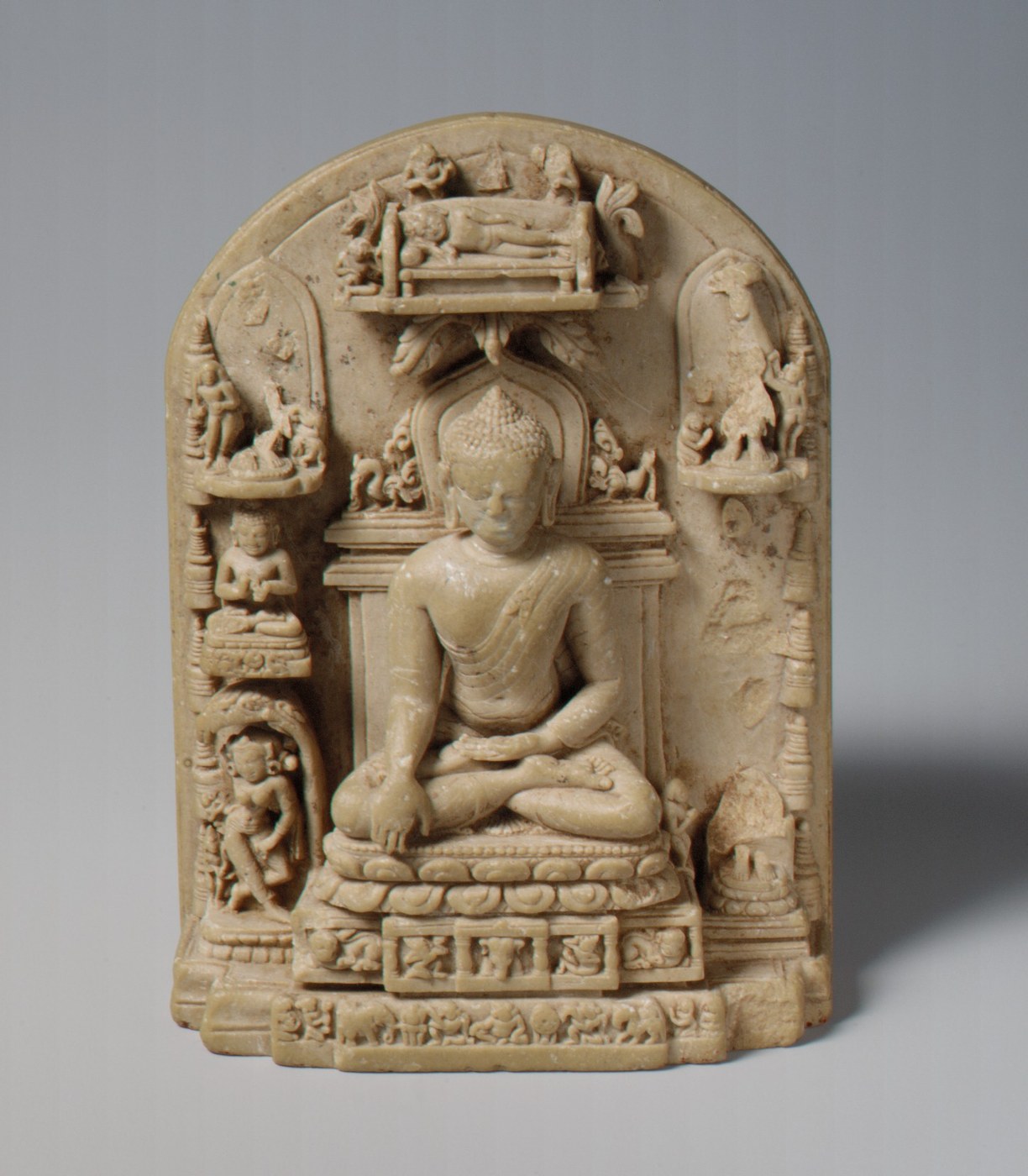
Plaque with Scenes from the Life of the Buddha, Bihar or West Bengal, twelfth century. Mudstone.
The Metropolitan Museum of Art. Purchase, Anonymous Gift, 1982. Accession 1982.233. Public Domain (CC0). · Museum record ↗ · CC0
The historical Library account
The Library’s historical retelling
The collection retells Mara’s attack, with weapons falling harmlessly as flowers. [5]
The earth’s answer
The following leaf depicts the earth’s witness and Mara’s defeated army. [6]
Read further in the library
Myths of the Hindus and Buddhists
Reading note
The 1914 collection retells the defeat of Mara. Both original leaves remain linked for comparison with the Pali discourses and the sculptural narrative discussed above.
Sources
- SN 23.1: Mortality ↗Pali discourse translated by Thanissaro BhikkhuReturn to text ↑
- Sutta Nipata 3.2: Exertion ↗Pali poem translated by Thanissaro Bhikkhu; Mara’s challenge and armiesReturn to text ↑
- SN 5.10: Sister Vajira ↗Pali discourse translated by Thanissaro Bhikkhu; encounter with the nun VajiraReturn to text ↑
- Shakyamuni Buddha’s Defeat of Mara ↗Michael C. Carlos Museum, Emory University; tenth-century Pala sculpture, 2001.001.007Return to text ↑
- Myths of the Hindus & Buddhists: printed page 269Sister Nivedita and Ananda K. Coomaraswamy, 1914; historical retellingReturn to text ↑
Examine the original Library page
Exact inherited citation retained. Original page image inspected again. The historical author’s account remains distinct from the primary, museum and scholarly sources used in the expanded entry.
fell at his feet as flowers
Open the original page in Myths of the Hindus and Buddhists ↗Scan leaf 327 · Sister Nivedita and Ananda K. Coomaraswamy
- Myths of the Hindus & Buddhists: printed page 270Sister Nivedita and Ananda K. Coomaraswamy, 1914; historical retellingReturn to text ↑
Examine the original Library page
Exact inherited citation retained. Original page image inspected again. The historical author’s account remains distinct from the primary, museum and scholarly sources used in the expanded entry.
one and an impartial witness
Open the original page in Myths of the Hindus and Buddhists ↗Scan leaf 328 · Sister Nivedita and Ananda K. Coomaraswamy
- Plaque with Scenes from the Life of the Buddha ↗The Metropolitan Museum of Art; object record 1982.233Return to text ↑
About this article & its sources
Selected Pali discourses, an Indian sculptural narrative and the Library’s 1914 retelling. Mara as an acting figure and Mara as language for mortality are explained through their particular texts.
Passage attributions
Who is Mara?
Passage 1: Pali discourse translated by Thanissaro Bhikkhu.
Passage 2: Pali discourse translated by Thanissaro Bhikkhu.
Mara’s armies in the poem of exertion
Passage 1: Pali poem translated by Thanissaro Bhikkhu; Mara’s challenge and armies.
Passage 2: Pali poem translated by Thanissaro Bhikkhu; Mara’s challenge and armies.
Passage 3: Pali poem translated by Thanissaro Bhikkhu; Mara’s challenge and armies.
Vajira answers the question differently
Passage 1: Pali discourse translated by Thanissaro Bhikkhu; encounter with the nun Vajira.
Passage 2: Pali discourse translated by Thanissaro Bhikkhu; encounter with the nun Vajira.
Passage 3: Pali discourse translated by Thanissaro Bhikkhu; encounter with the nun Vajira.
The challenge beneath the Bodhi tree
Passage 1: Michael C. Carlos Museum, Emory University; tenth-century Pala sculpture, 2001.001.007.
Passage 2: Michael C. Carlos Museum, Emory University; tenth-century Pala sculpture, 2001.001.007.
Passage 3: Michael C. Carlos Museum, Emory University; tenth-century Pala sculpture, 2001.001.007.
Mara’s defeat on a devotional plaque
Passage 1: The Metropolitan Museum of Art; historical object and visual description.
The Library’s historical retelling
Passage 1: Sister Nivedita and Ananda K. Coomaraswamy, 1914; historical retelling.
The earth’s answer
Passage 1: Sister Nivedita and Ananda K. Coomaraswamy, 1914; historical retelling.