Hinduism
Explore Hinduism’s history, scriptures, philosophies, deities, cosmology and living practices, with historical art and exact readings from the Library.
In this article
Many traditions under one heading
Hinduism names a broad field of religious traditions rooted in the Indian subcontinent and practised across the world. The Pluralism Project traces the name Hindu to older geographical descriptions associated with the Indus region and notes the wider use of Hinduism in the nineteenth century. The history of the name differs from the much longer histories of the texts, rituals and communities gathered under it. [1]
The same introduction describes householders and renunciants, different deities and different forms of community. Its examples include Vaiṣṇavas who honour Vishnu or Krishna, Śaivas who honour Shiva, and Śāktas who honour the Goddess. A useful introduction begins with these differences while following shared vocabularies through the particular traditions that explain them. [1]
History and sacred texts
How Hindu traditions developed
Hindu traditions took shape through overlapping histories of recitation, ritual, philosophical debate, devotional poetry and temple worship. Vedic compositions were transmitted orally over many centuries. The early Upanishads developed inquiries into the self and ultimate reality; the epics and later devotional literature opened other enduring settings for religious teaching. These developments did not replace one another neatly: Vedic recitation, household ritual and devotion continue together in many communities. [18]
- Second millennium BCE onward
Vedic traditions
Sanskrit hymns and ritual knowledge develop through oral transmission. [18]
- First millennium BCE
Upanishadic inquiry
Early Upanishads explore self, reality and liberation. [18]
- Late first millennium BCE and first millennium CE
Epics and devotional teaching
The Mahābhārata and Rāmāyaṇa develop over centuries. [18]
- Medieval centuries
Temples and regional bhakti
Temple traditions and regional-language devotional movements flourish. [18]
- Nineteenth century
Reform and global encounters
New organizations and interpretations address colonial society and international audiences. [18]
- Twentieth century onward
Diaspora communities
Migration creates new settings for temples, teachers and inherited practices. [18]
Veda, scripture and transmission
The Vedas are collections transmitted through oral recitation. The Pluralism Project distinguishes the Ṛgveda, with hymns addressed to deities; the Sāmaveda, associated with chants and melodies; the Yajurveda, with ritual formulae; and the Atharvaveda, containing hymns and other ritual material. The term śruti, what is heard, connects authority with the transmission of sacred speech. [2]
Vedic literature also includes ritual explanations in the Brāhmaṇas and philosophical inquiry in the Upanishads. Later bodies of authoritative literature include the Mahābhārata and Rāmāyaṇa, devotional poetry and other texts. The Bhagavad Gītā appears within the Mahābhārata. This range makes genre and language useful starting points: a hymn, a dialogue, an epic narrative and a regional devotional song can carry religious authority in different ways. [2]
Epics, Purāṇas and the life of a story
The Purāṇas bring accounts of origins, divine deeds, royal lineages, ritual and sacred places into large narrative collections. McComas Taylor’s introduction to the Viṣṇu Purāṇa describes a fluid literary field: lists of eighteen great Purāṇas coexist with many local texts and retellings. Their contents and emphases differ, and their composition and revision span many centuries. A Purāṇic account is therefore best identified by its particular text rather than presented as the Hindu creation story. [19]
The Viṣṇu Purāṇa organizes a Vaiṣṇava vision through creation and re-creation, divine and human genealogies, eras of the Manus and royal dynasties. Such narratives also place ethics and devotion within an expansive history of the world. Other traditions may give the Goddess or Shiva a different theological prominence. The genre’s breadth helps explain how stories, cosmology and practical religious instruction can appear in the same work. [19]
A story also acquires meaning in performance. At the Bharatiya Temple in Troy, Michigan, the Pluralism Project describes a Rama Navami celebration that honours Rama’s birth and enacts the wedding of Rama and Sita. Rama is understood as an incarnation of Vishnu; Hanuman embodies devoted service to him. Children’s drama, music and community participation make the narrative part of religious life in a new setting. This is one documented celebration, rather than a rule for every Hindu festival. [22]
The self, reality and liberation
Ātman, Brahman and the Upanishads
The Upanishads explore questions about the ground of existence, the inner self and the relationship between them. Their dialogues use the terms ātman and Brahman in investigating these questions. In the Pluralism Project’s account, a teacher’s example of a tiny seed points towards a reality that sustains what can be seen without itself being visible in the same way. [3]
Other passages use a different kind of teaching, describing ultimate reality through the limits of ordinary categories. The movement between analogy, dialogue and negation is part of how these texts teach. Later interpreters develop different accounts of the relation between the self and ultimate reality, so the wording of a passage and the interpretation offered by a named school both matter. [3]
Philosophical schools and debate
Shyam Ranganathan’s philosophical overview distinguishes a shared textual connection to the Vedas from a single doctrine accepted by all Hindu philosophers. It introduces six systematic traditions: Nyāya, Vaiśeṣika, Sāṅkhya, Yoga, Pūrvamīmāṃsā and Vedānta. Their inquiries concern knowledge, reasoning, the constitution of the world, action and liberation. The names identify histories of argument and interpretation rather than six interchangeable descriptions. [4]
Their answers can be sharply different. Śaṅkara’s Advaita understands the deepest self as identical with Brahman. Rāmānuja’s Viśiṣṭādvaita treats the world and individual selves as real, dependent aspects of Brahman, identified with Vishnu. Madhva’s Dvaita maintains a real distinction between God and individual selves. These are rival interpretations within Vedānta, not successive steps in a single agreed doctrine. These debates also developed in conversation with Buddhist and Jain thinkers. [4]
Karma, saṃsāra and mokṣa
The Hindu American Foundation’s educational introduction connects karma, action and its consequences, with saṃsāra, the cycle of birth and rebirth. It uses mokṣa for liberation from that cycle. These teachings place the consequences of conduct within an account of existence that extends beyond one life. They also connect spiritual aims with the question of how a person acts. [10]
Karma concerns the consequences of action across lives; mokṣa names release from the cycle in which those consequences bind a person. Questions about what is liberated and how liberation is attained depend on the tradition’s account of the self and the divine. A short definition establishes the vocabulary, while the philosophical differences described above explain why it does not amount to a single shared theology. [10]
The aims of life
The four puruṣārthas provide one influential vocabulary for the aims of human life: dharma, ethical or religious responsibility; artha, material well-being and resources; kāma, pleasure and desire; and mokṣa, liberation. Ranganathan explains that schools differ in how they value these aims. The scheme introduces a discussion about conduct, worldly life and release whose answers must be followed in particular texts and traditions. [4]
Knowledge, devotion and action
Wisdom, Vedānta and teachers
In the Pluralism Project’s account of Vedānta, Śaṅkara’s non-dual interpretation centres on Brahman and ātman. Jñāna names transformative understanding, and mokṣa is the liberation towards which that understanding is directed. The account presents wisdom as something cultivated through disciplined inquiry and a teacher’s guidance. Its explanation is attached to an identifiable interpretive tradition. [7]
Teachers, or gurus, transmit instruction within lineages and may confer initiation, dīkṣā. The same source uses the teacher–student setting of an Upanishad to explain the importance of preparation and sustained study. A teaching’s language, its transmission and the forms of life in which it is practised belong together when interpreting it. [7]
Bhakti and devotional expression
Bhakti names devotion, expressed through relationships with the divine. The Pluralism Project describes songs, hymns, offerings, dance and dramatic performance among its forms. It gives examples from devotion to Krishna, Rama, Shiva, Vishnu and the Goddess, including regional-language poetry. Devotional traditions thus carry their teachings through languages and artistic forms as well as philosophical explanation. [8]
Offerings made in homes and temples may be received back as prasād, understood as blessing or grace. The source’s examples of singers, dancers and worshippers show how a devotional relationship takes form in shared actions. The religious meaning of an offering is part of the practice being described, rather than something supplied by its material ingredients alone. [8]
Regional voices give bhakti much of its texture. Tamil Śaiva Nāyaṉmārs and Vaiṣṇava Āḻvārs, Tulsidas’s devotion to Rama and Ramprasad’s songs to Kali exemplify different devotional relationships. A song may address the deity as sovereign, beloved or mother. Its language and emotional register carry a theology alongside its words. [8]
Action and renunciation
The Bhagavad Gītā joins the question of action with the problem of attachment to its results. The Pluralism Project introduces this through Krishna’s counsel to Arjuna: engagement in the world can become a spiritual path when action is undertaken with detachment from personal claims to its fruits. Renunciation in this account concerns how one acts as well as whether one withdraws from ordinary affairs. [6]
The source places karma as a path beside wisdom and devotion, while describing its particular emphasis on active engagement. It also discusses Gandhi’s understanding of action and renunciation. These examples help distinguish karma as a broad account of actions and consequences from karma-yoga as a way of spiritual discipline. [6]
Reading Krishna’s counsel on action
Bhagavad Gītā 2.47 gives a compact example of how a verse becomes a teaching about life. In Swami Mukundananda’s translation and commentary, Krishna directs Arjuna towards duty while relinquishing possessiveness about its results. The verse also warns against attachment to inaction. Detachment in this interpretation therefore accompanies responsible activity: it does not provide permission to abandon action or treat its consequences as irrelevant. [23]
This is one interpreter’s explanation. The verse’s setting, the relationship between Krishna and Arjuna and the meaning of duty become part of a much wider conversation across commentarial traditions. Reading a short teaching alongside a named commentary lets the reader distinguish the verse from the interpretation built around it. It also shows why the Gītā can be read as a text of action, knowledge and devotion together. [23]
Deities and sacred worlds
Deities and traditions of worship
Himalayan Academy’s Śaiva educational introduction maps four broad traditions through their devotional and philosophical emphases. It describes Śaivism through Shiva, Śāktism through the Divine Mother or Shakti, and Vaiṣṇavism through Vishnu and forms such as Krishna and Rama. Its account of Smārta practice includes the worship of several divine forms. This is one community publisher’s introductory map of a much wider religious field. [11]
In the Academy’s account, Smārta worship can honour several deities as approaches to ultimate reality, while the other traditions centre their devotion differently. Vishnu, Shiva and the Goddess therefore cannot be reduced to interchangeable names in every Hindu theology. The same temple image may belong to different stories, lineages and philosophical explanations; identifying its community is part of understanding its meaning. [11]
A fifth-century terracotta plaque from Uttar Pradesh depicts Krishna overcoming the horse demon Keshi. The sculptor compresses an episode into a vigorous encounter between a human figure and a horse. Such narrative imagery offers a different entry into devotion from an abstract definition of divinity: an action identifies the figure and recalls a story for the viewer. The museum identifies this work as temple sculpture of the Gupta period. [26]
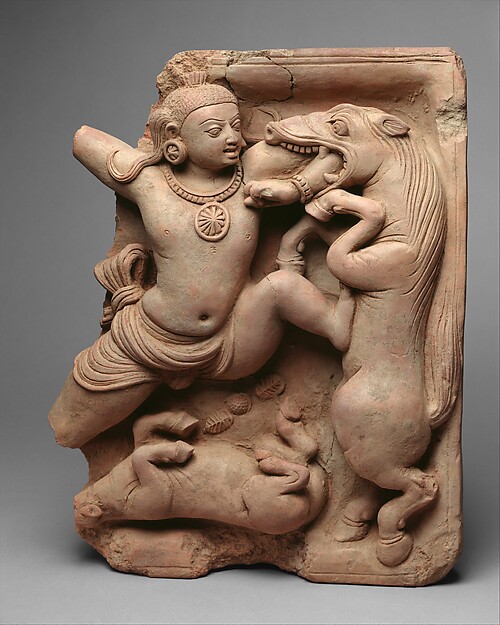
Krishna Killing the Horse Demon Keshi, Uttar Pradesh, India, fifth century, Gupta period. Terracotta, The Metropolitan Museum of Art, 1991.300.
Purchase, Florence and Herbert Irving Gift, 1991. Public Domain, The Met Open Access. · Museum record ↗ · CC0
The Goddess and the Divine Mother
The Pluralism Project’s account of goddess traditions follows names and forms including Parvati, Lakshmi, Durga and Kali. It describes Ma, Mother, as a devotional form of address and Shakti as a language of divine power. These names open different narratives and relationships; they need to be followed in the text, temple or community that uses them. [15]
The same source describes images created for festival worship and communities that honour particular women teachers through the language of the Divine Mother. Sarada Devi appears in its discussion of the Ramakrishna tradition. The examples show several settings in which religious presence is understood: an image, a narrative figure, a devotional address and a teacher honoured by followers. [15]
This Nepalese image of Durga gives her eighteen arms, making divine power visible through a complex arrangement of limbs and attributes. The museum identifies the subject as the slayer of the buffalo demon Mahishasura. Its original pedestal, which would have shown the demon, is now missing. That absence matters when interpreting the surviving object: the title preserves narrative information that the figure alone cannot show completely. [27]
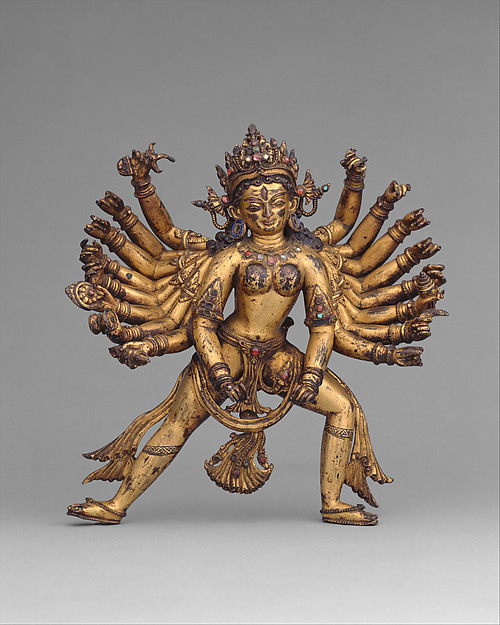
Durga as Slayer of the Buffalo Demon Mahishasura, Nepal, fourteenth–fifteenth century. Gilt copper alloy and semi-precious stones, The Metropolitan Museum of Art, 1986.498. The original pedestal is missing.
Gift of Alice and Nasli M. Heeramaneck, 1986. Public Domain, The Met Open Access. · Museum record ↗ · CC0
Worlds within cycles of time
In the Viṣṇu Purāṇa, time unfolds through repeating ages: Kṛta, Tretā, Dvāpara and Kali. These yugas belong to larger cycles within the days and nights of Brahmā. Creation, dissolution and re-creation are woven into a devotional account of the universe’s dependence on the divine. At the end of a cosmic day, worlds are overwhelmed; a new creation follows the interval of repose. [20]
Brahmā, the creator figure in this account, should be distinguished from Brahman, the term for ultimate reality discussed in the Upanishadic and Vedānta sections. The Purāṇa’s enormous periods and repeated worlds express a religious vision of cosmic time. They do not establish a correspondence with modern scientific cosmology, and this particular text does not settle how every Hindu understands the universe. [20][3]
Book Two presents a layered sacred world. Mount Meru stands within a geography of continents and oceans; other passages describe seven upper spheres, lower regions and realms of punishment. The text names Bhūrloka, Bhuvarloka and Svarloka, then higher worlds associated with sages, austerity and truth. Its account of the cosmic egg connects the visible world with successive enclosing layers and the power of Vishnu. [21]
These descriptions belong to the text’s cosmology, not a modern geographical atlas. They connect different kinds of existence with conduct, spiritual attainment and the divine order. Its hell narratives also contain historical social and moral prescriptions that require contextual reading. A sacred map can be influential without being the only map within a tradition; the vocabulary and arrangement vary across Hindu literature. [21]
Worship, festivals and art
Pūjā, images and darśan
Hindu worship takes place in homes, temples and other sacred settings. The Pluralism Project’s account of temple and image describes the mūrti as a focus of divine presence, established in many temples through consecration. Darśan concerns seeing the deity and being seen. The image therefore belongs within a relationship of presence and worship in the account being described. [9]
The same source follows daily ceremonies, gatherings, festivals and pilgrimage. It uses tīrtha, a crossing or ford, for places of religious encounter such as sacred rivers and pilgrimage sites. Temple architecture, an image, an offering and a journey can each be approached as part of this wider setting of religious life. [9]
Worship at home
The home altar is another important setting of Hindu practice. The Pluralism Project describes American households that adapt a cabinet, a dedicated room or a small table for worship. Its examples bring images, prayer and the everyday spaces of a home together. The scale of an altar can differ while its role in daily religious life remains significant for the people described. [14]
The account also follows scripture study and devotional singing in private homes. A household shrine may become a gathering place for a small community. Women in these examples exercise spiritual leadership and conduct worship. Looking at domestic practice therefore adds relationships and forms of religious authority that an account centred entirely on major temples would leave out. [14]
Sacred time and festivals
Mahāśivarātri, the Great Night of Shiva, provides one example of sacred time organized around a deity. The Pluralism Project records an all-night observance at a New York temple, including hymns, the bathing of a Shiva liṅga and its decoration. Its account relates the observance to a narrative in which Shiva is revealed through a column of light. [16]
Another example in the same account is a community’s offering of dance to Shiva as Naṭarāja, Lord of Dance. The performances are described as worship. These two cases connect calendar, story, image, music and movement within a festival setting. They also make variation visible within devotion to the same deity. [16]
How to read an image
An image’s form can explain something that a list of deity names cannot. Art historian Vidya Dehejia describes the relationship between temple architecture, sculpture and religious aims. Several arms can communicate powers that exceed the human body; several heads can present different aspects of a figure. Narrative reliefs place divine stories around spaces of worship. The visual vocabulary becomes clearer when the image’s date, region, original setting and devotional use remain in view. [24]
The Chola-period bronze below shows Shiva as Naṭarāja, Lord of Dance. A ring of flame surrounds him; the upper hands hold a drum and fire. One foot presses down on the figure associated with ignorance, while the raised foot offers refuge. The museum’s account relates the dance to creation and destruction, protection and release. The image joins several divine activities in one balanced movement. [25]
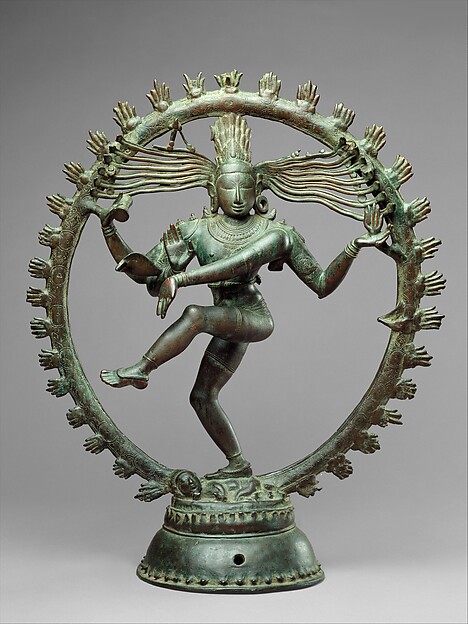
Shiva as Lord of Dance (Nataraja), Tamil Nadu, India, about the late eleventh century, Chola period. Bronze, The Metropolitan Museum of Art, 1987.80.1.
Gift of R. H. Ellsworth Ltd., in honor of Susan Dillon, 1987. Public Domain, The Met Open Access. · Museum record ↗ · CC0
Community, responsibility and change
A Ramakrishna Math and Mission perspective
Ramakrishna Math and Ramakrishna Mission explain their ideals through Vedānta as taught by Ramakrishna and Vivekananda. Their account brings knowledge, devotion, meditation and work together as paths of spiritual cultivation. It connects personal realization with service to others. These are the organizations’ own explanations of the relationship between religious life and practical responsibility. [12]
Their statement also gives a prominent place to harmony among religions. That claim belongs to the teaching being presented by these organizations; it is useful evidence for how this movement explains its aims. It can be read beside other Hindu communities whose devotional and philosophical formulations have their own histories. [12]
An ISKCON educational perspective
The Heart of Hinduism educational project identifies its publisher, ISKCON Educational Services, with the Vaiṣṇava tradition. Its introduction describes domestic and temple worship, the transmission of teachings through gurus, and the roles of Vishnu, Krishna and Rama in devotional life. It also presents its intention to describe other Hindu traditions respectfully. Naming the publisher makes the standpoint of this teaching resource visible. [13]
Read beside the Śaiva and Ramakrishna sources above, this resource gives another example of a living community explaining inherited ideas to a wider audience. Its emphasis on the supreme person, devotional life and spiritual transmission can be followed in its own vocabulary. A broad introduction becomes more useful when those particular voices remain identifiable. [13]
Diaspora and regional life
Hindu communities have established religious life in many parts of the world. The Pluralism Project follows communities in Africa, the Caribbean, Britain and North America, among other places. It connects these histories with migration and with the construction of temples and other community institutions. Place and migration history help explain how inherited practices acquire new settings. [17]
The domestic altars, temple observances and educational resources discussed above are examples of that continuing work of transmission. They join remembered languages, narratives and religious relationships with the circumstances of a new home. Reading a local community in detail gives substance to the broad word Hinduism while preserving the connections through which traditions travel. [17]
Reading historical interpretations in the Library
In Myths of the Hindus and Buddhists, Nivedita and Coomaraswamy describe Shiva’s dance through creation, preservation and destruction. The original page gives the statement its narrative setting: the dance is taught and witnessed within a story. Read beside the bronze above, the passage offers a historical interpretation of an image and the ideas it conveys. The exact scanned leaf is available in the source panel. [28]
The same book’s chapter on the Bhagavad Gītā explains action without attachment to its fruits. Its English prose interprets Krishna’s teaching for a particular readership; it should be distinguished from the Sanskrit dialogue and from contemporary commentary. The Library preserves that encounter with Hindu traditions as a source in its own right. It can be read alongside present-day scholarship and the named community voices cited throughout this article. [29]
Read further in the library

Hindu Mysticism
Reading note
S. N. Dasgupta’s lectures compare forms of mysticism in Indian thought, including Upanishadic inquiry, Yoga and devotion.
Myths of the Hindus and Buddhists
Reading note
Sister Nivedita and Ananda K. Coomaraswamy retell Hindu and Buddhist narratives with discussion of their religious and artistic settings.
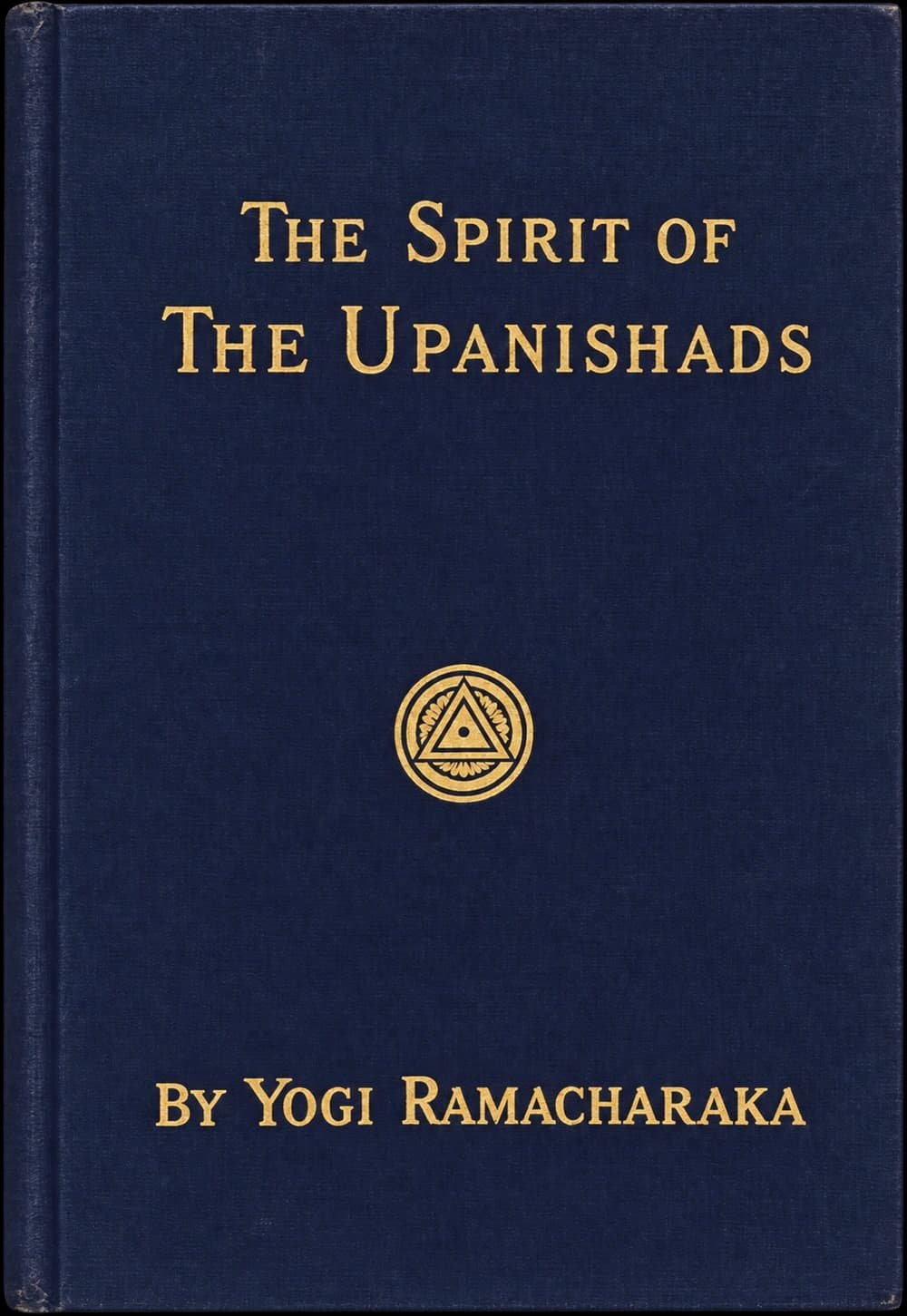
The Spirit of the Upanishads
Reading note
Ramacharaka’s selected adaptation of Upanishadic themes offers a historical reception of the texts. Its selection and interpretation should be distinguished from a complete Sanskrit-text translation.
Sources
- What Does “Hindu” Mean? ↗The Pluralism Project, Harvard UniversityReturn to text ↑
- Veda: Scripture and Authority ↗The Pluralism Project, Harvard UniversityReturn to text ↑
- Brahman and Atman: That Art Thou ↗The Pluralism Project, Harvard UniversityReturn to text ↑
- Hindu Philosophy ↗Shyam Ranganathan, Internet Encyclopedia of PhilosophyReturn to text ↑
- Dharma: The Social Order ↗The Pluralism Project, Harvard UniversityReturn to text ↑
- Karma: The Way of Action ↗The Pluralism Project, Harvard UniversityReturn to text ↑
- Vedanta: The Way of Wisdom ↗The Pluralism Project, Harvard UniversityReturn to text ↑
- Bhakti: The Way of Devotion ↗The Pluralism Project, Harvard UniversityReturn to text ↑
- Abodes of God: Temple and Image ↗The Pluralism Project, Harvard UniversityReturn to text ↑
- Hinduism 101: What? ↗Hindu American FoundationReturn to text ↑
- Hindu Basics: Four Denominations ↗Himalayan Academy, a Śaiva educational publisherReturn to text ↑
- Ideology of Ramakrishna Math and Ramakrishna Mission ↗Ramakrishna Math and Ramakrishna MissionReturn to text ↑
- A Summary of Hinduism ↗ISKCON Educational Services, Heart of HinduismReturn to text ↑
- Home Altar ↗The Pluralism Project, Harvard UniversityReturn to text ↑
- Many Ma’s: Goddess in America ↗The Pluralism Project, Harvard UniversityReturn to text ↑
- The Great Night of Shiva ↗The Pluralism Project, Harvard UniversityReturn to text ↑
- The Hindu Diaspora ↗The Pluralism Project, Harvard UniversityReturn to text ↑
- Hinduism: Historical timeline ↗The Pluralism Project, Harvard UniversityReturn to text ↑
- The Viṣṇu Purāṇa: Introduction ↗McComas Taylor, translator, The Viṣṇu Purāṇa, ANU PressReturn to text ↑
- The Viṣṇu Purāṇa, Book One, chapter 3: Divisions of time ↗McComas Taylor, translator, The Viṣṇu Purāṇa, ANU PressReturn to text ↑
- The Viṣṇu Purāṇa, Book Two: The world ↗McComas Taylor, translator, The Viṣṇu Purāṇa, ANU PressReturn to text ↑
- Rama, Sita, Hanuman ↗The Pluralism Project, Harvard UniversityReturn to text ↑
- Bhagavad Gītā 2.47: Translation and commentary ↗Swami MukundanandaReturn to text ↑
- Hinduism and Hindu Art ↗Vidya Dehejia, The Metropolitan Museum of ArtReturn to text ↑
- Shiva as Lord of Dance (Nataraja), 1987.80.1 ↗The Metropolitan Museum of ArtReturn to text ↑
- Krishna Killing the Horse Demon Keshi, 1991.300 ↗The Metropolitan Museum of ArtReturn to text ↑
- Durga as Slayer of the Buffalo Demon Mahishasura, 1986.498 ↗The Metropolitan Museum of ArtReturn to text ↑
- Myths of the Hindus and Buddhists: Shiva’s danceSister Nivedita and Ananda K. CoomaraswamyReturn to text ↑
Examine the original Library page
Printed page 312, original scan leaf 378. Nivedita and Coomaraswamy’s historical retelling relates Shiva’s dance to cosmic activity. This authored account is not a universal modern Śaiva interpretation.
his dance is the creation, preservation, and destruction of the universe
Open the original page in Myths of the Hindus and Buddhists ↗Scan leaf 378 · Sister Nivedita and Ananda K. Coomaraswamy
- Myths of the Hindus and Buddhists: The Bhagavad GītāSister Nivedita and Ananda K. CoomaraswamyReturn to text ↑
Examine the original Library page
Printed page 187, original scan leaf 231. A historical English interpretation of the Gītā, not a complete critical translation of the Sanskrit text.
without attachment to the fruits of action
Open the original page in Myths of the Hindus and Buddhists ↗Scan leaf 231 · Sister Nivedita and Ananda K. Coomaraswamy
About this article & its sources
An introduction to diverse Hindu traditions. Historical accounts, philosophical interpretations, particular community teachings and Purāṇic cosmology are identified by their sources. No single doctrine or practice represents every Hindu.
Passage attributions
Many traditions under one heading
Passage 1: Historical introduction: Harvard Pluralism Project.
Passage 2: Harvard Pluralism Project; concluding reading approach is Lumitheca synthesis.
How Hindu traditions developed
Passage 1: Harvard Pluralism Project; broad chronology.
Veda, scripture and transmission
Passage 1: Scriptural overview: Harvard Pluralism Project.
Passage 2: Harvard Pluralism Project; final reading guidance is Lumitheca synthesis.
Epics, Purāṇas and the life of a story
Passage 1: McComas Taylor, translator, The Viṣṇu Purāṇa, ANU Press.
Passage 2: McComas Taylor, translator, The Viṣṇu Purāṇa, ANU Press.
Passage 3: Harvard Pluralism Project; a local Rama Navami celebration.
Ātman, Brahman and the Upanishads
Passage 1: Account of Upanishadic teaching: Harvard Pluralism Project.
Passage 2: Harvard Pluralism Project; concluding interpretive scope is Lumitheca synthesis.
Philosophical schools and debate
Passage 1: Philosophical overview: Shyam Ranganathan, Internet Encyclopedia of Philosophy.
Passage 2: Shyam Ranganathan; three Vedānta interpretations.
Karma, saṃsāra and mokṣa
Passage 1: Community educational perspective: Hindu American Foundation.
Passage 2: Hindu American Foundation; final distinction is editorial synthesis.
The aims of life
Passage 1: Philosophical account of the puruṣārthas: Shyam Ranganathan.
Wisdom, Vedānta and teachers
Passage 1: Account of Śaṅkara and Vedānta: Harvard Pluralism Project.
Passage 2: Harvard Pluralism Project; final observation is Lumitheca synthesis.
Bhakti and devotional expression
Passage 1: Devotional overview: Harvard Pluralism Project.
Passage 2: Harvard Pluralism Project; final interpretive observation is Lumitheca synthesis.
Passage 3: Regional examples in the Harvard Pluralism Project.
Action and renunciation
Passage 1: Reading of the Bhagavad Gītā: Harvard Pluralism Project.
Passage 2: Harvard Pluralism Project; final distinction is Lumitheca synthesis.
Reading Krishna’s counsel on action
Passage 1: Swami Mukundananda on Bhagavad Gītā 2.47; a contemporary devotional commentary.
Passage 2: Mukundananda; final reading guidance is editorial synthesis.
Deities and traditions of worship
Passage 1: Community educational perspective: Himalayan Academy.
Passage 2: Himalayan Academy, a Śaiva publisher; scoped interpretation.
Passage 3: The Metropolitan Museum of Art, object 1991.300.
The Goddess and the Divine Mother
Passage 1: Account of goddess traditions: Harvard Pluralism Project.
Passage 2: Harvard Pluralism Project; concluding comparison is Lumitheca synthesis.
Passage 3: The Metropolitan Museum of Art, object 1986.498.
Worlds within cycles of time
Passage 1: McComas Taylor, translator, The Viṣṇu Purāṇa, ANU Press; Book One, chapter 3.
Passage 2: Viṣṇu Purāṇa; terminology clarified by the article’s Upanishadic context.
Passage 3: McComas Taylor, translator, The Viṣṇu Purāṇa, ANU Press; Book Two, chapters 2 and 7.
Passage 4: McComas Taylor, translator, The Viṣṇu Purāṇa, ANU Press; Book Two, chapters 6–7; contextual editorial synthesis.
Pūjā, images and darśan
Passage 1: Ritual and visual account: Harvard Pluralism Project.
Passage 2: Harvard Pluralism Project; final reading guidance is Lumitheca synthesis.
Worship at home
Passage 1: Documented household examples: Harvard Pluralism Project.
Passage 2: Harvard Pluralism Project; concluding observation is Lumitheca synthesis.
Sacred time and festivals
Passage 1: Documented festival account: Harvard Pluralism Project.
Passage 2: Harvard Pluralism Project; concluding observation is Lumitheca synthesis.
How to read an image
Passage 1: Vidya Dehejia, The Metropolitan Museum of Art.
Passage 2: The Metropolitan Museum of Art, object 1987.80.1.
Dharma, social life and hierarchy
Passage 1: Historical and social account: Harvard Pluralism Project.
Passage 2: Harvard Pluralism Project; final source distinction is Lumitheca synthesis.
A Ramakrishna Math and Mission perspective
Passage 1: Practitioner perspective: Ramakrishna Math and Ramakrishna Mission.
Passage 2: Ramakrishna Math and Mission; concluding comparative scope is Lumitheca synthesis.
An ISKCON educational perspective
Passage 1: Community educational perspective: ISKCON Educational Services.
Passage 2: Lumitheca synthesis of the attributed community accounts.