Vishnu
Explore Vishnu through avatars, Lakshmi, devotion, divine preservation and historical sculpture, with primary texts and checked Library passages.
In this article
Divine presence
Who is Vishnu?
Vishnu is a Hindu deity associated with the preservation of cosmic order and worshipped as supreme in many Vaishnava settings. Sacred images present him with royal dress, a crown and identifying attributes such as the conch and discus. His relationship with Shri, also known as Lakshmi, gives divine sovereignty an intimate devotional dimension. [1]
Vishnu and Lakshmi
The Walters Art Museum explains the small shrivatsa mark on a south Indian bronze as a sign of Shri’s presence. It describes a devotional understanding in which she dwells within Vishnu and mediates between him and human beings. The mark carries a relationship that may be easy to miss when looking only at the figure’s weapons or crown. [1]
This makes the image a point of approach as well as a representation of power. Preservation concerns a world upheld by divinity, while the devotee seeks a relationship with that sustaining presence. [1]
Avatars and devotion
Avatars and divine manifestation
The Bhagavata Purana describes divine manifestations in many forms. Its first book includes the boar, fish, tortoise, Narasimha, Rama and Krishna among a much longer sequence. Verse 1.3.26 explicitly describes the manifestations as innumerable. A familiar group of ten is therefore one way of organizing a larger field of narrative. [2]
The translation hosted by VedaBase also gives Krishna a particular theological priority: verse 1.3.28 presents him as the original divine person. This Gaudiya Vaishnava reading matters when comparing descriptions that call Krishna an avatar of Vishnu. The relationship should be explained through the tradition speaking, rather than forced into one hierarchy for all devotees. [2]
Why does the divine descend?
In Bhagavad Gita 4.8, Krishna connects divine appearance with the protection of the righteous and the restoration of dharma. Swami Mukundananda’s commentary asks why an all-powerful God would need a bodily descent to accomplish these ends. His answer emphasizes devotion: names, forms and sacred narratives make a personal relationship possible. [3]
On this reading, an avatar does more than resolve a crisis within a story. The remembered deeds become a continuing basis for love, attention and worship. Devotees can return to them long after the narrated encounter. [3]
Worship and historical art
The image within worship
In the south Indian practice described by the Smithsonian, puja honours the deity through clothing, bathing, food, flowers, light and sound. Darshan involves seeing and being seen. An image’s care and preparation belong to its religious life, alongside the narratives that identify the figure. [4]
Vishnu in the Mekong Delta
A seventh-century stone Vishnu at the Met comes from the Mekong Delta. His tall headdress and raised conch and discus make the figure recognizable; a lowered hand rests on the remains of a mace. The surviving body has an upright, balanced stance. [5]
The object places Vishnu within the history of southeast Asian religious art. Familiar attributes travelled into new artistic settings, where sculptors gave them local form. The museum dates this example to the second half of the seventh century. [5]
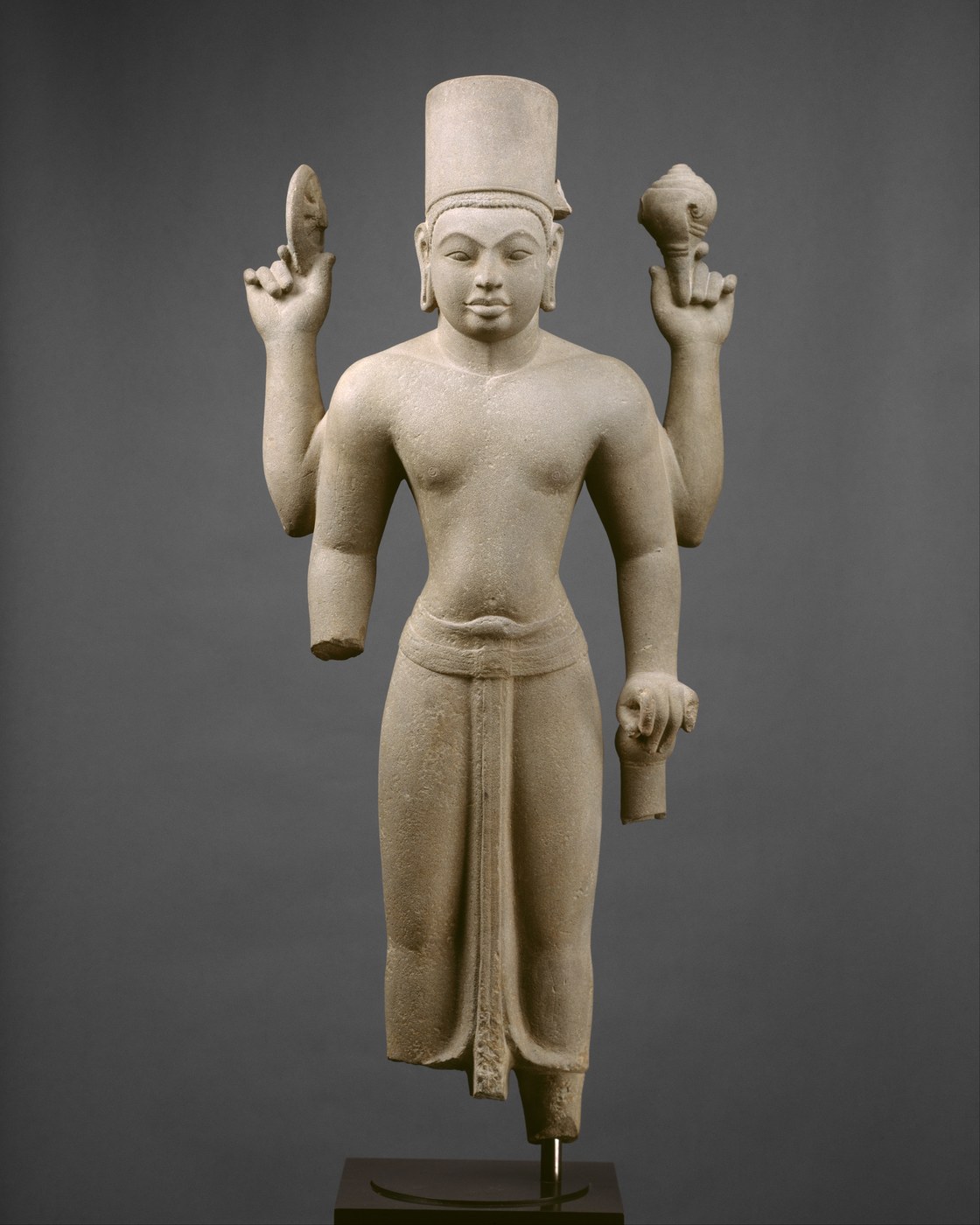
Standing Four-Armed Vishnu, Mekong Delta, second half of the seventh century. Stone.
The Metropolitan Museum of Art. Purchase, Lita Annenberg Hazen Charitable Trust Gift, 1992. Accession 1992.53. Public Domain (CC0). · Museum record ↗ · CC0
The Library’s epic retellings
The appeal for Rama’s birth
The first retained Library leaf retells the gods’ appeal for Vishnu’s birth as Dasharatha’s sons. [6]
Krishna’s epic setting
The second leaf introduces Krishna as a divine incarnation within the Mahabharata. It provides historical context rather than an explicit statement about Vishnu. [7]
Read further in the library
Myths of the Hindus and Buddhists
Reading note
Compare the collection’s historical epic presentation with the primary texts and particular devotional interpretations discussed here. Both inherited original leaves are retained.
Sources
- Vishnu, thirteenth century ↗The Walters Art Museum; Vishnu, Shri and south Indian devotionReturn to text ↑
- Srimad Bhagavatam 1.3 ↗A. C. Bhaktivedanta Swami Prabhupada, Bhaktivedanta Book Trust; Gaudiya Vaishnava translationReturn to text ↑
- Bhagavad Gita 4.8 ↗Swami Mukundananda; translation and devotional commentaryReturn to text ↑
- Hindu Belief & Practice ↗Smithsonian National Museum of Asian Art; south Indian worshipReturn to text ↑
- Standing Four-Armed Vishnu ↗The Metropolitan Museum of Art; Mekong Delta, second half of the seventh century, 1992.53Return to text ↑
- Myths of the Hindus & Buddhists: printed page 26Sister Nivedita and Ananda K. Coomaraswamy, 1914; historical Rama retellingReturn to text ↑
Examine the original Library page
Inherited edition and original-page identity preserved. Original scan inspected. Historical retelling remains distinct from broader primary, scholarly, museum and community sources.
clad in yellow robes, bearing mace and discus and conch
Open the original page in Myths of the Hindus and Buddhists ↗Scan leaf 48 · Sister Nivedita and Ananda K. Coomaraswamy
- Myths of the Hindus & Buddhists: printed page 118Sister Nivedita and Ananda K. Coomaraswamy, 1914; introduction to Krishna’s epic settingReturn to text ↑
Examine the original Library page
Inherited edition and original-page identity preserved. Original scan inspected. Historical retelling remains distinct from broader primary, scholarly, museum and community sources.
The story of a divine incarnation, Krishna
Open the original page in Myths of the Hindus and Buddhists ↗Scan leaf 154 · Sister Nivedita and Ananda K. Coomaraswamy
About this article & its sources
Selected Vaishnava texts and devotional interpretations, with south and southeast Asian art. Relationships between Vishnu, Krishna and divine manifestations retain their particular theological settings.
Passage attributions
Who is Vishnu?
Passage 1: The Walters Art Museum; Vishnu, Shri and south Indian devotion.
Vishnu and Lakshmi
Passage 1: The Walters Art Museum; Vishnu, Shri and south Indian devotion.
Passage 2: The Walters Art Museum; Vishnu, Shri and south Indian devotion.
Avatars and divine manifestation
Passage 1: A. C. Bhaktivedanta Swami Prabhupada, Bhaktivedanta Book Trust; Gaudiya Vaishnava translation.
Passage 2: A. C. Bhaktivedanta Swami Prabhupada, Bhaktivedanta Book Trust; Gaudiya Vaishnava translation.
Why does the divine descend?
Passage 1: Swami Mukundananda; translation and devotional commentary.
Passage 2: Swami Mukundananda; translation and devotional commentary.
The image within worship
Passage 1: Smithsonian National Museum of Asian Art; south Indian worship.
Vishnu in the Mekong Delta
Passage 1: The Metropolitan Museum of Art; Mekong Delta, second half of the seventh century, 1992.53.
Passage 2: The Metropolitan Museum of Art; Mekong Delta, second half of the seventh century, 1992.53.
The appeal for Rama’s birth
Passage 1: Sister Nivedita and Ananda K. Coomaraswamy, 1914; historical Rama retelling.
Krishna’s epic setting
Passage 1: Sister Nivedita and Ananda K. Coomaraswamy, 1914; introduction to Krishna’s epic setting.