Shiva
Explore Shiva through Shaiva teaching, the five divine acts, Nataraja’s dance, temple worship and historical accounts of Sati and Chidambaram.
In this article
Who is Shiva?
Shiva is a major deity of Hindu traditions, encountered as a yogi, a divine householder and a source of cosmic transformation. His narratives place him in cremation grounds and mountain settings, while also presenting him as Parvati’s husband and the father of Ganesha and Skanda. These roles bring renunciation and family life into the same sacred figure. [1]
The Smithsonian’s account describes a deity known through hymns, narratives, ritual, performance and visual art. Different forms answer different religious questions: how the world changes, how divine presence becomes accessible and how a person approaches liberation. [1]
Divine acts and the dance
The five divine acts
Himalayan Academy’s Shaiva explanation gives Shiva five acts: creation, preservation, dissolution, concealment and revelation. This extends beyond the familiar description of him as destroyer within a divine triad. In the account presented by Satguru Bodhinatha Veylanswami, the cosmic actions and the soul’s spiritual development belong to one divine activity. [2]
Concealment allows embodied experience within a limited awareness; revelation brings freedom from the illusion of separateness. Both are described as forms of grace. Dissolution likewise belongs to a larger cycle rather than signifying an evil power. This is a particular Shaiva theological framework, useful for understanding why devotees may worship Shiva as supreme. [2]
Reading Nataraja’s dance
Nataraja gives those acts a visual language. In Himalayan Academy’s explanation, the drum signals creation, the hand offering reassurance expresses preservation and the flame signifies dissolution. The figure beneath Shiva’s foot represents the ignorance through which the soul experiences separation. The raised foot and the hand directing attention towards it offer revealing grace. [3]
The dance combines movement with composure. Flying hair and spreading limbs surround a poised face. Devotees can read the image as an account of existence and release, with the same figure carrying both cosmic power and an invitation to approach. [3]
Worship and historical art
Seeing and serving the deity
Puja engages the senses through bathing, clothing, flowers, food, fragrance, lamps and sound. In the south Indian setting described by the Smithsonian, a deity is honoured with the attention given to a royal guest. Darshan names the exchange of seeing and being seen by the divine figure. [4]
These practices give an image a setting beyond the museum. Its eyes, adornment and preparation matter within a continuing relationship between deity and devotee. [4]
A dancing bronze from Tamil Nadu
The Met’s Nataraja was made in Tamil Nadu during the late twelfth or early thirteenth century. Shiva dances within a ring of flame, holding a drum and fire while one foot presses a small figure below. His other foot is raised, and his hair spreads to either side. [5]
The museum notes that images of this kind were carried in festival processions. The dance could therefore be encountered in movement through a community as well as in a shrine. [5]
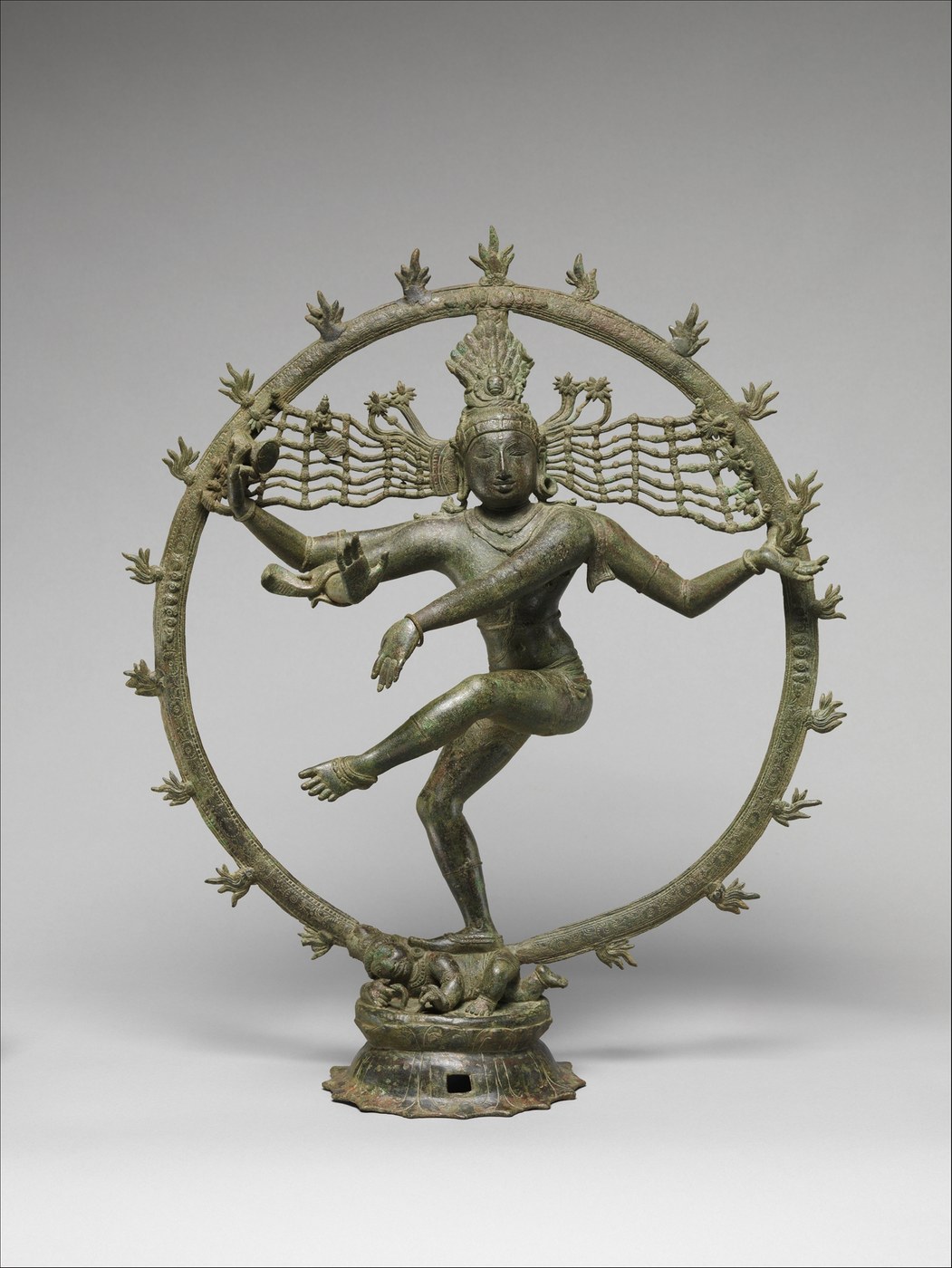
Shiva as Lord of Dance, Tamil Nadu, late twelfth–early thirteenth century. Copper alloy.
The Metropolitan Museum of Art. Harris Brisbane Dick Fund, 1964. Accession 64.251. Public Domain (CC0). · Museum record ↗ · CC0
The Library retellings
Sati and the excluded offering
The retained original leaf presents Sati questioning Shiva’s exclusion from Daksha’s sacrifice. [6]
The desire to see the dance
Another checked leaf connects the wish to witness Shiva’s dance with Chidambaram and cosmological teaching. [7]
Read further in the library
Myths of the Hindus and Buddhists
Reading note
The 1914 collection provides the checked Sati and dance passages. Its retellings remain distinct from the Shaiva explanations and museum interpretation cited above.
Sources
- Shiva ↗Smithsonian National Museum of Asian Art; narratives and embodied presenceReturn to text ↑
- Five Powers of Siva: Sadasiva in the Agama Scriptures ↗Himalayan Academy; introduction by Satguru Bodhinatha VeylanswamiReturn to text ↑
- Path to Siva, lesson 15: What Is the Meaning of Siva’s Dance? ↗Himalayan Academy; Shaiva interpretation of NatarajaReturn to text ↑
- Hindu Belief & Practice ↗Smithsonian National Museum of Asian Art; south Indian puja and darshanReturn to text ↑
- Shiva as Lord of Dance (Shiva Nataraja) ↗The Metropolitan Museum of Art; Tamil Nadu, late twelfth–early thirteenth century, 64.251Return to text ↑
- Myths of the Hindus & Buddhists: printed page 289Sister Nivedita and Ananda K. Coomaraswamy, 1914; Sati narrativeReturn to text ↑
Examine the original Library page
Inherited edition and original-page identity preserved. Original scan inspected. Historical retelling remains distinct from broader primary, scholarly, museum and community sources.
the oblation of true wisdom
Open the original page in Myths of the Hindus and Buddhists ↗Scan leaf 351 · Sister Nivedita and Ananda K. Coomaraswamy
- Myths of the Hindus & Buddhists: printed page 312Sister Nivedita and Ananda K. Coomaraswamy, 1914; historical account of the danceReturn to text ↑
Examine the original Library page
Inherited edition and original-page identity preserved. Original scan inspected. Historical retelling remains distinct from broader primary, scholarly, museum and community sources.
his dance is the creation, preservation, and destruction of the universe
Open the original page in Myths of the Hindus and Buddhists ↗Scan leaf 378 · Sister Nivedita and Ananda K. Coomaraswamy
About this article & its sources
Selected Shaiva explanations, south Indian worship and historical art, with the Library’s 1914 retellings. Theological perspectives are attributed rather than made uniform across Hindu traditions.
Passage attributions
Who is Shiva?
Passage 1: Smithsonian National Museum of Asian Art; narratives and embodied presence.
Passage 2: Smithsonian National Museum of Asian Art; narratives and embodied presence.
The five divine acts
Passage 1: Himalayan Academy; introduction by Satguru Bodhinatha Veylanswami.
Passage 2: Himalayan Academy; introduction by Satguru Bodhinatha Veylanswami.
Reading Nataraja’s dance
Passage 1: Himalayan Academy; Shaiva interpretation of Nataraja.
Passage 2: Himalayan Academy; Shaiva interpretation of Nataraja.
Seeing and serving the deity
Passage 1: Smithsonian National Museum of Asian Art; south Indian puja and darshan.
Passage 2: Smithsonian National Museum of Asian Art; south Indian puja and darshan.
A dancing bronze from Tamil Nadu
Passage 1: The Metropolitan Museum of Art; Tamil Nadu, late twelfth–early thirteenth century, 64.251.
Passage 2: The Metropolitan Museum of Art; Tamil Nadu, late twelfth–early thirteenth century, 64.251.
Sati and the excluded offering
Passage 1: Sister Nivedita and Ananda K. Coomaraswamy, 1914; Sati narrative.
The desire to see the dance
Passage 1: Sister Nivedita and Ananda K. Coomaraswamy, 1914; historical account of the dance.