Jainism
Explore Jainism through Mahavira, ahimsa, the soul and karma, the Five Vows, Digambara and Shvetambara traditions, worship and the practice of forgiveness.
In this article
What is Jainism?
Jainism is an Indian religious tradition that teaches a path of liberation through knowledge, self-discipline and nonviolence. Its name comes from jina, a conqueror: someone who has overcome the passions and karmic bondage that obstruct the soul. Jain tradition understands its teaching as eternal, renewed by great teachers rather than invented once by a creator. [1]
The Jain account of reality includes many individual souls and an eternal universe. It does not require a supreme creator who makes and governs everything. This distinguishes Jain theology from creator-centred religions, while leaving room for heavenly beings and profound reverence for liberated teachers. Its religious aim is freedom from rebirth through the purification of the soul. [1]
Jainism and Buddhism both questioned the authority assigned to Vedic tradition in Hinduism, while pursuing distinct accounts of liberation. [1]
The soul and liberation
Mahavira and the path of the tirthankaras
Mahavira is the great teacher most closely associated with Jainism’s historical formation in ancient northern India. Jain tradition remembers him as Vardhamana, who left a privileged household life for renunciation. After years of rigorous ascetic discipline, he attained kevalajnana, complete knowledge, and taught a path towards liberation. [2]
The stories of his endurance express an ideal of composure amid hardship and freedom from attachment. Traditional accounts give a detailed chronology of his life, but these dates should not be treated as universally settled historical evidence. His achievement is understood within the lineage of tirthankaras, teachers who make a ford across the cycle of rebirth. Calling Mahavira a founder without that setting would obscure Jainism’s own account of its much longer sacred history. [2]
Jain tradition honours twenty-four tirthankaras in the present cycle, with Mahavira as the twenty-fourth and Parshvanatha as his predecessor. Their images often show a composed standing or seated figure. Distinctive emblems and surrounding figures can identify a particular teacher within this shared visual language. [15]
Jiva: why every life matters
Jiva means the living soul. Jain teaching recognises an immense plurality of souls rather than one universal self into which individual beings disappear. Human beings, animals and plants belong within this account of living reality. The traditional classification extends further to forms of life associated with the elements, reflecting a religious cosmology rather than modern biological taxonomy. [3]
A soul’s present body does not exhaust what it is. Rebirth can carry it through different forms of existence, while its true capacities remain obscured by bondage. A liberated soul, a siddha, is free of embodiment and further rebirth. Reverence for other beings follows from taking this shared predicament seriously: the lives that people can easily overlook have their own significance and are vulnerable to harm. [3]
Karma as bondage
Jainism gives karma a distinctive meaning. It is understood as subtle matter associated with the soul through action and passion, obscuring the soul’s capacities for knowledge and bliss. The problem is more extensive than punishment for bad behaviour: actions performed with attachment can sustain the conditions of bondage even when they have favourable consequences. [4]
Liberation therefore requires both stopping the influx of new karma and shedding what has already accumulated. Discipline, reflection, meditation and the observance of vows belong to this work. Ascetics pursue it with particular intensity, while householders follow a more limited discipline within their responsibilities. This explains why conduct has such a precise place in Jainism. How one acts is connected to the condition of the soul, rather than being an ethical subject separate from spiritual understanding. [4]
Ethics and understanding
The Three Jewels and Five Vows
The Three Jewels are right vision or faith, right knowledge and right conduct. They describe aspects of one path: understanding without a corresponding way of life remains incomplete. Five vows give that path practical shape. Ahimsa concerns non-harming; satya, truthfulness; asteya, not taking what is not freely given; brahmacharya, sexual restraint; and aparigraha, non-possession or freedom from grasping. [5]
Renouncers undertake these as great vows with demanding obligations. Householders observe them in forms compatible with family and working life. Celibacy for a monastic, for example, is not the same undertaking as fidelity and restraint within marriage. The vows also involve speech, intention and complicity. Avoiding personal violence while arranging for someone else to cause harm would not resolve the ethical problem. [5]
Ahimsa and attention to small lives
Ahimsa is often translated as nonviolence or non-harming. In Jainism it reaches beyond relations between human beings to the whole range of living existence. Vegetarian practice follows from refusing to take animal life for food. Some dietary restrictions also aim to reduce damage to plants and other small forms of life. [6]
The care taken by Jain ascetics can be highly visible. Some use a small broom to reduce the risk of crushing tiny creatures; some traditions use a cloth covering over the mouth. These practices should be described in their particular monastic settings, not turned into a uniform portrait of every Jain. Their underlying concern is disciplined attention: apparently insignificant acts can affect another being’s life. [6]
Nonviolence in everyday decisions
For a householder, minimising harm involves decisions that cannot always be made perfectly. Food ingredients, employment, business activity, animal testing and environmental consequences can all become ethical questions. The practical difficulty of avoiding every injury does not remove the obligation to consider its extent. [7]
Jain communities help transmit this attention through education, discussion and shared habits. A child navigating a school lunch or an adult considering the work their business supports encounters the same general question at a different scale: how can a necessary activity cause less harm? This makes ahimsa a continuing exercise of judgment. Its relevance extends well beyond the dramatic austerities with which Jainism is sometimes associated. [7]
Anekantavada: the limits of a single viewpoint
Jain philosophy also develops anekantavada, the many-sidedness of reality. A thing can be understood under different aspects and conditions, so a partial description should not be mistaken for an exhaustive one. Syadvada expresses claims conditionally, attending to the standpoint from which they are made. This supports intellectual care without requiring the conclusion that every statement is equally true. [1]
Traditions, worship and sacred time
Digambara and Shvetambara traditions
The major historical divisions are Digambara, sky-clad, and Shvetambara, white-clad. Fully renouncing Digambara male ascetics give up clothing, while Shvetambara monks and nuns wear white. These are differences within ascetic discipline, not a claim that ordinary Digambara householders live unclothed. [8]
The traditions also differ over scripture and particular accounts of the tirthankaras. One consequential disagreement concerns women’s capacity for final liberation in their present embodiment: Shvetambara teaching affirms it, while traditional Digambara doctrine requires rebirth as male. Further divisions concern devotional practice and the use of images. The names identify substantial historical traditions with their own institutions; reducing their differences to clothing alone misses much of that history. [8]
Which texts do Jains study?
Jain sacred writings preserve teaching attributed to the Jinas through the work of disciples and later transmitters. The terms agama and siddhanta describe authoritative religious inheritance, but the collections recognised by different communities are not identical. Digambara and Shvetambara traditions differ over the survival and status of early scriptures. [13]
The Tattvartha Sutra occupies an unusually shared position across these divisions, setting out major Jain teachings in concise formulations. Narrative, commentary, philosophical argument and devotional works enlarge the literary world around such texts. Knowledge of scripture is important, while study remains connected to practice and guidance from teachers. The authority of a text thus depends on its place within a tradition of transmission, not only on its age or the availability of a printed edition. [13]
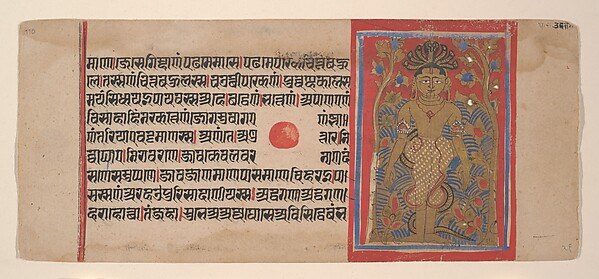
Parshvanatha’s Austerities, a fifteenth-century leaf from a Kalpasutra manuscript. Writing and painting share the page, placing the tirthankara’s sacred story within an illustrated textual inheritance.
The Metropolitan Museum of Art. Anonymous Gift, 1957. Accession 57.185.4. Public Domain (CC0). · Museum record ↗ · CC0
What happens in a Jain temple?
Many Jains honour images of the tirthankaras through puja, offerings and praise. Digambara and Shvetambara Murtipujak traditions include this devotion, while Shvetambara Sthanakvasi and Terapanthi traditions reject image worship. A temple-based description therefore covers an important part of Jain life without representing every community. [9]
The liberated teacher is not understood to need food or gifts. Devotional action benefits the worshipper by directing attention towards the qualities of the Jina and the possibility of liberation. Temples can also support teaching, festival gatherings and the relationship between householders and ascetics. Donations and the provision of necessities sustain religious life, connecting devotion in stone images with the living discipline of monks and nuns. [9]
Mahavira Jayanti and Divali
Jain festivals recall decisive moments in the lives of the tirthankaras. Mahavira Jayanti celebrates Mahavira’s birth through worship, teaching and communal events. Narratives of the auspicious dreams preceding his birth can be retold through performances and ritual, bringing sacred history into family and community life. [10]
Divali commemorates Mahavira’s final liberation. Its lamps express a specifically Jain understanding of illumination and freedom, even though a festival of the same name has other meanings in neighbouring traditions. Sharing a calendar occasion does not make the stories identical. Study, song, meditation and celebration give the remembrance a living form, with practices differing among households and institutions. [10]
Paryushana, Das Lakshana and forgiveness
Paryushana and Das Lakshana are periods of intensified religious reflection associated especially with Shvetambara and Digambara observance respectively. Study, vows, restraint and pratikraman, a practice of examining and acknowledging faults, turn attention towards how harm has occurred. The festival period makes room for repair alongside aspiration. [12]
JAINA’s educational account stresses forgiving others and seeking their forgiveness, extending the concern beyond friends to people with whom relations are difficult. Practices and lengths of observance vary, and austerities belong within personal and communal religious discipline. The central movement is from seeing faults to changing one’s disposition. Religious effort is tested in the quality of a relationship as well as in the rigour of an observance. [12]
Reading the Jain symbol
A widely used Jain emblem brings several teachings into one design. A hand marked with ahimsa foregrounds nonviolence. Three dots represent the Three Jewels, while a crescent and dot indicate the liberated souls at the summit of the traditional cosmos. The outline itself evokes the shape of the inhabited universe. [11]
Some versions include the ancient swastika as a sign of four conditions of rebirth. Its meaning in Jain religious use long predates the Nazi appropriation of that form. Communities, especially in diaspora, may adapt the design because of the associations viewers bring to it. Read in its own setting, the emblem joins cosmology, ethical practice and the destination of liberation in a single visual account. [11]
Sources
- Jain Philosophy ↗Internet Encyclopedia of PhilosophyReturn to text ↑
- Mahavira ↗Harvard University, The Pluralism ProjectReturn to text ↑
- Jiva: The Souls of All Beings ↗Harvard University, The Pluralism ProjectReturn to text ↑
- Karma: Clouding of the Soul ↗Harvard University, The Pluralism ProjectReturn to text ↑
- An Ethic for Living ↗Harvard University, The Pluralism ProjectReturn to text ↑
- Ahimsa: Reverence for Life ↗Harvard University, The Pluralism ProjectReturn to text ↑
- Ahimsa in Daily Life ↗Harvard University, The Pluralism ProjectReturn to text ↑
- Jain Renouncers: Sky Clad and White Clad ↗Harvard University, The Pluralism ProjectReturn to text ↑
- Temples and Images ↗Harvard University, The Pluralism ProjectReturn to text ↑
- Celebrating Mahavira: Mahavira Jayanti and Divali ↗Harvard University, The Pluralism ProjectReturn to text ↑
- The Jain Symbol ↗Harvard University, The Pluralism ProjectReturn to text ↑
- Paryushan Parv and Das Lakshan: Celebration of the Soul ↗JAINA, Federation of Jain Associations in North AmericaReturn to text ↑
- Sacred Writings ↗JAINpedia, scholarly and manuscript resourceReturn to text ↑
- Parsvanatha's Austerities: Folio from a Kalpasutra Manuscript ↗The Metropolitan Museum of Art, Open Access collection
- Tirthankaras: Ford-Makers ↗Harvard University, The Pluralism ProjectReturn to text ↑
About this article & its sources
An introduction to Jain teachings and lived practice, distinguishing the obligations of renouncers and householders and the differences between major traditions.
Passage attributions
What is Jainism?
Passage 1: Internet Encyclopedia of Philosophy.
Passage 2: Internet Encyclopedia of Philosophy.
Passage 3: Internet Encyclopedia of Philosophy.
Mahavira and the path of the tirthankaras
Passage 1: Harvard University, The Pluralism Project.
Passage 2: Harvard University, The Pluralism Project.
Passage 3: Harvard University, The Pluralism Project.
Jiva: why every life matters
Passage 1: Harvard University, The Pluralism Project.
Passage 2: Harvard University, The Pluralism Project.
Karma as bondage
Passage 1: Harvard University, The Pluralism Project.
Passage 2: Harvard University, The Pluralism Project.
The Three Jewels and Five Vows
Passage 1: Harvard University, The Pluralism Project.
Passage 2: Harvard University, The Pluralism Project.
Ahimsa and attention to small lives
Passage 1: Harvard University, The Pluralism Project.
Passage 2: Harvard University, The Pluralism Project.
Nonviolence in everyday decisions
Passage 1: Harvard University, The Pluralism Project.
Passage 2: Harvard University, The Pluralism Project.
Anekantavada: the limits of a single viewpoint
Passage 1: Internet Encyclopedia of Philosophy.
Digambara and Shvetambara traditions
Passage 1: Harvard University, The Pluralism Project.
Passage 2: Harvard University, The Pluralism Project.
Which texts do Jains study?
Passage 1: JAINpedia, scholarly and manuscript resource.
Passage 2: JAINpedia, scholarly and manuscript resource.
What happens in a Jain temple?
Passage 1: Harvard University, The Pluralism Project.
Passage 2: Harvard University, The Pluralism Project.
Mahavira Jayanti and Divali
Passage 1: Harvard University, The Pluralism Project.
Passage 2: Harvard University, The Pluralism Project.