Angels
Explore angels in Jewish, Christian and Islamic traditions, from divine messengers and heavenly hierarchies to guardian prayer, sacred art and later esoteric writing.
In this article
What are angels?
Angels are beings who serve as divine messengers and agents in Jewish, Christian and Islamic traditions. The familiar English name comes through Greek angelos, meaning messenger; the Hebrew malakh likewise names a messenger. The function matters: an angel may announce, guide, protect or carry out a divine command. The name alone does not supply one description of what every such being must look like. [1]
Biblical accounts gathered in the Jewish Encyclopedia describe appearances in human form alongside fire and other extraordinary imagery. Later Jewish discussions develop different explanations of these encounters. Their variety is a useful starting point. The subject concerns how divine action is communicated and represented, as well as the beings said to communicate it. A messenger’s role, an appearance in a narrative and a philosopher’s account of spiritual existence answer different questions. [1]
Nature and heavenly orders
Maimonides: forms without bodies
Maimonides gives a particularly clear philosophical account in Foundations of the Torah. Angels are forms without matter. When prophetic writings describe them with wings, fire or a bodily shape, he reads those descriptions as prophetic imagery. The appearance conveys something about an encounter; it does not establish an angel’s physical anatomy. [2]
His ten ranks express differences of degree, rather than distance. A higher angel is not simply standing above a lower one somewhere in the sky. The ordering concerns the relations between these immaterial beings and the knowledge appropriate to them. The lowest rank, the ishim, is associated with communication to prophets. Even the highest beings have limited knowledge of the Creator. This account joins angelology to questions about prophecy, understanding and the distinction between God and everything created. It is Maimonides’ formulation, rather than a list binding every Jewish school. [2]
Christian orders and divine service
The Orthodox Church in America describes angels as created, bodiless powers. In a strict use of its terminology, angels are one of nine ranks; the broader everyday word covers the whole company. Gabriel is associated with divine announcement and Michael with spiritual warfare. Physical appearances in scripture are understood symbolically. The distinction between Creator and created spiritual beings remains essential: angels serve God and are not additional gods. [3]
What does a hierarchy do?
The Celestial Hierarchy describes hierarchy as an order of knowledge and activity directed towards likeness to God. Its author, conventionally called Pseudo-Dionysius, writes under the name of the biblical Dionysius. In chapter III, the organizing concern is how beings receive divine illumination and communicate what they receive. [4]
Purification, illumination and perfection name parts of this movement. Those who receive light also become able to pass it on, according to their capacity. Read in that setting, hierarchy means more than a ladder of prestigious names. It describes participation and service: the members of an order are changed through what they receive and through what they make available to others. This helps explain why Christian accounts of heavenly ranks belong within theology and worship, rather than functioning solely as catalogues of supernatural species. [4]
Revelation and prayer
Angels and revelation in Islam
Yaqeen Institute’s account of Islam places belief in angels among the six articles of faith, alongside belief in God, revealed books, prophets, the Last Day and divine decree. Gabriel has a central role in revelation: the Quran is understood as communicated to Muhammad through him. Angels therefore belong to the account of how divine guidance reaches human beings. [5]
Names and roles can cross religious boundaries while their theological settings differ. Yaqeen explains references to the Holy Spirit in its Islamic account as Gabriel. That usage belongs within Muslim teaching about revelation and should be distinguished from the Christian doctrine of the Trinity. A shared English expression does not make the underlying doctrines interchangeable. Studying angels across traditions requires attention to what a messenger communicates, who receives the message and how that communication is understood. [5]
Guardian angels in prayer
For many believers the subject is encountered in prayer before it is encountered in a diagram. In his Orthodox reflection Angels in Our Life, Lawrence Farley points to prayers surrounding childbirth and baptism, together with daily appeals for angelic guardianship. These prayers ask for protection and guidance within a life directed towards God. [6]
The guardian is understood here as a spiritual being with its own existence. Prayer addresses a relationship of assistance, rather than treating the angel as a decorative emblem. This setting also gives the language of protection a religious purpose: help is sought for faithful living, amid the ordinary vulnerability of human life. Farley’s account is an Orthodox example. It should not be silently made the explanation of every image, personal experience or guardian belief found elsewhere. [6]
Images and later reception
A messenger at the doorway
Petrus Christus’s Annunciation makes divine announcement visible through a meeting at a church doorway. Gabriel approaches Mary, while architecture and an outdoor setting give the encounter a recognizable world. The Met identifies the panel as part of a larger composition. Its wings, clothing and setting belong to a fifteenth-century artist’s representation of the event. Looking at the image beside theological accounts reveals two connected questions: what angels are understood to be, and how an encounter with one can be pictured. [7]
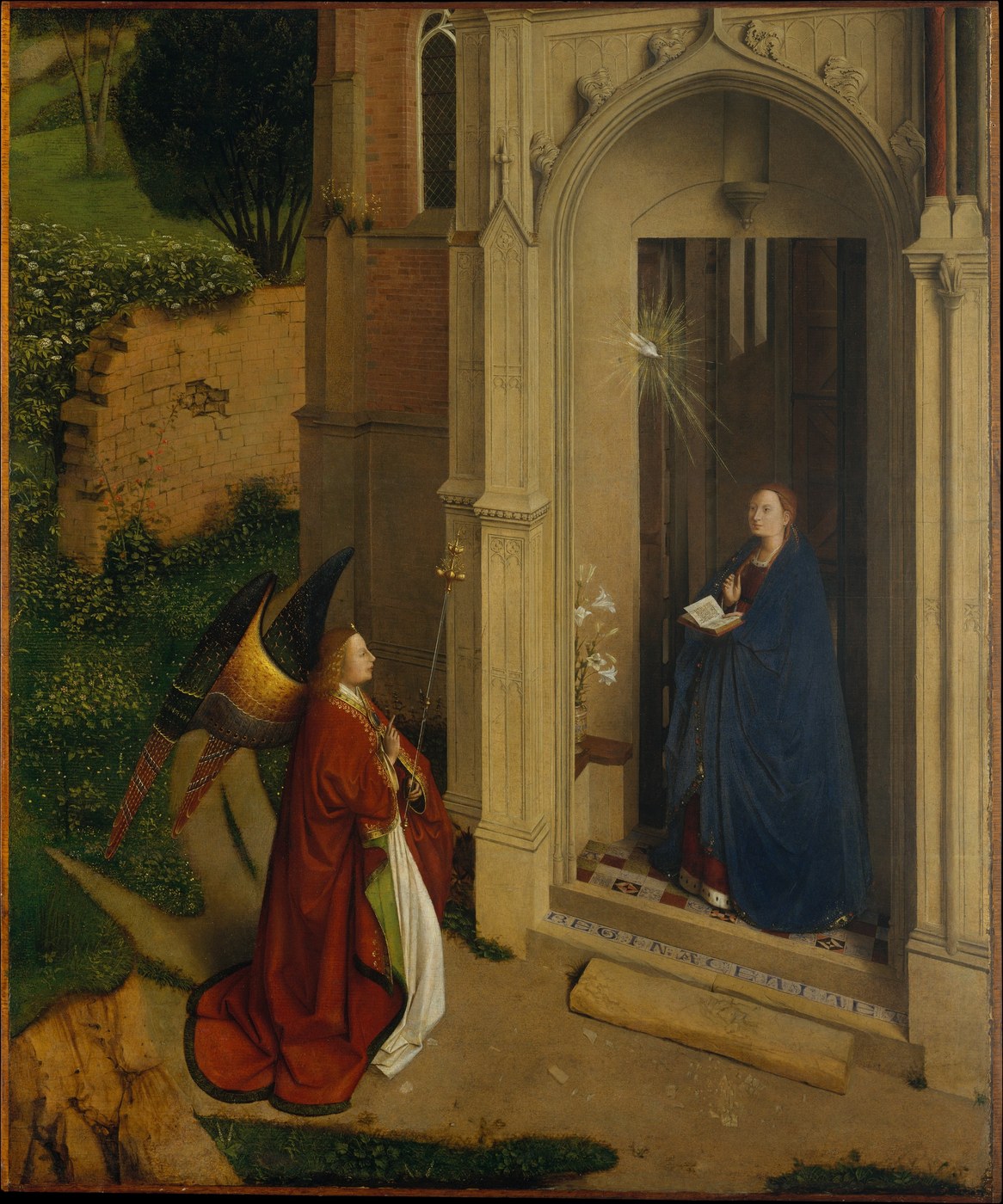
Petrus Christus, The Annunciation, ca. 1445. Oil on wood. Gabriel’s approach is pictured at a church doorway.
The Metropolitan Museum of Art. The Friedsam Collection, Bequest of Michael Friedsam, 1931. Accession 32.100.35. Public Domain (CC0). · Museum record ↗ · CC0
A later Theosophical account
C. W. Leadbeater’s The Astral Plane offers a different explanation of stories about guardian intervention. On the verified Library page, he discusses help from living or departed human beings, artificial elementals and, more rarely, devas. Some help works by strengthening a good intention already present in the person assisted. [8]
This is a historical Theosophical account, framed by Leadbeater’s claimed knowledge of an astral world. It connects with the existing entries on Guardian Angels in Theosophy and Devas in Theosophy. Keeping that setting explicit allows the reader to explore an influential esoteric reinterpretation without assigning its categories to Jewish, Christian or Islamic teaching. [8]
Read further in the library
The Astral Plane
Reading note
Leadbeater’s historical Theosophical account supplies the checked passage on guardian intervention. Its proposed astral categories are a distinct later interpretation, rather than a shared account of angels across religions.
Sources
- Angelology ↗Jewish Encyclopedia; historical reference, biblical sectionReturn to text ↑
- Mishneh Torah, Foundations of the Torah 2:3–9 ↗Maimonides; Eliyahu Touger translation, Moznaim, via SefariaReturn to text ↑
- Angels and Evil Spirits ↗The Orthodox Faith, Orthodox Church in America; institutional teachingReturn to text ↑
- The Celestial Hierarchy, chapter III ↗Pseudo-Dionysius; historical Christian account of hierarchy, hosted by CCELReturn to text ↑
- Basics of Islam: articles of faith ↗Yaqeen Institute; institutional Muslim explanationReturn to text ↑
- Angels in Our Life ↗Lawrence Farley, Orthodox Church in America, 11 April 2022Return to text ↑
- The Annunciation, Petrus Christus ↗The Metropolitan Museum of Art; ca. 1445, accession 32.100.35Return to text ↑
- The Astral Plane: guardian angels, printed page 93C. W. Leadbeater; historical Theosophical interpretation, verified Library leafReturn to text ↑
Examine the original Library page
Historical Theosophical account. Exact original leaf and live citation checked before use; not shared doctrine across the religious traditions discussed above.
All the stories of the intervention of guardian angels
Open the original page in The Astral Plane ↗Scan leaf 97 · C. W. Leadbeater
About this article & its sources
A comparative introduction to selected Jewish, Christian and Islamic accounts, with a separately identified Theosophical reception. Angelic ranks, embodiment and religious practice are attributed to their own sources.
Passage attributions
What are angels?
Passage 1: Jewish Encyclopedia; historical reference, biblical section.
Passage 2: Jewish Encyclopedia; historical reference, biblical section.
Maimonides: forms without bodies
Passage 1: Maimonides; Eliyahu Touger translation, Moznaim, via Sefaria.
Passage 2: Maimonides; Eliyahu Touger translation, Moznaim, via Sefaria.
Christian orders and divine service
Passage 1: The Orthodox Faith, Orthodox Church in America; institutional teaching.
What does a hierarchy do?
Passage 1: Pseudo-Dionysius; historical Christian account of hierarchy, hosted by CCEL.
Passage 2: Pseudo-Dionysius; historical Christian account of hierarchy, hosted by CCEL.
Angels and revelation in Islam
Passage 1: Yaqeen Institute; institutional Muslim explanation.
Passage 2: Yaqeen Institute; institutional Muslim explanation.
Guardian angels in prayer
Passage 1: Lawrence Farley, Orthodox Church in America, 11 April 2022.
Passage 2: Lawrence Farley, Orthodox Church in America, 11 April 2022.
A messenger at the doorway
Passage 1: The Metropolitan Museum of Art; ca. 1445, accession 32.100.35.