Spiritual Affinity
Spiritual affinity is a bond of shared affection, character or purpose. Compare soulmates, friendship and heavenly marriage in historical accounts.
In this article
What is spiritual affinity?
Spiritual affinity is a bond understood through affection, character or shared purpose. In Spiritualist books it can draw friends and relatives together after death, or make particular partners feel they belong to one another. [77][78][80][81]
Those bonds take several forms in the books: a chosen companion, a family household or a claim that one person has an enduring counterpart. Each form gives affinity a different place in life after death. [1][2][80][81]
See references (6)
- The Angels’ Diary and Celestion Study of Man, Reader page 185
- The Angels’ Diary and Celestion Study of Man, Reader page 186
- Life and Labor in the Spirit World, printed p. 32, Reader page 33
- Life and Labor in the Spirit World, printed p. 33, Reader page 34
- Life and Labor in the Spirit World, printed p. 70, Reader page 71
- Life and Labor in the Spirit World, printed p. 71, Reader page 72
Attraction and partnership
Lumen by Camille Flammarion
Camille Flammarion’s Lumen connects attraction, attention and recognition. During his return towards Earth, the narrator feels drawn to a sequence of scenes from his life. The dialogue compares this absorption with dreaming, when a compelling object occupies the mind and everything else fades. Its magnetism is therefore both a proposed movement of the soul and an image for concentrated attention. [86][87]
Affection gives the attraction a more personal setting. After witnessing his funeral, Lumen is drawn back towards Capella, where he meets his wife Sylvia. He explains the pull through invisible ties surviving death. They recognise one another and revisit scenes of their shared earthly love. The passage describes an enduring relationship without laying down a universal rule that every present attachment identifies one exclusive spiritual counterpart. [88][89][90]
The fourth conversation broadens the idea beyond a current partnership. A seemingly irresistible attraction turns Lumen’s gaze from Earth to another star, where he comes to recognise a former life. Similar landscapes and dispositions then help him interpret the tastes he brought into his earthly embodiment. The claimed connection can therefore concern a place, a former identity or a familiar kind of experience, as well as another person. [91][92][93][94]
The book later names psychic force as an unknown influence connecting living beings. Lovers separated by distance, appearances at a moment of death and parallel experiences of twins are presented as examples. Lumen treats such reports as convincing, but the dialogue does not supply the investigations needed to establish each case or distinguish competing explanations. Its assertion of proof should remain attributed to the speaker. [95][96][97]
These passages give affinity several roles without making them one demonstrated physical law. Attraction directs attention and travel in the celestial narrative; recognition links embodiments; affection sustains companionship; and psychic force is proposed to explain distant sympathy. Reading each setting separately preserves what is distinctive about the book’s account. [86][89][90][92][93][95][96][97]
The Angels’ Diary
The volume attributed to Effie M. Shirey and Charles Samson includes Hilda, a celestial romance itself attributed to Nathaniel Hawthorne. Its heroine is spiritually betrothed before birth. During earthly life she sees and speaks with a companion in the celestial world. Spiritual sight keeps the relationship available across their different conditions. [1][2]
The earthly friends around her know nothing of the romance. They find her fascinating and difficult to understand. The story gives affinity both an intimate and a hidden character. A relationship that shapes a life can remain invisible to the people who share its outward circumstances. [2]
A footnote supplies an interpretation. It says there is no marriage in heaven and describes the bond between soulmates as purely spiritual. It also says few people find their soulmate on earth, while those who do meet live in complete harmony. The note offers a general teaching beside the particular romance. [1][2]
The account concerns a specific kind of relationship. The prior betrothal, the companion’s celestial residence and Hilda’s continuing vision each contribute to its meaning. The novel is reported as a work in the book’s heavenly library, so the reference documents what the communicated text says about Hawthorne and affinity. [1][2]
Elsewhere in the volume, family reunions and the fifth sphere’s waiting relatives picture love surviving through many relationships. The soulmate passage adds the claim of a uniquely matched companion. Reading these examples together shows several ways in which the book makes enduring affection part of life beyond death. [3][4][2]
Gone West by J. S. M. Ward
In J. S. M. Ward’s Gone West, H. J. L., one of Ward’s reported spirit contributors, describes spiritual marriage as a future union of complementary people. At his own stage, men and women are said to associate little while earthly sexual attachments are being left behind. Increasing spiritual development allows them to draw together again. The account makes affinity part of a gradual change in how relationship is experienced. [5][6]
He places the eventual union beyond his present plane and acknowledges that he cannot fully understand it. Two people are said to become part of one another while each retains an individual identity. Earthly marriage at its highest offers an analogy for the union, but an earthly spouse is not necessarily the person’s spiritual complement. [6]
During a later visit to the astral plane, Ward describes a man meeting a young woman with obvious delight. His guide calls them twin souls who have already met there, although they have not met on earth. He hopes they will meet during earthly life, but does not claim to know that they will. The promised bond and the circumstances of a particular lifetime remain separate questions. [7]
These scenes give the idea two timescales: an encounter during sleep and a union beyond the narrator’s present experience. The language of twins names a particular relationship; the account of spiritual marriage explains how such a relationship might develop. Both remain teachings attributed to Ward’s contributors. [6][7]
A Subaltern in Spirit Land by J. S. M. Ward
J. S. M. Ward’s A Subaltern in Spirit Land complicates any simple expectation that earthly marriage identifies a permanent spiritual partner. Rex, Ward’s deceased brother, reports couples reunited on the astral plane, but also jealousy between successive spouses, affectionate arrangements and people searching unsuccessfully for a partner. One husband fears that his wife’s earlier death and greater spiritual development have placed her beyond his present reach. The chapter carries forward the difficulties of earthly relationships along with their attachments. [8][9][10]
When Ward asks about the biblical saying that people neither marry nor are given in marriage, H. J. L., one of Ward’s reported spirit contributors, assigns it to the spirit plane and distinguishes that condition from the more earthly relationships of the astral plane. This is his interpretation within Ward’s cosmology. The chapter therefore concerns the persistence and gradual alteration of personal ties; it does not identify every married couple as a uniquely matched pair of souls. [10]
A later family reunion makes the limits more personal. H. J. L. welcomes news of his wife’s arrival but says that she has passed beyond the region he can enter. He is glad for her even though their interests and spiritual positions differ. Here affection can survive separation, and a shared earthly life does not guarantee identical progress or permanent residence together. [11][12][13]
The seventh-division visit includes an elderly couple whose life together is described through duty and genuine affection. They say that their deaths occurred within a day of each other and that they were led away together by angelic guides. Yet even here they worry about separation when they pass onwards. Rex can offer only the limited information he has received. The scene presents a strong continuing bond without giving the reader an assured account of its ultimate form. [14][15]
See references (8)
- A Subaltern in Spirit Land, printed p. 108, Reader page 123
- A Subaltern in Spirit Land, printed p. 109, Reader page 124
- A Subaltern in Spirit Land, printed p. 110, Reader page 125
- A Subaltern in Spirit Land, printed p. 111, Reader page 126
- A Subaltern in Spirit Land, printed p. 112, Reader page 127
- A Subaltern in Spirit Land, printed p. 113, Reader page 128
- A Subaltern in Spirit Land, printed p. 296, Reader page 311
- A Subaltern in Spirit Land, printed p. 297, Reader page 312
The Encyclopaedia of Death and Life in Spirit-World, Volume I
J. R. Francis’s The Encyclopaedia of Death and Life in Spirit-World, Volume I, includes a guided vision by D. D. Glass. During a visit to a higher sphere, Glass asks about relationships between the sexes after death. The guide explains soulmates through shared aspirations and a blending of their auras. Compatibility depends on the condition and development of both partners. [16][17]
The account allows a pair to separate when one develops beyond the other. The guide describes this as a loss of attraction, with both people seeking more suitable companions. Separation is imagined as friendly and governed by spiritual affinity. It therefore need not mean betrayal or permanent exclusion from companionship. [17][18]
The dialogue also anticipates a later union so close that the partners no longer wish to part. It explains this through positive and negative forces, while saying that what mortals understand as the sex principle is eventually lost in a dual life. These are stages within the guide’s proposed system. The passage should not be reduced to a claim that every present attachment is eternal, or treated as a universal doctrine of relationships after death. [18]
See references (3)
Love in classical art
In Canova’s model for Cupid and Psyche, the two come together through an act of rescue. The embrace gives the classical story of these particular lovers a visible shape. The Spiritualist books ask a related question in their own terms: what makes two people belong together? [19]
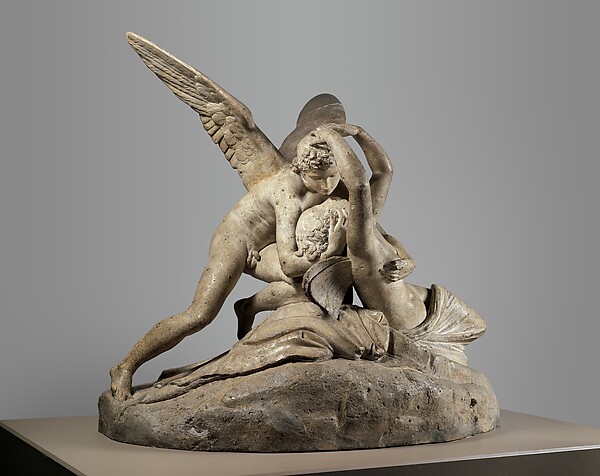
Antonio Canova, Cupid and Psyche, 1794. This plaster model shows Psyche rescued in Cupid’s embrace. Its classical lovers provide a visual comparison with the books’ ideas about spiritual companionship; the sculpture does not illustrate their particular soulmate teachings.
The Metropolitan Museum of Art. Gift of Isidor Straus, 1905. Accession 05.46. Public Domain. · Image source ↗ · Public Domain
Choice and companionship
A Wanderer in the Spirit Lands
In A Wanderer in the Spirit Lands, attributed to Franchezzo and transcribed by A. Farnese, love can connect people across different conditions. The living beloved’s care encourages Franchezzo, and he gradually becomes more able to communicate with her. Early in the story, however, his helpers require him to relinquish any demand that she sacrifice her freedom. She then chooses to continue the relationship. [20][21][22][23][28]
The book also describes enduring connections formed through hatred, guilt and ambition. An ancestor’s influence depends on a sympathy with his pride, and Franchezzo’s desire for revenge keeps him linked to an enemy. Forgiveness begins to loosen those ties. Affinity here concerns what people share in their desires and dispositions as well as whom they love. [24][25][26][29][30][31]
Benedetto’s story supplies an explicit limit to romantic reunion. His former passion is described as lacking true affinity. He and the woman concerned can forgive one another and still follow separate paths. Hassein, the narrator’s guide, similarly distinguishes a brief visit between relatives from a lasting home among people with shared interests and development. [27][32]
Franchezzo’s own permanent reunion remains a hope at the end: his beloved is still alive on earth. The narrative describes temporary visits and a sustained relationship, but it does not end by narrating her death or their final shared home. [33][34][35]
See references (16)
- A Wanderer in the Spirit Lands, Reader page 24
- A Wanderer in the Spirit Lands, Reader page 25
- A Wanderer in the Spirit Lands, Reader page 26
- A Wanderer in the Spirit Lands, Reader page 80
- A Wanderer in the Spirit Lands, Reader page 186
- A Wanderer in the Spirit Lands, Reader page 202
- A Wanderer in the Spirit Lands, Reader page 207
- A Wanderer in the Spirit Lands, Reader page 219
- A Wanderer in the Spirit Lands, Reader page 240
- A Wanderer in the Spirit Lands, Reader page 258
- A Wanderer in the Spirit Lands, Reader page 259
- A Wanderer in the Spirit Lands, Reader page 260
- A Wanderer in the Spirit Lands, Reader page 261
- A Wanderer in the Spirit Lands, Reader page 288
- A Wanderer in the Spirit Lands, Reader page 315
- A Wanderer in the Spirit Lands, Reader page 316
Evolution of Immortality
Evolution of Immortality, published by Freeman Benjamin Dowd as Rosicruciæ, makes spiritual partnership central to its account of perfection. A longing for complete companionship is interpreted as an inward image of a counterpart. When the same image becomes recognisable in both people, the book calls them twin souls. Their relationship is supposed to unite more than physical attraction or compatible interests. [39][40][41][42]
The author separates this union from the legal or ceremonial fact of marriage. Priestly rites and civil arrangements cannot create the bond he describes. At the same time, the appendix insists on monogamy as a Rosicrucian principle. These statements describe the particular fraternity and ideal presented by the book, rather than every relationship or every Rosicrucian organisation. [41][44]
The account also gives spiritual marriage an inward meaning. Thought and feeling, represented as masculine and feminine, are said to cooperate within each person. The same language of union is also applied to two spiritual counterparts. In the book’s scheme, personal development and mutual union belong together. Its language of counterparts should be read with its historical assumptions about sex and gender kept in view. [36][37][38][43][45]
See references (10)
- Evolution of Immortality, printed p. 60, Reader page 57
- Evolution of Immortality, printed p. 62, Reader page 59
- Evolution of Immortality, printed p. 63, Reader page 60
- Evolution of Immortality, printed p. 64, Reader page 61
- Evolution of Immortality, printed p. 65, Reader page 62
- Evolution of Immortality, printed p. 66, Reader page 63
- Evolution of Immortality, printed p. 67, Reader page 64
- Evolution of Immortality, printed p. 70, Reader page 67
- Evolution of Immortality, printed p. 141, Reader page 140
- Evolution of Immortality, printed p. 142, Reader page 141
Heaven and Its Wonders and Hell
Emanuel Swedenborg’s Heaven and Its Wonders and Hell describes heavenly marriage as a conjunction of two minds. The partners share willing and understanding so intimately that the pair can be spoken of as one angel. He grounds the union in the marriage of good and truth, using it to explain both the partners’ love and their participation in heavenly life. [46][47][48][49][50]
Mutuality is essential. Swedenborg says that both partners have understanding and will, and that neither predominates in a heavenly marriage. The wish to dominate destroys its delight because one person’s will is imposed without reciprocal sharing. Even outwardly peaceful spouses can therefore have very different inward relationships. [47][48][53][54][55]
Compatible partners are brought together by the Lord and recognise one another; their societies celebrate with marriage feasts. Heavenly conjunction produces good and truth in place of earthly offspring. Swedenborg uses this distinction to interpret the Gospel statement about neither marrying nor being given in marriage after resurrection. [56][57][58]
The account carries specific restrictions. It assumes male and female partners, rejects polygamy and denies genuine spiritual marriage between partners of different religions. These belong to Swedenborg’s theological model of good and truth. His emphasis on inner union also means that an earthly marriage may continue only temporarily after death if the partners’ ruling loves eventually separate them. [46][47][51][52][53][59][60]
Emanuel Swedenborg’s discussion of marriage in Heaven and Its Wonders and Hell requires a distinction between heavenly conjunction and earthly marrying. In §382[b], its offspring are good and truth rather than children. His interpretation of the Gospel saying about neither marrying nor being given in marriage depends on that change of meaning. [61][62]
The chapter also distinguishes a surviving outward bond from an inwardly shared life. Where love of domination governs, one will tries to occupy the other without reciprocal reception. In Swedenborg’s explanation this destroys the freedom and mutuality that make heavenly marriage possible, even if the earthly arrangement appears peaceful. [63][64][65]
Calling partners one angel is explained through two minds acting together in understanding and will. The image names the unity of their relationship. Its immediate explanation should be read before comparing it with another book’s proposed blending of two souls into a transformed body. [66][67][68][69][70]
Swedenborg’s account is not a guarantee that every earthly partnership continues in its existing form. He makes compatibility depend upon inward states and also imposes his own theological restrictions, including shared religion and monogamy. Those restrictions belong to his model rather than every account of reunion. [71][72][63][65][61][62][73]
Swedenborg explains one angel through two partners’ joined understanding and will. Dowd’s Evolution of Immortality also uses inward masculine and feminine powers, but goes on to propose perfected partners blending into a fire body. Conjunction of minds, cooperation of capacities within a person and a claimed transformed embodiment are three different relations; the shared language of two becoming one does not remove those differences. [74][75][36][66][67][68][69][62]
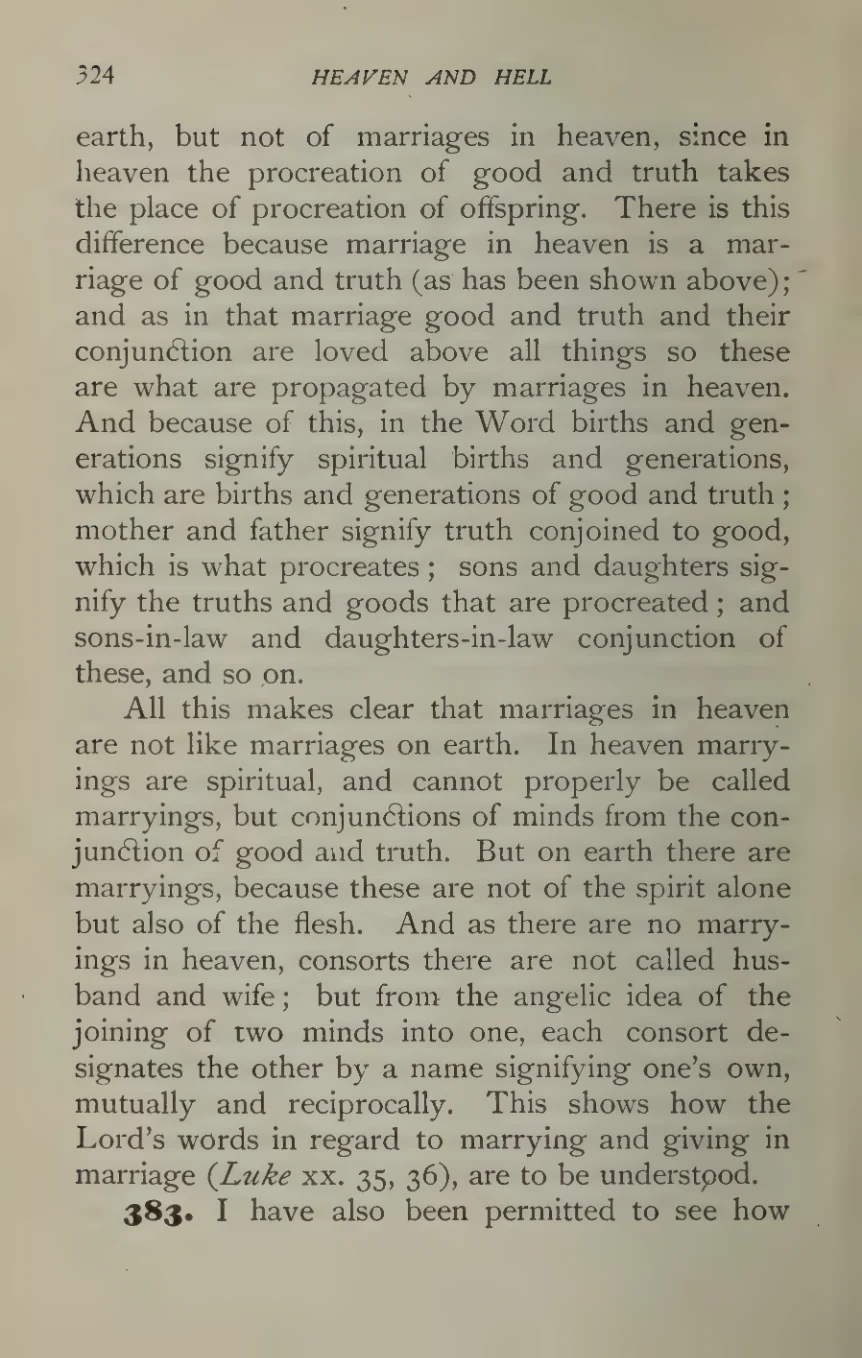
Source facsimile: Heaven and Its Wonders and Hell (1916), printed p. 324, Reader page 331.
Emanuel Swedenborg, Heaven and Its Wonders and Hell, J. C. Ager translation, New York, 1916. Public-domain historical page from the checksum-verified Library PDF. · Image source ↗ · Public Domain
See references (31)
- Evolution of Immortality, printed p. 60, Reader page 57
- Heaven and Its Wonders and Hell, printed p. 311, Reader page 318
- Heaven and Its Wonders and Hell, printed p. 312, Reader page 319
- Heaven and Its Wonders and Hell, printed p. 313, Reader page 320
- Heaven and Its Wonders and Hell, printed p. 314, Reader page 321
- Heaven and Its Wonders and Hell, printed p. 315, Reader page 322
- Heaven and Its Wonders and Hell, printed p. 318, Reader page 325
- Heaven and Its Wonders and Hell, printed p. 319, Reader page 326
- Heaven and Its Wonders and Hell, printed p. 320, Reader page 327
- Heaven and Its Wonders and Hell, printed p. 321, Reader page 328
- Heaven and Its Wonders and Hell, printed p. 322, Reader page 329
- Heaven and Its Wonders and Hell, printed p. 323, Reader page 330
- Heaven and Its Wonders and Hell, printed p. 324, Reader page 331
- Heaven and Its Wonders and Hell, printed p. 325, Reader page 332
- Heaven and Its Wonders and Hell, printed p. 447, Reader page 454
- Heaven and Its Wonders and Hell, printed p. 448, Reader page 455
- Heaven and Its Wonders and Hell, printed p. 323, Reader page 330
- Heaven and Its Wonders and Hell, printed p. 324, Reader page 331
- Heaven and Its Wonders and Hell, printed p. 320, Reader page 327
- Heaven and Its Wonders and Hell, printed p. 321, Reader page 328
- Heaven and Its Wonders and Hell, printed p. 322, Reader page 329
- Heaven and Its Wonders and Hell, printed p. 311, Reader page 318
- Heaven and Its Wonders and Hell, printed p. 312, Reader page 319
- Heaven and Its Wonders and Hell, printed p. 313, Reader page 320
- Heaven and Its Wonders and Hell, printed p. 314, Reader page 321
- Heaven and Its Wonders and Hell, printed p. 315, Reader page 322
- Heaven and Its Wonders and Hell, printed p. 318, Reader page 325
- Heaven and Its Wonders and Hell, printed p. 319, Reader page 326
- Heaven and Its Wonders and Hell, printed p. 325, Reader page 332
- Evolution of Immortality, printed p. 20, Reader page 17
- Evolution of Immortality, printed p. 21, Reader page 18
Life and Labor in the Spirit World: Shelhamer’s spirit-band
In Life and Labor in the Spirit World, credited to the medium M. T. Shelhamer’s spirit-band, Spirit Violet describes affection connecting the dead with living friends. Thought forms a magnetic chain through which she can communicate from her own home. A bond can therefore remain active across the supposed boundary without requiring a physical journey in every instance. [76][77][78]
Her shared household gives affinity a wider social form. Eight young spirits exchange knowledge, with private rooms available for solitude. More experienced guides are related to them through spiritual sympathy as well as family connection. The bonds of kinship and affinity coexist, while the group remains open to further development and useful work. [79][80][81]
The same vocabulary supports care beyond a particular household. Violet describes helpers strengthening another person through kindly thought and imagines spirits working together to protect a medium. Affection is treated as an active spiritual influence, with friendship and practical assistance as well as intimate partnership among its forms. [82][83][84][85]
See references (10)
- Life and Labor in the Spirit World, printed p. 31, Reader page 32
- Life and Labor in the Spirit World, printed p. 32, Reader page 33
- Life and Labor in the Spirit World, printed p. 33, Reader page 34
- Life and Labor in the Spirit World, printed p. 69, Reader page 70
- Life and Labor in the Spirit World, printed p. 70, Reader page 71
- Life and Labor in the Spirit World, printed p. 71, Reader page 72
- Life and Labor in the Spirit World, printed p. 194, Reader page 195
- Life and Labor in the Spirit World, printed p. 224, Reader page 225
- Life and Labor in the Spirit World, printed p. 225, Reader page 226
- Life and Labor in the Spirit World, printed p. 226, Reader page 227
A bond, a counterpart and a lasting union
The Hilda romance imagines a spiritual betrothal before earthly life. Dowd makes twin souls part of a theory of perfection. Ward’s sequel follows relationships marked by jealousy, separation and unequal development. These stories give spiritual affinity different implications for a present partnership. [1][2][39][40][41][42][8][9][10][14][15]
Franchezzo’s beloved retains the freedom to choose. Swedenborg says outward partners can separate if their deepest loves differ. In both cases, attachment during earthly life leaves a question about what will happen later. [20][21][22][23][28][33][34][35][46][47][48][49][50][51][52][53][59][60]
The Angels’ Diary gives Hilda a particular partner. Violet’s ties in Shelhamer’s collection extend to friends, relatives and teachers. Kinship and friendship give affinity a wider reach than the search for a counterpart. [1][2][77][78][80][81]
Flammarion makes concentrated attention part of his account of travel towards people and places. Swedenborg makes heavenly marriage a reciprocal joining of understanding and will. One account asks how someone is drawn elsewhere, and the other asks what makes a union last. [76][77][78][20][21][22][47][48][86][87][89][90][91][92][95][96]
See references (42)
- The Angels’ Diary and Celestion Study of Man, Reader page 185
- The Angels’ Diary and Celestion Study of Man, Reader page 186
- A Subaltern in Spirit Land, printed p. 108, Reader page 123
- A Subaltern in Spirit Land, printed p. 109, Reader page 124
- A Subaltern in Spirit Land, printed p. 110, Reader page 125
- A Subaltern in Spirit Land, printed p. 296, Reader page 311
- A Subaltern in Spirit Land, printed p. 297, Reader page 312
- A Wanderer in the Spirit Lands, Reader page 24
- A Wanderer in the Spirit Lands, Reader page 25
- A Wanderer in the Spirit Lands, Reader page 26
- A Wanderer in the Spirit Lands, Reader page 80
- A Wanderer in the Spirit Lands, Reader page 240
- A Wanderer in the Spirit Lands, Reader page 288
- A Wanderer in the Spirit Lands, Reader page 315
- A Wanderer in the Spirit Lands, Reader page 316
- Evolution of Immortality, printed p. 64, Reader page 61
- Evolution of Immortality, printed p. 65, Reader page 62
- Evolution of Immortality, printed p. 66, Reader page 63
- Evolution of Immortality, printed p. 67, Reader page 64
- Heaven and Its Wonders and Hell, printed p. 311, Reader page 318
- Heaven and Its Wonders and Hell, printed p. 312, Reader page 319
- Heaven and Its Wonders and Hell, printed p. 313, Reader page 320
- Heaven and Its Wonders and Hell, printed p. 314, Reader page 321
- Heaven and Its Wonders and Hell, printed p. 315, Reader page 322
- Heaven and Its Wonders and Hell, printed p. 318, Reader page 325
- Heaven and Its Wonders and Hell, printed p. 319, Reader page 326
- Heaven and Its Wonders and Hell, printed p. 320, Reader page 327
- Heaven and Its Wonders and Hell, printed p. 447, Reader page 454
- Heaven and Its Wonders and Hell, printed p. 448, Reader page 455
- Life and Labor in the Spirit World, printed p. 31, Reader page 32
- Life and Labor in the Spirit World, printed p. 32, Reader page 33
- Life and Labor in the Spirit World, printed p. 33, Reader page 34
- Life and Labor in the Spirit World, printed p. 70, Reader page 71
- Life and Labor in the Spirit World, printed p. 71, Reader page 72
- Lumen, Reader page 63
- Lumen, Reader page 64
- Lumen, Reader page 66
- Lumen, Reader page 67
- Lumen, Reader page 142
- Lumen, Reader page 143
- Lumen, Reader page 166
- Lumen, Reader page 167
Read further in the library
The Angels’ Diary and Celestion Study of Man
Reading note
Hilda and her celestial companion. Read the original passage in the 1903 edition.

Gone West
Reading note
Ward’s separately attributed account, with exact pages of the consulted edition.
A Subaltern in Spirit Land: A Sequel to Gone West
Reading note
Ward’s sequel supplies a distinct account of this subject, cited to the 1920 edition.
The Encyclopaedia of Death and Life in the Spirit-World, Volume I
Reading note
D. D. Glass’s distinct account of changing companionship and a proposed eventual dual life.

A Wanderer in the Spirit Lands
Reading note
Love, resentment, shared interests and forgiveness create or loosen different kinds of connection.
Evolution of Immortality
Reading note
A sustained discussion of twin souls, inward conjunction and the difference between legal and spiritual marriage.

Heaven and Its Wonders and Hell
Reading note
Heavenly marriage joins minds through reciprocal sharing and freedom, within Swedenborg’s particular theological model.
Life and Labour in the Spirit World
Reading note
The separately titled account draws on exact passages in the consulted Library edition.

Lumen
Reading note
The separately titled account draws on exact passages in the consulted Library edition.
Sources
See references (97)
- The Angels’ Diary and Celestion Study of Man, Reader page 185Effie M. Shirey and Charles Samson, The Angels’ Diary and Celestion Study of Man (1903).Read this page in The Angels’ Diary and Celestion Study of Man ↗Return to text ↑
- The Angels’ Diary and Celestion Study of Man, Reader page 186Effie M. Shirey and Charles Samson, The Angels’ Diary and Celestion Study of Man (1903).Read this page in The Angels’ Diary and Celestion Study of Man ↗Return to text ↑
- The Angels’ Diary and Celestion Study of Man, Reader page 36Effie M. Shirey and Charles Samson, The Angels’ Diary and Celestion Study of Man (1903).Read this page in The Angels’ Diary and Celestion Study of Man ↗Return to text ↑
- The Angels’ Diary and Celestion Study of Man, Reader page 59Effie M. Shirey and Charles Samson, The Angels’ Diary and Celestion Study of Man (1903).Read this page in The Angels’ Diary and Celestion Study of Man ↗Return to text ↑
- Gone West, printed p. 58, Reader page 71J. S. M. Ward, Gone West, 1920 third impression in the 2009 Geoff Cutler digital transcription.Read this page in Gone West ↗Return to text ↑
- Gone West, printed p. 59, Reader page 72J. S. M. Ward, Gone West, 1920 third impression in the 2009 Geoff Cutler digital transcription.Read this page in Gone West ↗Return to text ↑
- Gone West, printed p. 78, Reader page 91J. S. M. Ward, Gone West, 1920 third impression in the 2009 Geoff Cutler digital transcription.Read this page in Gone West ↗Return to text ↑
- A Subaltern in Spirit Land, printed p. 108, Reader page 123J. S. M. Ward, A Subaltern in Spirit Land: A Sequel to Gone West, William Rider & Son, 1920.Read this page in A Subaltern in Spirit Land: A Sequel to Gone West ↗Return to text ↑
- A Subaltern in Spirit Land, printed p. 109, Reader page 124J. S. M. Ward, A Subaltern in Spirit Land: A Sequel to Gone West, William Rider & Son, 1920.Read this page in A Subaltern in Spirit Land: A Sequel to Gone West ↗Return to text ↑
- A Subaltern in Spirit Land, printed p. 110, Reader page 125J. S. M. Ward, A Subaltern in Spirit Land: A Sequel to Gone West, William Rider & Son, 1920.Read this page in A Subaltern in Spirit Land: A Sequel to Gone West ↗Return to text ↑
- A Subaltern in Spirit Land, printed p. 111, Reader page 126J. S. M. Ward, A Subaltern in Spirit Land: A Sequel to Gone West, William Rider & Son, 1920.Read this page in A Subaltern in Spirit Land: A Sequel to Gone West ↗Return to text ↑
- A Subaltern in Spirit Land, printed p. 112, Reader page 127J. S. M. Ward, A Subaltern in Spirit Land: A Sequel to Gone West, William Rider & Son, 1920.Read this page in A Subaltern in Spirit Land: A Sequel to Gone West ↗Return to text ↑
- A Subaltern in Spirit Land, printed p. 113, Reader page 128J. S. M. Ward, A Subaltern in Spirit Land: A Sequel to Gone West, William Rider & Son, 1920.Read this page in A Subaltern in Spirit Land: A Sequel to Gone West ↗Return to text ↑
- A Subaltern in Spirit Land, printed p. 296, Reader page 311J. S. M. Ward, A Subaltern in Spirit Land: A Sequel to Gone West, William Rider & Son, 1920.Read this page in A Subaltern in Spirit Land: A Sequel to Gone West ↗Return to text ↑
- A Subaltern in Spirit Land, printed p. 297, Reader page 312J. S. M. Ward, A Subaltern in Spirit Land: A Sequel to Gone West, William Rider & Son, 1920.Read this page in A Subaltern in Spirit Land: A Sequel to Gone West ↗Return to text ↑
- The Encyclopaedia of Death and Life in Spirit-World, Volume I, printed p. 253, Reader page 252D. D. Glass, account reproduced in J. R. Francis (compiler), The Encyclopaedia of Death and Life in Spirit-World, Volume I, fourth edition, Chicago, 1903, printed pp. 253–257.Read this page in The Encyclopaedia of Death and Life in the Spirit-World, Volume I ↗Return to text ↑
- The Encyclopaedia of Death and Life in Spirit-World, Volume I, printed p. 256, Reader page 255D. D. Glass, account reproduced in J. R. Francis (compiler), The Encyclopaedia of Death and Life in Spirit-World, Volume I, fourth edition, Chicago, 1903, printed pp. 253–257.Read this page in The Encyclopaedia of Death and Life in the Spirit-World, Volume I ↗Return to text ↑
- The Encyclopaedia of Death and Life in Spirit-World, Volume I, printed p. 257, Reader page 256D. D. Glass, account reproduced in J. R. Francis (compiler), The Encyclopaedia of Death and Life in Spirit-World, Volume I, fourth edition, Chicago, 1903, printed pp. 253–257.Read this page in The Encyclopaedia of Death and Life in the Spirit-World, Volume I ↗Return to text ↑
- The Metropolitan Museum of Art: Cupid and Psyche, Antonio Canova, 1794 ↗The Metropolitan Museum of Art, object 188954, accession 05.46. Object record identifies a full-scale plaster model, Gift of Isidor Straus, 1905. Public-domain image and official object API checked.Return to text ↑
- A Wanderer in the Spirit Lands, Reader page 24Franchezzo (source attribution), A Wanderer in the Spirit Lands, transcribed by A. Farnese. W. J. Sinkins, London, 1896. Date confirmed on the consulted title-page facsimile.Read this page in A Wanderer in the Spirit Lands ↗Return to text ↑
- A Wanderer in the Spirit Lands, Reader page 25Franchezzo (source attribution), A Wanderer in the Spirit Lands, transcribed by A. Farnese. W. J. Sinkins, London, 1896. Date confirmed on the consulted title-page facsimile.Read this page in A Wanderer in the Spirit Lands ↗Return to text ↑
- A Wanderer in the Spirit Lands, Reader page 26Franchezzo (source attribution), A Wanderer in the Spirit Lands, transcribed by A. Farnese. W. J. Sinkins, London, 1896. Date confirmed on the consulted title-page facsimile.Read this page in A Wanderer in the Spirit Lands ↗Return to text ↑
- A Wanderer in the Spirit Lands, Reader page 80Franchezzo (source attribution), A Wanderer in the Spirit Lands, transcribed by A. Farnese. W. J. Sinkins, London, 1896. Date confirmed on the consulted title-page facsimile.Read this page in A Wanderer in the Spirit Lands ↗Return to text ↑
- A Wanderer in the Spirit Lands, Reader page 186Franchezzo (source attribution), A Wanderer in the Spirit Lands, transcribed by A. Farnese. W. J. Sinkins, London, 1896. Date confirmed on the consulted title-page facsimile.Read this page in A Wanderer in the Spirit Lands ↗Return to text ↑
- A Wanderer in the Spirit Lands, Reader page 202Franchezzo (source attribution), A Wanderer in the Spirit Lands, transcribed by A. Farnese. W. J. Sinkins, London, 1896. Date confirmed on the consulted title-page facsimile.Read this page in A Wanderer in the Spirit Lands ↗Return to text ↑
- A Wanderer in the Spirit Lands, Reader page 207Franchezzo (source attribution), A Wanderer in the Spirit Lands, transcribed by A. Farnese. W. J. Sinkins, London, 1896. Date confirmed on the consulted title-page facsimile.Read this page in A Wanderer in the Spirit Lands ↗Return to text ↑
- A Wanderer in the Spirit Lands, Reader page 219Franchezzo (source attribution), A Wanderer in the Spirit Lands, transcribed by A. Farnese. W. J. Sinkins, London, 1896. Date confirmed on the consulted title-page facsimile.Read this page in A Wanderer in the Spirit Lands ↗Return to text ↑
- A Wanderer in the Spirit Lands, Reader page 240Franchezzo (source attribution), A Wanderer in the Spirit Lands, transcribed by A. Farnese. W. J. Sinkins, London, 1896. Date confirmed on the consulted title-page facsimile.Read this page in A Wanderer in the Spirit Lands ↗Return to text ↑
- A Wanderer in the Spirit Lands, Reader page 258Franchezzo (source attribution), A Wanderer in the Spirit Lands, transcribed by A. Farnese. W. J. Sinkins, London, 1896. Date confirmed on the consulted title-page facsimile.Read this page in A Wanderer in the Spirit Lands ↗Return to text ↑
- A Wanderer in the Spirit Lands, Reader page 259Franchezzo (source attribution), A Wanderer in the Spirit Lands, transcribed by A. Farnese. W. J. Sinkins, London, 1896. Date confirmed on the consulted title-page facsimile.Read this page in A Wanderer in the Spirit Lands ↗Return to text ↑
- A Wanderer in the Spirit Lands, Reader page 260Franchezzo (source attribution), A Wanderer in the Spirit Lands, transcribed by A. Farnese. W. J. Sinkins, London, 1896. Date confirmed on the consulted title-page facsimile.Read this page in A Wanderer in the Spirit Lands ↗Return to text ↑
- A Wanderer in the Spirit Lands, Reader page 261Franchezzo (source attribution), A Wanderer in the Spirit Lands, transcribed by A. Farnese. W. J. Sinkins, London, 1896. Date confirmed on the consulted title-page facsimile.Read this page in A Wanderer in the Spirit Lands ↗Return to text ↑
- A Wanderer in the Spirit Lands, Reader page 288Franchezzo (source attribution), A Wanderer in the Spirit Lands, transcribed by A. Farnese. W. J. Sinkins, London, 1896. Date confirmed on the consulted title-page facsimile.Read this page in A Wanderer in the Spirit Lands ↗Return to text ↑
- A Wanderer in the Spirit Lands, Reader page 315Franchezzo (source attribution), A Wanderer in the Spirit Lands, transcribed by A. Farnese. W. J. Sinkins, London, 1896. Date confirmed on the consulted title-page facsimile.Read this page in A Wanderer in the Spirit Lands ↗Return to text ↑
- A Wanderer in the Spirit Lands, Reader page 316Franchezzo (source attribution), A Wanderer in the Spirit Lands, transcribed by A. Farnese. W. J. Sinkins, London, 1896. Date confirmed on the consulted title-page facsimile.Read this page in A Wanderer in the Spirit Lands ↗Return to text ↑
- Evolution of Immortality, printed p. 60, Reader page 57Rosicruciæ (catalogued as Freeman Benjamin Dowd), Evolution of Immortality. Eulian Publishing Company, Salem, 1900.Read this page in Evolution of Immortality ↗Return to text ↑
- Evolution of Immortality, printed p. 62, Reader page 59Rosicruciæ (catalogued as Freeman Benjamin Dowd), Evolution of Immortality. Eulian Publishing Company, Salem, 1900.Read this page in Evolution of Immortality ↗Return to text ↑
- Evolution of Immortality, printed p. 63, Reader page 60Rosicruciæ (catalogued as Freeman Benjamin Dowd), Evolution of Immortality. Eulian Publishing Company, Salem, 1900.Read this page in Evolution of Immortality ↗Return to text ↑
- Evolution of Immortality, printed p. 64, Reader page 61Rosicruciæ (catalogued as Freeman Benjamin Dowd), Evolution of Immortality. Eulian Publishing Company, Salem, 1900.Read this page in Evolution of Immortality ↗Return to text ↑
- Evolution of Immortality, printed p. 65, Reader page 62Rosicruciæ (catalogued as Freeman Benjamin Dowd), Evolution of Immortality. Eulian Publishing Company, Salem, 1900.Read this page in Evolution of Immortality ↗Return to text ↑
- Evolution of Immortality, printed p. 66, Reader page 63Rosicruciæ (catalogued as Freeman Benjamin Dowd), Evolution of Immortality. Eulian Publishing Company, Salem, 1900.Read this page in Evolution of Immortality ↗Return to text ↑
- Evolution of Immortality, printed p. 67, Reader page 64Rosicruciæ (catalogued as Freeman Benjamin Dowd), Evolution of Immortality. Eulian Publishing Company, Salem, 1900.Read this page in Evolution of Immortality ↗Return to text ↑
- Evolution of Immortality, printed p. 70, Reader page 67Rosicruciæ (catalogued as Freeman Benjamin Dowd), Evolution of Immortality. Eulian Publishing Company, Salem, 1900.Read this page in Evolution of Immortality ↗Return to text ↑
- Evolution of Immortality, printed p. 141, Reader page 140Rosicruciæ (catalogued as Freeman Benjamin Dowd), Evolution of Immortality. Eulian Publishing Company, Salem, 1900.Read this page in Evolution of Immortality ↗Return to text ↑
- Evolution of Immortality, printed p. 142, Reader page 141Rosicruciæ (catalogued as Freeman Benjamin Dowd), Evolution of Immortality. Eulian Publishing Company, Salem, 1900.Read this page in Evolution of Immortality ↗Return to text ↑
- Heaven and Its Wonders and Hell, printed p. 311, Reader page 318Emanuel Swedenborg, Heaven and Its Wonders and Hell, translated by J. C. Ager. The American Swedenborg Printing and Publishing Society, New York, 1916. Original Latin work first published in 1758.Read this page in Heaven and Its Wonders and Hell ↗Return to text ↑
- Heaven and Its Wonders and Hell, printed p. 312, Reader page 319Emanuel Swedenborg, Heaven and Its Wonders and Hell, translated by J. C. Ager. The American Swedenborg Printing and Publishing Society, New York, 1916. Original Latin work first published in 1758.Read this page in Heaven and Its Wonders and Hell ↗Return to text ↑
- Heaven and Its Wonders and Hell, printed p. 313, Reader page 320Emanuel Swedenborg, Heaven and Its Wonders and Hell, translated by J. C. Ager. The American Swedenborg Printing and Publishing Society, New York, 1916. Original Latin work first published in 1758.Read this page in Heaven and Its Wonders and Hell ↗Return to text ↑
- Heaven and Its Wonders and Hell, printed p. 314, Reader page 321Emanuel Swedenborg, Heaven and Its Wonders and Hell, translated by J. C. Ager. The American Swedenborg Printing and Publishing Society, New York, 1916. Original Latin work first published in 1758.Read this page in Heaven and Its Wonders and Hell ↗Return to text ↑
- Heaven and Its Wonders and Hell, printed p. 315, Reader page 322Emanuel Swedenborg, Heaven and Its Wonders and Hell, translated by J. C. Ager. The American Swedenborg Printing and Publishing Society, New York, 1916. Original Latin work first published in 1758.Read this page in Heaven and Its Wonders and Hell ↗Return to text ↑
- Heaven and Its Wonders and Hell, printed p. 318, Reader page 325Emanuel Swedenborg, Heaven and Its Wonders and Hell, translated by J. C. Ager. The American Swedenborg Printing and Publishing Society, New York, 1916. Original Latin work first published in 1758.Read this page in Heaven and Its Wonders and Hell ↗Return to text ↑
- Heaven and Its Wonders and Hell, printed p. 319, Reader page 326Emanuel Swedenborg, Heaven and Its Wonders and Hell, translated by J. C. Ager. The American Swedenborg Printing and Publishing Society, New York, 1916. Original Latin work first published in 1758.Read this page in Heaven and Its Wonders and Hell ↗Return to text ↑
- Heaven and Its Wonders and Hell, printed p. 320, Reader page 327Emanuel Swedenborg, Heaven and Its Wonders and Hell, translated by J. C. Ager. The American Swedenborg Printing and Publishing Society, New York, 1916. Original Latin work first published in 1758.Read this page in Heaven and Its Wonders and Hell ↗Return to text ↑
- Heaven and Its Wonders and Hell, printed p. 321, Reader page 328Emanuel Swedenborg, Heaven and Its Wonders and Hell, translated by J. C. Ager. The American Swedenborg Printing and Publishing Society, New York, 1916. Original Latin work first published in 1758.Read this page in Heaven and Its Wonders and Hell ↗Return to text ↑
- Heaven and Its Wonders and Hell, printed p. 322, Reader page 329Emanuel Swedenborg, Heaven and Its Wonders and Hell, translated by J. C. Ager. The American Swedenborg Printing and Publishing Society, New York, 1916. Original Latin work first published in 1758.Read this page in Heaven and Its Wonders and Hell ↗Return to text ↑
- Heaven and Its Wonders and Hell, printed p. 323, Reader page 330Emanuel Swedenborg, Heaven and Its Wonders and Hell, translated by J. C. Ager. The American Swedenborg Printing and Publishing Society, New York, 1916. Original Latin work first published in 1758.Read this page in Heaven and Its Wonders and Hell ↗Return to text ↑
- Heaven and Its Wonders and Hell, printed p. 324, Reader page 331Emanuel Swedenborg, Heaven and Its Wonders and Hell, translated by J. C. Ager. The American Swedenborg Printing and Publishing Society, New York, 1916. Original Latin work first published in 1758.Read this page in Heaven and Its Wonders and Hell ↗Return to text ↑
- Heaven and Its Wonders and Hell, printed p. 325, Reader page 332Emanuel Swedenborg, Heaven and Its Wonders and Hell, translated by J. C. Ager. The American Swedenborg Printing and Publishing Society, New York, 1916. Original Latin work first published in 1758.Read this page in Heaven and Its Wonders and Hell ↗Return to text ↑
- Heaven and Its Wonders and Hell, printed p. 447, Reader page 454Emanuel Swedenborg, Heaven and Its Wonders and Hell, translated by J. C. Ager. The American Swedenborg Printing and Publishing Society, New York, 1916. Original Latin work first published in 1758.Read this page in Heaven and Its Wonders and Hell ↗Return to text ↑
- Heaven and Its Wonders and Hell, printed p. 448, Reader page 455Emanuel Swedenborg, Heaven and Its Wonders and Hell, translated by J. C. Ager. The American Swedenborg Printing and Publishing Society, New York, 1916. Original Latin work first published in 1758.Read this page in Heaven and Its Wonders and Hell ↗Return to text ↑
- Heaven and Its Wonders and Hell, printed p. 323, Reader page 330Emanuel Swedenborg, Heaven and Its Wonders and Hell, From Things Heard and Seen, translated by J. C. Ager. American Swedenborg Printing and Publishing Society, New York, 1916. Latin original first published in 1758. Numbered sections and exact pages refer to this consulted edition. Claims of spiritual experience remain attributed.Read this page in Heaven and Its Wonders and Hell ↗Return to text ↑
- Heaven and Its Wonders and Hell, printed p. 324, Reader page 331Emanuel Swedenborg, Heaven and Its Wonders and Hell, From Things Heard and Seen, translated by J. C. Ager. American Swedenborg Printing and Publishing Society, New York, 1916. Latin original first published in 1758. Numbered sections and exact pages refer to this consulted edition. Claims of spiritual experience remain attributed.Read this page in Heaven and Its Wonders and Hell ↗Return to text ↑
- Heaven and Its Wonders and Hell, printed p. 320, Reader page 327Emanuel Swedenborg, Heaven and Its Wonders and Hell, From Things Heard and Seen, translated by J. C. Ager. American Swedenborg Printing and Publishing Society, New York, 1916. Latin original first published in 1758. Numbered sections and exact pages refer to this consulted edition. Claims of spiritual experience remain attributed.Read this page in Heaven and Its Wonders and Hell ↗Return to text ↑
- Heaven and Its Wonders and Hell, printed p. 321, Reader page 328Emanuel Swedenborg, Heaven and Its Wonders and Hell, From Things Heard and Seen, translated by J. C. Ager. American Swedenborg Printing and Publishing Society, New York, 1916. Latin original first published in 1758. Numbered sections and exact pages refer to this consulted edition. Claims of spiritual experience remain attributed.Read this page in Heaven and Its Wonders and Hell ↗Return to text ↑
- Heaven and Its Wonders and Hell, printed p. 322, Reader page 329Emanuel Swedenborg, Heaven and Its Wonders and Hell, From Things Heard and Seen, translated by J. C. Ager. American Swedenborg Printing and Publishing Society, New York, 1916. Latin original first published in 1758. Numbered sections and exact pages refer to this consulted edition. Claims of spiritual experience remain attributed.Read this page in Heaven and Its Wonders and Hell ↗Return to text ↑
- Heaven and Its Wonders and Hell, printed p. 311, Reader page 318Emanuel Swedenborg, Heaven and Its Wonders and Hell, From Things Heard and Seen, translated by J. C. Ager. American Swedenborg Printing and Publishing Society, New York, 1916. Latin original first published in 1758. Numbered sections and exact pages refer to this consulted edition. Claims of spiritual experience remain attributed.Read this page in Heaven and Its Wonders and Hell ↗Return to text ↑
- Heaven and Its Wonders and Hell, printed p. 312, Reader page 319Emanuel Swedenborg, Heaven and Its Wonders and Hell, From Things Heard and Seen, translated by J. C. Ager. American Swedenborg Printing and Publishing Society, New York, 1916. Latin original first published in 1758. Numbered sections and exact pages refer to this consulted edition. Claims of spiritual experience remain attributed.Read this page in Heaven and Its Wonders and Hell ↗Return to text ↑
- Heaven and Its Wonders and Hell, printed p. 313, Reader page 320Emanuel Swedenborg, Heaven and Its Wonders and Hell, From Things Heard and Seen, translated by J. C. Ager. American Swedenborg Printing and Publishing Society, New York, 1916. Latin original first published in 1758. Numbered sections and exact pages refer to this consulted edition. Claims of spiritual experience remain attributed.Read this page in Heaven and Its Wonders and Hell ↗Return to text ↑
- Heaven and Its Wonders and Hell, printed p. 314, Reader page 321Emanuel Swedenborg, Heaven and Its Wonders and Hell, From Things Heard and Seen, translated by J. C. Ager. American Swedenborg Printing and Publishing Society, New York, 1916. Latin original first published in 1758. Numbered sections and exact pages refer to this consulted edition. Claims of spiritual experience remain attributed.Read this page in Heaven and Its Wonders and Hell ↗Return to text ↑
- Heaven and Its Wonders and Hell, printed p. 315, Reader page 322Emanuel Swedenborg, Heaven and Its Wonders and Hell, From Things Heard and Seen, translated by J. C. Ager. American Swedenborg Printing and Publishing Society, New York, 1916. Latin original first published in 1758. Numbered sections and exact pages refer to this consulted edition. Claims of spiritual experience remain attributed.Read this page in Heaven and Its Wonders and Hell ↗Return to text ↑
- Heaven and Its Wonders and Hell, printed p. 318, Reader page 325Emanuel Swedenborg, Heaven and Its Wonders and Hell, From Things Heard and Seen, translated by J. C. Ager. American Swedenborg Printing and Publishing Society, New York, 1916. Latin original first published in 1758. Numbered sections and exact pages refer to this consulted edition. Claims of spiritual experience remain attributed.Read this page in Heaven and Its Wonders and Hell ↗Return to text ↑
- Heaven and Its Wonders and Hell, printed p. 319, Reader page 326Emanuel Swedenborg, Heaven and Its Wonders and Hell, From Things Heard and Seen, translated by J. C. Ager. American Swedenborg Printing and Publishing Society, New York, 1916. Latin original first published in 1758. Numbered sections and exact pages refer to this consulted edition. Claims of spiritual experience remain attributed.Read this page in Heaven and Its Wonders and Hell ↗Return to text ↑
- Heaven and Its Wonders and Hell, printed p. 325, Reader page 332Emanuel Swedenborg, Heaven and Its Wonders and Hell, From Things Heard and Seen, translated by J. C. Ager. American Swedenborg Printing and Publishing Society, New York, 1916. Latin original first published in 1758. Numbered sections and exact pages refer to this consulted edition. Claims of spiritual experience remain attributed.Read this page in Heaven and Its Wonders and Hell ↗Return to text ↑
- Evolution of Immortality, printed p. 20, Reader page 17Rosicruciæ (catalogued as Freeman Benjamin Dowd), Evolution of Immortality. Eulian Publishing Company, Salem, 1900.Read this page in Evolution of Immortality ↗Return to text ↑
- Evolution of Immortality, printed p. 21, Reader page 18Rosicruciæ (catalogued as Freeman Benjamin Dowd), Evolution of Immortality. Eulian Publishing Company, Salem, 1900.Read this page in Evolution of Immortality ↗Return to text ↑
- Life and Labor in the Spirit World, printed p. 31, Reader page 32Members of the Spirit-Band of Miss M. T. Shelhamer, Life and Labor in the Spirit World, Second Thousand, Boston: Colby & Rich, 1885. Exact Library edition IMJ-0202-E001. Parts I, II and III are respectively attributed to Spirit Violet, Spirit May and John Critchley Prince. Original metadata and retained Library PageRefs verified; consequential passages checked against actual Library facsimiles. Original Library PDF bytes remain unavailable.Read this page in Life and Labour in the Spirit World ↗Return to text ↑
- Life and Labor in the Spirit World, printed p. 32, Reader page 33Members of the Spirit-Band of Miss M. T. Shelhamer, Life and Labor in the Spirit World, Second Thousand, Boston: Colby & Rich, 1885. Exact Library edition IMJ-0202-E001. Parts I, II and III are respectively attributed to Spirit Violet, Spirit May and John Critchley Prince. Original metadata and retained Library PageRefs verified; consequential passages checked against actual Library facsimiles. Original Library PDF bytes remain unavailable.Read this page in Life and Labour in the Spirit World ↗Return to text ↑
- Life and Labor in the Spirit World, printed p. 33, Reader page 34Members of the Spirit-Band of Miss M. T. Shelhamer, Life and Labor in the Spirit World, Second Thousand, Boston: Colby & Rich, 1885. Exact Library edition IMJ-0202-E001. Parts I, II and III are respectively attributed to Spirit Violet, Spirit May and John Critchley Prince. Original metadata and retained Library PageRefs verified; consequential passages checked against actual Library facsimiles. Original Library PDF bytes remain unavailable.Read this page in Life and Labour in the Spirit World ↗Return to text ↑
- Life and Labor in the Spirit World, printed p. 69, Reader page 70Members of the Spirit-Band of Miss M. T. Shelhamer, Life and Labor in the Spirit World, Second Thousand, Boston: Colby & Rich, 1885. Exact Library edition IMJ-0202-E001. Parts I, II and III are respectively attributed to Spirit Violet, Spirit May and John Critchley Prince. Original metadata and retained Library PageRefs verified; consequential passages checked against actual Library facsimiles. Original Library PDF bytes remain unavailable.Read this page in Life and Labour in the Spirit World ↗Return to text ↑
- Life and Labor in the Spirit World, printed p. 70, Reader page 71Members of the Spirit-Band of Miss M. T. Shelhamer, Life and Labor in the Spirit World, Second Thousand, Boston: Colby & Rich, 1885. Exact Library edition IMJ-0202-E001. Parts I, II and III are respectively attributed to Spirit Violet, Spirit May and John Critchley Prince. Original metadata and retained Library PageRefs verified; consequential passages checked against actual Library facsimiles. Original Library PDF bytes remain unavailable.Read this page in Life and Labour in the Spirit World ↗Return to text ↑
- Life and Labor in the Spirit World, printed p. 71, Reader page 72Members of the Spirit-Band of Miss M. T. Shelhamer, Life and Labor in the Spirit World, Second Thousand, Boston: Colby & Rich, 1885. Exact Library edition IMJ-0202-E001. Parts I, II and III are respectively attributed to Spirit Violet, Spirit May and John Critchley Prince. Original metadata and retained Library PageRefs verified; consequential passages checked against actual Library facsimiles. Original Library PDF bytes remain unavailable.Read this page in Life and Labour in the Spirit World ↗Return to text ↑
- Life and Labor in the Spirit World, printed p. 194, Reader page 195Members of the Spirit-Band of Miss M. T. Shelhamer, Life and Labor in the Spirit World, Second Thousand, Boston: Colby & Rich, 1885. Exact Library edition IMJ-0202-E001. Parts I, II and III are respectively attributed to Spirit Violet, Spirit May and John Critchley Prince. Original metadata and retained Library PageRefs verified; consequential passages checked against actual Library facsimiles. Original Library PDF bytes remain unavailable.Read this page in Life and Labour in the Spirit World ↗Return to text ↑
- Life and Labor in the Spirit World, printed p. 224, Reader page 225Members of the Spirit-Band of Miss M. T. Shelhamer, Life and Labor in the Spirit World, Second Thousand, Boston: Colby & Rich, 1885. Exact Library edition IMJ-0202-E001. Parts I, II and III are respectively attributed to Spirit Violet, Spirit May and John Critchley Prince. Original metadata and retained Library PageRefs verified; consequential passages checked against actual Library facsimiles. Original Library PDF bytes remain unavailable.Read this page in Life and Labour in the Spirit World ↗Return to text ↑
- Life and Labor in the Spirit World, printed p. 225, Reader page 226Members of the Spirit-Band of Miss M. T. Shelhamer, Life and Labor in the Spirit World, Second Thousand, Boston: Colby & Rich, 1885. Exact Library edition IMJ-0202-E001. Parts I, II and III are respectively attributed to Spirit Violet, Spirit May and John Critchley Prince. Original metadata and retained Library PageRefs verified; consequential passages checked against actual Library facsimiles. Original Library PDF bytes remain unavailable.Read this page in Life and Labour in the Spirit World ↗Return to text ↑
- Life and Labor in the Spirit World, printed p. 226, Reader page 227Members of the Spirit-Band of Miss M. T. Shelhamer, Life and Labor in the Spirit World, Second Thousand, Boston: Colby & Rich, 1885. Exact Library edition IMJ-0202-E001. Parts I, II and III are respectively attributed to Spirit Violet, Spirit May and John Critchley Prince. Original metadata and retained Library PageRefs verified; consequential passages checked against actual Library facsimiles. Original Library PDF bytes remain unavailable.Read this page in Life and Labour in the Spirit World ↗Return to text ↑
- Lumen, Reader page 63Camille Flammarion, Lumen, authorised English translation by A. A. M. and R. M., Dodd, Mead and Company, New York, 1897. Exact selected Library edition IMJ-0398-E001. Lumen and Quaerens are speakers in the dialogue; claims made by the narrator are attributed to this text. Original PageIDs and current Reader positions are verified separately from printed pagination.Read this page in Lumen ↗Return to text ↑
- Lumen, Reader page 64Camille Flammarion, Lumen, authorised English translation by A. A. M. and R. M., Dodd, Mead and Company, New York, 1897. Exact selected Library edition IMJ-0398-E001. Lumen and Quaerens are speakers in the dialogue; claims made by the narrator are attributed to this text. Original PageIDs and current Reader positions are verified separately from printed pagination.Read this page in Lumen ↗Return to text ↑
- Lumen, Reader page 65Camille Flammarion, Lumen, authorised English translation by A. A. M. and R. M., Dodd, Mead and Company, New York, 1897. Exact selected Library edition IMJ-0398-E001. Lumen and Quaerens are speakers in the dialogue; claims made by the narrator are attributed to this text. Original PageIDs and current Reader positions are verified separately from printed pagination.Read this page in Lumen ↗Return to text ↑
- Lumen, Reader page 66Camille Flammarion, Lumen, authorised English translation by A. A. M. and R. M., Dodd, Mead and Company, New York, 1897. Exact selected Library edition IMJ-0398-E001. Lumen and Quaerens are speakers in the dialogue; claims made by the narrator are attributed to this text. Original PageIDs and current Reader positions are verified separately from printed pagination.Read this page in Lumen ↗Return to text ↑
- Lumen, Reader page 67Camille Flammarion, Lumen, authorised English translation by A. A. M. and R. M., Dodd, Mead and Company, New York, 1897. Exact selected Library edition IMJ-0398-E001. Lumen and Quaerens are speakers in the dialogue; claims made by the narrator are attributed to this text. Original PageIDs and current Reader positions are verified separately from printed pagination.Read this page in Lumen ↗Return to text ↑
- Lumen, Reader page 142Camille Flammarion, Lumen, authorised English translation by A. A. M. and R. M., Dodd, Mead and Company, New York, 1897. Exact selected Library edition IMJ-0398-E001. Lumen and Quaerens are speakers in the dialogue; claims made by the narrator are attributed to this text. Original PageIDs and current Reader positions are verified separately from printed pagination.Read this page in Lumen ↗Return to text ↑
- Lumen, Reader page 143Camille Flammarion, Lumen, authorised English translation by A. A. M. and R. M., Dodd, Mead and Company, New York, 1897. Exact selected Library edition IMJ-0398-E001. Lumen and Quaerens are speakers in the dialogue; claims made by the narrator are attributed to this text. Original PageIDs and current Reader positions are verified separately from printed pagination.Read this page in Lumen ↗Return to text ↑
- Lumen, Reader page 155Camille Flammarion, Lumen, authorised English translation by A. A. M. and R. M., Dodd, Mead and Company, New York, 1897. Exact selected Library edition IMJ-0398-E001. Lumen and Quaerens are speakers in the dialogue; claims made by the narrator are attributed to this text. Original PageIDs and current Reader positions are verified separately from printed pagination.Read this page in Lumen ↗Return to text ↑
- Lumen, Reader page 156Camille Flammarion, Lumen, authorised English translation by A. A. M. and R. M., Dodd, Mead and Company, New York, 1897. Exact selected Library edition IMJ-0398-E001. Lumen and Quaerens are speakers in the dialogue; claims made by the narrator are attributed to this text. Original PageIDs and current Reader positions are verified separately from printed pagination.Read this page in Lumen ↗Return to text ↑
- Lumen, Reader page 166Camille Flammarion, Lumen, authorised English translation by A. A. M. and R. M., Dodd, Mead and Company, New York, 1897. Exact selected Library edition IMJ-0398-E001. Lumen and Quaerens are speakers in the dialogue; claims made by the narrator are attributed to this text. Original PageIDs and current Reader positions are verified separately from printed pagination.Read this page in Lumen ↗Return to text ↑
- Lumen, Reader page 167Camille Flammarion, Lumen, authorised English translation by A. A. M. and R. M., Dodd, Mead and Company, New York, 1897. Exact selected Library edition IMJ-0398-E001. Lumen and Quaerens are speakers in the dialogue; claims made by the narrator are attributed to this text. Original PageIDs and current Reader positions are verified separately from printed pagination.Read this page in Lumen ↗Return to text ↑
- Lumen, Reader page 168Camille Flammarion, Lumen, authorised English translation by A. A. M. and R. M., Dodd, Mead and Company, New York, 1897. Exact selected Library edition IMJ-0398-E001. Lumen and Quaerens are speakers in the dialogue; claims made by the narrator are attributed to this text. Original PageIDs and current Reader positions are verified separately from printed pagination.Read this page in Lumen ↗Return to text ↑