Forgiveness
Forgiveness changes how a person responds to wrongdoing. Compare Christian teachings on mercy with Franchezzo’s account of repair and Dowd’s account of inner change.
In this article
What is forgiveness?
Forgiveness is a change in how someone responds to a wrong. It can mean giving up revenge, extending mercy or acknowledging a wrong without letting it govern the future. In Christian teaching, asking for God’s forgiveness is tied to how a person treats others. The Spiritualist and Rosicrucian books here also ask what responsibility endures after pardon. [1][7][8][15]
Forgiveness in Christian prayer
Matthew 6:12 ties the request for God’s forgiveness to forgiving other people. Jesus makes the connection explicit in verses 14–15, immediately after the Lord’s Prayer. The person who prays appears as someone who needs mercy and can offer it. [1]
Luke 15:11–32 gives mercy a narrative form. A son returns after exhausting his inheritance and is received by his father with an embrace and a feast. The older brother’s resentment makes the welcome a question for the whole household. Rembrandt’s etching concentrates attention on the moment of reception. [13][14]
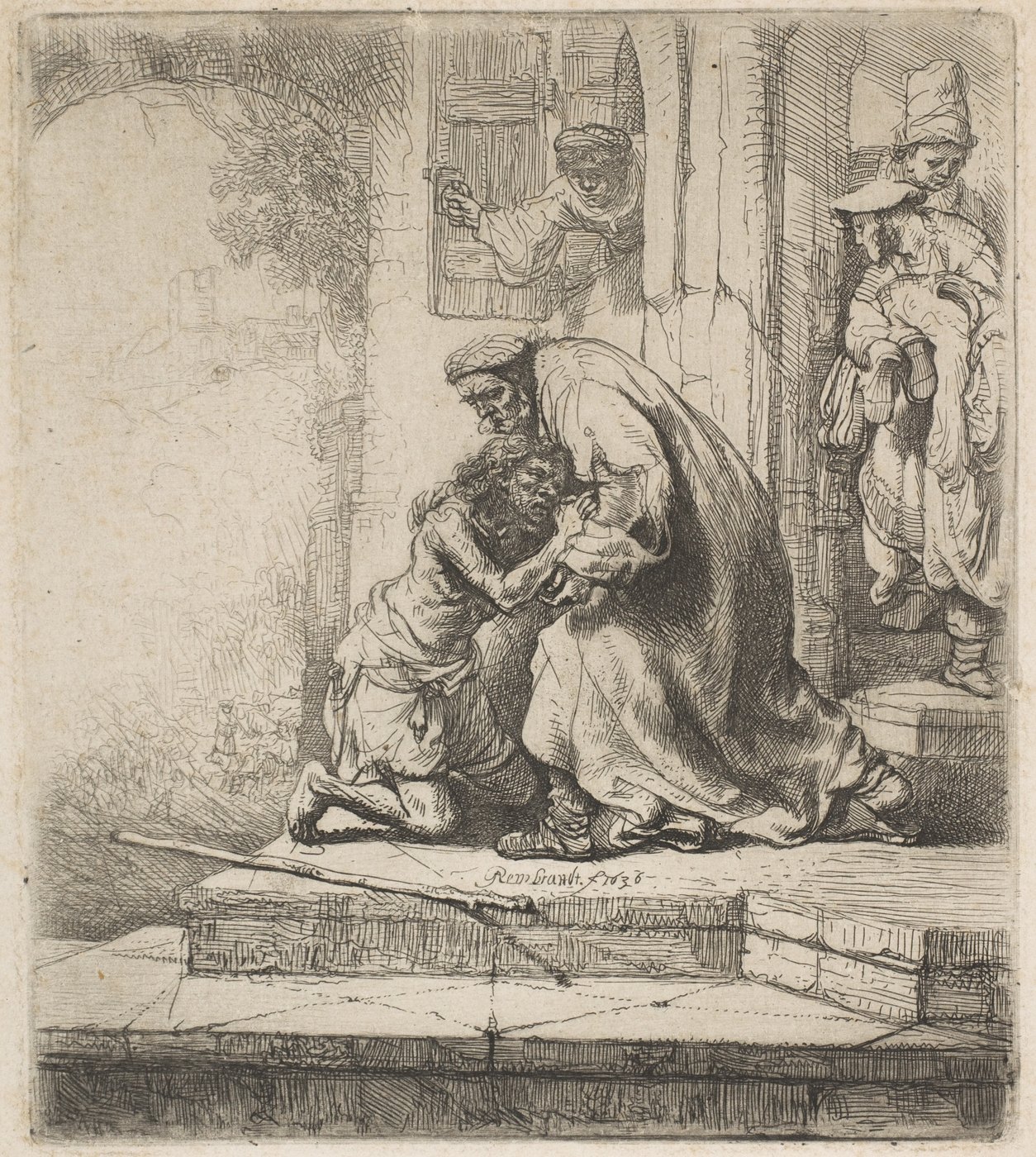
Rembrandt, The Return of the Prodigal Son, 1636. Etching. The kneeling son is received by his father in the scene told in Luke 15.
The Metropolitan Museum of Art. Bequest of Harry G. Friedman, 1965. Accession 66.521.49. Public Domain (CC0). · Image source ↗ · CC0
A Wanderer in the Spirit Lands
In A Wanderer in the Spirit Lands, attributed to Franchezzo and transcribed by A. Farnese, resentment can hold people close even when they hate the connection. A wronged husband remains absorbed in revenge while his wife hopes for their reunion. Her message reaches him through a helper, and he finally becomes willing to leave the place where he has watched his enemy suffer. [2][3][4][5]
Franchezzo must learn a similar lesson. At first, he can restrain revenge without wishing his enemy well. Only later does an opportunity arise to help that person. When he acts on it, their relationship changes, although a final meeting to ask each other’s pardon remains in the future. Forgiveness develops through time, insight and a concrete choice. [7][8][9]
The story of Benedetto also separates forgiveness from resuming a romance. He is expected to ask pardon and offer it to the woman with whom he had a destructive relationship, yet their paths will then diverge. Later he finds companionship with Franchezzo. In this narrative, release can make a different future possible rather than restore the old relationship. [6][10][11]
Franchezzo distinguishes accepting pardon from repairing the effects of one’s actions. Release can allow people to go separate ways. The person who caused harm still has work to do. [5][6][8][12]
See references (11)
- A Wanderer in the Spirit Lands, Reader page 165
- A Wanderer in the Spirit Lands, Reader page 166
- A Wanderer in the Spirit Lands, Reader page 167
- A Wanderer in the Spirit Lands, Reader page 168
- A Wanderer in the Spirit Lands, Reader page 219
- A Wanderer in the Spirit Lands, Reader page 258
- A Wanderer in the Spirit Lands, Reader page 259
- A Wanderer in the Spirit Lands, Reader page 260
- A Wanderer in the Spirit Lands, Reader page 296
- A Wanderer in the Spirit Lands, Reader page 297
- A Wanderer in the Spirit Lands, Reader page 309
Evolution of Immortality
In Evolution of Immortality, Freeman Benjamin Dowd writes as Rosicruciæ of forgiveness as a transformation of the forces involved in a wrong. He describes making a hostile passion inert and drawing its energy back into an ordered life, rather than simply cutting an unwanted faculty out of the person. Love is the power that supposedly makes this change possible. [15][16][17]
The same image is applied to one’s own actions. When earlier wrongs return to consciousness, the person is asked to recognise them as their offspring and receive them without renewing the desire that first produced them. Self-forgiveness follows this recognition and change. The account gives an inward counterpart to the interpersonal acts of mercy described by other sources. [18][19]
The appendix preserves a distinction between forgiveness and escaping consequences. It says that the old record cannot be erased, although different conduct can establish a new one. Its social vision then favours preventing harm and providing practical assistance over vindictive punishment. These are the book’s connected ideals of transformation, responsibility and mercy. [20][21]
See references (7)
- Evolution of Immortality, printed p. 50, Reader page 47
- Evolution of Immortality, printed p. 51, Reader page 48
- Evolution of Immortality, printed p. 52, Reader page 49
- Evolution of Immortality, printed p. 76, Reader page 73
- Evolution of Immortality, printed p. 77, Reader page 74
- Evolution of Immortality, printed p. 133, Reader page 132
- Evolution of Immortality, printed p. 139, Reader page 138
What remains after pardon
For Franchezzo, forgiveness changes what people do with and for one another, even when they go separate ways. For Dowd, love also changes what a person does with the energy of resentment. Both preserve a place for responsibility after pardon. [2][3][4][5][6][10][11][15][16][17][20][21]
See references (12)
- A Wanderer in the Spirit Lands, Reader page 165
- A Wanderer in the Spirit Lands, Reader page 166
- A Wanderer in the Spirit Lands, Reader page 167
- A Wanderer in the Spirit Lands, Reader page 168
- A Wanderer in the Spirit Lands, Reader page 219
- A Wanderer in the Spirit Lands, Reader page 296
- A Wanderer in the Spirit Lands, Reader page 297
- Evolution of Immortality, printed p. 50, Reader page 47
- Evolution of Immortality, printed p. 51, Reader page 48
- Evolution of Immortality, printed p. 52, Reader page 49
- Evolution of Immortality, printed p. 133, Reader page 132
- Evolution of Immortality, printed p. 139, Reader page 138
Read further in the library
A Wanderer in the Spirit Lands
Reading note
Franchezzo’s struggle with revenge and Benedetto’s separate path connect pardon with responsibility and changed relationships.
Evolution of Immortality
Reading note
The return of past wrongs, self-forgiveness and the continued consequences of actions are considered together.
Sources
See references (21)
- Matthew 6:12–15, forgiveness in the Lord’s Prayer ↗New American Bible, Revised Edition, United States Conference of Catholic Bishops. Primary text, verses 12–15.Return to text ↑
- A Wanderer in the Spirit Lands, Reader page 165Franchezzo (source attribution), A Wanderer in the Spirit Lands, transcribed by A. Farnese. W. J. Sinkins, London, 1896. Consulted printing confirmed on its title-page facsimile.Read this page in A Wanderer in the Spirit Lands ↗Return to text ↑
- A Wanderer in the Spirit Lands, Reader page 166Franchezzo (source attribution), A Wanderer in the Spirit Lands, transcribed by A. Farnese. W. J. Sinkins, London, 1896. Consulted printing confirmed on its title-page facsimile.Read this page in A Wanderer in the Spirit Lands ↗Return to text ↑
- A Wanderer in the Spirit Lands, Reader page 167Franchezzo (source attribution), A Wanderer in the Spirit Lands, transcribed by A. Farnese. W. J. Sinkins, London, 1896. Consulted printing confirmed on its title-page facsimile.Read this page in A Wanderer in the Spirit Lands ↗Return to text ↑
- A Wanderer in the Spirit Lands, Reader page 168Franchezzo (source attribution), A Wanderer in the Spirit Lands, transcribed by A. Farnese. W. J. Sinkins, London, 1896. Consulted printing confirmed on its title-page facsimile.Read this page in A Wanderer in the Spirit Lands ↗Return to text ↑
- A Wanderer in the Spirit Lands, Reader page 219Franchezzo (source attribution), A Wanderer in the Spirit Lands, transcribed by A. Farnese. W. J. Sinkins, London, 1896. Consulted printing confirmed on its title-page facsimile.Read this page in A Wanderer in the Spirit Lands ↗Return to text ↑
- A Wanderer in the Spirit Lands, Reader page 258Franchezzo (source attribution), A Wanderer in the Spirit Lands, transcribed by A. Farnese. W. J. Sinkins, London, 1896. Consulted printing confirmed on its title-page facsimile.Read this page in A Wanderer in the Spirit Lands ↗Return to text ↑
- A Wanderer in the Spirit Lands, Reader page 259Franchezzo (source attribution), A Wanderer in the Spirit Lands, transcribed by A. Farnese. W. J. Sinkins, London, 1896. Consulted printing confirmed on its title-page facsimile.Read this page in A Wanderer in the Spirit Lands ↗Return to text ↑
- A Wanderer in the Spirit Lands, Reader page 260Franchezzo (source attribution), A Wanderer in the Spirit Lands, transcribed by A. Farnese. W. J. Sinkins, London, 1896. Consulted printing confirmed on its title-page facsimile.Read this page in A Wanderer in the Spirit Lands ↗Return to text ↑
- A Wanderer in the Spirit Lands, Reader page 296Franchezzo (source attribution), A Wanderer in the Spirit Lands, transcribed by A. Farnese. W. J. Sinkins, London, 1896. Consulted printing confirmed on its title-page facsimile.Read this page in A Wanderer in the Spirit Lands ↗Return to text ↑
- A Wanderer in the Spirit Lands, Reader page 297Franchezzo (source attribution), A Wanderer in the Spirit Lands, transcribed by A. Farnese. W. J. Sinkins, London, 1896. Consulted printing confirmed on its title-page facsimile.Read this page in A Wanderer in the Spirit Lands ↗Return to text ↑
- A Wanderer in the Spirit Lands, Reader page 309Franchezzo (source attribution), A Wanderer in the Spirit Lands, transcribed by A. Farnese. W. J. Sinkins, London, 1896. Consulted printing confirmed on its title-page facsimile.Read this page in A Wanderer in the Spirit Lands ↗Return to text ↑
- Luke 15:11–32, return of the lost son ↗New American Bible, Revised Edition, United States Conference of Catholic Bishops. Primary text, Luke 15:11–32.Return to text ↑
- Rembrandt, The Return of the Prodigal Son, 1636 ↗The Metropolitan Museum of Art. Bequest of Harry G. Friedman,1965. Accession66.521.49. Public Domain; Open Access.Return to text ↑
- Evolution of Immortality, printed p. 50, Reader page 47Rosicruciæ (catalogued as Freeman Benjamin Dowd), Evolution of Immortality. Eulian Publishing Company, Salem, 1900.Read this page in Evolution of Immortality ↗Return to text ↑
- Evolution of Immortality, printed p. 51, Reader page 48Rosicruciæ (catalogued as Freeman Benjamin Dowd), Evolution of Immortality. Eulian Publishing Company, Salem, 1900.Read this page in Evolution of Immortality ↗Return to text ↑
- Evolution of Immortality, printed p. 52, Reader page 49Rosicruciæ (catalogued as Freeman Benjamin Dowd), Evolution of Immortality. Eulian Publishing Company, Salem, 1900.Read this page in Evolution of Immortality ↗Return to text ↑
- Evolution of Immortality, printed p. 76, Reader page 73Rosicruciæ (catalogued as Freeman Benjamin Dowd), Evolution of Immortality. Eulian Publishing Company, Salem, 1900.Read this page in Evolution of Immortality ↗Return to text ↑
- Evolution of Immortality, printed p. 77, Reader page 74Rosicruciæ (catalogued as Freeman Benjamin Dowd), Evolution of Immortality. Eulian Publishing Company, Salem, 1900.Read this page in Evolution of Immortality ↗Return to text ↑
- Evolution of Immortality, printed p. 133, Reader page 132Rosicruciæ (catalogued as Freeman Benjamin Dowd), Evolution of Immortality. Eulian Publishing Company, Salem, 1900.Read this page in Evolution of Immortality ↗Return to text ↑
- Evolution of Immortality, printed p. 139, Reader page 138Rosicruciæ (catalogued as Freeman Benjamin Dowd), Evolution of Immortality. Eulian Publishing Company, Salem, 1900.Read this page in Evolution of Immortality ↗Return to text ↑