Free Will
Free will concerns what a person can choose and be held responsible for. Compare Dante, Swedenborg and Vivekananda on desire and freedom.
In this article
The question
What is free will?
Free will concerns what a person can choose and what makes the choice their own. A desire can feel strong before the person has decided to act on it. Religious and philosophical accounts ask how habit, outside pressure or divine purpose affect that power to choose. [1][3][4][18][19][44]
See references (6)
- Catechism of the Catholic Church, 1731–1738: freedom and responsibility
- Purgatory and Paradise, Purgatory XVIII, Reader page 108
- Purgatory and Paradise, Purgatory XVIII, Reader page 109
- A Wanderer in the Spirit Lands, Reader page 306
- Evolution of Immortality, printed p. 45, Reader page 42
- Karma-Yoga, Reader page 95
Freedom, habit and responsibility
The Catholic Catechism links free action to reason and will. It also says ignorance, fear, habit or coercion can diminish responsibility. The circumstances matter when asking how freely a person acted. [1]
The same text understands growth in goodness as an increase in freedom. Within this religious framework, freedom has a direction: a person becomes better able to act according to the good. That is a theological account of freedom’s fulfilment, alongside its account of choosing between alternatives. [1]
Choice, influence and condition
The Divine Comedy by Dante Alighieri
In Dante Alighieri’s Purgatory XVI, Marco Lombardo rejects the idea that the heavens compel every action. He allows that they may set a desire in motion. The person still has a mind capable of judging that impulse, which is why reward and blame can be just. [2]
Virgil develops the distinction in Purgatory XVIII. An apprehended good attracts the soul and awakens desire. Dante asks whether this sequence excuses every action that follows. Virgil locates another power at the threshold of assent: a person can harbour or dismiss the affection. The first arising of love and the decision to follow it are different moments in the explanation. [3][4]
At the summit of the mountain, Virgil tells Dante that his will is now free, upright and whole, and that he may follow its guidance. The declaration marks the result of an education through the journey. Choice has not disappeared; the traveller has become better prepared to exercise it. The guide’s withdrawal gives that restored capacity a visible place in the story. [5]
Paradise XVII turns from influence to foreknowledge. Cacciaguida says that events appear in the eternal sight without receiving necessity from being seen, just as watching a ship does not drive it down a river. This is the poem’s proposed distinction between knowing and causing. It belongs beside the earlier arguments about influence and assent, while leaving their philosophical adequacy open to examination. [6]
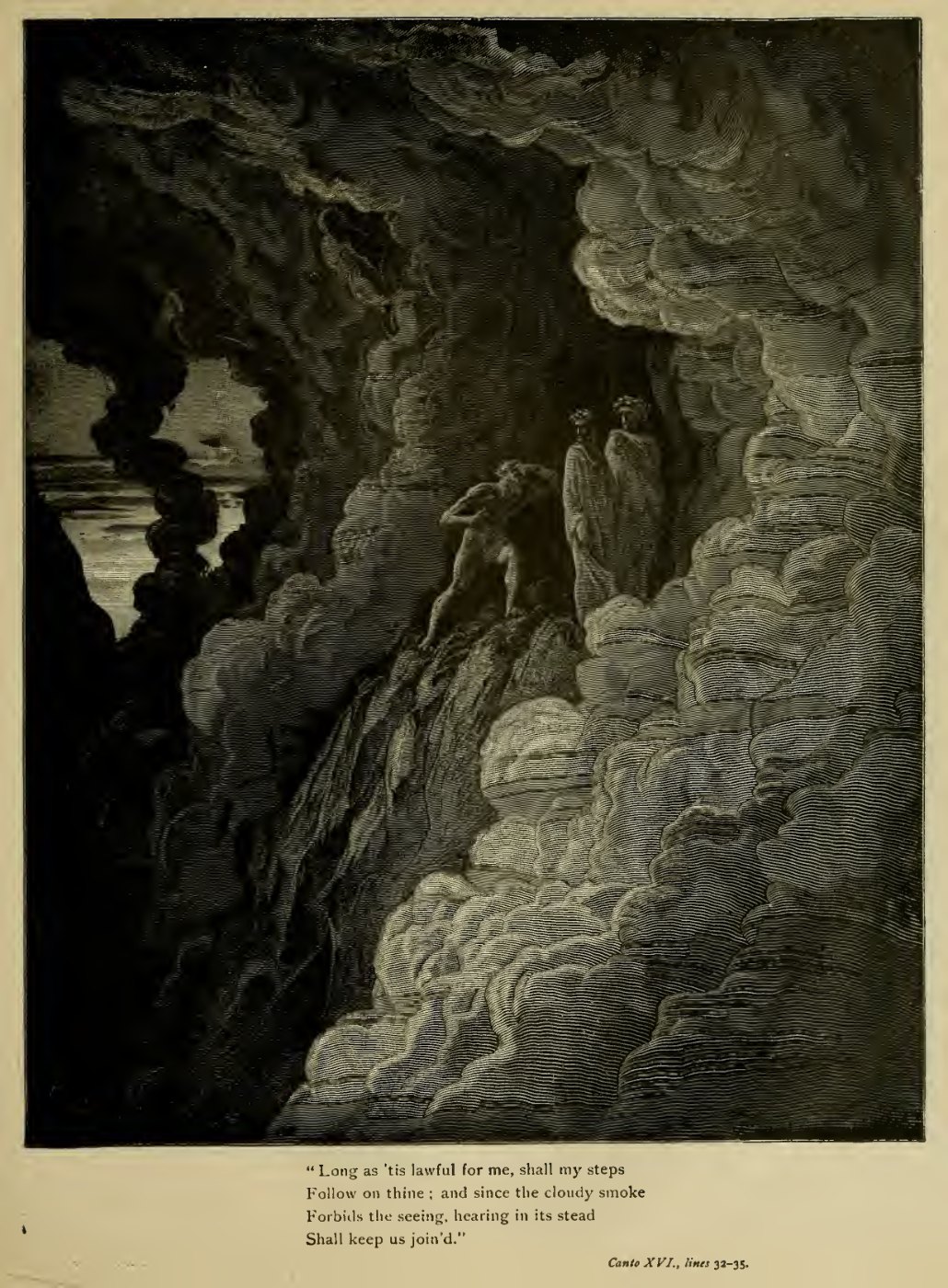
Marco Lombardo accompanies the travellers in the smoke of Purgatory XVI, the setting of his discussion of free will. Doré’s original caption describes hearing keeping the companions together when sight fails.
Design by Gustave Doré. Purgatory and Paradise, Henry Francis Cary translation, Thompson & Thomas, Chicago, 1901. Public Domain. · Image source ↗ · Public Domain
A Wanderer in the Spirit Lands
In A Wanderer in the Spirit Lands, attributed to Franchezzo and transcribed by A. Farnese, freedom includes the ability to accept or refuse help. Franchezzo must relinquish his demand that the woman he loves remain bound to him before she chooses to continue loving him. The Brotherhood likewise allows members to leave and return. The narrative gives development meaning through personal response. [8][9][10]
This freedom coexists with limits. Guides restrain harmful action, some spirits cannot yet reach a higher sphere, and certain prisoners would injure others if released. Hassein, the narrator’s guide, says guardians cannot direct a person like a puppet, while other episodes describe protection and intervention. The book does not portray every spirit as possessing unlimited power to do whatever it wishes. [11][12][13][14][15]
The final vision introduces a more specific tension between destiny and choice. Ahrinziman says that major earthly events are appointed for a soul’s education, but the soul’s response determines whether they become occasions for good or ill. Earlier, he warns that predictions of timing may be mistaken or altered. These are the account’s stated qualifications, rather than a fully worked philosophical resolution of freedom and foreknowledge. [16][17][18]
See references (11)
- A Wanderer in the Spirit Lands, Reader page 25
- A Wanderer in the Spirit Lands, Reader page 26
- A Wanderer in the Spirit Lands, Reader page 42
- A Wanderer in the Spirit Lands, Reader page 85
- A Wanderer in the Spirit Lands, Reader page 87
- A Wanderer in the Spirit Lands, Reader page 132
- A Wanderer in the Spirit Lands, Reader page 181
- A Wanderer in the Spirit Lands, Reader page 183
- A Wanderer in the Spirit Lands, Reader page 244
- A Wanderer in the Spirit Lands, Reader page 305
- A Wanderer in the Spirit Lands, Reader page 306
Evolution of Immortality
Freeman Benjamin Dowd’s Evolution of Immortality, written as Rosicruciæ, connects freedom with both choosing and carrying a choice into action. The person who governs their own responses is said to alter the circumstances surrounding them. The book recognises conditioning by environment and ancestry, while arguing that these influences do not exhaust what a person can become. [19][20][21][25]
Freedom is also a relation to other people. Domination binds the ruler to conflict, whereas fellowship, practical help and concern for another person’s good enlarge the life of the soul. The appendix attacks caste and inherited privilege as human arrangements that frustrate an original equality. Its ideal of self-possession is therefore joined to an ideal of shared freedom. [22][23][24][30][31]
At its furthest reach, the argument gives a perfected being extraordinary control over form and matter. That proposed power is part of the author’s esoteric account of immortality. It extends beyond the ordinary philosophical question of whether a person acts voluntarily, and should remain distinguishable from the more limited accounts of consent and responsibility discussed elsewhere in this entry. [26][27][28][29]
See references (13)
- Evolution of Immortality, printed p. 45, Reader page 42
- Evolution of Immortality, printed p. 48, Reader page 45
- Evolution of Immortality, printed p. 49, Reader page 46
- Evolution of Immortality, printed p. 55, Reader page 52
- Evolution of Immortality, printed p. 57, Reader page 54
- Evolution of Immortality, printed p. 58, Reader page 55
- Evolution of Immortality, printed p. 72, Reader page 69
- Evolution of Immortality, printed p. 115, Reader page 114
- Evolution of Immortality, printed p. 116, Reader page 115
- Evolution of Immortality, printed p. 125, Reader page 124
- Evolution of Immortality, printed p. 126, Reader page 125
- Evolution of Immortality, printed p. 132, Reader page 131
- Evolution of Immortality, printed p. 133, Reader page 132
Heaven and Its Wonders and Hell
In Heaven and Its Wonders and Hell, Emanuel Swedenborg explains human freedom through an equilibrium between good and evil influences. The Lord maintains the relation between heaven and hell so that a person can receive one influence or the other. This is not a struggle between two equally sovereign gods: the entire order, including the restraint of the hells, remains dependent on Divine government. [35][36][37]
The purpose of freedom is appropriation. A thought imposed on someone does not become their enduring love simply because it has entered the understanding. Reformation requires recognising evil, ceasing to will it and learning to act from a different affection. Swedenborg accordingly distinguishes inner freedom to think and choose from a licence to injure others. Civil and moral laws properly restrain outward wrongdoing. [38][39][40]
Spirits mediate this relation. Near the conclusion, Swedenborg specifies that people are joined to heaven and hell through companions in the intermediate world of spirits. That world holds the balance in which a person’s character can appear. This mediation connects inward choices with the larger societies whose lives are compatible with them. [41]
His account also distinguishes earthly reformation from what follows death. The ruling love acquired in life then remains, even while understanding and wisdom can develop within it. Freedom after death expresses that love; it does not provide an indefinitely renewed opportunity to replace it with its opposite. This gives the book’s language of choice a different reach in the two conditions. [32][33][34]
See references (10)
- Heaven and Its Wonders and Hell, printed p. 413, Reader page 420
- Heaven and Its Wonders and Hell, printed p. 427, Reader page 434
- Heaven and Its Wonders and Hell, printed p. 485, Reader page 492
- Heaven and Its Wonders and Hell, printed p. 503, Reader page 510
- Heaven and Its Wonders and Hell, printed p. 504, Reader page 511
- Heaven and Its Wonders and Hell, printed p. 563, Reader page 570
- Heaven and Its Wonders and Hell, printed p. 568, Reader page 575
- Heaven and Its Wonders and Hell, printed p. 569, Reader page 576
- Heaven and Its Wonders and Hell, printed p. 570, Reader page 577
- Heaven and Its Wonders and Hell, printed p. 571, Reader page 578
Karma-Yoga by Swami Vivekananda
In Karma Yoga, Swami Vivekananda describes karma through actions and thoughts that cause further actions and thoughts. He argues that the will we can observe already belongs to the same conditions of space, time and causation. [42][43][44]
He explicitly denies that a will within those conditions is free. The spiritual freedom he seeks belongs instead to that which is not exhausted by its conditioned manifestation as human will. Liberation is consequently more than choosing among alternatives while everything else in the causal order remains unchanged. [44][45]
The argument does not remove present action from his teaching. Earlier he says that what a person does now can change their future; the discipline of Karma Yoga teaches a worker to loosen attachment through action. Practical formation of character and ultimate freedom play different roles in the explanation. [46][47][48]
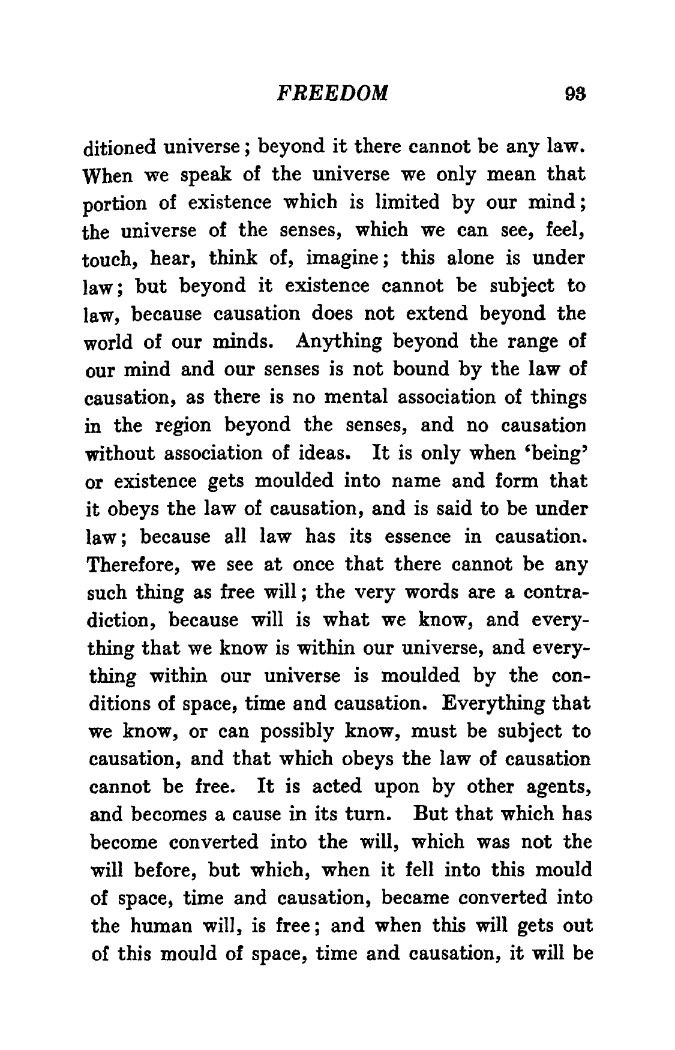
Source facsimile: Karma-Yoga (1939), Reader page 95. Vivekananda rejects free will within causal conditioning while locating freedom beyond that conditioning.
Swami Vivekananda, Karma-Yoga, English second printing in the 1939 combined volume. Historical public-domain text, exact checksum-verified Library scan. · Image source ↗ · Public Domain
What remains open to choice?
Dante makes room for assent after an influence begins. Franchezzo puts the ability to accept or refuse help inside a relationship. Dowd connects choice to governing one’s response as circumstances change. [2][6][8][9][10][19][20][21][25]
Swedenborg says earthly freedom permits reformation. After death, freedom expresses the ruling love a person has made their own. His account locates the power to reverse direction in a particular part of a life. [35][36][37][32][33][34]
Dante keeps a power of assent within a world of influences. Vivekananda places the observable will within causation and seeks liberation beyond that order. The two locate decisive freedom in different places. [2][3][4][44][45]
See references (19)
- Purgatory and Paradise, Purgatory XVI, Reader page 98
- Purgatory and Paradise, Purgatory XVIII, Reader page 108
- Purgatory and Paradise, Purgatory XVIII, Reader page 109
- Purgatory and Paradise, Paradise XVII, Reader page 287
- A Wanderer in the Spirit Lands, Reader page 25
- A Wanderer in the Spirit Lands, Reader page 26
- A Wanderer in the Spirit Lands, Reader page 42
- Evolution of Immortality, printed p. 45, Reader page 42
- Evolution of Immortality, printed p. 48, Reader page 45
- Evolution of Immortality, printed p. 49, Reader page 46
- Evolution of Immortality, printed p. 72, Reader page 69
- Heaven and Its Wonders and Hell, printed p. 413, Reader page 420
- Heaven and Its Wonders and Hell, printed p. 427, Reader page 434
- Heaven and Its Wonders and Hell, printed p. 485, Reader page 492
- Heaven and Its Wonders and Hell, printed p. 503, Reader page 510
- Heaven and Its Wonders and Hell, printed p. 504, Reader page 511
- Heaven and Its Wonders and Hell, printed p. 563, Reader page 570
- Karma-Yoga, Reader page 95
- Karma-Yoga, Reader page 96
Read further in the library
Purgatory and Paradise: The Vision of Dante
Reading note
A separately attributed account in the consulted Cary translation, with exact current Library Reader leaves.
A Wanderer in the Spirit Lands
Reading note
Choices, limited intervention and a proposed framework of destiny are considered through particular encounters and a closing vision.
Evolution of Immortality
Reading note
Choice and self-government are connected with conditioning, mutual freedom and the proposed powers of a perfected being.

Heaven and Its Wonders and Hell
Reading note
Spiritual equilibrium and freely received love explain choice and the limits of postmortem change.
Karma Yoga
Reading note
The separately titled account draws on exact passages in the consulted Library edition.
Sources
See references (48)
- Catechism of the Catholic Church, 1731–1738: freedom and responsibility ↗Catholic Church, official doctrinal text. This is a Catholic formulation, not a survey of all positions on free will.Return to text ↑
- Purgatory and Paradise, Purgatory XVI, Reader page 98Dante Alighieri, The Divine Comedy, translated by Henry Francis Cary. Inferno: undated New Edition, Thompson & Thomas, Chicago. Purgatory and Paradise: New Edition, Thompson & Thomas, Chicago, 1901. Designs by Gustave Doré.Read this page in Purgatory and Paradise: The Vision of Dante ↗Return to text ↑
- Purgatory and Paradise, Purgatory XVIII, Reader page 108Dante Alighieri, The Divine Comedy, translated by Henry Francis Cary. Inferno: undated New Edition, Thompson & Thomas, Chicago. Purgatory and Paradise: New Edition, Thompson & Thomas, Chicago, 1901. Designs by Gustave Doré.Read this page in Purgatory and Paradise: The Vision of Dante ↗Return to text ↑
- Purgatory and Paradise, Purgatory XVIII, Reader page 109Dante Alighieri, The Divine Comedy, translated by Henry Francis Cary. Inferno: undated New Edition, Thompson & Thomas, Chicago. Purgatory and Paradise: New Edition, Thompson & Thomas, Chicago, 1901. Designs by Gustave Doré.Read this page in Purgatory and Paradise: The Vision of Dante ↗Return to text ↑
- Purgatory and Paradise, Purgatory XXVII, Reader page 164Dante Alighieri, The Divine Comedy, translated by Henry Francis Cary. Inferno: undated New Edition, Thompson & Thomas, Chicago. Purgatory and Paradise: New Edition, Thompson & Thomas, Chicago, 1901. Designs by Gustave Doré.Read this page in Purgatory and Paradise: The Vision of Dante ↗Return to text ↑
- Purgatory and Paradise, Paradise XVII, Reader page 287Dante Alighieri, The Divine Comedy, translated by Henry Francis Cary. Inferno: undated New Edition, Thompson & Thomas, Chicago. Purgatory and Paradise: New Edition, Thompson & Thomas, Chicago, 1901. Designs by Gustave Doré.Read this page in Purgatory and Paradise: The Vision of Dante ↗Return to text ↑
- Purgatory and Paradise, Purgatory XVI, Reader page 103Dante Alighieri, The Divine Comedy, translated by Henry Francis Cary. Inferno: undated New Edition, Thompson & Thomas, Chicago. Purgatory and Paradise: New Edition, Thompson & Thomas, Chicago, 1901. Designs by Gustave Doré.Read this page in Purgatory and Paradise: The Vision of Dante ↗
- A Wanderer in the Spirit Lands, Reader page 25Franchezzo (source attribution), A Wanderer in the Spirit Lands, transcribed by A. Farnese. W. J. Sinkins, London, 1896. Date confirmed on the consulted title-page facsimile.Read this page in A Wanderer in the Spirit Lands ↗Return to text ↑
- A Wanderer in the Spirit Lands, Reader page 26Franchezzo (source attribution), A Wanderer in the Spirit Lands, transcribed by A. Farnese. W. J. Sinkins, London, 1896. Date confirmed on the consulted title-page facsimile.Read this page in A Wanderer in the Spirit Lands ↗Return to text ↑
- A Wanderer in the Spirit Lands, Reader page 42Franchezzo (source attribution), A Wanderer in the Spirit Lands, transcribed by A. Farnese. W. J. Sinkins, London, 1896. Date confirmed on the consulted title-page facsimile.Read this page in A Wanderer in the Spirit Lands ↗Return to text ↑
- A Wanderer in the Spirit Lands, Reader page 85Franchezzo (source attribution), A Wanderer in the Spirit Lands, transcribed by A. Farnese. W. J. Sinkins, London, 1896. Date confirmed on the consulted title-page facsimile.Read this page in A Wanderer in the Spirit Lands ↗Return to text ↑
- A Wanderer in the Spirit Lands, Reader page 87Franchezzo (source attribution), A Wanderer in the Spirit Lands, transcribed by A. Farnese. W. J. Sinkins, London, 1896. Date confirmed on the consulted title-page facsimile.Read this page in A Wanderer in the Spirit Lands ↗Return to text ↑
- A Wanderer in the Spirit Lands, Reader page 132Franchezzo (source attribution), A Wanderer in the Spirit Lands, transcribed by A. Farnese. W. J. Sinkins, London, 1896. Date confirmed on the consulted title-page facsimile.Read this page in A Wanderer in the Spirit Lands ↗Return to text ↑
- A Wanderer in the Spirit Lands, Reader page 181Franchezzo (source attribution), A Wanderer in the Spirit Lands, transcribed by A. Farnese. W. J. Sinkins, London, 1896. Date confirmed on the consulted title-page facsimile.Read this page in A Wanderer in the Spirit Lands ↗Return to text ↑
- A Wanderer in the Spirit Lands, Reader page 183Franchezzo (source attribution), A Wanderer in the Spirit Lands, transcribed by A. Farnese. W. J. Sinkins, London, 1896. Date confirmed on the consulted title-page facsimile.Read this page in A Wanderer in the Spirit Lands ↗Return to text ↑
- A Wanderer in the Spirit Lands, Reader page 244Franchezzo (source attribution), A Wanderer in the Spirit Lands, transcribed by A. Farnese. W. J. Sinkins, London, 1896. Date confirmed on the consulted title-page facsimile.Read this page in A Wanderer in the Spirit Lands ↗Return to text ↑
- A Wanderer in the Spirit Lands, Reader page 305Franchezzo (source attribution), A Wanderer in the Spirit Lands, transcribed by A. Farnese. W. J. Sinkins, London, 1896. Date confirmed on the consulted title-page facsimile.Read this page in A Wanderer in the Spirit Lands ↗Return to text ↑
- A Wanderer in the Spirit Lands, Reader page 306Franchezzo (source attribution), A Wanderer in the Spirit Lands, transcribed by A. Farnese. W. J. Sinkins, London, 1896. Date confirmed on the consulted title-page facsimile.Read this page in A Wanderer in the Spirit Lands ↗Return to text ↑
- Evolution of Immortality, printed p. 45, Reader page 42Rosicruciæ (catalogued as Freeman Benjamin Dowd), Evolution of Immortality. Eulian Publishing Company, Salem, 1900.Read this page in Evolution of Immortality ↗Return to text ↑
- Evolution of Immortality, printed p. 48, Reader page 45Rosicruciæ (catalogued as Freeman Benjamin Dowd), Evolution of Immortality. Eulian Publishing Company, Salem, 1900.Read this page in Evolution of Immortality ↗Return to text ↑
- Evolution of Immortality, printed p. 49, Reader page 46Rosicruciæ (catalogued as Freeman Benjamin Dowd), Evolution of Immortality. Eulian Publishing Company, Salem, 1900.Read this page in Evolution of Immortality ↗Return to text ↑
- Evolution of Immortality, printed p. 55, Reader page 52Rosicruciæ (catalogued as Freeman Benjamin Dowd), Evolution of Immortality. Eulian Publishing Company, Salem, 1900.Read this page in Evolution of Immortality ↗Return to text ↑
- Evolution of Immortality, printed p. 57, Reader page 54Rosicruciæ (catalogued as Freeman Benjamin Dowd), Evolution of Immortality. Eulian Publishing Company, Salem, 1900.Read this page in Evolution of Immortality ↗Return to text ↑
- Evolution of Immortality, printed p. 58, Reader page 55Rosicruciæ (catalogued as Freeman Benjamin Dowd), Evolution of Immortality. Eulian Publishing Company, Salem, 1900.Read this page in Evolution of Immortality ↗Return to text ↑
- Evolution of Immortality, printed p. 72, Reader page 69Rosicruciæ (catalogued as Freeman Benjamin Dowd), Evolution of Immortality. Eulian Publishing Company, Salem, 1900.Read this page in Evolution of Immortality ↗Return to text ↑
- Evolution of Immortality, printed p. 115, Reader page 114Rosicruciæ (catalogued as Freeman Benjamin Dowd), Evolution of Immortality. Eulian Publishing Company, Salem, 1900.Read this page in Evolution of Immortality ↗Return to text ↑
- Evolution of Immortality, printed p. 116, Reader page 115Rosicruciæ (catalogued as Freeman Benjamin Dowd), Evolution of Immortality. Eulian Publishing Company, Salem, 1900.Read this page in Evolution of Immortality ↗Return to text ↑
- Evolution of Immortality, printed p. 125, Reader page 124Rosicruciæ (catalogued as Freeman Benjamin Dowd), Evolution of Immortality. Eulian Publishing Company, Salem, 1900.Read this page in Evolution of Immortality ↗Return to text ↑
- Evolution of Immortality, printed p. 126, Reader page 125Rosicruciæ (catalogued as Freeman Benjamin Dowd), Evolution of Immortality. Eulian Publishing Company, Salem, 1900.Read this page in Evolution of Immortality ↗Return to text ↑
- Evolution of Immortality, printed p. 132, Reader page 131Rosicruciæ (catalogued as Freeman Benjamin Dowd), Evolution of Immortality. Eulian Publishing Company, Salem, 1900.Read this page in Evolution of Immortality ↗Return to text ↑
- Evolution of Immortality, printed p. 133, Reader page 132Rosicruciæ (catalogued as Freeman Benjamin Dowd), Evolution of Immortality. Eulian Publishing Company, Salem, 1900.Read this page in Evolution of Immortality ↗Return to text ↑
- Heaven and Its Wonders and Hell, printed p. 413, Reader page 420Emanuel Swedenborg, Heaven and Its Wonders and Hell, translated by J. C. Ager. The American Swedenborg Printing and Publishing Society, New York, 1916. Original Latin work first published in 1758.Read this page in Heaven and Its Wonders and Hell ↗Return to text ↑
- Heaven and Its Wonders and Hell, printed p. 427, Reader page 434Emanuel Swedenborg, Heaven and Its Wonders and Hell, translated by J. C. Ager. The American Swedenborg Printing and Publishing Society, New York, 1916. Original Latin work first published in 1758.Read this page in Heaven and Its Wonders and Hell ↗Return to text ↑
- Heaven and Its Wonders and Hell, printed p. 485, Reader page 492Emanuel Swedenborg, Heaven and Its Wonders and Hell, translated by J. C. Ager. The American Swedenborg Printing and Publishing Society, New York, 1916. Original Latin work first published in 1758.Read this page in Heaven and Its Wonders and Hell ↗Return to text ↑
- Heaven and Its Wonders and Hell, printed p. 503, Reader page 510Emanuel Swedenborg, Heaven and Its Wonders and Hell, translated by J. C. Ager. The American Swedenborg Printing and Publishing Society, New York, 1916. Original Latin work first published in 1758.Read this page in Heaven and Its Wonders and Hell ↗Return to text ↑
- Heaven and Its Wonders and Hell, printed p. 504, Reader page 511Emanuel Swedenborg, Heaven and Its Wonders and Hell, translated by J. C. Ager. The American Swedenborg Printing and Publishing Society, New York, 1916. Original Latin work first published in 1758.Read this page in Heaven and Its Wonders and Hell ↗Return to text ↑
- Heaven and Its Wonders and Hell, printed p. 563, Reader page 570Emanuel Swedenborg, Heaven and Its Wonders and Hell, translated by J. C. Ager. The American Swedenborg Printing and Publishing Society, New York, 1916. Original Latin work first published in 1758.Read this page in Heaven and Its Wonders and Hell ↗Return to text ↑
- Heaven and Its Wonders and Hell, printed p. 568, Reader page 575Emanuel Swedenborg, Heaven and Its Wonders and Hell, translated by J. C. Ager. The American Swedenborg Printing and Publishing Society, New York, 1916. Original Latin work first published in 1758.Read this page in Heaven and Its Wonders and Hell ↗Return to text ↑
- Heaven and Its Wonders and Hell, printed p. 569, Reader page 576Emanuel Swedenborg, Heaven and Its Wonders and Hell, translated by J. C. Ager. The American Swedenborg Printing and Publishing Society, New York, 1916. Original Latin work first published in 1758.Read this page in Heaven and Its Wonders and Hell ↗Return to text ↑
- Heaven and Its Wonders and Hell, printed p. 570, Reader page 577Emanuel Swedenborg, Heaven and Its Wonders and Hell, translated by J. C. Ager. The American Swedenborg Printing and Publishing Society, New York, 1916. Original Latin work first published in 1758.Read this page in Heaven and Its Wonders and Hell ↗Return to text ↑
- Heaven and Its Wonders and Hell, printed p. 571, Reader page 578Emanuel Swedenborg, Heaven and Its Wonders and Hell, translated by J. C. Ager. The American Swedenborg Printing and Publishing Society, New York, 1916. Original Latin work first published in 1758.Read this page in Heaven and Its Wonders and Hell ↗Return to text ↑
- Karma-Yoga, Reader page 93Swami Vivekananda, Karma-Yoga, in Karma-Yoga & Bhakti-Yoga, English second printing, Ramakrishna-Vivekananda Center of New York, Inc., 1939. Exact Library edition IMJ-0097-E002. Only the Karma-Yoga part is used in this crawl; the old Work slug mentioning Hindi does not identify this edition’s language.Read this page in Karma Yoga ↗Return to text ↑
- Karma-Yoga, Reader page 94Swami Vivekananda, Karma-Yoga, in Karma-Yoga & Bhakti-Yoga, English second printing, Ramakrishna-Vivekananda Center of New York, Inc., 1939. Exact Library edition IMJ-0097-E002. Only the Karma-Yoga part is used in this crawl; the old Work slug mentioning Hindi does not identify this edition’s language.Read this page in Karma Yoga ↗Return to text ↑
- Karma-Yoga, Reader page 95Swami Vivekananda, Karma-Yoga, in Karma-Yoga & Bhakti-Yoga, English second printing, Ramakrishna-Vivekananda Center of New York, Inc., 1939. Exact Library edition IMJ-0097-E002. Only the Karma-Yoga part is used in this crawl; the old Work slug mentioning Hindi does not identify this edition’s language.Read this page in Karma Yoga ↗Return to text ↑
- Karma-Yoga, Reader page 96Swami Vivekananda, Karma-Yoga, in Karma-Yoga & Bhakti-Yoga, English second printing, Ramakrishna-Vivekananda Center of New York, Inc., 1939. Exact Library edition IMJ-0097-E002. Only the Karma-Yoga part is used in this crawl; the old Work slug mentioning Hindi does not identify this edition’s language.Read this page in Karma Yoga ↗Return to text ↑
- Karma-Yoga, Reader page 10Swami Vivekananda, Karma-Yoga, in Karma-Yoga & Bhakti-Yoga, English second printing, Ramakrishna-Vivekananda Center of New York, Inc., 1939. Exact Library edition IMJ-0097-E002. Only the Karma-Yoga part is used in this crawl; the old Work slug mentioning Hindi does not identify this edition’s language.Read this page in Karma Yoga ↗Return to text ↑
- Karma-Yoga, printed p. 96, Reader page 98Swami Vivekananda, Karma-Yoga, in Karma-Yoga & Bhakti-Yoga, English second printing, Ramakrishna-Vivekananda Center of New York, Inc., 1939. Exact Library edition IMJ-0097-E002. Only the Karma-Yoga part is used in this crawl; the old Work slug mentioning Hindi does not identify this edition’s language.Read this page in Karma Yoga ↗Return to text ↑
- Karma-Yoga, Reader page 99Swami Vivekananda, Karma-Yoga, in Karma-Yoga & Bhakti-Yoga, English second printing, Ramakrishna-Vivekananda Center of New York, Inc., 1939. Exact Library edition IMJ-0097-E002. Only the Karma-Yoga part is used in this crawl; the old Work slug mentioning Hindi does not identify this edition’s language.Read this page in Karma Yoga ↗Return to text ↑