World of spirits
In Swedenborg’s account, the world of spirits lies between heaven and hell. Learn what happens after death and why spirits go to different societies.
In this article
What is the world of spirits?
In Emanuel Swedenborg’s account, the world of spirits is the intermediate realm between heaven and hell. Most people arrive there after death. They may recognise friends and still act as they did in earthly life, while the motives and affections that direct their lives gradually become visible. [1][2][3]
A person may know or repeat something they do not believe, or act considerately for the sake of appearances. Swedenborg describes the intermediate state as a time when such divisions fall away. What people say and do comes to express what they truly love. [2][4][5]
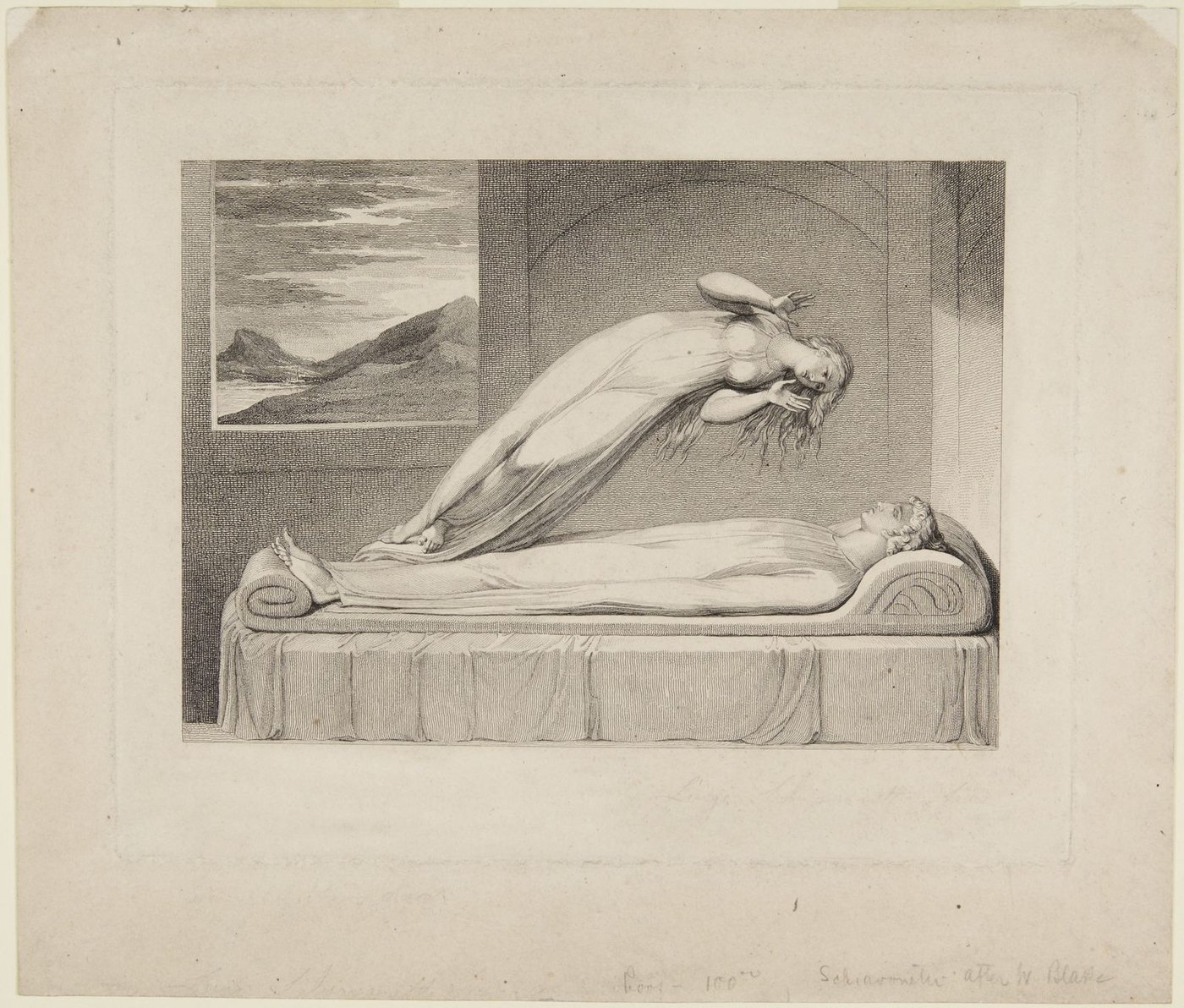
Luigi Schiavonetti after William Blake, The Soul Hovering over the Body Reluctantly Parting with Life, 1805–08. Made for Robert Blair’s poem The Grave, the print visualises separation at death. Swedenborg’s intermediate world concerns the life that follows such a separation.
Princeton University Art Museum. Gift of Frank Jewett Mather Jr., x1947-85. Public Domain. · Image source ↗ · Public Domain
See references (5)
- Heaven and Its Wonders and Hell, printed p. 363, Reader page 370
- Heaven and Its Wonders and Hell, printed p. 364, Reader page 371
- Heaven and Its Wonders and Hell, printed p. 367, Reader page 374
- Heaven and Its Wonders and Hell, printed p. 365, Reader page 372
- Heaven and Its Wonders and Hell, printed p. 366, Reader page 373
Why is it both a place and a state?
Swedenborg describes a valley between mountains and rocks. Paths lead towards heaven, and guarded openings descend into the hells. These features belong to his account of correspondences: the landscape makes inward affinities visible. A society that feels like home to one spirit can be unbearable to another. [6][7]
Heaven and Its Wonders and Hell
Emanuel Swedenborg’s Heaven and Its Wonders and Hell distinguishes three usual stages in this world. In the first, the person retains familiar outward habits, appearance and speech. Friends and relatives recognise the newcomer and may show them cities, gardens and other places. This continuity can make death difficult to recognise at first. [8][9][10][11]
The second stage discloses the interiors of will and thought. What had been hidden by social convention can now become open conduct. This is also when earlier companionships may separate. Swedenborg describes people moving towards the societies that agree with their ruling love, making that agreement the basis of their final association. [12][13][14][15]
For those entering heaven, a third stage supplies instruction. They learn through teaching suited to their disposition and through representations of useful activity. Those moving towards hell do not pass through an equivalent heavenly school. The book also allows exceptions in which a person already prepared proceeds quickly into a final state. [8][16][17][18][19][20]
Swedenborg gives the whole stay a range from moments to years, with thirty years as its upper limit. He gives a separate estimate for the first stage, which he says seldom lasts more than a year. [3][21][22]
See references (16)
- Heaven and Its Wonders and Hell, printed p. 367, Reader page 374
- Heaven and Its Wonders and Hell, printed p. 445, Reader page 452
- Heaven and Its Wonders and Hell, printed p. 446, Reader page 453
- Heaven and Its Wonders and Hell, printed p. 447, Reader page 454
- Heaven and Its Wonders and Hell, printed p. 448, Reader page 455
- Heaven and Its Wonders and Hell, printed p. 452, Reader page 459
- Heaven and Its Wonders and Hell, printed p. 455, Reader page 462
- Heaven and Its Wonders and Hell, printed p. 465, Reader page 472
- Heaven and Its Wonders and Hell, printed p. 466, Reader page 473
- Heaven and Its Wonders and Hell, printed p. 468, Reader page 475
- Heaven and Its Wonders and Hell, printed p. 470, Reader page 477
- Heaven and Its Wonders and Hell, printed p. 471, Reader page 478
- Heaven and Its Wonders and Hell, printed p. 474, Reader page 481
- Heaven and Its Wonders and Hell, printed p. 475, Reader page 482
- Heaven and Its Wonders and Hell, printed p. 450, Reader page 457
- Heaven and Its Wonders and Hell, printed p. 451, Reader page 458
Meeting again and finding a society
Friends and relatives may recognise one another soon after death. That reunion can be genuine even if they later separate. Swedenborg places the familiar encounter early and the lasting choice of company after the spirits’ deeper affections have become visible. [6][10][11]
Read further in the library

Heaven and Its Wonders and Hell
Reading note
The intermediate state, its usual stages and the disclosure of a person’s enduring character.
Sources
See references (23)
- Heaven and Its Wonders and Hell, printed p. 363, Reader page 370Emanuel Swedenborg, Heaven and Its Wonders and Hell, translated by J. C. Ager. The American Swedenborg Printing and Publishing Society, New York, 1916. Original Latin work first published in 1758.Read this page in Heaven and Its Wonders and Hell ↗Return to text ↑
- Heaven and Its Wonders and Hell, printed p. 364, Reader page 371Emanuel Swedenborg, Heaven and Its Wonders and Hell, translated by J. C. Ager. The American Swedenborg Printing and Publishing Society, New York, 1916. Original Latin work first published in 1758.Read this page in Heaven and Its Wonders and Hell ↗Return to text ↑
- Heaven and Its Wonders and Hell, printed p. 367, Reader page 374Emanuel Swedenborg, Heaven and Its Wonders and Hell, translated by J. C. Ager. The American Swedenborg Printing and Publishing Society, New York, 1916. Original Latin work first published in 1758.Read this page in Heaven and Its Wonders and Hell ↗Return to text ↑
- Heaven and Its Wonders and Hell, printed p. 365, Reader page 372Emanuel Swedenborg, Heaven and Its Wonders and Hell, translated by J. C. Ager. The American Swedenborg Printing and Publishing Society, New York, 1916. Original Latin work first published in 1758.Read this page in Heaven and Its Wonders and Hell ↗Return to text ↑
- Heaven and Its Wonders and Hell, printed p. 366, Reader page 373Emanuel Swedenborg, Heaven and Its Wonders and Hell, translated by J. C. Ager. The American Swedenborg Printing and Publishing Society, New York, 1916. Original Latin work first published in 1758.Read this page in Heaven and Its Wonders and Hell ↗Return to text ↑
- Heaven and Its Wonders and Hell, printed p. 368, Reader page 375Emanuel Swedenborg, Heaven and Its Wonders and Hell, translated by J. C. Ager. The American Swedenborg Printing and Publishing Society, New York, 1916. Original Latin work first published in 1758.Read this page in Heaven and Its Wonders and Hell ↗Return to text ↑
- Heaven and Its Wonders and Hell, printed p. 369, Reader page 376Emanuel Swedenborg, Heaven and Its Wonders and Hell, translated by J. C. Ager. The American Swedenborg Printing and Publishing Society, New York, 1916. Original Latin work first published in 1758.Read this page in Heaven and Its Wonders and Hell ↗Return to text ↑
- Heaven and Its Wonders and Hell, printed p. 445, Reader page 452Emanuel Swedenborg, Heaven and Its Wonders and Hell, translated by J. C. Ager. The American Swedenborg Printing and Publishing Society, New York, 1916. Original Latin work first published in 1758.Read this page in Heaven and Its Wonders and Hell ↗Return to text ↑
- Heaven and Its Wonders and Hell, printed p. 446, Reader page 453Emanuel Swedenborg, Heaven and Its Wonders and Hell, translated by J. C. Ager. The American Swedenborg Printing and Publishing Society, New York, 1916. Original Latin work first published in 1758.Read this page in Heaven and Its Wonders and Hell ↗Return to text ↑
- Heaven and Its Wonders and Hell, printed p. 447, Reader page 454Emanuel Swedenborg, Heaven and Its Wonders and Hell, translated by J. C. Ager. The American Swedenborg Printing and Publishing Society, New York, 1916. Original Latin work first published in 1758.Read this page in Heaven and Its Wonders and Hell ↗Return to text ↑
- Heaven and Its Wonders and Hell, printed p. 448, Reader page 455Emanuel Swedenborg, Heaven and Its Wonders and Hell, translated by J. C. Ager. The American Swedenborg Printing and Publishing Society, New York, 1916. Original Latin work first published in 1758.Read this page in Heaven and Its Wonders and Hell ↗Return to text ↑
- Heaven and Its Wonders and Hell, printed p. 452, Reader page 459Emanuel Swedenborg, Heaven and Its Wonders and Hell, translated by J. C. Ager. The American Swedenborg Printing and Publishing Society, New York, 1916. Original Latin work first published in 1758.Read this page in Heaven and Its Wonders and Hell ↗Return to text ↑
- Heaven and Its Wonders and Hell, printed p. 455, Reader page 462Emanuel Swedenborg, Heaven and Its Wonders and Hell, translated by J. C. Ager. The American Swedenborg Printing and Publishing Society, New York, 1916. Original Latin work first published in 1758.Read this page in Heaven and Its Wonders and Hell ↗Return to text ↑
- Heaven and Its Wonders and Hell, printed p. 465, Reader page 472Emanuel Swedenborg, Heaven and Its Wonders and Hell, translated by J. C. Ager. The American Swedenborg Printing and Publishing Society, New York, 1916. Original Latin work first published in 1758.Read this page in Heaven and Its Wonders and Hell ↗Return to text ↑
- Heaven and Its Wonders and Hell, printed p. 466, Reader page 473Emanuel Swedenborg, Heaven and Its Wonders and Hell, translated by J. C. Ager. The American Swedenborg Printing and Publishing Society, New York, 1916. Original Latin work first published in 1758.Read this page in Heaven and Its Wonders and Hell ↗Return to text ↑
- Heaven and Its Wonders and Hell, printed p. 468, Reader page 475Emanuel Swedenborg, Heaven and Its Wonders and Hell, translated by J. C. Ager. The American Swedenborg Printing and Publishing Society, New York, 1916. Original Latin work first published in 1758.Read this page in Heaven and Its Wonders and Hell ↗Return to text ↑
- Heaven and Its Wonders and Hell, printed p. 470, Reader page 477Emanuel Swedenborg, Heaven and Its Wonders and Hell, translated by J. C. Ager. The American Swedenborg Printing and Publishing Society, New York, 1916. Original Latin work first published in 1758.Read this page in Heaven and Its Wonders and Hell ↗Return to text ↑
- Heaven and Its Wonders and Hell, printed p. 471, Reader page 478Emanuel Swedenborg, Heaven and Its Wonders and Hell, translated by J. C. Ager. The American Swedenborg Printing and Publishing Society, New York, 1916. Original Latin work first published in 1758.Read this page in Heaven and Its Wonders and Hell ↗Return to text ↑
- Heaven and Its Wonders and Hell, printed p. 474, Reader page 481Emanuel Swedenborg, Heaven and Its Wonders and Hell, translated by J. C. Ager. The American Swedenborg Printing and Publishing Society, New York, 1916. Original Latin work first published in 1758.Read this page in Heaven and Its Wonders and Hell ↗Return to text ↑
- Heaven and Its Wonders and Hell, printed p. 475, Reader page 482Emanuel Swedenborg, Heaven and Its Wonders and Hell, translated by J. C. Ager. The American Swedenborg Printing and Publishing Society, New York, 1916. Original Latin work first published in 1758.Read this page in Heaven and Its Wonders and Hell ↗Return to text ↑
- Heaven and Its Wonders and Hell, printed p. 450, Reader page 457Emanuel Swedenborg, Heaven and Its Wonders and Hell, translated by J. C. Ager. The American Swedenborg Printing and Publishing Society, New York, 1916. Original Latin work first published in 1758.Read this page in Heaven and Its Wonders and Hell ↗Return to text ↑
- Heaven and Its Wonders and Hell, printed p. 451, Reader page 458Emanuel Swedenborg, Heaven and Its Wonders and Hell, translated by J. C. Ager. The American Swedenborg Printing and Publishing Society, New York, 1916. Original Latin work first published in 1758.Read this page in Heaven and Its Wonders and Hell ↗Return to text ↑
- Luigi Schiavonetti after William Blake, The Soul Hovering over the Body Reluctantly Parting with Life, 1805–08. ↗Princeton University Art Museum. Gift of Frank Jewett Mather Jr., x1947-85. Public Domain.