Ruling love
Ruling love is the dominant affection that shapes a person’s choices in Swedenborg’s account. It determines the company in which a spirit feels at home.
In this article
What is a ruling love?
A ruling love is the affection that gives a person’s life its direction. In Emanuel Swedenborg’s account, many smaller interests can serve that dominant love. It becomes visible in what a person repeatedly chooses and what they hope to gain through those choices. [1][2]
Two people may defend a just cause for different reasons. One may care about justice, while the other seeks a reputation for being just. The act looks similar from outside. Swedenborg asks what gives each person delight and what the act helps them pursue. [3][4][5]
See references (5)
- Heaven and Its Wonders and Hell, printed p. 421, Reader page 428
- Heaven and Its Wonders and Hell, printed p. 422, Reader page 429
- Heaven and Its Wonders and Hell, printed p. 417, Reader page 424
- Heaven and Its Wonders and Hell, printed p. 418, Reader page 425
- Heaven and Its Wonders and Hell, printed p. 419, Reader page 426
Heaven and Its Wonders and Hell
In Heaven and Its Wonders and Hell, Emanuel Swedenborg says that a person’s ruling love remains after death. What was concealed by outward habits is gradually disclosed. Ideas and appearances that do not agree with that love are removed, until the spirit’s speech, form and willing express a coherent inward life. [1][6][7][8]
Company follows the same relation. A spirit feels at home in the society whose life agrees with its own, and finds opposed surroundings distressing. Recognition and even apparent visibility can depend on this agreement. Swedenborg uses paths, faces and direction of movement to describe how inward affinity becomes outwardly perceptible. [6][9][10][11][12]
The persistence is consequential. Swedenborg denies that instruction after death can replace an infernal ruling love with a heavenly one. In his explanation, the natural plane on which reformation rested during earthly life has become quiescent. Taking away the person’s love would take away the life that makes that spirit itself. [8][13][14]
Learning continues after death, even as the ruling love endures. Swedenborg says wisdom can deepen through new applications of what a person already loves. The orientation of the spirit can stay fixed while its understanding grows. [15][16]
See references (12)
- Heaven and Its Wonders and Hell, printed p. 421, Reader page 428
- Heaven and Its Wonders and Hell, printed p. 423, Reader page 430
- Heaven and Its Wonders and Hell, printed p. 424, Reader page 431
- Heaven and Its Wonders and Hell, printed p. 427, Reader page 434
- Heaven and Its Wonders and Hell, printed p. 425, Reader page 432
- Heaven and Its Wonders and Hell, printed p. 426, Reader page 433
- Heaven and Its Wonders and Hell, printed p. 429, Reader page 436
- Heaven and Its Wonders and Hell, printed p. 430, Reader page 437
- Heaven and Its Wonders and Hell, printed p. 485, Reader page 492
- Heaven and Its Wonders and Hell, printed p. 486, Reader page 493
- Heaven and Its Wonders and Hell, printed p. 413, Reader page 420
- Heaven and Its Wonders and Hell, printed p. 414, Reader page 421
How can a ruling love become visible?
Swedenborg connects love with delight: what someone repeatedly seeks and enjoys reveals what gives their life its direction. He also insists that willing must find expression when there is an opportunity to act. His examples concern the relation between inward purpose and a whole pattern of conduct. They do not offer an infallible way for a reader to assign another person a spiritual destination from a single action. [17][1][18][19][20]
Earthly choices matter because, in Swedenborg’s account, they form the character disclosed after death. What someone loves goes on to shape which company feels familiar to them and what later teaching can take root. [8][21]
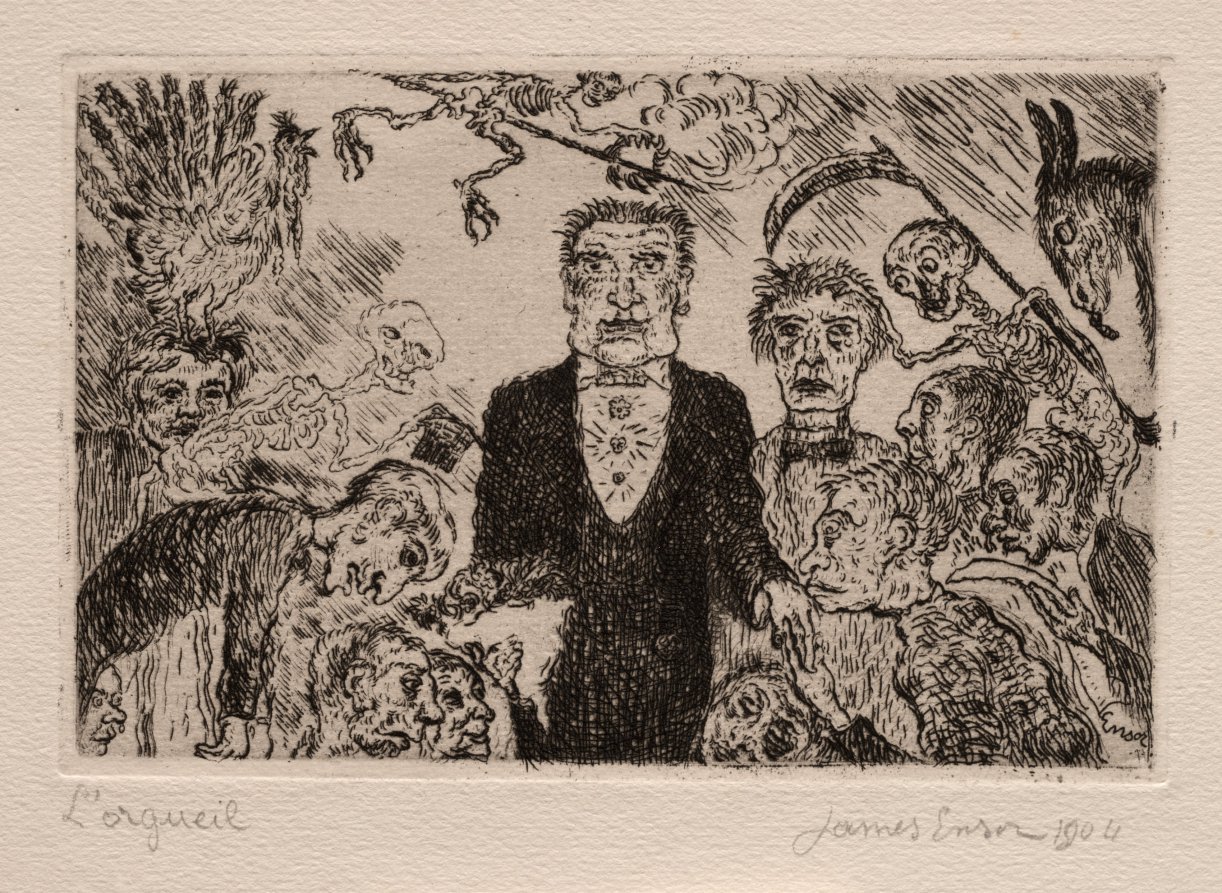
James Ensor, Pride, 1904, etching from The Seven Deadly Sins. The caricatures turn an inward motive into a visible scene.
The Cleveland Museum of Art. Purchase from the J. H. Wade Fund. 1971.108.4. CC0. · Image source ↗ · CC0
See references (7)
- Heaven and Its Wonders and Hell, printed p. 421, Reader page 428
- Heaven and Its Wonders and Hell, printed p. 427, Reader page 434
- Heaven and Its Wonders and Hell, printed p. 420, Reader page 427
- Heaven and Its Wonders and Hell, printed p. 434, Reader page 441
- Heaven and Its Wonders and Hell, printed p. 435, Reader page 442
- Heaven and Its Wonders and Hell, printed p. 437, Reader page 444
- Heaven and Its Wonders and Hell, printed p. 468, Reader page 475
Read further in the library

Heaven and Its Wonders and Hell
Reading note
An organising affection determines spiritual company, appearance and the direction of continuing development.
Sources
See references (22)
- Heaven and Its Wonders and Hell, printed p. 421, Reader page 428Emanuel Swedenborg, Heaven and Its Wonders and Hell, translated by J. C. Ager. The American Swedenborg Printing and Publishing Society, New York, 1916. Original Latin work first published in 1758.Read this page in Heaven and Its Wonders and Hell ↗Return to text ↑
- Heaven and Its Wonders and Hell, printed p. 422, Reader page 429Emanuel Swedenborg, Heaven and Its Wonders and Hell, translated by J. C. Ager. The American Swedenborg Printing and Publishing Society, New York, 1916. Original Latin work first published in 1758.Read this page in Heaven and Its Wonders and Hell ↗Return to text ↑
- Heaven and Its Wonders and Hell, printed p. 417, Reader page 424Emanuel Swedenborg, Heaven and Its Wonders and Hell, translated by J. C. Ager. The American Swedenborg Printing and Publishing Society, New York, 1916. Original Latin work first published in 1758.Read this page in Heaven and Its Wonders and Hell ↗Return to text ↑
- Heaven and Its Wonders and Hell, printed p. 418, Reader page 425Emanuel Swedenborg, Heaven and Its Wonders and Hell, translated by J. C. Ager. The American Swedenborg Printing and Publishing Society, New York, 1916. Original Latin work first published in 1758.Read this page in Heaven and Its Wonders and Hell ↗Return to text ↑
- Heaven and Its Wonders and Hell, printed p. 419, Reader page 426Emanuel Swedenborg, Heaven and Its Wonders and Hell, translated by J. C. Ager. The American Swedenborg Printing and Publishing Society, New York, 1916. Original Latin work first published in 1758.Read this page in Heaven and Its Wonders and Hell ↗Return to text ↑
- Heaven and Its Wonders and Hell, printed p. 423, Reader page 430Emanuel Swedenborg, Heaven and Its Wonders and Hell, translated by J. C. Ager. The American Swedenborg Printing and Publishing Society, New York, 1916. Original Latin work first published in 1758.Read this page in Heaven and Its Wonders and Hell ↗Return to text ↑
- Heaven and Its Wonders and Hell, printed p. 424, Reader page 431Emanuel Swedenborg, Heaven and Its Wonders and Hell, translated by J. C. Ager. The American Swedenborg Printing and Publishing Society, New York, 1916. Original Latin work first published in 1758.Read this page in Heaven and Its Wonders and Hell ↗Return to text ↑
- Heaven and Its Wonders and Hell, printed p. 427, Reader page 434Emanuel Swedenborg, Heaven and Its Wonders and Hell, translated by J. C. Ager. The American Swedenborg Printing and Publishing Society, New York, 1916. Original Latin work first published in 1758.Read this page in Heaven and Its Wonders and Hell ↗Return to text ↑
- Heaven and Its Wonders and Hell, printed p. 425, Reader page 432Emanuel Swedenborg, Heaven and Its Wonders and Hell, translated by J. C. Ager. The American Swedenborg Printing and Publishing Society, New York, 1916. Original Latin work first published in 1758.Read this page in Heaven and Its Wonders and Hell ↗Return to text ↑
- Heaven and Its Wonders and Hell, printed p. 426, Reader page 433Emanuel Swedenborg, Heaven and Its Wonders and Hell, translated by J. C. Ager. The American Swedenborg Printing and Publishing Society, New York, 1916. Original Latin work first published in 1758.Read this page in Heaven and Its Wonders and Hell ↗Return to text ↑
- Heaven and Its Wonders and Hell, printed p. 429, Reader page 436Emanuel Swedenborg, Heaven and Its Wonders and Hell, translated by J. C. Ager. The American Swedenborg Printing and Publishing Society, New York, 1916. Original Latin work first published in 1758.Read this page in Heaven and Its Wonders and Hell ↗Return to text ↑
- Heaven and Its Wonders and Hell, printed p. 430, Reader page 437Emanuel Swedenborg, Heaven and Its Wonders and Hell, translated by J. C. Ager. The American Swedenborg Printing and Publishing Society, New York, 1916. Original Latin work first published in 1758.Read this page in Heaven and Its Wonders and Hell ↗Return to text ↑
- Heaven and Its Wonders and Hell, printed p. 485, Reader page 492Emanuel Swedenborg, Heaven and Its Wonders and Hell, translated by J. C. Ager. The American Swedenborg Printing and Publishing Society, New York, 1916. Original Latin work first published in 1758.Read this page in Heaven and Its Wonders and Hell ↗Return to text ↑
- Heaven and Its Wonders and Hell, printed p. 486, Reader page 493Emanuel Swedenborg, Heaven and Its Wonders and Hell, translated by J. C. Ager. The American Swedenborg Printing and Publishing Society, New York, 1916. Original Latin work first published in 1758.Read this page in Heaven and Its Wonders and Hell ↗Return to text ↑
- Heaven and Its Wonders and Hell, printed p. 413, Reader page 420Emanuel Swedenborg, Heaven and Its Wonders and Hell, translated by J. C. Ager. The American Swedenborg Printing and Publishing Society, New York, 1916. Original Latin work first published in 1758.Read this page in Heaven and Its Wonders and Hell ↗Return to text ↑
- Heaven and Its Wonders and Hell, printed p. 414, Reader page 421Emanuel Swedenborg, Heaven and Its Wonders and Hell, translated by J. C. Ager. The American Swedenborg Printing and Publishing Society, New York, 1916. Original Latin work first published in 1758.Read this page in Heaven and Its Wonders and Hell ↗Return to text ↑
- Heaven and Its Wonders and Hell, printed p. 420, Reader page 427Emanuel Swedenborg, Heaven and Its Wonders and Hell, translated by J. C. Ager. The American Swedenborg Printing and Publishing Society, New York, 1916. Original Latin work first published in 1758.Read this page in Heaven and Its Wonders and Hell ↗Return to text ↑
- Heaven and Its Wonders and Hell, printed p. 434, Reader page 441Emanuel Swedenborg, Heaven and Its Wonders and Hell, translated by J. C. Ager. The American Swedenborg Printing and Publishing Society, New York, 1916. Original Latin work first published in 1758.Read this page in Heaven and Its Wonders and Hell ↗Return to text ↑
- Heaven and Its Wonders and Hell, printed p. 435, Reader page 442Emanuel Swedenborg, Heaven and Its Wonders and Hell, translated by J. C. Ager. The American Swedenborg Printing and Publishing Society, New York, 1916. Original Latin work first published in 1758.Read this page in Heaven and Its Wonders and Hell ↗Return to text ↑
- Heaven and Its Wonders and Hell, printed p. 437, Reader page 444Emanuel Swedenborg, Heaven and Its Wonders and Hell, translated by J. C. Ager. The American Swedenborg Printing and Publishing Society, New York, 1916. Original Latin work first published in 1758.Read this page in Heaven and Its Wonders and Hell ↗Return to text ↑
- Heaven and Its Wonders and Hell, printed p. 468, Reader page 475Emanuel Swedenborg, Heaven and Its Wonders and Hell, translated by J. C. Ager. The American Swedenborg Printing and Publishing Society, New York, 1916. Original Latin work first published in 1758.Read this page in Heaven and Its Wonders and Hell ↗Return to text ↑
- The Seven Deadly Sins: Pride, 1904 ↗The Seven Deadly Sins: Pride, 1904. James Ensor (Belgian, 1860–1949). Etching. The Cleveland Museum of Art, Purchase from the J. H. Wade Fund, 1971.108.4. CC0 open-access image.