Correspondences
A correspondence connects a visible thing with a spiritual meaning or use. Compare Swedenborg’s account with symbolic systems in two occult books.
In this article
What are correspondences?
A correspondence is a relationship between something visible and an inward quality or function. In Swedenborg’s account, a garden can express understanding, clothes can express truths and a bodily organ can express a kind of service. The connection often depends on what the thing does, as food nourishes the body. [1][2][3][4]
For Swedenborg, this is also a claim about how the world exists. He believes natural forms depend on spiritual causes and give them an outward expression. In other esoteric systems, the term can describe agreed associations used in ritual, such as a colour or a material assigned to a planet. [1][5][6][34][35]
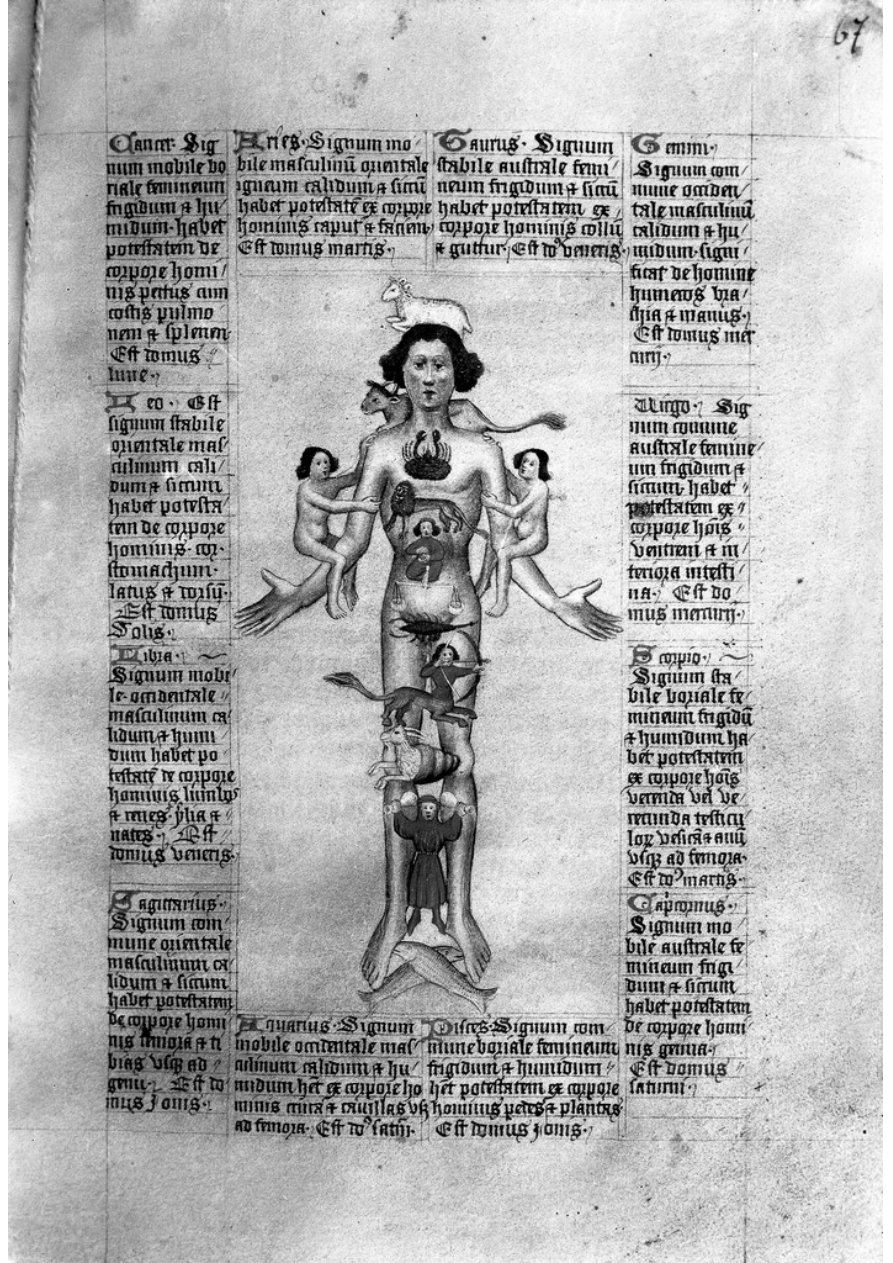
An archival photograph of a manuscript page showing a Zodiac Man. Wellcome Collection, M0007103; the photograph record is dated 30 July 1940. Signs arranged across the body provide a historical body-and-cosmos comparison, distinct from Swedenborg’s correspondences of heavenly societies and uses.
Wellcome Collection, M0007103, Wellcome Library; GB. Public Domain Mark. Original manuscript date not established by this record. · Image source ↗ · Public Domain
See references (8)
- Heaven and Its Wonders and Hell, printed p. 64, Reader page 71
- Heaven and Its Wonders and Hell, printed p. 69, Reader page 76
- Heaven and Its Wonders and Hell, printed p. 79, Reader page 86
- Heaven and Its Wonders and Hell, printed p. 131, Reader page 138
- Heaven and Its Wonders and Hell, printed p. 73, Reader page 80
- Heaven and Its Wonders and Hell, printed p. 74, Reader page 81
- Magica Sexualis, printed p. 165, Reader page 173
- Magica Sexualis, printed p. 166, Reader page 174
Heaven and Its Wonders and Hell
In Heaven and Its Wonders and Hell, Emanuel Swedenborg begins with the human being. Thought, affection and the body have different functions but act together. He extends that relation to heaven, where communities perform uses corresponding to bodily members and organs. The whole heaven can therefore be described as the Grand Man, with each community contributing to a common life. [7][8][9][10][2]
He then follows correspondences through animals, plants and human activities. Trees, fruit, bread and gardens acquire meanings through nourishment, growth, understanding and useful action. The use matters: an outward form provides a place in which an inward good can become active. This allows bodily, natural and social life to be discussed within one connected account. [11][12][3][13][14]
Scriptural interpretation follows the same principle. Swedenborg reads the gates, walls, foundations and measurements of the New Jerusalem as truths and goods of a new church. He distinguishes the outward wording from the spiritual meaning it contains, while treating their relation as one of conjunction. The literal image remains the form through which the inward account is given. [15][16][17][18]
Afterlife landscapes offer further examples. People’s enduring loves become surroundings and delights suited to them. Fields, vineyards, gardens and transparent houses express receptive forms of life; caves, barrenness and ruins can express opposed dispositions. These are meaningful appearances in the world Swedenborg describes, rather than illustrations recovered independently from that world. [19][20][21][22][23]
See references (19)
- Heaven and Its Wonders and Hell, printed p. 69, Reader page 76
- Heaven and Its Wonders and Hell, printed p. 79, Reader page 86
- Heaven and Its Wonders and Hell, printed p. 43, Reader page 50
- Heaven and Its Wonders and Hell, printed p. 65, Reader page 72
- Heaven and Its Wonders and Hell, printed p. 67, Reader page 74
- Heaven and Its Wonders and Hell, printed p. 68, Reader page 75
- Heaven and Its Wonders and Hell, printed p. 77, Reader page 84
- Heaven and Its Wonders and Hell, printed p. 78, Reader page 85
- Heaven and Its Wonders and Hell, printed p. 80, Reader page 87
- Heaven and Its Wonders and Hell, printed p. 81, Reader page 88
- Heaven and Its Wonders and Hell, printed p. 139, Reader page 146
- Heaven and Its Wonders and Hell, printed p. 243, Reader page 250
- Heaven and Its Wonders and Hell, printed p. 244, Reader page 251
- Heaven and Its Wonders and Hell, printed p. 245, Reader page 252
- Heaven and Its Wonders and Hell, printed p. 437, Reader page 444
- Heaven and Its Wonders and Hell, printed p. 438, Reader page 445
- Heaven and Its Wonders and Hell, printed p. 440, Reader page 447
- Heaven and Its Wonders and Hell, printed p. 441, Reader page 448
- Heaven and Its Wonders and Hell, printed p. 442, Reader page 449
Magica Sexualis by Émile Laurent and Paul Nagour
Émile Laurent and Paul Nagour’s Magica Sexualis develops correspondences through the making of a Venus talisman. Its quoted example brings the material, shape, timing and colour of an object into agreement with the intended purpose. Copper and the circular form are selected because the source assigns them to Venus. The desired result is supposed to emerge from a coordinated set of relationships. [34][35]
The following list extends the network across several senses. It associates Venus with the dove, rose, olive tree, green colour, melody and an alluring scent, as well as a letter, musical note and particular numbers. The significance lies in the arrangement: a flower, a metal and a sound can support the same aim because they occupy corresponding places within that system. [36]
The author quoted by the compilers explains the observances as ways of impressing his will upon the object. This gives the list an operational role. It is not simply a vocabulary for interpreting an image after it has been made; it is presented as a guide to preparing an object intended to act. The account’s confidence in the result remains its own claim. [35][36]
Elsewhere the book groups the colours and compounds of copper with Venus, and gathers plants and perfumes under divine names. These passages broaden the scheme while also revealing how readily an analogy can become an assertion about origins. A resemblance between colours, a shared name or a similar ritual object does not by itself establish that two cults or symbolic systems have the same history. [37][38][39][40]
See references (7)
Light-Bearers of Darkness: Inquire Within
Light-Bearers of Darkness, by Inquire Within, assembles correspondences from several esoteric settings. Its tattvic table assigns a dark egg to Akasa and sound, a blue sphere to Vayu and touch, a red triangle to Tegas and sight, a silver crescent to Apas and taste, and a yellow square to Prithivi and smell. These are the particular forms and spellings printed in the book’s account of tattvic vision. [28]
The reproduced Mystic Repast gives ordinary objects elemental roles. A rose represents air, a lamp fire, wine water, and bread and salt earth. Elsewhere the analysis of INRI links letters with Virgo and Isis, Scorpio and Apophis, and the Sun and Osiris, before developing the IAO and LVX formulae. A ritual object or letter can thus participate in several linked systems of meaning. [29][30]
In the discussion of eurythmy, the author connects vowels with planets and consonants with the zodiac, then interprets movement and sound as ways of attracting corresponding forces. This last step is the critic’s proposed explanation of efficacy. A shared symbolic vocabulary does not by itself establish the claimed mechanism or prove that the organisations using it have one hidden director. [31][32]
The volume’s wider argument is an antisemitic political polemic. Its tables and reproduced rituals can be examined as particular symbolic arrangements while its claim that resemblance reveals a world conspiracy remains unsupported by those correspondences. [33][31][32]
See references (6)
- Light-Bearers of Darkness, printed p. 128, Reader page 131
- Light-Bearers of Darkness, printed p. 153, Reader page 156
- Light-Bearers of Darkness, printed p. 156, Reader page 159
- Light-Bearers of Darkness, printed p. 73, Reader page 76
- Light-Bearers of Darkness, printed p. 75, Reader page 78
- Light-Bearers of Darkness, printed p. 10, Reader page 13
How the same object carries different meanings
Nourishment is one clue to what food means in Swedenborg’s account. In the Mystic Repast reproduced by Inquire Within, bread and salt instead have an elemental role. Magica Sexualis groups materials, colours and timing around a planetary association. The meaning follows the use, ceremony or purpose that makes the connection work in each account. [11][12][3][13][14][28][29][30][2][35][36]
The same author can vary the meaning with the setting. For Swedenborg, fire can express heavenly love or destructive desire. The appearance is similar, while the love it makes visible differs. [2][24][25][26]
The word correspondence can cover an interpretation of a text, an association used in ritual or a claim about spiritual causation. Asking which of these the author means is more reliable than transferring a list of symbols from one tradition to another. [1][8][16]
See references (17)
- Heaven and Its Wonders and Hell, printed p. 64, Reader page 71
- Heaven and Its Wonders and Hell, printed p. 69, Reader page 76
- Heaven and Its Wonders and Hell, printed p. 79, Reader page 86
- Heaven and Its Wonders and Hell, printed p. 65, Reader page 72
- Heaven and Its Wonders and Hell, printed p. 77, Reader page 84
- Heaven and Its Wonders and Hell, printed p. 78, Reader page 85
- Heaven and Its Wonders and Hell, printed p. 80, Reader page 87
- Heaven and Its Wonders and Hell, printed p. 81, Reader page 88
- Heaven and Its Wonders and Hell, printed p. 243, Reader page 250
- Heaven and Its Wonders and Hell, printed p. 93, Reader page 100
- Heaven and Its Wonders and Hell, printed p. 533, Reader page 540
- Heaven and Its Wonders and Hell, printed p. 534, Reader page 541
- Light-Bearers of Darkness, printed p. 128, Reader page 131
- Light-Bearers of Darkness, printed p. 153, Reader page 156
- Light-Bearers of Darkness, printed p. 156, Reader page 159
- Magica Sexualis, printed p. 166, Reader page 174
- Magica Sexualis, printed p. 167, Reader page 175
Read further in the library

Heaven and Its Wonders and Hell
Reading note
Bodies, nature, scripture and spiritual landscapes express relationships between inward causes and outward forms.
Light-Bearers of Darkness
Reading note
The separately titled account draws on exact passages in the consulted Library edition.
Magica Sexualis
Reading note
The separately titled account draws on exact passages in the consulted Library edition.
Sources
See references (40)
- Heaven and Its Wonders and Hell, printed p. 64, Reader page 71Emanuel Swedenborg, Heaven and Its Wonders and Hell, translated by J. C. Ager. The American Swedenborg Printing and Publishing Society, New York, 1916. Original Latin work first published in 1758.Read this page in Heaven and Its Wonders and Hell ↗Return to text ↑
- Heaven and Its Wonders and Hell, printed p. 69, Reader page 76Emanuel Swedenborg, Heaven and Its Wonders and Hell, translated by J. C. Ager. The American Swedenborg Printing and Publishing Society, New York, 1916. Original Latin work first published in 1758.Read this page in Heaven and Its Wonders and Hell ↗Return to text ↑
- Heaven and Its Wonders and Hell, printed p. 79, Reader page 86Emanuel Swedenborg, Heaven and Its Wonders and Hell, translated by J. C. Ager. The American Swedenborg Printing and Publishing Society, New York, 1916. Original Latin work first published in 1758.Read this page in Heaven and Its Wonders and Hell ↗Return to text ↑
- Heaven and Its Wonders and Hell, printed p. 131, Reader page 138Emanuel Swedenborg, Heaven and Its Wonders and Hell, translated by J. C. Ager. The American Swedenborg Printing and Publishing Society, New York, 1916. Original Latin work first published in 1758.Read this page in Heaven and Its Wonders and Hell ↗Return to text ↑
- Heaven and Its Wonders and Hell, printed p. 73, Reader page 80Emanuel Swedenborg, Heaven and Its Wonders and Hell, translated by J. C. Ager. The American Swedenborg Printing and Publishing Society, New York, 1916. Original Latin work first published in 1758.Read this page in Heaven and Its Wonders and Hell ↗Return to text ↑
- Heaven and Its Wonders and Hell, printed p. 74, Reader page 81Emanuel Swedenborg, Heaven and Its Wonders and Hell, translated by J. C. Ager. The American Swedenborg Printing and Publishing Society, New York, 1916. Original Latin work first published in 1758.Read this page in Heaven and Its Wonders and Hell ↗Return to text ↑
- Heaven and Its Wonders and Hell, printed p. 43, Reader page 50Emanuel Swedenborg, Heaven and Its Wonders and Hell, translated by J. C. Ager. The American Swedenborg Printing and Publishing Society, New York, 1916. Original Latin work first published in 1758.Read this page in Heaven and Its Wonders and Hell ↗Return to text ↑
- Heaven and Its Wonders and Hell, printed p. 65, Reader page 72Emanuel Swedenborg, Heaven and Its Wonders and Hell, translated by J. C. Ager. The American Swedenborg Printing and Publishing Society, New York, 1916. Original Latin work first published in 1758.Read this page in Heaven and Its Wonders and Hell ↗Return to text ↑
- Heaven and Its Wonders and Hell, printed p. 67, Reader page 74Emanuel Swedenborg, Heaven and Its Wonders and Hell, translated by J. C. Ager. The American Swedenborg Printing and Publishing Society, New York, 1916. Original Latin work first published in 1758.Read this page in Heaven and Its Wonders and Hell ↗Return to text ↑
- Heaven and Its Wonders and Hell, printed p. 68, Reader page 75Emanuel Swedenborg, Heaven and Its Wonders and Hell, translated by J. C. Ager. The American Swedenborg Printing and Publishing Society, New York, 1916. Original Latin work first published in 1758.Read this page in Heaven and Its Wonders and Hell ↗Return to text ↑
- Heaven and Its Wonders and Hell, printed p. 77, Reader page 84Emanuel Swedenborg, Heaven and Its Wonders and Hell, translated by J. C. Ager. The American Swedenborg Printing and Publishing Society, New York, 1916. Original Latin work first published in 1758.Read this page in Heaven and Its Wonders and Hell ↗Return to text ↑
- Heaven and Its Wonders and Hell, printed p. 78, Reader page 85Emanuel Swedenborg, Heaven and Its Wonders and Hell, translated by J. C. Ager. The American Swedenborg Printing and Publishing Society, New York, 1916. Original Latin work first published in 1758.Read this page in Heaven and Its Wonders and Hell ↗Return to text ↑
- Heaven and Its Wonders and Hell, printed p. 80, Reader page 87Emanuel Swedenborg, Heaven and Its Wonders and Hell, translated by J. C. Ager. The American Swedenborg Printing and Publishing Society, New York, 1916. Original Latin work first published in 1758.Read this page in Heaven and Its Wonders and Hell ↗Return to text ↑
- Heaven and Its Wonders and Hell, printed p. 81, Reader page 88Emanuel Swedenborg, Heaven and Its Wonders and Hell, translated by J. C. Ager. The American Swedenborg Printing and Publishing Society, New York, 1916. Original Latin work first published in 1758.Read this page in Heaven and Its Wonders and Hell ↗Return to text ↑
- Heaven and Its Wonders and Hell, printed p. 139, Reader page 146Emanuel Swedenborg, Heaven and Its Wonders and Hell, translated by J. C. Ager. The American Swedenborg Printing and Publishing Society, New York, 1916. Original Latin work first published in 1758.Read this page in Heaven and Its Wonders and Hell ↗Return to text ↑
- Heaven and Its Wonders and Hell, printed p. 243, Reader page 250Emanuel Swedenborg, Heaven and Its Wonders and Hell, translated by J. C. Ager. The American Swedenborg Printing and Publishing Society, New York, 1916. Original Latin work first published in 1758.Read this page in Heaven and Its Wonders and Hell ↗Return to text ↑
- Heaven and Its Wonders and Hell, printed p. 244, Reader page 251Emanuel Swedenborg, Heaven and Its Wonders and Hell, translated by J. C. Ager. The American Swedenborg Printing and Publishing Society, New York, 1916. Original Latin work first published in 1758.Read this page in Heaven and Its Wonders and Hell ↗Return to text ↑
- Heaven and Its Wonders and Hell, printed p. 245, Reader page 252Emanuel Swedenborg, Heaven and Its Wonders and Hell, translated by J. C. Ager. The American Swedenborg Printing and Publishing Society, New York, 1916. Original Latin work first published in 1758.Read this page in Heaven and Its Wonders and Hell ↗Return to text ↑
- Heaven and Its Wonders and Hell, printed p. 437, Reader page 444Emanuel Swedenborg, Heaven and Its Wonders and Hell, translated by J. C. Ager. The American Swedenborg Printing and Publishing Society, New York, 1916. Original Latin work first published in 1758.Read this page in Heaven and Its Wonders and Hell ↗Return to text ↑
- Heaven and Its Wonders and Hell, printed p. 438, Reader page 445Emanuel Swedenborg, Heaven and Its Wonders and Hell, translated by J. C. Ager. The American Swedenborg Printing and Publishing Society, New York, 1916. Original Latin work first published in 1758.Read this page in Heaven and Its Wonders and Hell ↗Return to text ↑
- Heaven and Its Wonders and Hell, printed p. 440, Reader page 447Emanuel Swedenborg, Heaven and Its Wonders and Hell, translated by J. C. Ager. The American Swedenborg Printing and Publishing Society, New York, 1916. Original Latin work first published in 1758.Read this page in Heaven and Its Wonders and Hell ↗Return to text ↑
- Heaven and Its Wonders and Hell, printed p. 441, Reader page 448Emanuel Swedenborg, Heaven and Its Wonders and Hell, translated by J. C. Ager. The American Swedenborg Printing and Publishing Society, New York, 1916. Original Latin work first published in 1758.Read this page in Heaven and Its Wonders and Hell ↗Return to text ↑
- Heaven and Its Wonders and Hell, printed p. 442, Reader page 449Emanuel Swedenborg, Heaven and Its Wonders and Hell, translated by J. C. Ager. The American Swedenborg Printing and Publishing Society, New York, 1916. Original Latin work first published in 1758.Read this page in Heaven and Its Wonders and Hell ↗Return to text ↑
- Heaven and Its Wonders and Hell, printed p. 93, Reader page 100Emanuel Swedenborg, Heaven and Its Wonders and Hell, translated by J. C. Ager. The American Swedenborg Printing and Publishing Society, New York, 1916. Original Latin work first published in 1758.Read this page in Heaven and Its Wonders and Hell ↗Return to text ↑
- Heaven and Its Wonders and Hell, printed p. 533, Reader page 540Emanuel Swedenborg, Heaven and Its Wonders and Hell, translated by J. C. Ager. The American Swedenborg Printing and Publishing Society, New York, 1916. Original Latin work first published in 1758.Read this page in Heaven and Its Wonders and Hell ↗Return to text ↑
- Heaven and Its Wonders and Hell, printed p. 534, Reader page 541Emanuel Swedenborg, Heaven and Its Wonders and Hell, translated by J. C. Ager. The American Swedenborg Printing and Publishing Society, New York, 1916. Original Latin work first published in 1758.Read this page in Heaven and Its Wonders and Hell ↗Return to text ↑
- M0007103: Manuscript page including illustration of Zodiac man ↗Wellcome Collection, M0007103. Primary download cover gives photograph record date 30 July 1940 and Public Domain Mark; original manuscript date unspecified.
- Light-Bearers of Darkness, printed p. 128, Reader page 131Inquire Within, Light-Bearers of Darkness (first printed 1930; supplied facsimile reprinted 2001), exact selected Library edition IMJ-0032-E002. Quotations and reported documents are read through this polemical source, unless a separately titled account states otherwise. Original source leaf 206 is absent; original PageIDs and current Reader positions are verified.Read this page in Light-Bearers of Darkness ↗Return to text ↑
- Light-Bearers of Darkness, printed p. 153, Reader page 156Inquire Within, Light-Bearers of Darkness (first printed 1930; supplied facsimile reprinted 2001), exact selected Library edition IMJ-0032-E002. Quotations and reported documents are read through this polemical source, unless a separately titled account states otherwise. Original source leaf 206 is absent; original PageIDs and current Reader positions are verified.Read this page in Light-Bearers of Darkness ↗Return to text ↑
- Light-Bearers of Darkness, printed p. 156, Reader page 159Inquire Within, Light-Bearers of Darkness (first printed 1930; supplied facsimile reprinted 2001), exact selected Library edition IMJ-0032-E002. Quotations and reported documents are read through this polemical source, unless a separately titled account states otherwise. Original source leaf 206 is absent; original PageIDs and current Reader positions are verified.Read this page in Light-Bearers of Darkness ↗Return to text ↑
- Light-Bearers of Darkness, printed p. 73, Reader page 76Inquire Within, Light-Bearers of Darkness (first printed 1930; supplied facsimile reprinted 2001), exact selected Library edition IMJ-0032-E002. Quotations and reported documents are read through this polemical source, unless a separately titled account states otherwise. Original source leaf 206 is absent; original PageIDs and current Reader positions are verified.Read this page in Light-Bearers of Darkness ↗Return to text ↑
- Light-Bearers of Darkness, printed p. 75, Reader page 78Inquire Within, Light-Bearers of Darkness (first printed 1930; supplied facsimile reprinted 2001), exact selected Library edition IMJ-0032-E002. Quotations and reported documents are read through this polemical source, unless a separately titled account states otherwise. Original source leaf 206 is absent; original PageIDs and current Reader positions are verified.Read this page in Light-Bearers of Darkness ↗Return to text ↑
- Light-Bearers of Darkness, printed p. 10, Reader page 13Inquire Within, Light-Bearers of Darkness (first printed 1930; supplied facsimile reprinted 2001), exact selected Library edition IMJ-0032-E002. Quotations and reported documents are read through this polemical source, unless a separately titled account states otherwise. Original source leaf 206 is absent; original PageIDs and current Reader positions are verified.Read this page in Light-Bearers of Darkness ↗Return to text ↑
- Magica Sexualis, printed p. 165, Reader page 173Émile Laurent and Paul Nagour, Magica Sexualis, privately printed by Falstaff Press Inc., New York, undated inspected edition. Exact original Library edition IMJ-0105-E001. The work is a historical compilation; its quoted fiction, trial allegations and medical interpretations are not treated as independently verified facts. Current Reader positions are mapped separately from printed pagination.Read this page in Magica Sexualis ↗Return to text ↑
- Magica Sexualis, printed p. 166, Reader page 174Émile Laurent and Paul Nagour, Magica Sexualis, privately printed by Falstaff Press Inc., New York, undated inspected edition. Exact original Library edition IMJ-0105-E001. The work is a historical compilation; its quoted fiction, trial allegations and medical interpretations are not treated as independently verified facts. Current Reader positions are mapped separately from printed pagination.Read this page in Magica Sexualis ↗Return to text ↑
- Magica Sexualis, printed p. 167, Reader page 175Émile Laurent and Paul Nagour, Magica Sexualis, privately printed by Falstaff Press Inc., New York, undated inspected edition. Exact original Library edition IMJ-0105-E001. The work is a historical compilation; its quoted fiction, trial allegations and medical interpretations are not treated as independently verified facts. Current Reader positions are mapped separately from printed pagination.Read this page in Magica Sexualis ↗Return to text ↑
- Magica Sexualis, Reader page 165Émile Laurent and Paul Nagour, Magica Sexualis, privately printed by Falstaff Press Inc., New York, undated inspected edition. Exact original Library edition IMJ-0105-E001. The work is a historical compilation; its quoted fiction, trial allegations and medical interpretations are not treated as independently verified facts. Current Reader positions are mapped separately from printed pagination.Read this page in Magica Sexualis ↗Return to text ↑
- Magica Sexualis, Reader page 166Émile Laurent and Paul Nagour, Magica Sexualis, privately printed by Falstaff Press Inc., New York, undated inspected edition. Exact original Library edition IMJ-0105-E001. The work is a historical compilation; its quoted fiction, trial allegations and medical interpretations are not treated as independently verified facts. Current Reader positions are mapped separately from printed pagination.Read this page in Magica Sexualis ↗Return to text ↑
- Magica Sexualis, printed p. 176, Reader page 184Émile Laurent and Paul Nagour, Magica Sexualis, privately printed by Falstaff Press Inc., New York, undated inspected edition. Exact original Library edition IMJ-0105-E001. The work is a historical compilation; its quoted fiction, trial allegations and medical interpretations are not treated as independently verified facts. Current Reader positions are mapped separately from printed pagination.Read this page in Magica Sexualis ↗Return to text ↑
- Magica Sexualis, Reader page 185Émile Laurent and Paul Nagour, Magica Sexualis, privately printed by Falstaff Press Inc., New York, undated inspected edition. Exact original Library edition IMJ-0105-E001. The work is a historical compilation; its quoted fiction, trial allegations and medical interpretations are not treated as independently verified facts. Current Reader positions are mapped separately from printed pagination.Read this page in Magica Sexualis ↗Return to text ↑