Grand Man
The Grand Man, or Greatest Man, is Swedenborg’s image of heaven as one human form. Each angelic society serves a purpose, like an organ within a living body.
In this article
What is the Grand Man?
The Grand Man, also called the Greatest Man, is Emanuel Swedenborg’s name for heaven understood as one human form. Its angelic societies have different purposes, just as organs do. The whole lives through what each community contributes. [1][2][3]
The form is collective and spiritual. Swedenborg grounds it in what he calls the Lord’s Divine Human. As the communities receive good and truth, the order in which they serve one another takes a human form. [4][5][6]
See references (6)
- Heaven and Its Wonders and Hell, printed p. 43, Reader page 50
- Heaven and Its Wonders and Hell, printed p. 44, Reader page 51
- Heaven and Its Wonders and Hell, printed p. 46, Reader page 53
- Heaven and Its Wonders and Hell, printed p. 57, Reader page 64
- Heaven and Its Wonders and Hell, printed p. 58, Reader page 65
- Heaven and Its Wonders and Hell, printed p. 63, Reader page 70
Heaven and Its Wonders and Hell
Emanuel Swedenborg’s Heaven and Its Wonders and Hell describes several scales of human form. The entire heaven, a particular society and an individual angel can each be viewed as a human whole. A society may appear as one angel when its members are seen together. What joins the scales is an order of shared good, rather than the disappearance of the individuals composing it. [7][1][2]
The bodily correspondences make its organisation more specific. Communities can belong to provinces associated with the heart, lungs, eyes, ears, arms or other members, according to their uses. Swedenborg relates willing and understanding to these functions and says that heavenly life flows into the corresponding activities of a human being. The anatomical language expresses his spiritual account of dependence and service. [8][9][10][11]
A heart or an eye has a use that helps sustain the whole body. Swedenborg gives the same pattern to heavenly societies: their differences let them contribute in particular ways, and their members find their own good in the good of others. [3][12][13][14][15]
The form is never completed by excluding later arrivals. Swedenborg says heaven becomes more perfect through an increasing number of associations, and denies a fixed limit at which it closes. No individual angel knows the entire arrangement exhaustively. Its full order belongs to the Lord’s knowledge, while each member participates through its own reception and use. [16][17][18][15][19]
See references (16)
- Heaven and Its Wonders and Hell, printed p. 43, Reader page 50
- Heaven and Its Wonders and Hell, printed p. 44, Reader page 51
- Heaven and Its Wonders and Hell, printed p. 46, Reader page 53
- Heaven and Its Wonders and Hell, printed p. 37, Reader page 44
- Heaven and Its Wonders and Hell, printed p. 67, Reader page 74
- Heaven and Its Wonders and Hell, printed p. 68, Reader page 75
- Heaven and Its Wonders and Hell, printed p. 69, Reader page 76
- Heaven and Its Wonders and Hell, printed p. 70, Reader page 77
- Heaven and Its Wonders and Hell, printed p. 48, Reader page 55
- Heaven and Its Wonders and Hell, printed p. 345, Reader page 352
- Heaven and Its Wonders and Hell, printed p. 346, Reader page 353
- Heaven and Its Wonders and Hell, printed p. 360, Reader page 367
- Heaven and Its Wonders and Hell, printed p. 50, Reader page 57
- Heaven and Its Wonders and Hell, printed p. 51, Reader page 58
- Heaven and Its Wonders and Hell, printed p. 156, Reader page 163
- Heaven and Its Wonders and Hell, printed p. 361, Reader page 368
How does it relate to microcosm and macrocosm?
Robert Fludd’s diagram places an individual body within a larger cosmic order. Swedenborg gives the analogy a different direction. Many societies together make a human form, because each contributes something to the life of heaven. The comparison helps explain why what the societies do matters as much as how they appear. [20][8][21][15][22]
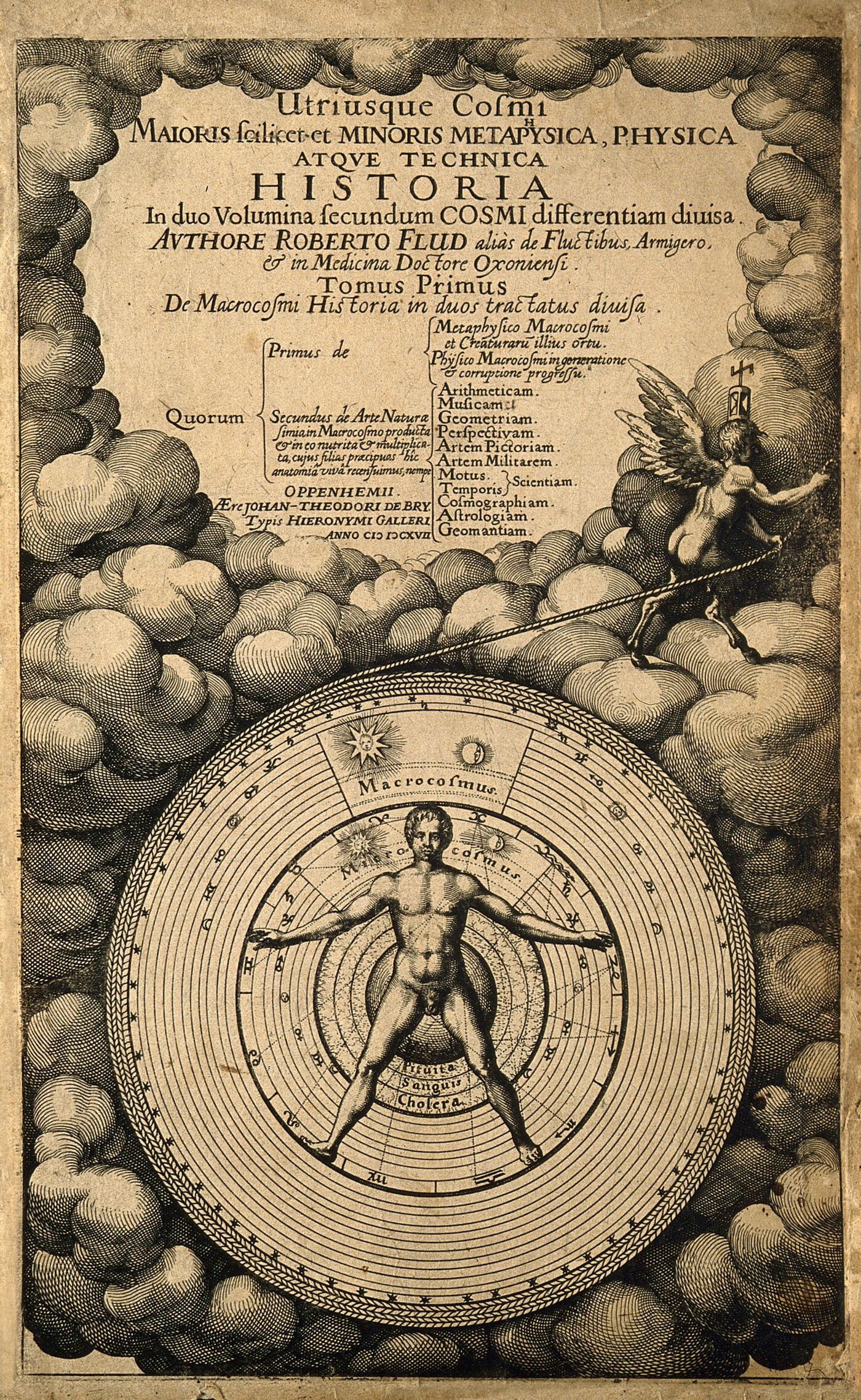
Title page of Robert Fludd’s Utriusque cosmi historia, 1617. The surrounding rings place the human figure within the microcosm and macrocosm. Wellcome Collection, 2989i.
Wellcome Collection, 2989i. Public Domain Mark. · Image source ↗ · Public Domain
See references (5)
- Heaven and Its Wonders and Hell, printed p. 67, Reader page 74
- Heaven and Its Wonders and Hell, printed p. 360, Reader page 367
- Heaven and Its Wonders and Hell, printed p. 64, Reader page 71
- Heaven and Its Wonders and Hell, printed p. 359, Reader page 366
- The microcosm (man) and the macrocosm (the world), 1617: Wellcome Collection 2989i
Read further in the library

Heaven and Its Wonders and Hell
Reading note
Heaven’s societies are described as a coordinated human form, united through shared uses.
Sources
See references (22)
- Heaven and Its Wonders and Hell, printed p. 43, Reader page 50Emanuel Swedenborg, Heaven and Its Wonders and Hell, translated by J. C. Ager. The American Swedenborg Printing and Publishing Society, New York, 1916. Original Latin work first published in 1758.Read this page in Heaven and Its Wonders and Hell ↗Return to text ↑
- Heaven and Its Wonders and Hell, printed p. 44, Reader page 51Emanuel Swedenborg, Heaven and Its Wonders and Hell, translated by J. C. Ager. The American Swedenborg Printing and Publishing Society, New York, 1916. Original Latin work first published in 1758.Read this page in Heaven and Its Wonders and Hell ↗Return to text ↑
- Heaven and Its Wonders and Hell, printed p. 46, Reader page 53Emanuel Swedenborg, Heaven and Its Wonders and Hell, translated by J. C. Ager. The American Swedenborg Printing and Publishing Society, New York, 1916. Original Latin work first published in 1758.Read this page in Heaven and Its Wonders and Hell ↗Return to text ↑
- Heaven and Its Wonders and Hell, printed p. 57, Reader page 64Emanuel Swedenborg, Heaven and Its Wonders and Hell, translated by J. C. Ager. The American Swedenborg Printing and Publishing Society, New York, 1916. Original Latin work first published in 1758.Read this page in Heaven and Its Wonders and Hell ↗Return to text ↑
- Heaven and Its Wonders and Hell, printed p. 58, Reader page 65Emanuel Swedenborg, Heaven and Its Wonders and Hell, translated by J. C. Ager. The American Swedenborg Printing and Publishing Society, New York, 1916. Original Latin work first published in 1758.Read this page in Heaven and Its Wonders and Hell ↗Return to text ↑
- Heaven and Its Wonders and Hell, printed p. 63, Reader page 70Emanuel Swedenborg, Heaven and Its Wonders and Hell, translated by J. C. Ager. The American Swedenborg Printing and Publishing Society, New York, 1916. Original Latin work first published in 1758.Read this page in Heaven and Its Wonders and Hell ↗Return to text ↑
- Heaven and Its Wonders and Hell, printed p. 37, Reader page 44Emanuel Swedenborg, Heaven and Its Wonders and Hell, translated by J. C. Ager. The American Swedenborg Printing and Publishing Society, New York, 1916. Original Latin work first published in 1758.Read this page in Heaven and Its Wonders and Hell ↗Return to text ↑
- Heaven and Its Wonders and Hell, printed p. 67, Reader page 74Emanuel Swedenborg, Heaven and Its Wonders and Hell, translated by J. C. Ager. The American Swedenborg Printing and Publishing Society, New York, 1916. Original Latin work first published in 1758.Read this page in Heaven and Its Wonders and Hell ↗Return to text ↑
- Heaven and Its Wonders and Hell, printed p. 68, Reader page 75Emanuel Swedenborg, Heaven and Its Wonders and Hell, translated by J. C. Ager. The American Swedenborg Printing and Publishing Society, New York, 1916. Original Latin work first published in 1758.Read this page in Heaven and Its Wonders and Hell ↗Return to text ↑
- Heaven and Its Wonders and Hell, printed p. 69, Reader page 76Emanuel Swedenborg, Heaven and Its Wonders and Hell, translated by J. C. Ager. The American Swedenborg Printing and Publishing Society, New York, 1916. Original Latin work first published in 1758.Read this page in Heaven and Its Wonders and Hell ↗Return to text ↑
- Heaven and Its Wonders and Hell, printed p. 70, Reader page 77Emanuel Swedenborg, Heaven and Its Wonders and Hell, translated by J. C. Ager. The American Swedenborg Printing and Publishing Society, New York, 1916. Original Latin work first published in 1758.Read this page in Heaven and Its Wonders and Hell ↗Return to text ↑
- Heaven and Its Wonders and Hell, printed p. 48, Reader page 55Emanuel Swedenborg, Heaven and Its Wonders and Hell, translated by J. C. Ager. The American Swedenborg Printing and Publishing Society, New York, 1916. Original Latin work first published in 1758.Read this page in Heaven and Its Wonders and Hell ↗Return to text ↑
- Heaven and Its Wonders and Hell, printed p. 345, Reader page 352Emanuel Swedenborg, Heaven and Its Wonders and Hell, translated by J. C. Ager. The American Swedenborg Printing and Publishing Society, New York, 1916. Original Latin work first published in 1758.Read this page in Heaven and Its Wonders and Hell ↗Return to text ↑
- Heaven and Its Wonders and Hell, printed p. 346, Reader page 353Emanuel Swedenborg, Heaven and Its Wonders and Hell, translated by J. C. Ager. The American Swedenborg Printing and Publishing Society, New York, 1916. Original Latin work first published in 1758.Read this page in Heaven and Its Wonders and Hell ↗Return to text ↑
- Heaven and Its Wonders and Hell, printed p. 360, Reader page 367Emanuel Swedenborg, Heaven and Its Wonders and Hell, translated by J. C. Ager. The American Swedenborg Printing and Publishing Society, New York, 1916. Original Latin work first published in 1758.Read this page in Heaven and Its Wonders and Hell ↗Return to text ↑
- Heaven and Its Wonders and Hell, printed p. 50, Reader page 57Emanuel Swedenborg, Heaven and Its Wonders and Hell, translated by J. C. Ager. The American Swedenborg Printing and Publishing Society, New York, 1916. Original Latin work first published in 1758.Read this page in Heaven and Its Wonders and Hell ↗Return to text ↑
- Heaven and Its Wonders and Hell, printed p. 51, Reader page 58Emanuel Swedenborg, Heaven and Its Wonders and Hell, translated by J. C. Ager. The American Swedenborg Printing and Publishing Society, New York, 1916. Original Latin work first published in 1758.Read this page in Heaven and Its Wonders and Hell ↗Return to text ↑
- Heaven and Its Wonders and Hell, printed p. 156, Reader page 163Emanuel Swedenborg, Heaven and Its Wonders and Hell, translated by J. C. Ager. The American Swedenborg Printing and Publishing Society, New York, 1916. Original Latin work first published in 1758.Read this page in Heaven and Its Wonders and Hell ↗Return to text ↑
- Heaven and Its Wonders and Hell, printed p. 361, Reader page 368Emanuel Swedenborg, Heaven and Its Wonders and Hell, translated by J. C. Ager. The American Swedenborg Printing and Publishing Society, New York, 1916. Original Latin work first published in 1758.Read this page in Heaven and Its Wonders and Hell ↗Return to text ↑
- Heaven and Its Wonders and Hell, printed p. 64, Reader page 71Emanuel Swedenborg, Heaven and Its Wonders and Hell, translated by J. C. Ager. The American Swedenborg Printing and Publishing Society, New York, 1916. Original Latin work first published in 1758.Read this page in Heaven and Its Wonders and Hell ↗Return to text ↑
- Heaven and Its Wonders and Hell, printed p. 359, Reader page 366Emanuel Swedenborg, Heaven and Its Wonders and Hell, translated by J. C. Ager. The American Swedenborg Printing and Publishing Society, New York, 1916. Original Latin work first published in 1758.Read this page in Heaven and Its Wonders and Hell ↗Return to text ↑
- The microcosm (man) and the macrocosm (the world), 1617: Wellcome Collection 2989i ↗Wellcome Collection, 2989i. Engraving credited to T. de Bry, 1617; associated with Robert Fludd. Public Domain Mark.Return to text ↑