New Jerusalem
New Jerusalem is the holy city in Revelation 21. Compare the city’s architecture and meaning in Revelation, Swedenborg and Claude Bragdon.
In this article
What is New Jerusalem?
New Jerusalem is the holy city the Book of Revelation describes descending out of heaven from God. Its gates, walls and foundations give the hope of renewed life an architectural form. Emanuel Swedenborg reads the city as a new church. Claude Bragdon takes its equal dimensions into a story about worlds and people joined by love. [1][2][3][17][22][23][24]
A wall protects, a gate lets people enter and a foundation holds up the building. Swedenborg gives these functions spiritual meanings. Bragdon begins with a different detail: the city has the same length, breadth and height. [1][3][17]
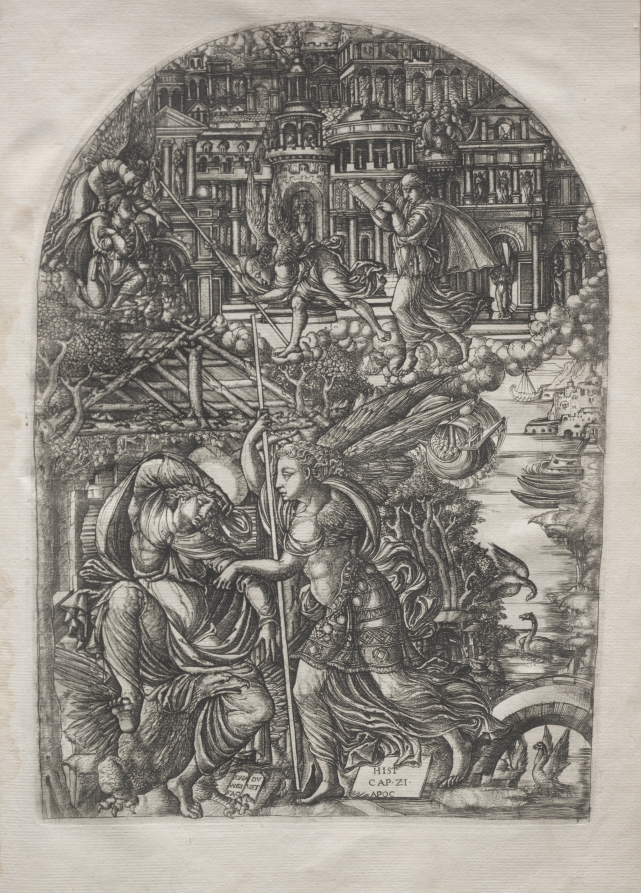
Jean Duvet, The Angel Shows Saint John the New Jerusalem, from The Apocalypse, 1546–56. The engraving gives the scriptural city a crowded architectural form, with an angel and John in the foreground.
The Cleveland Museum of Art. Gift of the Hanna Fund. 1953.213.28. CC0. · Image source ↗ · CC0
See references (7)
- Heaven and Its Wonders and Hell, printed p. 139, Reader page 146
- Heaven and Its Wonders and Hell, printed p. 243, Reader page 250
- Heaven and Its Wonders and Hell, printed p. 244, Reader page 251
- Revelation 21:9–27, the New Jerusalem
- A Primer of Higher Space, Reader page 79
- A Primer of Higher Space, Reader page 80
- A Primer of Higher Space, Reader page 81
Heaven and Its Wonders and Hell
In Heaven and Its Wonders and Hell, Emanuel Swedenborg introduces New Jerusalem while explaining how the Word connects heaven and human life. He reads the city as a new church and uses correspondences to relate each part of its architecture to the good or truth that gives the church its life. [2][3][4][5]
The wall expresses protecting truth. Gates concern truths that lead into good, while foundations concern the knowledges on which the church is established. Gold and precious stones receive meanings through Divine good and the truths of doctrine. Their material splendour carries an inward order in his interpretation. [1][3]
Measurements also matter. Length, breadth and height are read through states and degrees of good and truth. The angel’s measure and the human measure belong to one correspondence between heaven and the person. Swedenborg does not use these dimensions to calculate the earthly footprint of a future city. [6][7][2][3]
Elsewhere he describes real houses, palaces, gardens and churches in the heavenly world. These appearances correspond to their inhabitants’ love and understanding. His reading of New Jerusalem belongs within that wider relation between inward life and outward form, while the scriptural city specifically concerns the church and its doctrine. [8][9][10][11][12]
See references (12)
- Heaven and Its Wonders and Hell, printed p. 139, Reader page 146
- Heaven and Its Wonders and Hell, printed p. 243, Reader page 250
- Heaven and Its Wonders and Hell, printed p. 244, Reader page 251
- Heaven and Its Wonders and Hell, printed p. 245, Reader page 252
- Heaven and Its Wonders and Hell, printed p. 246, Reader page 253
- Heaven and Its Wonders and Hell, printed p. 143, Reader page 150
- Heaven and Its Wonders and Hell, printed p. 144, Reader page 151
- Heaven and Its Wonders and Hell, printed p. 135, Reader page 142
- Heaven and Its Wonders and Hell, printed p. 136, Reader page 143
- Heaven and Its Wonders and Hell, printed p. 137, Reader page 144
- Heaven and Its Wonders and Hell, printed p. 163, Reader page 170
- Heaven and Its Wonders and Hell, printed p. 164, Reader page 171
A Primer of Higher Space by Claude Bragdon
In Man the Square, Claude Bragdon builds a geometric parable around Revelation’s city of equal length, breadth and height. He imagines the archetypal world as a clear cube and ordinary experience as a coloured film within it. A visible world can then be one section of a larger reality. [18][19][20][21]
Christos teaches the plane dwellers that alignment through love brings the faces of their higher cubes together. If it becomes universal, the separate cubes unite in a larger crystal cube and the film vanishes. Bragdon calls that transparent unity the Heavenly City and describes the White Light passing through it unobstructed. [22][23][24]
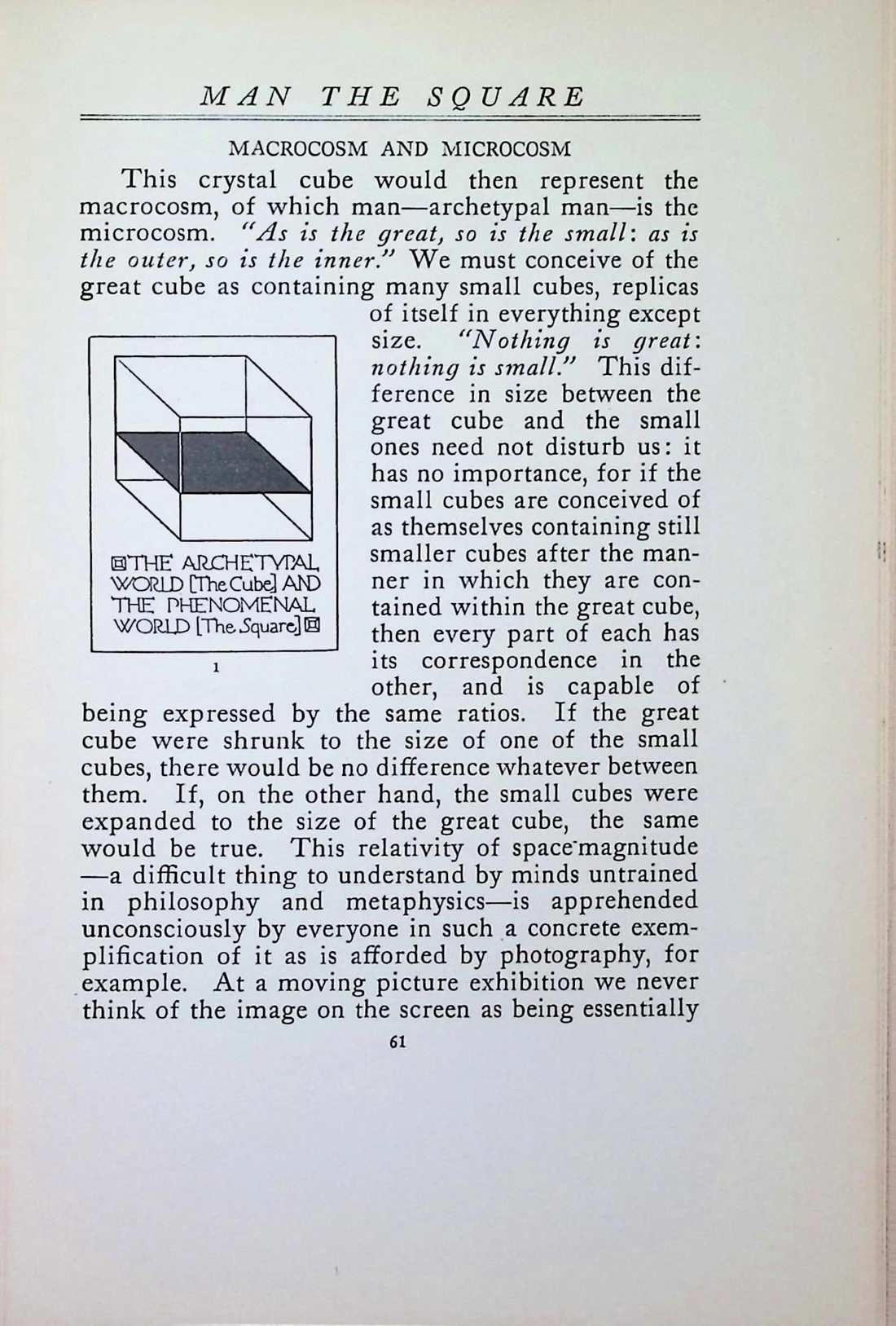
Illustration 1, printed p. 61, Reader page 64. Bragdon’s crystal cube and intersecting film provide the spatial model that returns in his account of the Heavenly City.
Claude Bragdon, A Primer of Higher Space, The Manas Press, 1913. Stickley Museum scan via Internet Archive. · Image source ↗ · Public Domain
What the city brings together
Swedenborg asks what protects, opens and sustains the life of a church. Bragdon asks what lets separate lives form a larger whole. Their starting points differ: Swedenborg follows what parts of the city do, while Bragdon follows the shape of the city itself. [3][4][5][22][23][24]
Revelation supplies the image both authors take up. Here the city descends from God, and the glory of God lights it. It is a shared dwelling where the relationship between God and the people gives the city its character. [13][1][3][17]
Revelation presents a city descending from God and illuminated by divine glory. Swedenborg cites the city in explaining the connection of the Lord and heaven with human life through the Word. Bragdon makes the equal dimensions the starting point for a parable in which love joins individual consciousnesses into a larger whole. [18][19][23][17][2][3]
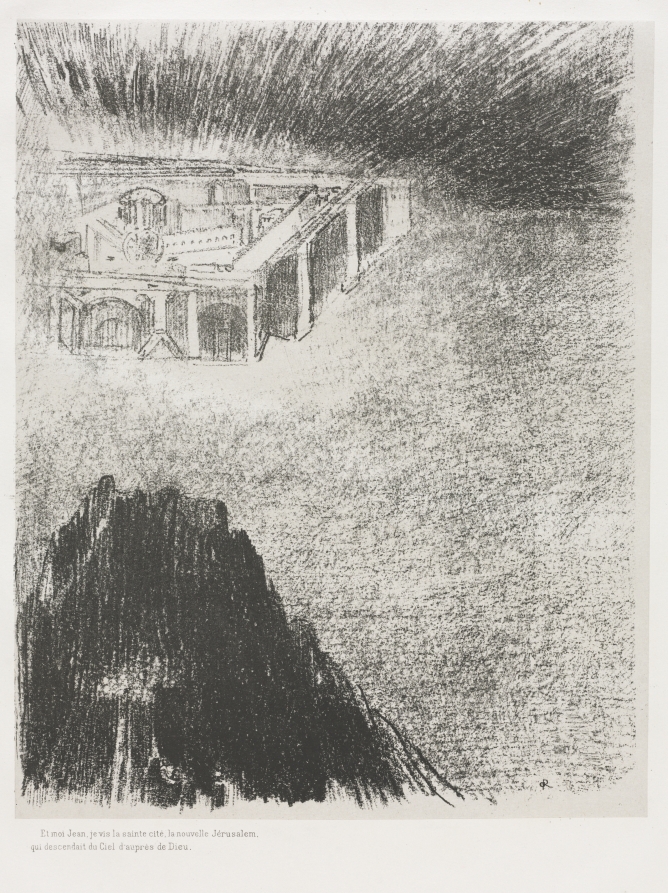
Odilon Redon, And I, John, Saw the Holy City, New Jerusalem, Coming Down from God and out of Heaven, 1899. Lithograph from The Apocalypse of Saint John. The city appears as a luminous presence above a dark landscape.
The Cleveland Museum of Art. Gift of Ralph King. 1926.140.12. CC0. · Image source ↗ · CC0
See references (12)
- Heaven and Its Wonders and Hell, printed p. 139, Reader page 146
- Heaven and Its Wonders and Hell, printed p. 243, Reader page 250
- Heaven and Its Wonders and Hell, printed p. 244, Reader page 251
- Heaven and Its Wonders and Hell, printed p. 245, Reader page 252
- Heaven and Its Wonders and Hell, printed p. 246, Reader page 253
- Heaven and Its Wonders and Hell, printed p. 42, Reader page 49
- Revelation 21:9–27, the New Jerusalem
- A Primer of Higher Space, Reader page 62
- A Primer of Higher Space, Reader page 63
- A Primer of Higher Space, Reader page 79
- A Primer of Higher Space, Reader page 80
- A Primer of Higher Space, Reader page 81
Read further in the library

Heaven and Its Wonders and Hell
Reading note
The city’s gates, walls, foundations and measurements are interpreted as a new church and its doctrine.
A Primer of Higher Space
Reading note
The separately titled account draws on exact passages in the consulted Library edition.
Sources
See references (24)
- Heaven and Its Wonders and Hell, printed p. 139, Reader page 146Emanuel Swedenborg, Heaven and Its Wonders and Hell, translated by J. C. Ager. The American Swedenborg Printing and Publishing Society, New York, 1916. Original Latin work first published in 1758.Read this page in Heaven and Its Wonders and Hell ↗Return to text ↑
- Heaven and Its Wonders and Hell, printed p. 243, Reader page 250Emanuel Swedenborg, Heaven and Its Wonders and Hell, translated by J. C. Ager. The American Swedenborg Printing and Publishing Society, New York, 1916. Original Latin work first published in 1758.Read this page in Heaven and Its Wonders and Hell ↗Return to text ↑
- Heaven and Its Wonders and Hell, printed p. 244, Reader page 251Emanuel Swedenborg, Heaven and Its Wonders and Hell, translated by J. C. Ager. The American Swedenborg Printing and Publishing Society, New York, 1916. Original Latin work first published in 1758.Read this page in Heaven and Its Wonders and Hell ↗Return to text ↑
- Heaven and Its Wonders and Hell, printed p. 245, Reader page 252Emanuel Swedenborg, Heaven and Its Wonders and Hell, translated by J. C. Ager. The American Swedenborg Printing and Publishing Society, New York, 1916. Original Latin work first published in 1758.Read this page in Heaven and Its Wonders and Hell ↗Return to text ↑
- Heaven and Its Wonders and Hell, printed p. 246, Reader page 253Emanuel Swedenborg, Heaven and Its Wonders and Hell, translated by J. C. Ager. The American Swedenborg Printing and Publishing Society, New York, 1916. Original Latin work first published in 1758.Read this page in Heaven and Its Wonders and Hell ↗Return to text ↑
- Heaven and Its Wonders and Hell, printed p. 143, Reader page 150Emanuel Swedenborg, Heaven and Its Wonders and Hell, translated by J. C. Ager. The American Swedenborg Printing and Publishing Society, New York, 1916. Original Latin work first published in 1758.Read this page in Heaven and Its Wonders and Hell ↗Return to text ↑
- Heaven and Its Wonders and Hell, printed p. 144, Reader page 151Emanuel Swedenborg, Heaven and Its Wonders and Hell, translated by J. C. Ager. The American Swedenborg Printing and Publishing Society, New York, 1916. Original Latin work first published in 1758.Read this page in Heaven and Its Wonders and Hell ↗Return to text ↑
- Heaven and Its Wonders and Hell, printed p. 135, Reader page 142Emanuel Swedenborg, Heaven and Its Wonders and Hell, translated by J. C. Ager. The American Swedenborg Printing and Publishing Society, New York, 1916. Original Latin work first published in 1758.Read this page in Heaven and Its Wonders and Hell ↗Return to text ↑
- Heaven and Its Wonders and Hell, printed p. 136, Reader page 143Emanuel Swedenborg, Heaven and Its Wonders and Hell, translated by J. C. Ager. The American Swedenborg Printing and Publishing Society, New York, 1916. Original Latin work first published in 1758.Read this page in Heaven and Its Wonders and Hell ↗Return to text ↑
- Heaven and Its Wonders and Hell, printed p. 137, Reader page 144Emanuel Swedenborg, Heaven and Its Wonders and Hell, translated by J. C. Ager. The American Swedenborg Printing and Publishing Society, New York, 1916. Original Latin work first published in 1758.Read this page in Heaven and Its Wonders and Hell ↗Return to text ↑
- Heaven and Its Wonders and Hell, printed p. 163, Reader page 170Emanuel Swedenborg, Heaven and Its Wonders and Hell, translated by J. C. Ager. The American Swedenborg Printing and Publishing Society, New York, 1916. Original Latin work first published in 1758.Read this page in Heaven and Its Wonders and Hell ↗Return to text ↑
- Heaven and Its Wonders and Hell, printed p. 164, Reader page 171Emanuel Swedenborg, Heaven and Its Wonders and Hell, translated by J. C. Ager. The American Swedenborg Printing and Publishing Society, New York, 1916. Original Latin work first published in 1758.Read this page in Heaven and Its Wonders and Hell ↗Return to text ↑
- Heaven and Its Wonders and Hell, printed p. 42, Reader page 49Emanuel Swedenborg, Heaven and Its Wonders and Hell, translated by J. C. Ager. The American Swedenborg Printing and Publishing Society, New York, 1916. Original Latin work first published in 1758.Read this page in Heaven and Its Wonders and Hell ↗Return to text ↑
- The Apocalypse: The Angel Shows Saint John the New Jerusalem, 1546–56 ↗The Apocalypse: The Angel Shows Saint John the New Jerusalem, 1546–56. Jean Duvet (French, 1485–1561). Engraving. The Cleveland Museum of Art, Gift of the Hanna Fund, 1953.213.28. CC0 open-access image.
- And I, John, Saw the Holy City, New Jerusalem, Coming Down from God and out of Heaven, 1899 ↗The Apocalypse of Saint John: And I, John, Saw the Holy City, New Jerusalem, Coming Down from God and out of Heaven, 1899. Odilon Redon (French, 1840–1916), printed by Blanchard, published by Ambroise Vollard (French, 1867–1939). Lithograph; image: 30 x 23.7 cm (11 13/16 x 9 5/16 in.). The Cleveland Museum of Art, Gift of Ralph King, 1926.140.12. CC0 open-access image.
- Man the Square, illustration 1, the cube and the phenomenal world ↗Claude Bragdon, A Primer of Higher Space, The Manas Press, 1913. Stickley Museum scan via Internet Archive.
- Revelation 21:9–27, the New Jerusalem ↗Revelation 21:9–27, New American Bible, Revised Edition, United States Conference of Catholic Bishops.Return to text ↑
- A Primer of Higher Space, Reader page 62Claude Bragdon, A Primer of Higher Space (The Fourth Dimension), The Manas Press, Rochester, New York, 1913. Lumitheca Library edition IMJ-0599-E001.Read this page in A Primer of Higher Space ↗Return to text ↑
- A Primer of Higher Space, Reader page 63Claude Bragdon, A Primer of Higher Space (The Fourth Dimension), The Manas Press, Rochester, New York, 1913. Lumitheca Library edition IMJ-0599-E001.Read this page in A Primer of Higher Space ↗Return to text ↑
- A Primer of Higher Space, Reader page 64Claude Bragdon, A Primer of Higher Space (The Fourth Dimension), The Manas Press, Rochester, New York, 1913. Lumitheca Library edition IMJ-0599-E001.Read this page in A Primer of Higher Space ↗Return to text ↑
- A Primer of Higher Space, Reader page 77Claude Bragdon, A Primer of Higher Space (The Fourth Dimension), The Manas Press, Rochester, New York, 1913. Lumitheca Library edition IMJ-0599-E001.Read this page in A Primer of Higher Space ↗Return to text ↑
- A Primer of Higher Space, Reader page 79Claude Bragdon, A Primer of Higher Space (The Fourth Dimension), The Manas Press, Rochester, New York, 1913. Lumitheca Library edition IMJ-0599-E001.Read this page in A Primer of Higher Space ↗Return to text ↑
- A Primer of Higher Space, Reader page 80Claude Bragdon, A Primer of Higher Space (The Fourth Dimension), The Manas Press, Rochester, New York, 1913. Lumitheca Library edition IMJ-0599-E001.Read this page in A Primer of Higher Space ↗Return to text ↑
- A Primer of Higher Space, Reader page 81Claude Bragdon, A Primer of Higher Space (The Fourth Dimension), The Manas Press, Rochester, New York, 1913. Lumitheca Library edition IMJ-0599-E001.Read this page in A Primer of Higher Space ↗Return to text ↑