Karma
Karma concerns action and its consequences. Compare Hindu, Buddhist and Jain teachings with accounts of character, responsibility and rebirth.
In this article
What is karma?
Karma means action and, in many Indian religious traditions, the consequences of action. The Bhagavad Gita asks how to act without clinging to the result. In Buddhist teaching, intention gives action its karmic significance. Jain teaching describes karmic matter that binds to the soul. [1][3][5]
These differences affect what it means to change one’s conduct or seek liberation. A teaching about what someone intends, a teaching about attachment and a teaching about a substance that binds the soul answer different questions. The Buddhist Pāli term is kamma. [1][3][5][6]
See references (4)
- Bhagavad Gita 2.47, translated by Swami Mukundananda
- Nibbedhika Sutta, AN 6:63, § 5 on kamma, translated by Ṭhānissaro Bhikkhu
- Jagmanderlal Jaini, Outlines of Jainism, Part II, chapter II: passages citing Tattvārthasūtra VI.1–2, VIII.1–2 and X.2
- Initiation and Its Results, printed p. 61, Reader page 60
The Bhagavad Gita: action and attachment
Bhagavad Gita 2.47 tells Arjuna to act without treating the fruits of action as his possession. It also warns against becoming attached to inaction. The passage keeps the duty to act while changing what the person who acts expects to gain. [1]
Verse 3.9 relates the bondage of action to work done as an offering. Swami Mukundananda’s translation makes the devotional direction explicit: action is performed for God rather than for a privately possessed result. This is a particular religious explanation of how one acts without becoming bound by work. [2]
The Nibbedhika Sutta: intention and its consequences
In the Nibbedhika Sutta, AN 6:63, the Buddha calls intention kamma. What a person intends finds expression in action of body, speech or mind. The discourse distinguishes when results occur and describes a path to the ending of kamma. [3]
SN 36:21 poses another question: is everything a person feels entirely caused by what was done before? The Buddha rejects that position, naming several kinds of bodily and environmental cause alongside karmic result. The text’s ancient medical vocabulary belongs to its setting; its relevance here is the refusal of a single exclusive explanation for every feeling. [4]
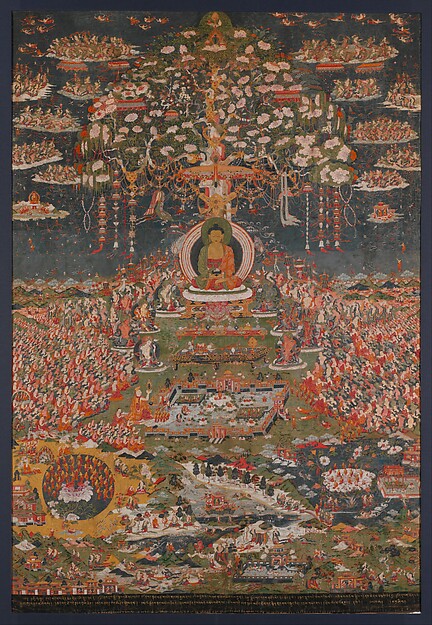
Amitabha’s Pure Land, Central Tibet, ca. 1700. Figures emerging from lotus flowers give rebirth a visual form in this Mahayana painting.
The Metropolitan Museum of Art, Purchase, Barbara and William Karatz Gift and funds from various donors, 2004 · Image source ↗ · CC0
Outlines of Jainism by Jagmanderlal Jaini: karmic bondage
Jagmanderlal Jaini’s Outlines of Jainism presents translated passages from the Tattvārthasūtra and other Jain texts. In the selections citing VI.1–2 and VIII.1–2, bodily, mental and verbal activity is related to an influx of karma, while passion joins the soul to karmic matter. The account explicitly belongs to a theory of soul and matter. [5]
Jaini distinguishes stopping the inflow of new karma from removing karma already bound to the soul. In his selection from Tattvārthasūtra X.2, both belong to liberation. [5]
In Ghostly Japan by Lafcadio Hearn
Lafcadio Hearn’s Japanese Buddhist Proverbs shows karmic language entering ordinary explanations of affection, good fortune and adversity. One expression describes a relationship as deep in karma; another likens cause and effect to a wheel. These sayings reveal how people narrate connections between lives, rather than giving a single systematic account of moral causation. [36][37][38]
Hearn also records sayings that assign a child’s misfortune to previous wrongdoing or to the parents’ karma. These can turn suffering into an accusation. Importantly, his note on the parental-karma proverb says the popular idea does not fully accord with the Buddhist teaching he distinguishes from it. Recording a historical saying does not establish its explanation of disability or hardship. [37][38][39]
The ghost stories give karma another role. In A Passional Karma, a priest explains the dangerous bond between the living man and the dead woman through attachment continuing across lives. Ingwa-banashi uses a karmic frame around the suffering inflicted by a jealous dead woman. These are explanations within narratives. They should not become a judgement that someone experiencing abuse has earned it. [40][41][42][43]
The range of the sayings matters. Hearn records karma as a way of talking about affection, repeated consequences and misfortune. In the ghost stories it can also give a plot its shape. [44][45][37][38][39]
See references (10)
- In Ghostly Japan, Reader page 163
- In Ghostly Japan, Reader page 168
- In Ghostly Japan, Reader page 169
- In Ghostly Japan, Reader page 181
- In Ghostly Japan, Reader page 94
- In Ghostly Japan, Reader page 95
- In Ghostly Japan, Reader page 195
- In Ghostly Japan, Reader page 202
- In Ghostly Japan, Reader page 161
- In Ghostly Japan, Reader page 162
Initiation and Its Results by Rudolf Steiner
Rudolf Steiner’s Initiation and Its Results introduces karma through the relation between a higher nature and the personality of a particular life. The student is said to perceive the spiritual connections from which attributes and destiny arise. His present lower self is only one form that the higher nature can assume. [7][6][8]
The Lesser Guardian’s speech gives that explanation a dramatic setting. Invisible powers previously ordered the results of conduct and the character formed through experience. At the threshold, the person is told that a portion of this responsibility must now be taken over consciously. [9][10][11]
The Guardian’s appearance is described as a body made from noble and ignoble deeds. Subsequent conduct changes it. The image connects the inherited past with a future task: the student must transform what has been made, rather than merely discover a fixed sentence imposed from outside. [10][11][12][13]
Steiner also makes strong claims about suffering, explaining blows of fate through harmful deeds in earlier lives. These are assertions within his karmic scheme. They are not independent evidence of the cause of an individual’s suffering, and should not be borrowed as a reason to blame a person for what has happened to them. [9][10][14][15]
His later account ties repeated embodiment to capacities that must be formed on earth. It also includes a hierarchy of national and racial forms. The latter is a historical racial claim in this book, not a neutral account of the value or spiritual status of living peoples. [14][15][16][17]
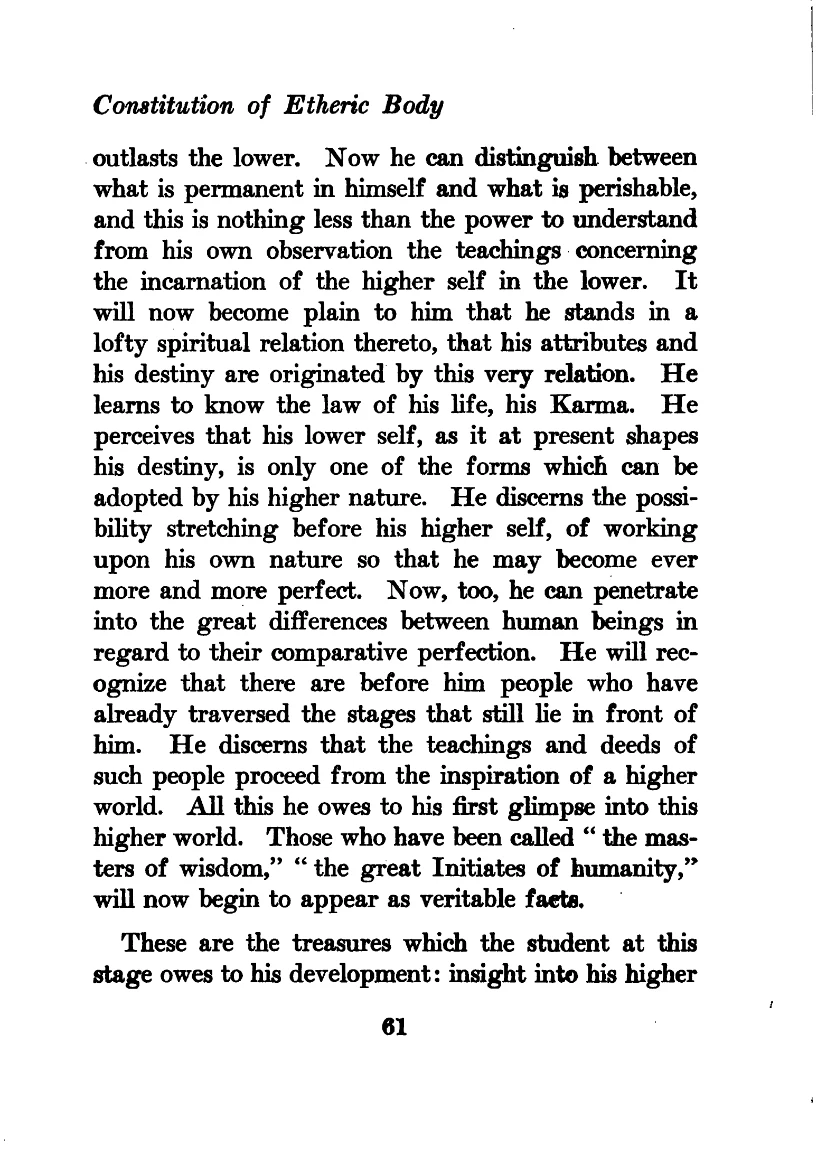
Source facsimile: Initiation and Its Results (1909), printed p. 61, Reader page 60.
Rudolf Steiner, Initiation and Its Results, Clifford Bax translation, First American Edition, 1909. Public-domain historical page from the checksum-verified Library PDF. · Image source ↗ · Public Domain
See references (12)
- Initiation and Its Results, printed p. 61, Reader page 60
- Initiation and Its Results, printed p. 60, Reader page 59
- Initiation and Its Results, printed p. 62, Reader page 61
- Initiation and Its Results, printed p. 108, Reader page 105
- Initiation and Its Results, printed p. 109, Reader page 106
- Initiation and Its Results, printed p. 110, Reader page 107
- Initiation and Its Results, printed p. 111, Reader page 108
- Initiation and Its Results, printed p. 112, Reader page 109
- Initiation and Its Results, printed p. 121, Reader page 117
- Initiation and Its Results, printed p. 122, Reader page 118
- Initiation and Its Results, printed p. 123, Reader page 119
- Initiation and Its Results, printed p. 128, Reader page 124
Karma-Yoga by Swami Vivekananda
Swami Vivekananda opens Karma-Yoga by explaining karma here as work. Breathing, speaking, listening and thinking all belong to its scope. Such acts leave traces, and their accumulation helps form character. His emphasis falls on a person’s common actions, which disclose a sustained disposition more clearly than one impressive performance. [19][20][21][22]
He connects character with will, then extends the explanation across lives in his accounts of the Buddha and Jesus. He also makes strong claims that karma determines what a person deserves. Those claims belong to his metaphysical and ethical argument; they do not establish the cause of someone’s poverty, illness or suffering. [22][23]
The same passage insists that present actions can change the future. For Vivekananda, responsibility is not exhausted by an inherited past: learning how to work is a way of forming a different character. His later description of samskaras explains how repeated thoughts and actions establish tendencies that can be countered by other tendencies. [23][24][25][26][27]
The chapter on freedom gives karma a wider meaning as causation. Vivekananda links regular sequences of events with mental association and the Nyaya term vyapti. He then confines causal law to existence conditioned by space, time and causation, placing ultimate freedom beyond that framework. This is his philosophical account of law, rather than a conclusion demonstrated by present-day physics. [28][29][30][31]
He holds that an action must bear its result, while also arguing that selfless action frees a worker from personal bondage. These propositions have different roles in the book. One concerns consequence within the causal order; the other concerns the worker’s attachment and the freedom of the Self. Reading either alone conceals the problem that Karma Yoga is meant to address. [32][33][34][35]
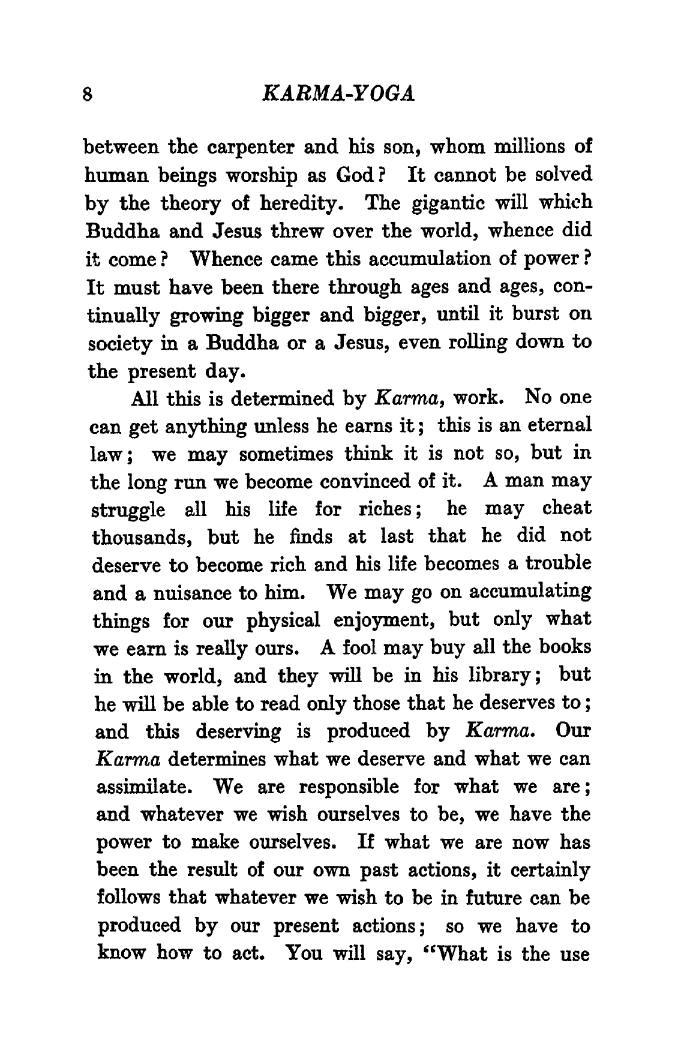
Source facsimile: Karma-Yoga (1939), Reader page 10. Vivekananda joins claims about past action with the possibility of changing one’s future through present conduct.
Swami Vivekananda, Karma-Yoga, English second printing in the 1939 combined volume. Historical public-domain text, exact checksum-verified Library scan. · Image source ↗ · Public Domain
See references (17)
- Karma-Yoga, Reader page 5
- Karma-Yoga, Reader page 7
- Karma-Yoga, Reader page 8
- Karma-Yoga, Reader page 9
- Karma-Yoga, Reader page 10
- Karma-Yoga, printed p. 37, Reader page 39
- Karma-Yoga, Reader page 40
- Karma-Yoga, Reader page 41
- Karma-Yoga, Reader page 42
- Karma-Yoga, Reader page 93
- Karma-Yoga, Reader page 94
- Karma-Yoga, Reader page 95
- Karma-Yoga, Reader page 96
- Karma-Yoga, Reader page 77
- Karma-Yoga, Reader page 84
- Karma-Yoga, Reader page 121
- Karma-Yoga, Reader page 122
Does karma mean fate?
The Gita treats attachment as something a person can change. AN 6:63 gives present intention a role, and the Jain account distinguishes new bondage from the removal of accumulated karma. In each case, what someone does now can matter. [1][3][5]
SN 36:21 rejects the claim that every feeling comes entirely from past deeds. That gives important context to Hearn’s proverbs about misfortune and to Steiner’s account of earlier lives. The sources disagree about how much a particular hardship can tell us about someone’s past. [4][39][9][14]
Vivekananda describes work as a way to form character over time. Steiner gives past conduct a visible form in the Guardian and makes further conduct part of the story. Each account puts responsibility in the present as well as the past. [21][23][11][12]
See references (14)
- Bhagavad Gita 2.47, translated by Swami Mukundananda
- Bhagavad Gita 3.9, translated by Swami Mukundananda
- Nibbedhika Sutta, AN 6:63, § 5 on kamma, translated by Ṭhānissaro Bhikkhu
- Sivaka Sutta, SN 36:21, dialogue on the causes of feeling, translated by Ṭhānissaro Bhikkhu
- Jagmanderlal Jaini, Outlines of Jainism, Part II, chapter II: passages citing Tattvārthasūtra VI.1–2, VIII.1–2 and X.2
- Initiation and Its Results, printed p. 61, Reader page 60
- Initiation and Its Results, printed p. 108, Reader page 105
- Initiation and Its Results, printed p. 109, Reader page 106
- Initiation and Its Results, printed p. 110, Reader page 107
- Initiation and Its Results, printed p. 111, Reader page 108
- Initiation and Its Results, printed p. 121, Reader page 117
- Karma-Yoga, Reader page 8
- Karma-Yoga, Reader page 10
- In Ghostly Japan, Reader page 181
In the library

Initiation and Its Results
Reading note
The separately titled account draws on exact passages in the consulted Library edition.
Karma Yoga
Reading note
The separately titled account draws on exact passages in the consulted Library edition.

In Ghostly Japan
Reading note
The separately titled account draws on exact passages in the consulted Library edition.
Sources
See references (45)
- Bhagavad Gita 2.47, translated by Swami Mukundananda ↗Bhagavad Gita 2.47. Swami Mukundananda’s translation and the Sanskrit verse distinguish acting from attachment to results and from attachment to inaction.
- Bhagavad Gita 3.9, translated by Swami Mukundananda ↗Bhagavad Gita 3.9. Swami Mukundananda’s translation presents action as an offering to God; this devotional interpretation is attributed.
- Nibbedhika Sutta, AN 6:63, § 5 on kamma, translated by Ṭhānissaro Bhikkhu ↗Early Buddhist discourse traditionally attributed to the Buddha. Exact § 5 on intention, bodily/verbal/mental action, results and the path to cessation, in Ṭhānissaro Bhikkhu’s translation.
- Sivaka Sutta, SN 36:21, dialogue on the causes of feeling, translated by Ṭhānissaro Bhikkhu ↗Early Buddhist discourse traditionally attributed to the Buddha. The article cites the dialogue, distinguishing it from the translator’s preceding explanatory essay.
- Jagmanderlal Jaini, Outlines of Jainism, Part II, chapter II: passages citing Tattvārthasūtra VI.1–2, VIII.1–2 and X.2 ↗Jagmanderlal Jaini, Outlines of Jainism (1916), edited with preliminary note by F. W. Thomas. Primary Jain exposition and translated scriptural selections; the quoted sutra numbers identify the particular teachings.
- Initiation and Its Results, printed p. 61, Reader page 60Rudolf Steiner, Initiation and Its Results: A Sequel to The Way of Initiation, translated by Clifford Bax. First American Edition, 1909. Macoy Publishing and Masonic Supply Co., New York; Max Gysi, London. Claims of clairvoyant perception and subtle organs remain attributed. References identify the exact consulted Library edition.Read this page in Initiation and Its Results ↗
- Initiation and Its Results, printed p. 60, Reader page 59Rudolf Steiner, Initiation and Its Results: A Sequel to The Way of Initiation, translated by Clifford Bax. First American Edition, 1909. Macoy Publishing and Masonic Supply Co., New York; Max Gysi, London. Claims of clairvoyant perception and subtle organs remain attributed. References identify the exact consulted Library edition.Read this page in Initiation and Its Results ↗
- Initiation and Its Results, printed p. 62, Reader page 61Rudolf Steiner, Initiation and Its Results: A Sequel to The Way of Initiation, translated by Clifford Bax. First American Edition, 1909. Macoy Publishing and Masonic Supply Co., New York; Max Gysi, London. Claims of clairvoyant perception and subtle organs remain attributed. References identify the exact consulted Library edition.Read this page in Initiation and Its Results ↗
- Initiation and Its Results, printed p. 108, Reader page 105Rudolf Steiner, Initiation and Its Results: A Sequel to The Way of Initiation, translated by Clifford Bax. First American Edition, 1909. Macoy Publishing and Masonic Supply Co., New York; Max Gysi, London. Claims of clairvoyant perception and subtle organs remain attributed. References identify the exact consulted Library edition.Read this page in Initiation and Its Results ↗
- Initiation and Its Results, printed p. 109, Reader page 106Rudolf Steiner, Initiation and Its Results: A Sequel to The Way of Initiation, translated by Clifford Bax. First American Edition, 1909. Macoy Publishing and Masonic Supply Co., New York; Max Gysi, London. Claims of clairvoyant perception and subtle organs remain attributed. References identify the exact consulted Library edition.Read this page in Initiation and Its Results ↗
- Initiation and Its Results, printed p. 110, Reader page 107Rudolf Steiner, Initiation and Its Results: A Sequel to The Way of Initiation, translated by Clifford Bax. First American Edition, 1909. Macoy Publishing and Masonic Supply Co., New York; Max Gysi, London. Claims of clairvoyant perception and subtle organs remain attributed. References identify the exact consulted Library edition.Read this page in Initiation and Its Results ↗
- Initiation and Its Results, printed p. 111, Reader page 108Rudolf Steiner, Initiation and Its Results: A Sequel to The Way of Initiation, translated by Clifford Bax. First American Edition, 1909. Macoy Publishing and Masonic Supply Co., New York; Max Gysi, London. Claims of clairvoyant perception and subtle organs remain attributed. References identify the exact consulted Library edition.Read this page in Initiation and Its Results ↗
- Initiation and Its Results, printed p. 112, Reader page 109Rudolf Steiner, Initiation and Its Results: A Sequel to The Way of Initiation, translated by Clifford Bax. First American Edition, 1909. Macoy Publishing and Masonic Supply Co., New York; Max Gysi, London. Claims of clairvoyant perception and subtle organs remain attributed. References identify the exact consulted Library edition.Read this page in Initiation and Its Results ↗
- Initiation and Its Results, printed p. 121, Reader page 117Rudolf Steiner, Initiation and Its Results: A Sequel to The Way of Initiation, translated by Clifford Bax. First American Edition, 1909. Macoy Publishing and Masonic Supply Co., New York; Max Gysi, London. Claims of clairvoyant perception and subtle organs remain attributed. References identify the exact consulted Library edition.Read this page in Initiation and Its Results ↗
- Initiation and Its Results, printed p. 122, Reader page 118Rudolf Steiner, Initiation and Its Results: A Sequel to The Way of Initiation, translated by Clifford Bax. First American Edition, 1909. Macoy Publishing and Masonic Supply Co., New York; Max Gysi, London. Claims of clairvoyant perception and subtle organs remain attributed. References identify the exact consulted Library edition.Read this page in Initiation and Its Results ↗
- Initiation and Its Results, printed p. 123, Reader page 119Rudolf Steiner, Initiation and Its Results: A Sequel to The Way of Initiation, translated by Clifford Bax. First American Edition, 1909. Macoy Publishing and Masonic Supply Co., New York; Max Gysi, London. Claims of clairvoyant perception and subtle organs remain attributed. References identify the exact consulted Library edition.Read this page in Initiation and Its Results ↗
- Initiation and Its Results, printed p. 128, Reader page 124Rudolf Steiner, Initiation and Its Results: A Sequel to The Way of Initiation, translated by Clifford Bax. First American Edition, 1909. Macoy Publishing and Masonic Supply Co., New York; Max Gysi, London. Claims of clairvoyant perception and subtle organs remain attributed. References identify the exact consulted Library edition.Read this page in Initiation and Its Results ↗
- Amitabha, the Buddha of the Western Pure Land (Sukhavati), ca. 1700 ↗The Metropolitan Museum of Art, accession 2004.139; CC0 image
- Karma-Yoga, Reader page 5Swami Vivekananda, Karma-Yoga, in Karma-Yoga & Bhakti-Yoga, English second printing, Ramakrishna-Vivekananda Center of New York, Inc., 1939. Exact Library edition IMJ-0097-E002. Only the Karma-Yoga part is used in this crawl; the old Work slug mentioning Hindi does not identify this edition’s language.Read this page in Karma Yoga ↗
- Karma-Yoga, Reader page 7Swami Vivekananda, Karma-Yoga, in Karma-Yoga & Bhakti-Yoga, English second printing, Ramakrishna-Vivekananda Center of New York, Inc., 1939. Exact Library edition IMJ-0097-E002. Only the Karma-Yoga part is used in this crawl; the old Work slug mentioning Hindi does not identify this edition’s language.Read this page in Karma Yoga ↗
- Karma-Yoga, Reader page 8Swami Vivekananda, Karma-Yoga, in Karma-Yoga & Bhakti-Yoga, English second printing, Ramakrishna-Vivekananda Center of New York, Inc., 1939. Exact Library edition IMJ-0097-E002. Only the Karma-Yoga part is used in this crawl; the old Work slug mentioning Hindi does not identify this edition’s language.Read this page in Karma Yoga ↗
- Karma-Yoga, Reader page 9Swami Vivekananda, Karma-Yoga, in Karma-Yoga & Bhakti-Yoga, English second printing, Ramakrishna-Vivekananda Center of New York, Inc., 1939. Exact Library edition IMJ-0097-E002. Only the Karma-Yoga part is used in this crawl; the old Work slug mentioning Hindi does not identify this edition’s language.Read this page in Karma Yoga ↗
- Karma-Yoga, Reader page 10Swami Vivekananda, Karma-Yoga, in Karma-Yoga & Bhakti-Yoga, English second printing, Ramakrishna-Vivekananda Center of New York, Inc., 1939. Exact Library edition IMJ-0097-E002. Only the Karma-Yoga part is used in this crawl; the old Work slug mentioning Hindi does not identify this edition’s language.Read this page in Karma Yoga ↗
- Karma-Yoga, printed p. 37, Reader page 39Swami Vivekananda, Karma-Yoga, in Karma-Yoga & Bhakti-Yoga, English second printing, Ramakrishna-Vivekananda Center of New York, Inc., 1939. Exact Library edition IMJ-0097-E002. Only the Karma-Yoga part is used in this crawl; the old Work slug mentioning Hindi does not identify this edition’s language.Read this page in Karma Yoga ↗
- Karma-Yoga, Reader page 40Swami Vivekananda, Karma-Yoga, in Karma-Yoga & Bhakti-Yoga, English second printing, Ramakrishna-Vivekananda Center of New York, Inc., 1939. Exact Library edition IMJ-0097-E002. Only the Karma-Yoga part is used in this crawl; the old Work slug mentioning Hindi does not identify this edition’s language.Read this page in Karma Yoga ↗
- Karma-Yoga, Reader page 41Swami Vivekananda, Karma-Yoga, in Karma-Yoga & Bhakti-Yoga, English second printing, Ramakrishna-Vivekananda Center of New York, Inc., 1939. Exact Library edition IMJ-0097-E002. Only the Karma-Yoga part is used in this crawl; the old Work slug mentioning Hindi does not identify this edition’s language.Read this page in Karma Yoga ↗
- Karma-Yoga, Reader page 42Swami Vivekananda, Karma-Yoga, in Karma-Yoga & Bhakti-Yoga, English second printing, Ramakrishna-Vivekananda Center of New York, Inc., 1939. Exact Library edition IMJ-0097-E002. Only the Karma-Yoga part is used in this crawl; the old Work slug mentioning Hindi does not identify this edition’s language.Read this page in Karma Yoga ↗
- Karma-Yoga, Reader page 93Swami Vivekananda, Karma-Yoga, in Karma-Yoga & Bhakti-Yoga, English second printing, Ramakrishna-Vivekananda Center of New York, Inc., 1939. Exact Library edition IMJ-0097-E002. Only the Karma-Yoga part is used in this crawl; the old Work slug mentioning Hindi does not identify this edition’s language.Read this page in Karma Yoga ↗
- Karma-Yoga, Reader page 94Swami Vivekananda, Karma-Yoga, in Karma-Yoga & Bhakti-Yoga, English second printing, Ramakrishna-Vivekananda Center of New York, Inc., 1939. Exact Library edition IMJ-0097-E002. Only the Karma-Yoga part is used in this crawl; the old Work slug mentioning Hindi does not identify this edition’s language.Read this page in Karma Yoga ↗
- Karma-Yoga, Reader page 95Swami Vivekananda, Karma-Yoga, in Karma-Yoga & Bhakti-Yoga, English second printing, Ramakrishna-Vivekananda Center of New York, Inc., 1939. Exact Library edition IMJ-0097-E002. Only the Karma-Yoga part is used in this crawl; the old Work slug mentioning Hindi does not identify this edition’s language.Read this page in Karma Yoga ↗
- Karma-Yoga, Reader page 96Swami Vivekananda, Karma-Yoga, in Karma-Yoga & Bhakti-Yoga, English second printing, Ramakrishna-Vivekananda Center of New York, Inc., 1939. Exact Library edition IMJ-0097-E002. Only the Karma-Yoga part is used in this crawl; the old Work slug mentioning Hindi does not identify this edition’s language.Read this page in Karma Yoga ↗
- Karma-Yoga, Reader page 77Swami Vivekananda, Karma-Yoga, in Karma-Yoga & Bhakti-Yoga, English second printing, Ramakrishna-Vivekananda Center of New York, Inc., 1939. Exact Library edition IMJ-0097-E002. Only the Karma-Yoga part is used in this crawl; the old Work slug mentioning Hindi does not identify this edition’s language.Read this page in Karma Yoga ↗
- Karma-Yoga, Reader page 84Swami Vivekananda, Karma-Yoga, in Karma-Yoga & Bhakti-Yoga, English second printing, Ramakrishna-Vivekananda Center of New York, Inc., 1939. Exact Library edition IMJ-0097-E002. Only the Karma-Yoga part is used in this crawl; the old Work slug mentioning Hindi does not identify this edition’s language.Read this page in Karma Yoga ↗
- Karma-Yoga, Reader page 121Swami Vivekananda, Karma-Yoga, in Karma-Yoga & Bhakti-Yoga, English second printing, Ramakrishna-Vivekananda Center of New York, Inc., 1939. Exact Library edition IMJ-0097-E002. Only the Karma-Yoga part is used in this crawl; the old Work slug mentioning Hindi does not identify this edition’s language.Read this page in Karma Yoga ↗
- Karma-Yoga, Reader page 122Swami Vivekananda, Karma-Yoga, in Karma-Yoga & Bhakti-Yoga, English second printing, Ramakrishna-Vivekananda Center of New York, Inc., 1939. Exact Library edition IMJ-0097-E002. Only the Karma-Yoga part is used in this crawl; the old Work slug mentioning Hindi does not identify this edition’s language.Read this page in Karma Yoga ↗
- In Ghostly Japan, Reader page 163Lafcadio Hearn, In Ghostly Japan, Little, Brown, and Company, Boston, 1899. Exact consulted Library edition IMJ-0654-E001, with title page visually checked. Persistent PageIDs and current Reader positions are verified from the supplied edition. Embedded stories, translations and quotations are attributed to Hearn’s presentation unless an original source has separately been consulted.Read this page in In Ghostly Japan ↗
- In Ghostly Japan, Reader page 168Lafcadio Hearn, In Ghostly Japan, Little, Brown, and Company, Boston, 1899. Exact consulted Library edition IMJ-0654-E001, with title page visually checked. Persistent PageIDs and current Reader positions are verified from the supplied edition. Embedded stories, translations and quotations are attributed to Hearn’s presentation unless an original source has separately been consulted.Read this page in In Ghostly Japan ↗
- In Ghostly Japan, Reader page 169Lafcadio Hearn, In Ghostly Japan, Little, Brown, and Company, Boston, 1899. Exact consulted Library edition IMJ-0654-E001, with title page visually checked. Persistent PageIDs and current Reader positions are verified from the supplied edition. Embedded stories, translations and quotations are attributed to Hearn’s presentation unless an original source has separately been consulted.Read this page in In Ghostly Japan ↗
- In Ghostly Japan, Reader page 181Lafcadio Hearn, In Ghostly Japan, Little, Brown, and Company, Boston, 1899. Exact consulted Library edition IMJ-0654-E001, with title page visually checked. Persistent PageIDs and current Reader positions are verified from the supplied edition. Embedded stories, translations and quotations are attributed to Hearn’s presentation unless an original source has separately been consulted.Read this page in In Ghostly Japan ↗
- In Ghostly Japan, Reader page 94Lafcadio Hearn, In Ghostly Japan, Little, Brown, and Company, Boston, 1899. Exact consulted Library edition IMJ-0654-E001, with title page visually checked. Persistent PageIDs and current Reader positions are verified from the supplied edition. Embedded stories, translations and quotations are attributed to Hearn’s presentation unless an original source has separately been consulted.Read this page in In Ghostly Japan ↗
- In Ghostly Japan, Reader page 95Lafcadio Hearn, In Ghostly Japan, Little, Brown, and Company, Boston, 1899. Exact consulted Library edition IMJ-0654-E001, with title page visually checked. Persistent PageIDs and current Reader positions are verified from the supplied edition. Embedded stories, translations and quotations are attributed to Hearn’s presentation unless an original source has separately been consulted.Read this page in In Ghostly Japan ↗
- In Ghostly Japan, Reader page 195Lafcadio Hearn, In Ghostly Japan, Little, Brown, and Company, Boston, 1899. Exact consulted Library edition IMJ-0654-E001, with title page visually checked. Persistent PageIDs and current Reader positions are verified from the supplied edition. Embedded stories, translations and quotations are attributed to Hearn’s presentation unless an original source has separately been consulted.Read this page in In Ghostly Japan ↗
- In Ghostly Japan, Reader page 202Lafcadio Hearn, In Ghostly Japan, Little, Brown, and Company, Boston, 1899. Exact consulted Library edition IMJ-0654-E001, with title page visually checked. Persistent PageIDs and current Reader positions are verified from the supplied edition. Embedded stories, translations and quotations are attributed to Hearn’s presentation unless an original source has separately been consulted.Read this page in In Ghostly Japan ↗
- In Ghostly Japan, Reader page 161Lafcadio Hearn, In Ghostly Japan, Little, Brown, and Company, Boston, 1899. Exact consulted Library edition IMJ-0654-E001, with title page visually checked. Persistent PageIDs and current Reader positions are verified from the supplied edition. Embedded stories, translations and quotations are attributed to Hearn’s presentation unless an original source has separately been consulted.Read this page in In Ghostly Japan ↗
- In Ghostly Japan, Reader page 162Lafcadio Hearn, In Ghostly Japan, Little, Brown, and Company, Boston, 1899. Exact consulted Library edition IMJ-0654-E001, with title page visually checked. Persistent PageIDs and current Reader positions are verified from the supplied edition. Embedded stories, translations and quotations are attributed to Hearn’s presentation unless an original source has separately been consulted.Read this page in In Ghostly Japan ↗