Samskaras
Samskaras are impressions left by thoughts and actions. Read how Vivekananda uses a lake and two thorns to explain habit, ethical action and liberation.
In this article
Understanding the concept
Samskaras are impressions left by thoughts and actions. They can persist after the experience has ended and make a similar response more likely later. The Sanskrit word can also refer to rites of passage. Here it concerns mind, action and character in Vivekananda’s teaching. [2][3]
In Karma Yoga, a single action leaves an impression and repeated actions can establish a disposition. Vivekananda then asks how the same process that creates a habit can help someone become free of it. [3][4][5]
Karma-Yoga by Swami Vivekananda
Swami Vivekananda introduces samskara through the image of a lake. A wave subsides, but leaves a mark and the possibility of rising again. He applies this to bodily movements and thoughts as well as conspicuous deeds. An impression need not remain visible on the surface to affect subsequent conduct. [2][3]
He describes character as the accumulated force of these impressions. Repeated harmful actions strengthen harmful tendencies; repeated good actions strengthen good ones. His account gives such patterns considerable power, at times describing a person as being driven by them. Yet the proposed discipline depends on changing the pattern through renewed thought and action. [3][4][5]
The tortoise withdrawing its limbs pictures someone whose character is stable enough to govern the senses. Vivekananda treats that stability as a stage. He then asks how a person can go beyond dependence on the good results they have learned to seek. [4][5]
In the two-thorns analogy, one thorn removes another. Both can be set aside after the work is done. Vivekananda uses the image for the sequence from countering harmful impressions with good ones to acting without clinging to either pattern. [4][5]
Attachment also affects the depth of an impression. Vivekananda contrasts the many faces someone sees during a day with a brief glimpse of a loved person that returns vividly to memory. He invokes prior associations to explain the difference. The example makes his account more specific than the claim that every encounter leaves an equally powerful trace. [5][6]
From this he argues for continued work without allowing its ripples to conquer the mind. The objective is not inactivity or a new collection of admirable traits to possess. It is action whose relation to the self has changed, so that the accumulated pattern no longer binds the worker in the same way. [5][6][7]
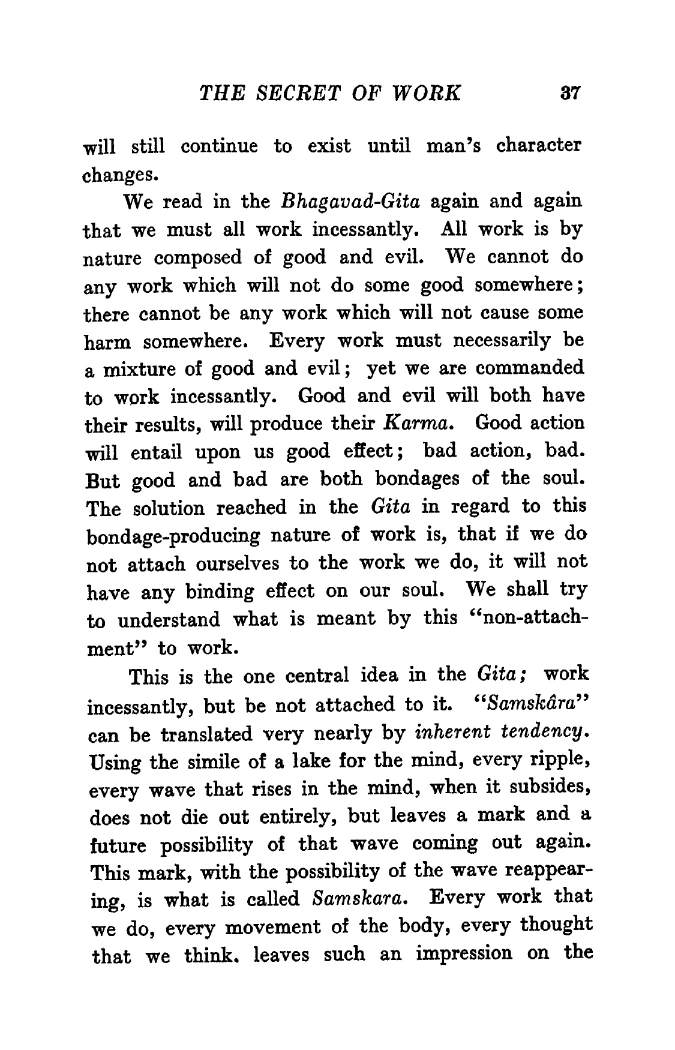
Karma-Yoga (1939), printed p. 37, Library Reader page 39. Vivekananda uses a lake to picture how a thought or action can leave a tendency behind.
Swami Vivekananda, Karma-Yoga, English second printing in the 1939 combined volume. Historical public-domain text, exact checksum-verified Library scan. · Image source ↗ · Public Domain
Raja-Yoga by Swami Vivekananda: impressions and restraint
In his Raja-Yoga commentary on Yoga Sutra I.12, Swami Vivekananda connects repeated impressions with habits. At I.18 and I.50–51 he follows what happens to them in concentration. An impression formed in samādhi can obstruct other impressions and is eventually restrained in turn. [1]
Action, habit and meditation
Vivekananda likens the impression to a wave that settles and leaves the possibility of another wave. Its value in the argument is that an action can end while its influence on a later response remains. [2][3][5][6]
Karma-Yoga approaches impressions through repeated action and the character it builds. Raja-Yoga asks what happens to those impressions when attention is gathered. The two books let the reader follow one author’s idea through conduct and meditation. [2][5][1]
Read further in the library
Karma Yoga
Reading note
The separately titled account draws on exact passages in the consulted Library edition.
Sources
See references (7)
- Patanjali’s Yoga Aphorisms I.12–16, I.18 and I.50–51, translated and explained by Swami Vivekananda in Raja-Yoga ↗Swami Vivekananda’s translation and commentary on Yoga Sutra chapter I in Raja-Yoga. This is a second book by the same interpreter, not independent corroboration. Sutra numbers identify passages; no unverified Library pagination supplied.Return to text ↑
- Karma-Yoga, printed p. 37, Reader page 39Swami Vivekananda, Karma-Yoga, in Karma-Yoga & Bhakti-Yoga, English second printing, Ramakrishna-Vivekananda Center of New York, Inc., 1939. Exact Library edition IMJ-0097-E002. Only the Karma-Yoga part is used in this crawl; the old Work slug mentioning Hindi does not identify this edition’s language.Read this page in Karma Yoga ↗Return to text ↑
- Karma-Yoga, Reader page 40Swami Vivekananda, Karma-Yoga, in Karma-Yoga & Bhakti-Yoga, English second printing, Ramakrishna-Vivekananda Center of New York, Inc., 1939. Exact Library edition IMJ-0097-E002. Only the Karma-Yoga part is used in this crawl; the old Work slug mentioning Hindi does not identify this edition’s language.Read this page in Karma Yoga ↗Return to text ↑
- Karma-Yoga, Reader page 41Swami Vivekananda, Karma-Yoga, in Karma-Yoga & Bhakti-Yoga, English second printing, Ramakrishna-Vivekananda Center of New York, Inc., 1939. Exact Library edition IMJ-0097-E002. Only the Karma-Yoga part is used in this crawl; the old Work slug mentioning Hindi does not identify this edition’s language.Read this page in Karma Yoga ↗Return to text ↑
- Karma-Yoga, Reader page 42Swami Vivekananda, Karma-Yoga, in Karma-Yoga & Bhakti-Yoga, English second printing, Ramakrishna-Vivekananda Center of New York, Inc., 1939. Exact Library edition IMJ-0097-E002. Only the Karma-Yoga part is used in this crawl; the old Work slug mentioning Hindi does not identify this edition’s language.Read this page in Karma Yoga ↗Return to text ↑
- Karma-Yoga, Reader page 43Swami Vivekananda, Karma-Yoga, in Karma-Yoga & Bhakti-Yoga, English second printing, Ramakrishna-Vivekananda Center of New York, Inc., 1939. Exact Library edition IMJ-0097-E002. Only the Karma-Yoga part is used in this crawl; the old Work slug mentioning Hindi does not identify this edition’s language.Read this page in Karma Yoga ↗Return to text ↑
- Karma-Yoga, Reader page 44Swami Vivekananda, Karma-Yoga, in Karma-Yoga & Bhakti-Yoga, English second printing, Ramakrishna-Vivekananda Center of New York, Inc., 1939. Exact Library edition IMJ-0097-E002. Only the Karma-Yoga part is used in this crawl; the old Work slug mentioning Hindi does not identify this edition’s language.Read this page in Karma Yoga ↗Return to text ↑