Second Death
What is the second death? Revelation uses the term for final judgment. Compare Plutarch’s separation of mind and soul with a Spiritualist account of renewal.
In this article
What does second death mean?
Second death names a further event beyond bodily death in some religious and philosophical accounts. Revelation uses the expression in a vision of judgment. In a myth recounted by Plutarch it marks a separation of mind from soul. In A Wanderer in the Spirit Lands it describes leaving a spiritual envelope for a renewed form. [1][14][2][3][4]
The second death in Revelation
In Revelation 20:11–15, the dead are judged according to their deeds. Death and Hades are thrown into the pool of fire, which the passage calls the second death. Verse 6 says it has no power over those who share in the first resurrection. [1]
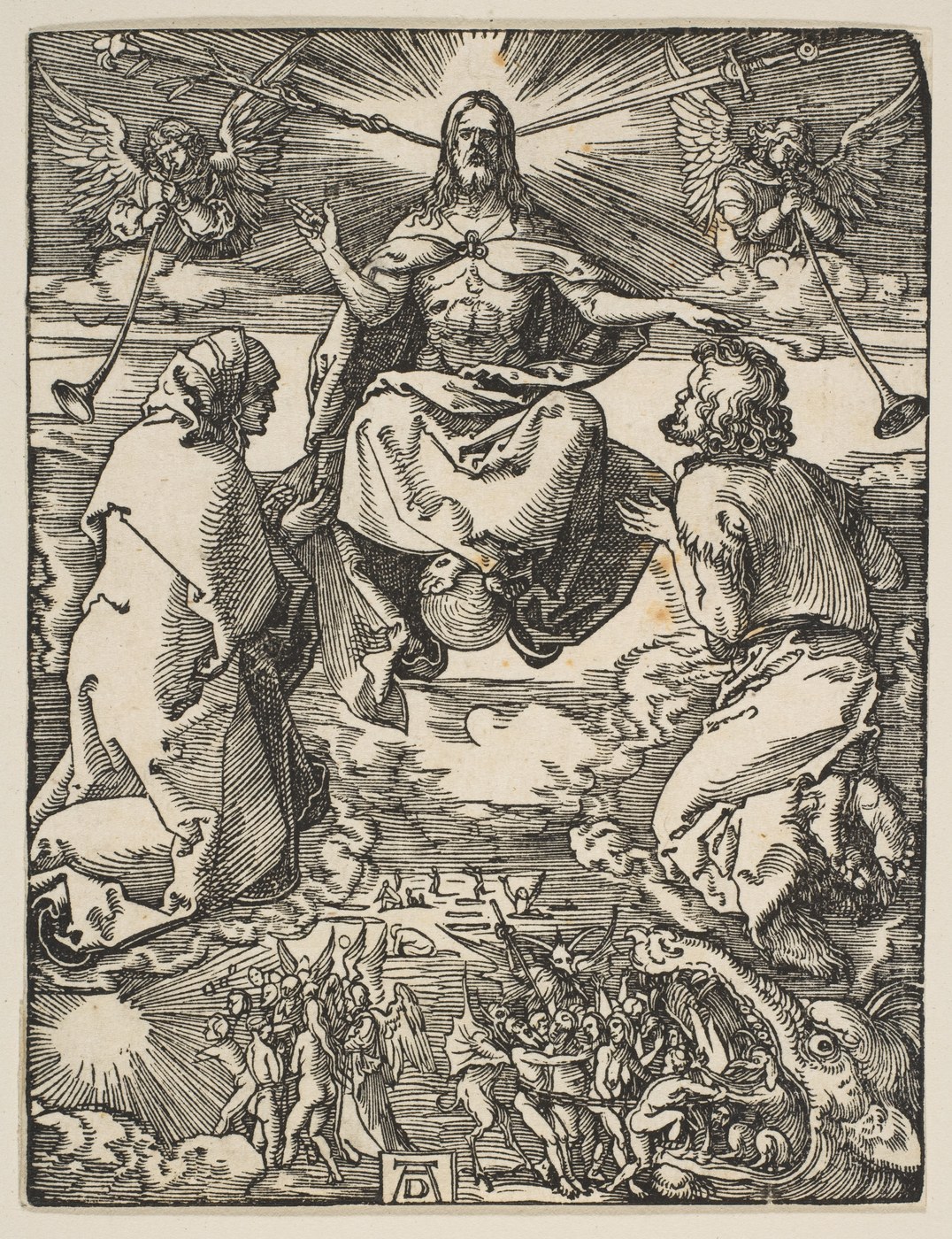
Albrecht Dürer, The Last Judgment, from The Small Passion, ca. 1510. A historical Christian vision of judgment, the context in which Revelation uses the expression second death.
The Metropolitan Museum of Art. Gift of Junius Spencer Morgan, 1919. Accession 19.73.206. Public Domain (CC0). · Image source ↗ · CC0
On the Face in the Moon by Plutarch
In the closing myth of Plutarch’s On the Face in the Moon, the earth supplies the body, the moon the soul and the sun the mind. The first death separates soul from body. At the second, Persephone detaches mind from soul. [14]
Man the Grand Symbol of the Mysteries by Manly P. Hall
Manly P. Hall presents a sequence of two deaths through C. W. King’s reading of Plutarch. The first separates the soul from the body. In the second, the higher mind, or nous, separates from the animal soul. Hall describes the mind returning to the sun and the animal soul gradually being absorbed into the lunar sphere. [15][16]
Hall treats moon and sun as images of different conditions. He also compares the mind’s ascent with passage through seven planetary gates and brings in a Gnostic account of passing seven powers. The pairing belongs to his comparative reading. [16][17][18]
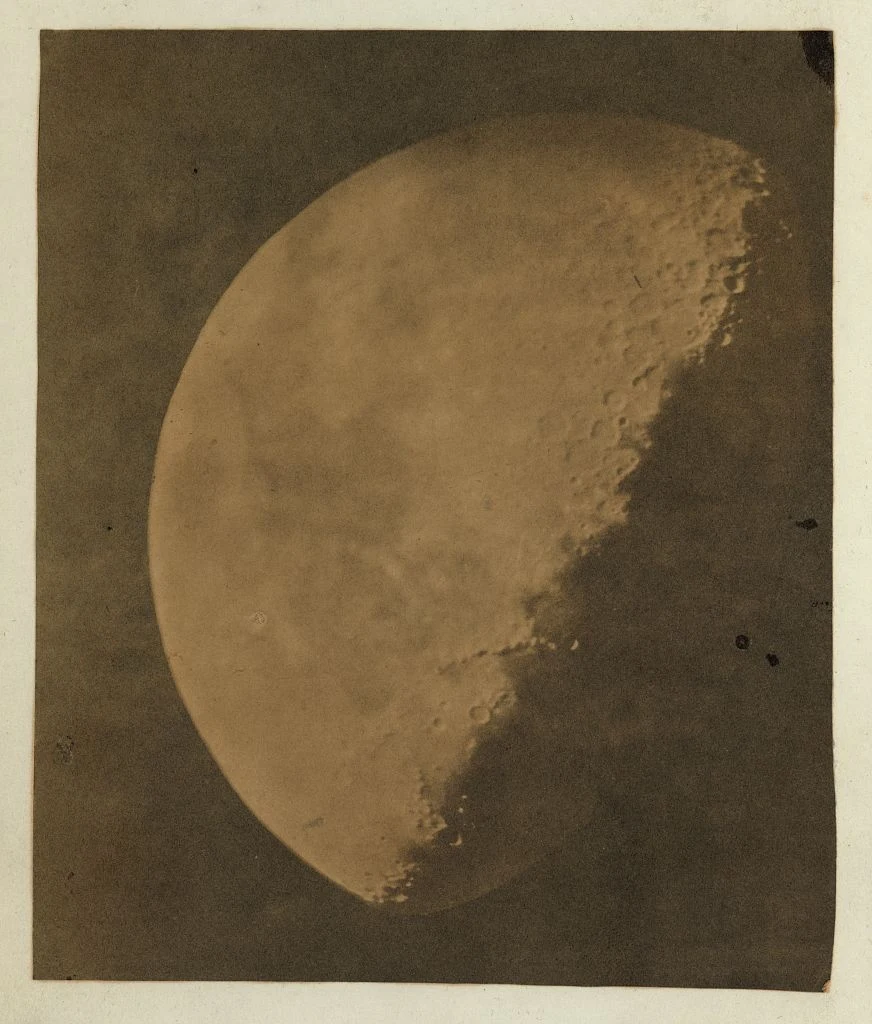
John Adams Whipple’s photograph of the Moon, where Plutarch’s myth places the second separation of mind from soul.
John Adams Whipple, photographed in 1851 and published in 1853. Library of Congress, LC-DIG-ppmsca-22196. No known restrictions on publication. · Image source ↗ · Public Domain
A Wanderer in the Spirit Lands
A Wanderer in the Spirit Lands, attributed to Franchezzo and transcribed by A. Farnese, gives a different meaning to the name in chapter XII. Franchezzo prepares to leave his first sphere for the second. He explains that the change usually involves a period of unconsciousness, although other spirits may make a more conscious transition. [2][3]
After a sleep described as lasting two weeks, he awakens with a new envelope. The old astral form dissolves, while he retains his identity and an adult appearance. He calls this a Second Death and a resurrection of the higher self. The event is an advance in his continuing life, rather than the death of another earthly body. [4]
The rescue journey supplies related scenes. A mist-like form rises from an unconscious spirit’s former covering and is borne away by higher helpers. At the battlefield, the same process follows the soothing of exhausted spirits who are ready to leave that condition. These scenes give the book’s idea of changing envelopes a visible narrative form. [5][6][7]
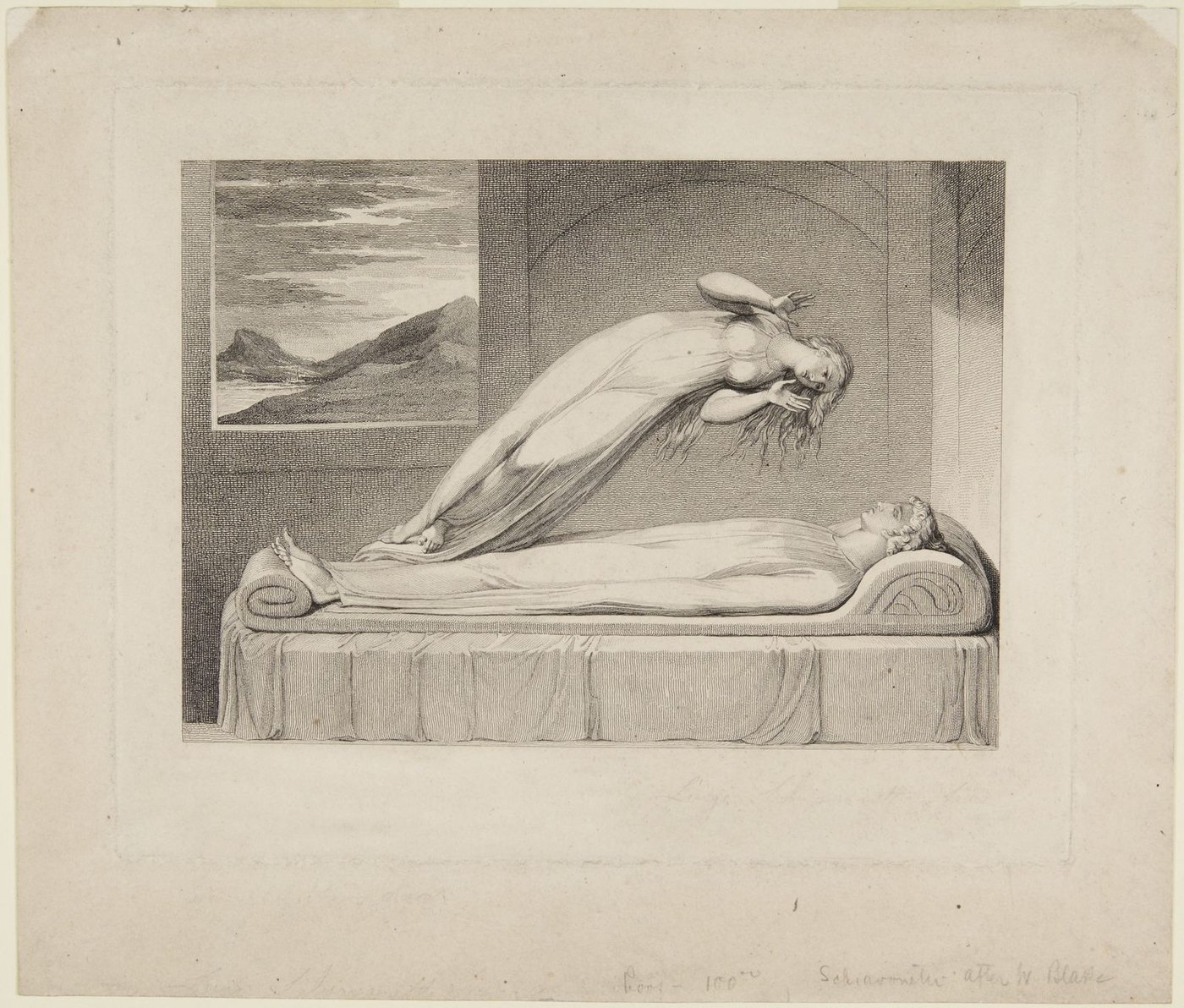
Luigi Schiavonetti after William Blake, The Soul Hovering over the Body Reluctantly Parting with Life, 1805–08, for Robert Blair’s The Grave. The separation offers an artistic comparison for Franchezzo’s idea of a person outlasting a bodily form.
Princeton University Art Museum. Gift of Frank Jewett Mather Jr., x1947-85. Public Domain. · Image source ↗ · Public Domain
Judgment, separation and renewal
Each account gives the second death a different consequence. Revelation places it at the final judgment. Plutarch describes the mind separating from the soul, an ascent Hall develops through parallels with other traditions. In Franchezzo’s account the same person wakes in a new spiritual body. [15][16][14][2][3][4]
Franchezzo’s wider account rejects eternal misery and the destruction of individual souls. That belief helps explain why a phrase Revelation uses in a judgment scene can name a stage of renewal in his own story. [1][8][9][10]
See references (10)
- Revelation 20:6,11–15, judgment and the second death
- A Wanderer in the Spirit Lands, Reader page 88
- A Wanderer in the Spirit Lands, Reader page 89
- A Wanderer in the Spirit Lands, Reader page 90
- A Wanderer in the Spirit Lands, Reader page 230
- A Wanderer in the Spirit Lands, Reader page 231
- A Wanderer in the Spirit Lands, Reader page 267
- On the Face in the Moon 943a to 945a
- Man the Grand Symbol of the Mysteries, Reader page 194
- Man the Grand Symbol of the Mysteries, Reader page 195
Read further in the library

A Wanderer in the Spirit Lands
Reading note
A deep sleep, a renewed envelope and related rescue scenes illustrate the book’s meaning of a further death.
Man the Grand Symbol of the Mysteries
Reading note
The separately titled account draws on exact passages in the consulted Library edition.
Sources
See references (18)
- Revelation 20:6,11–15, judgment and the second death ↗New American Bible, Revised Edition, United States Conference of Catholic Bishops. Primary text, Revelation 20.Return to text ↑
- A Wanderer in the Spirit Lands, Reader page 88Franchezzo (source attribution), A Wanderer in the Spirit Lands, transcribed by A. Farnese. W. J. Sinkins, London, 1896. Consulted printing confirmed on its title-page facsimile.Read this page in A Wanderer in the Spirit Lands ↗Return to text ↑
- A Wanderer in the Spirit Lands, Reader page 89Franchezzo (source attribution), A Wanderer in the Spirit Lands, transcribed by A. Farnese. W. J. Sinkins, London, 1896. Consulted printing confirmed on its title-page facsimile.Read this page in A Wanderer in the Spirit Lands ↗Return to text ↑
- A Wanderer in the Spirit Lands, Reader page 90Franchezzo (source attribution), A Wanderer in the Spirit Lands, transcribed by A. Farnese. W. J. Sinkins, London, 1896. Consulted printing confirmed on its title-page facsimile.Read this page in A Wanderer in the Spirit Lands ↗Return to text ↑
- A Wanderer in the Spirit Lands, Reader page 154Franchezzo (source attribution), A Wanderer in the Spirit Lands, transcribed by A. Farnese. W. J. Sinkins, London, 1896. Consulted printing confirmed on its title-page facsimile.Read this page in A Wanderer in the Spirit Lands ↗Return to text ↑
- A Wanderer in the Spirit Lands, Reader page 226Franchezzo (source attribution), A Wanderer in the Spirit Lands, transcribed by A. Farnese. W. J. Sinkins, London, 1896. Consulted printing confirmed on its title-page facsimile.Read this page in A Wanderer in the Spirit Lands ↗Return to text ↑
- A Wanderer in the Spirit Lands, Reader page 227Franchezzo (source attribution), A Wanderer in the Spirit Lands, transcribed by A. Farnese. W. J. Sinkins, London, 1896. Consulted printing confirmed on its title-page facsimile.Read this page in A Wanderer in the Spirit Lands ↗Return to text ↑
- A Wanderer in the Spirit Lands, Reader page 230Franchezzo (source attribution), A Wanderer in the Spirit Lands, transcribed by A. Farnese. W. J. Sinkins, London, 1896. Consulted printing confirmed on its title-page facsimile.Read this page in A Wanderer in the Spirit Lands ↗Return to text ↑
- A Wanderer in the Spirit Lands, Reader page 231Franchezzo (source attribution), A Wanderer in the Spirit Lands, transcribed by A. Farnese. W. J. Sinkins, London, 1896. Consulted printing confirmed on its title-page facsimile.Read this page in A Wanderer in the Spirit Lands ↗Return to text ↑
- A Wanderer in the Spirit Lands, Reader page 267Franchezzo (source attribution), A Wanderer in the Spirit Lands, transcribed by A. Farnese. W. J. Sinkins, London, 1896. Consulted printing confirmed on its title-page facsimile.Read this page in A Wanderer in the Spirit Lands ↗Return to text ↑
- The Last Judgment, from "The Small Passion" ↗The Metropolitan Museum of Art; object record 19.73.206
- Luigi Schiavonetti after William Blake, The Soul Hovering over the Body Reluctantly Parting with Life, 1805–08. ↗Princeton University Art Museum. Gift of Frank Jewett Mather Jr., x1947-85. Public Domain.
- Phase of the moon taken March 1851 ↗John Adams Whipple, photographed in 1851 and published in 1853. Library of Congress, LC-DIG-ppmsca-22196. No known restrictions on publication.
- On the Face in the Moon 943a to 945a ↗Plutarch, On the Face in the Moon 943a to 945a, translated by Harold Cherniss, Loeb Classical Library, 1957.Return to text ↑
- Man the Grand Symbol of the Mysteries, Reader page 194Manly P. Hall, Man the Grand Symbol of the Mysteries, Fourth Edition, The Philosophers Press, Los Angeles, 1937. Lumitheca Library edition IMJ-0603-E001.Read this page in Man the Grand Symbol of the Mysteries ↗Return to text ↑
- Man the Grand Symbol of the Mysteries, Reader page 195Manly P. Hall, Man the Grand Symbol of the Mysteries, Fourth Edition, The Philosophers Press, Los Angeles, 1937. Lumitheca Library edition IMJ-0603-E001.Read this page in Man the Grand Symbol of the Mysteries ↗Return to text ↑
- Man the Grand Symbol of the Mysteries, Reader page 196Manly P. Hall, Man the Grand Symbol of the Mysteries, Fourth Edition, The Philosophers Press, Los Angeles, 1937. Lumitheca Library edition IMJ-0603-E001.Read this page in Man the Grand Symbol of the Mysteries ↗Return to text ↑
- Man the Grand Symbol of the Mysteries, Reader page 197Manly P. Hall, Man the Grand Symbol of the Mysteries, Fourth Edition, The Philosophers Press, Los Angeles, 1937. Lumitheca Library edition IMJ-0603-E001.Read this page in Man the Grand Symbol of the Mysteries ↗Return to text ↑