Divine Emanation
Divine emanation is the idea that life or being flows from a first source. Compare Plotinus, Geoffrey Hodson and The Angels’ Diary.
In this article
What is divine emanation?
Divine emanation is the idea that life or being flows from a divine source. The image of a flow explains how many kinds of life can depend on one origin. Different writers use it for the emergence of being, the formation of worlds or the passage of divine life through them. [5][1][6][2]
An account of emanation often describes a return as well as an outflow. A new being may turn towards what gives it life. An author might picture the same relation as a current that moves through several realms and back to its source. [1][2][14][16]
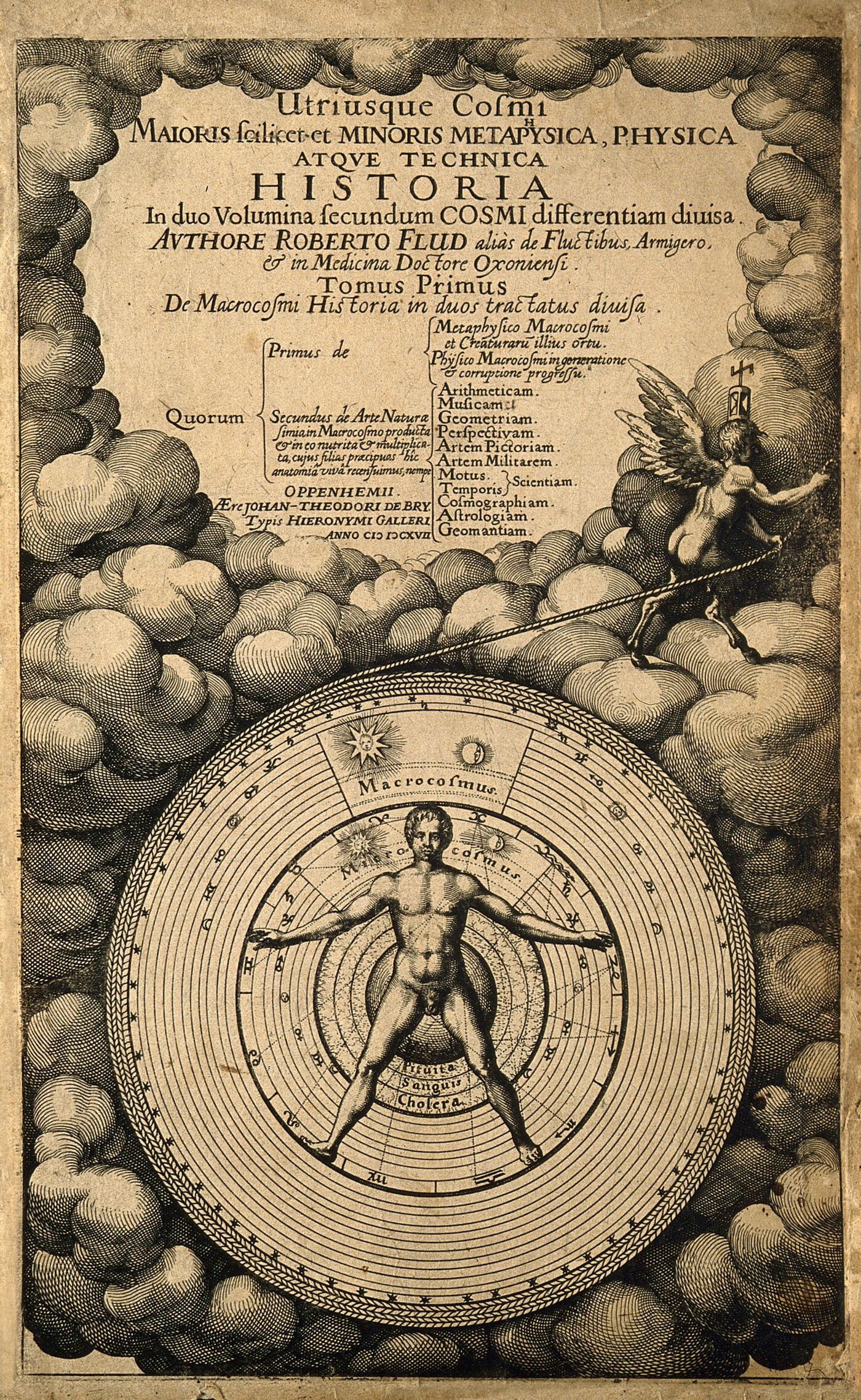
The microcosm within the macrocosm: a 1617 title page associated with Robert Fludd. Its linked figures and concentric circles picture a human life within a larger cosmic order. It supplies an earlier visual comparison for dependence and connection. Its symbolism belongs to Fludd’s setting and is not a diagram of the divine centre described in The Angels’ Diary.
Wellcome Collection, 2989i. T. de Bry, 1617, associated with Robert Fludd. Public Domain Mark. · Image source ↗ · Public Domain
See references (6)
- The Angels’ Diary and Celestion Study of Man, Reader page 94
- The Angels’ Diary and Celestion Study of Man, Reader page 168
- The Angels’ Diary and Celestion Study of Man, Reader page 93
- The Angels’ Diary and Celestion Study of Man, Reader page 95
- The Angels’ Diary and Celestion Study of Man, Reader page 206
- The Angels’ Diary and Celestion Study of Man, Reader page 208
The One in Plotinus’s Enneads
In Enneads V.2.1, Plotinus uses overflow as a metaphor. The One gives rise to Intellect, which turns towards its source. Intellect in turn gives rise to Soul. The sequence describes dependence: each order draws its fullness from what precedes it. [26]
The Kingdom of the Gods by Geoffrey Hodson
In The Kingdom of the Gods, Geoffrey Hodson calls the One the first emanation from the Absolute. Creative thought contains the patterns of worlds and expresses them through denser forms. Hodson uses a threefold and sevenfold order to explain how manifestation unfolds. [19][20][21][22]
Hodson also distinguishes an impersonal divine principle from the being he calls the Logos of a solar system. He uses the Logos to explain how a particular system can have an origin and a sustaining life while the universal source remains beyond the limits of that system. [23][24][25]
Robert Fludd’s 1617 title page places an enclosed human figure within the order of the cosmos. It offers an earlier image of nested orders, a theme Hodson applies to manifestation.
Wellcome Collection, 2989i. Public Domain Mark. · Image source ↗ · Public Domain
The Angels’ Diary
The Angels’ Diary, attributed to Effie M. Shirey and Charles Samson, places a divine centre in the Paradise of God. Life and wisdom pass from there through spiritual spheres into material nature. The traveller’s geography becomes an account of what keeps living things connected to their source. [3][4][5][1]
The current also returns. What radiates into the life of nature is said to flow back to its source, and this circulation explains why the supply can remain inexhaustible. The book invites the reader to picture continual giving without the giver being depleted. [1]
As the force passes toward earthly conditions, it takes on coarser elements. The author compares this with a spirit being clothed in a physical body. Colour and vibration make the current imaginable to spiritual sight. The electrical and magnetic vocabulary belongs to the book’s esoteric explanation of dependence between different orders of being. [6][7][8]
Celestion Study of Man, attributed to Charles Samson, brings the same dependence down to the scale of a person. The soul is described as a spark from God with faculties present in miniature. The winter lilac, with leaves and a flower concealed in its bud, becomes an analogy for what a divine inheritance can contain before it unfolds. [9][10][11][12][2]
The chapters on the Trinity and Holy Ghost extend the idea into a particular reading of Christian language. Divine power is said to find expression through nature and to become manifest within the soul. These are interpretations made by the communicated text and carry its own account of spiritual development. [13][14][15][16]
Flowing forth, returning and unfolding give the book three related images for divine life. The first connects creation with a source, the second explains renewal and the third describes a person’s growth. Keeping their roles distinct makes the account of emanation more intelligible than treating every use of spiritual force as interchangeable. [1][2][14]
See references (16)
- The Angels’ Diary and Celestion Study of Man, Reader page 94
- The Angels’ Diary and Celestion Study of Man, Reader page 168
- The Angels’ Diary and Celestion Study of Man, Reader page 86
- The Angels’ Diary and Celestion Study of Man, Reader page 87
- The Angels’ Diary and Celestion Study of Man, Reader page 93
- The Angels’ Diary and Celestion Study of Man, Reader page 95
- The Angels’ Diary and Celestion Study of Man, Reader page 96
- The Angels’ Diary and Celestion Study of Man, Reader page 97
- The Angels’ Diary and Celestion Study of Man, Reader page 114
- The Angels’ Diary and Celestion Study of Man, Reader page 158
- The Angels’ Diary and Celestion Study of Man, Reader page 159
- The Angels’ Diary and Celestion Study of Man, Reader page 167
- The Angels’ Diary and Celestion Study of Man, Reader page 205
- The Angels’ Diary and Celestion Study of Man, Reader page 206
- The Angels’ Diary and Celestion Study of Man, Reader page 207
- The Angels’ Diary and Celestion Study of Man, Reader page 208
Outflow and return in the two Library accounts
The Diary follows the current through places a traveller can visit before it returns to its source. Hodson’s One, Three and Seven explain how an origin gives rise to many orders. Both use outflow and return, with different answers to what takes shape along the way. [19][20][22][3][5][1][6]
See references (7)
- The Angels’ Diary and Celestion Study of Man, Reader page 94
- The Angels’ Diary and Celestion Study of Man, Reader page 86
- The Angels’ Diary and Celestion Study of Man, Reader page 93
- The Angels’ Diary and Celestion Study of Man, Reader page 95
- The Kingdom of the Gods, Reader page 5
- The Kingdom of the Gods, Reader page 6
- The Kingdom of the Gods, Reader page 126
Read further in the library
The Angels’ Diary and Celestion Study of Man
Reading note
The outward and returning current. Read the original passage in the 1903 edition.
The Kingdom of the Gods
Reading note
The separately titled account draws on exact passages in the consulted Library edition.
Sources
See references (26)
- The Angels’ Diary and Celestion Study of Man, Reader page 94Effie M. Shirey and Charles Samson, The Angels’ Diary and Celestion Study of Man (1903).Read this page in The Angels’ Diary and Celestion Study of Man ↗Return to text ↑
- The Angels’ Diary and Celestion Study of Man, Reader page 168Charles Samson, Celestion Study of Man, in the 1903 volume.Read this page in The Angels’ Diary and Celestion Study of Man ↗Return to text ↑
- The Angels’ Diary and Celestion Study of Man, Reader page 86Effie M. Shirey and Charles Samson, The Angels’ Diary and Celestion Study of Man (1903).Read this page in The Angels’ Diary and Celestion Study of Man ↗Return to text ↑
- The Angels’ Diary and Celestion Study of Man, Reader page 87Effie M. Shirey and Charles Samson, The Angels’ Diary and Celestion Study of Man (1903).Read this page in The Angels’ Diary and Celestion Study of Man ↗Return to text ↑
- The Angels’ Diary and Celestion Study of Man, Reader page 93Effie M. Shirey and Charles Samson, The Angels’ Diary and Celestion Study of Man (1903).Read this page in The Angels’ Diary and Celestion Study of Man ↗Return to text ↑
- The Angels’ Diary and Celestion Study of Man, Reader page 95Effie M. Shirey and Charles Samson, The Angels’ Diary and Celestion Study of Man (1903).Read this page in The Angels’ Diary and Celestion Study of Man ↗Return to text ↑
- The Angels’ Diary and Celestion Study of Man, Reader page 96Effie M. Shirey and Charles Samson, The Angels’ Diary and Celestion Study of Man (1903).Read this page in The Angels’ Diary and Celestion Study of Man ↗Return to text ↑
- The Angels’ Diary and Celestion Study of Man, Reader page 97Effie M. Shirey and Charles Samson, The Angels’ Diary and Celestion Study of Man (1903).Read this page in The Angels’ Diary and Celestion Study of Man ↗Return to text ↑
- The Angels’ Diary and Celestion Study of Man, Reader page 114Charles Samson, Celestion Study of Man, in the 1903 volume.Read this page in The Angels’ Diary and Celestion Study of Man ↗Return to text ↑
- The Angels’ Diary and Celestion Study of Man, Reader page 158Charles Samson, Celestion Study of Man, in the 1903 volume.Read this page in The Angels’ Diary and Celestion Study of Man ↗Return to text ↑
- The Angels’ Diary and Celestion Study of Man, Reader page 159Charles Samson, Celestion Study of Man, in the 1903 volume.Read this page in The Angels’ Diary and Celestion Study of Man ↗Return to text ↑
- The Angels’ Diary and Celestion Study of Man, Reader page 167Charles Samson, Celestion Study of Man, in the 1903 volume.Read this page in The Angels’ Diary and Celestion Study of Man ↗Return to text ↑
- The Angels’ Diary and Celestion Study of Man, Reader page 205Effie M. Shirey and Charles Samson, The Angels’ Diary and Celestion Study of Man (1903).Read this page in The Angels’ Diary and Celestion Study of Man ↗Return to text ↑
- The Angels’ Diary and Celestion Study of Man, Reader page 206Effie M. Shirey and Charles Samson, The Angels’ Diary and Celestion Study of Man (1903).Read this page in The Angels’ Diary and Celestion Study of Man ↗Return to text ↑
- The Angels’ Diary and Celestion Study of Man, Reader page 207Effie M. Shirey and Charles Samson, The Angels’ Diary and Celestion Study of Man (1903).Read this page in The Angels’ Diary and Celestion Study of Man ↗Return to text ↑
- The Angels’ Diary and Celestion Study of Man, Reader page 208Effie M. Shirey and Charles Samson, The Angels’ Diary and Celestion Study of Man (1903).Read this page in The Angels’ Diary and Celestion Study of Man ↗Return to text ↑
- Robert Fludd’s microcosm and macrocosm title page, engraving associated with T. de Bry, 1617 ↗Wellcome Collection, 2989i. T. de Bry, 1617, associated with Robert Fludd. Public Domain Mark.
- The microcosm (man) and the macrocosm (the world), 1617: Wellcome Collection 2989i ↗Wellcome Collection, 2989i. Engraving credited to T. de Bry, 1617; associated with Robert Fludd. Public Domain Mark.
- The Kingdom of the Gods, Reader page 5Geoffrey Hodson, The Kingdom of the Gods, Theosophical Publishing House, first published 1952, thirteenth reprint 2007. Lumitheca Library edition IMJ-0606-E001.Read this page in The Kingdom of the Gods ↗Return to text ↑
- The Kingdom of the Gods, Reader page 6Geoffrey Hodson, The Kingdom of the Gods, Theosophical Publishing House, first published 1952, thirteenth reprint 2007. Lumitheca Library edition IMJ-0606-E001.Read this page in The Kingdom of the Gods ↗Return to text ↑
- The Kingdom of the Gods, Reader page 125Geoffrey Hodson, The Kingdom of the Gods, Theosophical Publishing House, first published 1952, thirteenth reprint 2007. Lumitheca Library edition IMJ-0606-E001.Read this page in The Kingdom of the Gods ↗Return to text ↑
- The Kingdom of the Gods, Reader page 126Geoffrey Hodson, The Kingdom of the Gods, Theosophical Publishing House, first published 1952, thirteenth reprint 2007. Lumitheca Library edition IMJ-0606-E001.Read this page in The Kingdom of the Gods ↗Return to text ↑
- The Kingdom of the Gods, Reader page 13Geoffrey Hodson, The Kingdom of the Gods, Theosophical Publishing House, first published 1952, thirteenth reprint 2007. Lumitheca Library edition IMJ-0606-E001.Read this page in The Kingdom of the Gods ↗Return to text ↑
- The Kingdom of the Gods, Reader page 14Geoffrey Hodson, The Kingdom of the Gods, Theosophical Publishing House, first published 1952, thirteenth reprint 2007. Lumitheca Library edition IMJ-0606-E001.Read this page in The Kingdom of the Gods ↗Return to text ↑
- The Kingdom of the Gods, Reader page 16Geoffrey Hodson, The Kingdom of the Gods, Theosophical Publishing House, first published 1952, thirteenth reprint 2007. Lumitheca Library edition IMJ-0606-E001.Read this page in The Kingdom of the Gods ↗Return to text ↑
- Plotinus, Enneads V.2.1, MacKenna translation, volume IV, printed p. 16 ↗Plotinus, The Enneads, translated by Stephen MacKenna (1926), volume IV, printed p. 16.Return to text ↑