Michael
Explore Michael as Israel’s advocate, a Christian heavenly commander and Mikail in Islamic teaching, with religious practice and a historical Spanish painting.
In this article
Who is Michael?
Michael is an angel associated with protection and advocacy in Jewish tradition. His Hebrew name is commonly understood as the question Who is like God? The Jewish Encyclopedia introduces him through Daniel, where he is a prince connected with the protection of Israel. [1]
Later Jewish accounts develop that advocacy in different directions. Michael can defend the people, intercede or participate in stories of rescue. These traditions connect a heavenly figure with the fortunes of a community. They should be read as particular interpretations and narratives, rather than treated as one continuous biography with every episode equally present in scripture. [1]
A Jewish account of divine kindness
Baruch Davidson’s Chabad explanation associates Michael’s missions with divine kindness, contrasting Gabriel’s role in severe judgment. These are ways of describing the tasks angels perform in the divine service. The distinction connects a named figure with a religious understanding of how God acts towards the world. [2]
The same explanation places angelic names within an expanding tradition of interpretation. Michael’s familiar name does not imply that all early narratives name their messengers or that every later classification uses identical categories. [2]
The Christian heavenly commander
The Orthodox Church in America presents Michael as chief commander of the heavenly powers. Its account of rebellion describes him remaining faithful to God and confronting the fallen spirits. The name’s question becomes part of the figure’s significance: the heavenly commander serves the Creator rather than claiming the Creator’s place. [3]
This role is also carried through worship. The Orthodox Synaxis on November 8 honours Michael and the other bodiless powers, and prayers ask for protection and intercession. Icons make service visible through attributes such as a lance or fiery sword. Such images belong to a tradition of spiritual conflict and guardianship. They do not turn the angel into an independent god or make bodily armour a philosophical definition of angelic nature. [3]
Mikail in Islamic teaching
Michael also appears in Islamic teaching as Mikail. In his study of God, angels and human beings, Salih Sayilgan describes Mikail’s responsibility in relation to the natural world. He places that function alongside other angelic tasks, including Gabriel’s role in revelation. [4]
The comparison shows why a shared name needs its religious setting. Michael’s Christian military imagery is not a sufficient explanation of Mikail’s Islamic role. Each belongs within an account of created beings acting under divine authority, but the narratives and emphases differ. [4]
Michael in a Spanish panel
The Master of Belmonte’s Saint Michael, painted in northern Spain between 1450 and 1500, gives the heavenly warrior elaborate armour, a shield and a lance. A monstrous figure lies beneath his feet. The Met identifies that defeated figure as the Antichrist and interprets the contrast between angelic beauty and grotesque evil within the painting’s Christian setting. [5]
This is a particular historical image, with its own choices about clothing, weapons and the defeated opponent. It shows how a religious role becomes visible in a local artistic language. The painting is most informative when read beside the traditions it interprets, rather than used as a universal portrait of Michael across religions. [5]
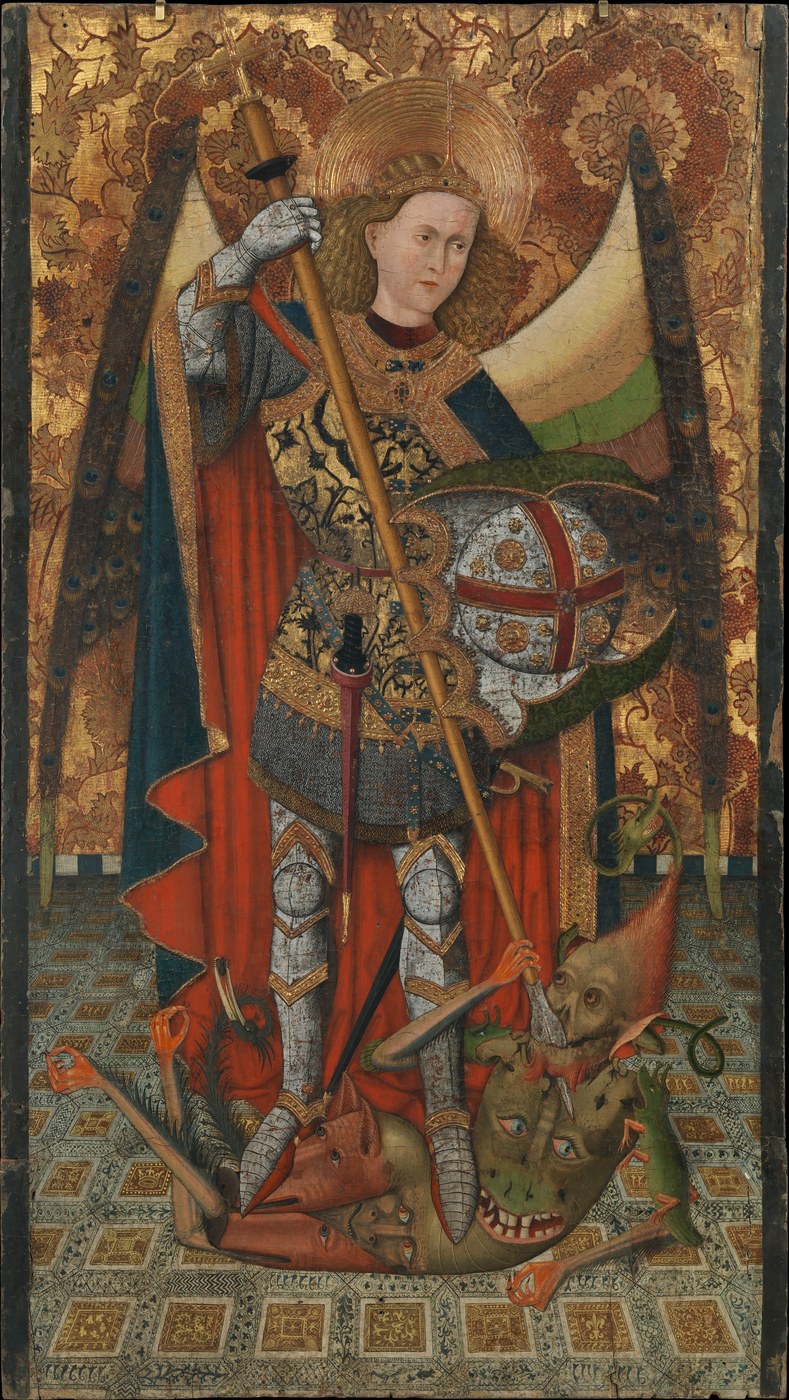
Master of Belmonte, Saint Michael, northern Spain, 1450–1500. Tempera and oil on wood. The museum identifies the defeated figure as the Antichrist.
The Metropolitan Museum of Art. The Cloisters Collection, 1955. Accession 55.120.2. Public Domain (CC0). · Museum record ↗ · CC0
Sources
- Michael ↗Joseph Jacobs, M. Seligsohn and Mary W. Montgomery, Jewish Encyclopedia; historical referenceReturn to text ↑
- What Are Angels? ↗Baruch S. Davidson, Chabad.org; Jewish community explanationReturn to text ↑
- Synaxis of the Archangel Michael and the Other Bodiless Powers ↗Orthodox Church in America; feast, intercession and iconographic teachingReturn to text ↑
- God, Angels, Humans, and Satan ↗Salih Sayilgan, God, Evil, and Suffering in Islam, Cambridge University Press, 2023; section on angelic rolesReturn to text ↑
- Saint Michael, Master of Belmonte ↗The Metropolitan Museum of Art; North Spanish panel, 1450–1500, accession 55.120.2Return to text ↑
About this article & its sources
Selected Jewish interpretations, Orthodox Christian teaching and a limited Islamic comparison. Different roles and systems of rank retain their own settings; Milton’s literary figure remains a separate entry.
Passage attributions
Who is Michael?
Passage 1: Joseph Jacobs, M. Seligsohn and Mary W. Montgomery, Jewish Encyclopedia; historical reference.
Passage 2: Joseph Jacobs, M. Seligsohn and Mary W. Montgomery, Jewish Encyclopedia; historical reference.
A Jewish account of divine kindness
Passage 1: Baruch S. Davidson, Chabad.org; Jewish community explanation.
Passage 2: Baruch S. Davidson, Chabad.org; Jewish community explanation.
The Christian heavenly commander
Passage 1: Orthodox Church in America; feast, intercession and iconographic teaching.
Passage 2: Orthodox Church in America; feast, intercession and iconographic teaching.