Gabriel
Explore Gabriel’s roles in Daniel, the Christian Annunciation and Islamic revelation, with Jewish interpretation, Orthodox worship and a historical drawing.
In this article
Who is Gabriel?
Gabriel is an angel associated with the interpretation of visions and the communication of divine purposes. In Daniel, he explains visions to the seer. Later religious traditions develop his role through announcement, judgment and revelation. The Jewish Encyclopedia introduces him beside Michael, while gathering accounts that assign them different tasks. [1]
That variety matters. Gabriel is not only a name attached to a single familiar scene. Jewish interpretive traditions connect him with divine judgment, elemental imagery and acts carried out in the world. These are developments within particular sources. They need not form one uniform description of his rank, appearance or duties. [1]
Gabriel and divine judgment
In Baruch Davidson’s Chabad account, Gabriel’s missions express divine severity and judgment, while Michael’s are associated with kindness. The distinction concerns different forms of service within a divine order. It does not make one angel good and the other evil. [2]
This Jewish explanation is useful beside Christian images of Gabriel announcing good news. A figure’s best-known role in one setting does not exhaust the meanings given to him in another. The relationship between name, task and interpretation must remain visible. [2]
Christian announcement and worship
The announcements in Luke
Luke identifies Gabriel as the messenger who announces John’s birth to Zechariah and Jesus’ birth to Mary. The paired encounters place him within the Gospel’s opening account of divine promise. [3]
Gabriel in Orthodox worship
The Orthodox Church in America commemorates Gabriel on March 26, the day after the Annunciation. Its explanation makes the relationship clear: after celebrating the announcement to Mary, the Church honours the messenger through whom it came. The feast directs attention to faithful service within the Christian account of salvation. [4]
Its traditional account also attributes a wider range of appearances to Gabriel, including care for Mary and announcements connected with Christ’s life. Such attributions belong to Church tradition. They should not be confused with the narrower question of which scriptural passages explicitly give an angel his name. [4]
Prayer and intercession give these accounts a living setting. Gabriel is remembered as an active servant of God and as one to whom Christians may turn in prayer. The commemoration brings narrative, worship and an understanding of angelic assistance together. [4]
Jibril and Islamic revelation
In Islamic teaching, Gabriel is known as Jibril and has a central role in revelation. Salih Sayilgan’s account describes him bringing the Quran to Muhammad by divine permission and appearing in different forms, including human form. The angel’s role concerns the communication of guidance. [5]
This gives the comparison with the Annunciation both a connection and a limit. A messenger communicates a divine purpose, but the revelation, recipient and theological meaning belong to their own religious setting. Jibril’s place in Islam is understood through Islamic teaching, rather than through a Christian image alone. [5]
Representing the messenger
A drawing studies the messenger’s gesture
Nicolas Mignard’s seventeenth-century Study for the Archangel Gabriel presents a winged figure in profile, with one arm raised and drapery moving around the body. Red chalk and graphite, with white highlights, give the gesture a material presence. The drawing is an artist’s study of a religious figure, not evidence of a single appearance shared by every angelic encounter. [6]
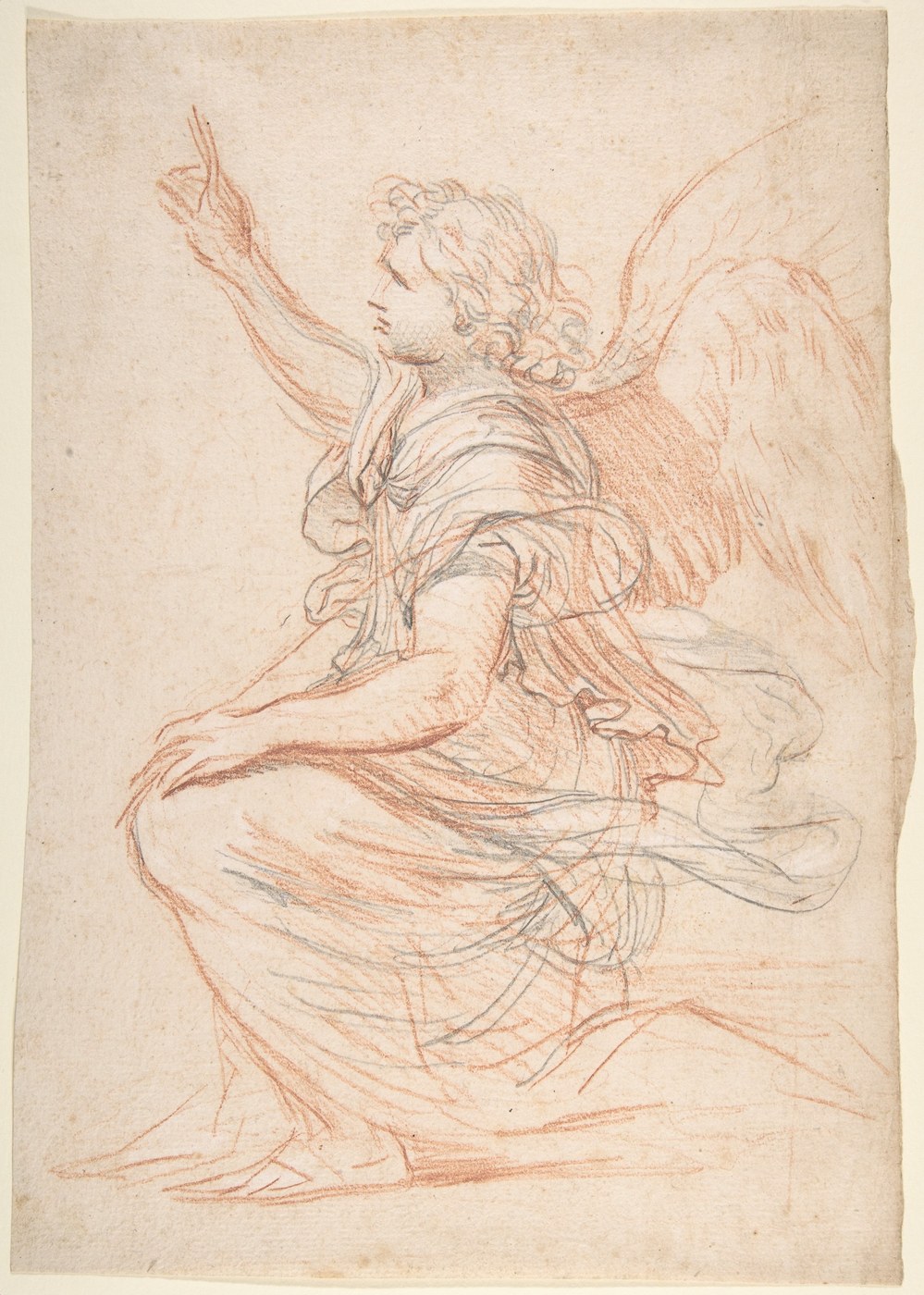
Nicolas Mignard, Study for the Archangel Gabriel, seventeenth century. Red chalk and graphite, heightened with white chalk.
The Metropolitan Museum of Art. Purchase, Stephen A. Geiger Gift, in honor of his mother, Mildred K. Geiger, and in memory of his father, Howard W. Geiger, 1999. Accession 1999.166. Public Domain (CC0). · Museum record ↗ · CC0
Gabriel within an Annunciation pair
A fourteenth-century painted wood Gabriel at the National Gallery of Art belongs with a companion Mary. The museum explains that these sculptures enact the Annunciation and may once have flanked an entrance to a church’s high-altar area. Their arrangement would have made the meeting part of the space through which a worshipper moved. [7]
The figures are early copies of a marble pair in Pisa. That history shows a religious scene moving between materials and settings while retaining its recognizable relationship: messenger and recipient. Reading the pair together restores something lost when Gabriel is viewed only as an isolated figure. [7]
Sources
- Gabriel ↗Solomon Schechter, Ludwig Blau and Emil G. Hirsch, Jewish Encyclopedia; historical referenceReturn to text ↑
- What Are Angels? ↗Baruch S. Davidson, Chabad.org; Jewish community explanationReturn to text ↑
- Luke 1:19 and 1:26–38 ↗Gospel according to Luke, New American Bible Revised Edition, hosted by the USCCBReturn to text ↑
- Synaxis of the Archangel Gabriel ↗Orthodox Church in America; tradition, commemoration and intercessionReturn to text ↑
- God, Angels, Humans, and Satan ↗Salih Sayilgan, God, Evil, and Suffering in Islam, Cambridge University Press, 2023; Gabriel and revelationReturn to text ↑
- Study for the Archangel Gabriel ↗Nicolas Mignard, seventeenth century; The Metropolitan Museum of Art, accession 1999.166Return to text ↑
- The Archangel Gabriel ↗National Gallery of Art; Pisan fourteenth-century sculpture, 1325/1350, accession 1961.9.97Return to text ↑
About this article & its sources
Selected Jewish and Christian texts and interpretations, with Islamic teaching on Jibril. Named scriptural appearances are distinguished from later attributions and artistic representations.
Passage attributions
Who is Gabriel?
Passage 1: Solomon Schechter, Ludwig Blau and Emil G. Hirsch, Jewish Encyclopedia; historical reference.
Passage 2: Solomon Schechter, Ludwig Blau and Emil G. Hirsch, Jewish Encyclopedia; historical reference.
Gabriel and divine judgment
Passage 1: Baruch S. Davidson, Chabad.org; Jewish community explanation.
Passage 2: Baruch S. Davidson, Chabad.org; Jewish community explanation.
The announcements in Luke
Passage 1: Gospel according to Luke, New American Bible Revised Edition, hosted by the USCCB.
Gabriel in Orthodox worship
Passage 1: Orthodox Church in America; tradition, commemoration and intercession.
Passage 2: Orthodox Church in America; tradition, commemoration and intercession.
Passage 3: Orthodox Church in America; tradition, commemoration and intercession.
Jibril and Islamic revelation
Passage 1: Salih Sayilgan, God, Evil, and Suffering in Islam, Cambridge University Press, 2023; Gabriel and revelation.
Passage 2: Salih Sayilgan, God, Evil, and Suffering in Islam, Cambridge University Press, 2023; Gabriel and revelation.
A drawing studies the messenger’s gesture
Passage 1: Nicolas Mignard, seventeenth century; The Metropolitan Museum of Art, accession 1999.166.