The Seven Chakras in Order: Names, Symbols and Origins
Explore the names and petals of the six centres and crown lotus. Compare Pūrṇānanda’s diagrams with Leadbeater’s seven centres and their colours.
In this article
Read the names and the images in their own sources
Open the verse behind each label, then compare the six centres and crown with Leadbeater’s different list.
Pūrṇānanda’s sequence from base to crown
- Mūlādhāra
- Root or base. Four petals in Pūrṇānanda.
- Svādhiṣṭhāna
- Near the root of the generative organ. Six petals in Pūrṇānanda.
- Maṇipūra
- Navel. Ten petals in Pūrṇānanda.
- Anāhata
- Heart. Twelve petals in Pūrṇānanda.
- Viśuddha
- Throat. Sixteen petals in Pūrṇānanda.
- Ājñā
- Between the eyebrows. Two petals in Pūrṇānanda.
- Sahasrāra
- Above the six. A thousand-petalled lotus in the passage above the centres.
Compare another system and two historical images
- Pūrṇānanda in The Serpent Power
- Woodroffe’s edition prints lotus illustrations with the Sanskrit text and translation.
- Leadbeater’s splenic centre
- The plate and chapter place the second named centre at the spleen.
- The historical manuscript
- Compare the layout of the existing manuscript image with the two printed works.
Understanding the concept
The widely used sequence runs from Mūlādhāra to Sahasrāra. In Pūrṇānanda’s Ṣaṭ-cakra-nirūpaṇa, the title refers to six centres, while the text also describes the thousand-petalled lotus above them. Another seven-place list appears in Leadbeater’s The Chakras. Comparing the two makes it possible to name the positions without assuming that the lists coincide. [1][8][73]
Chakras are centres in the subtle body, often pictured as wheels or lotuses. In one Tantric map, Pūrṇānanda gives each centre petals, letters and deities that make it a distinct focus for contemplation. [56][57][58]
A reader can meet six centres in the title of Pūrṇānanda’s text and a seventh lotus above the sequence. Later authors adapt the imagery for their own accounts of spiritual perception and development. [59][60][15][16]
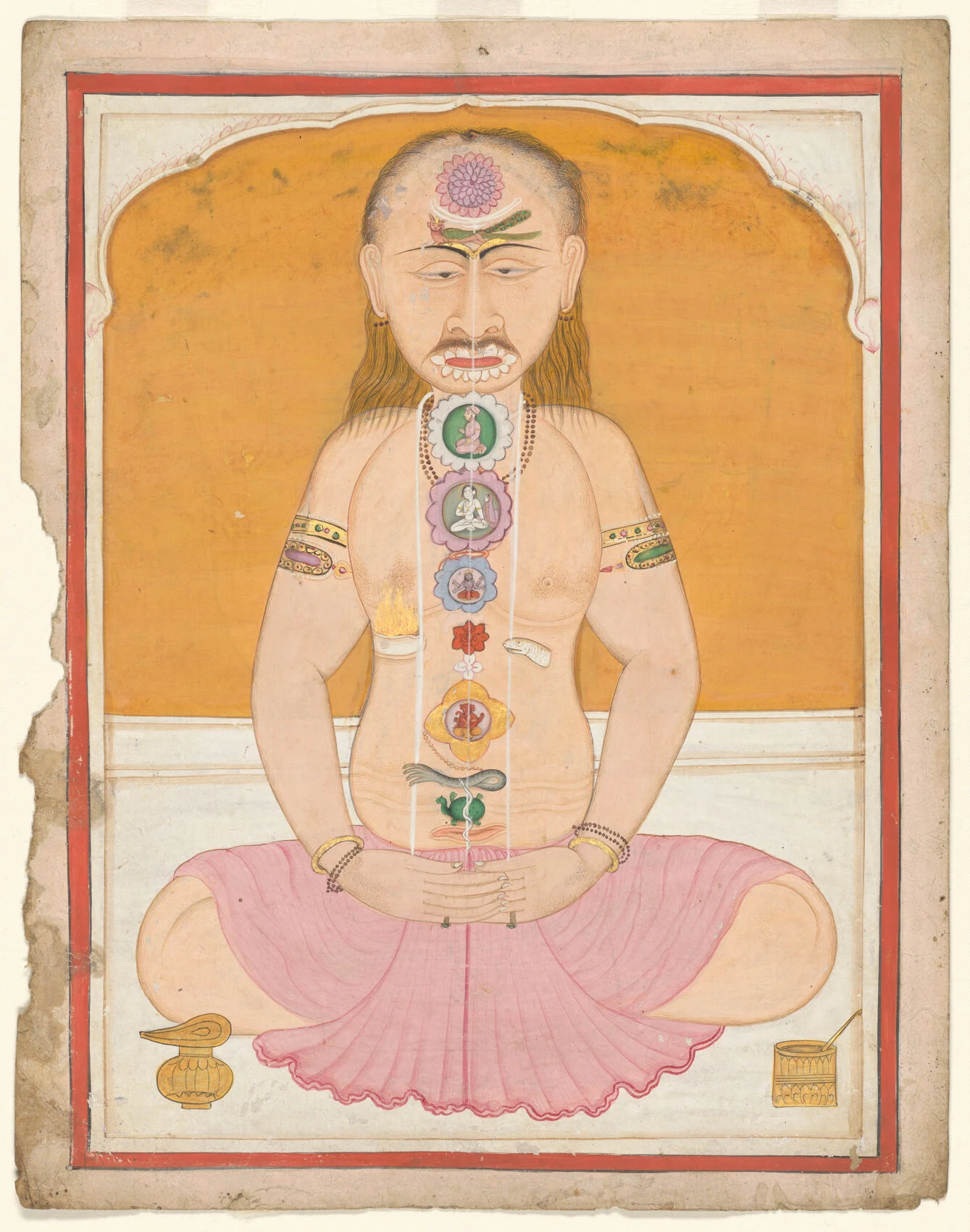
A painted map of subtle-body centres from Wellcome MS Hindi (Indic) beta 511.
Wellcome Collection, MS Hindi (Indic) beta 511, recto. Public Domain Mark. Source image resized by IIIF and converted to WebP; no crop or recolouring. · Image source ↗ · Public Domain
See references (10)
- Pūrṇānanda, Ṣaṭcakranirūpaṇa, preliminary verse, translated by Arthur Avalon
- Pūrṇānanda, Ṣaṭcakranirūpaṇa, verse 40, translated by Arthur Avalon
- Initiation and Its Results, printed p. 15, Reader page 15
- Initiation and Its Results, printed p. 16, Reader page 16
- The Serpent Power, Reader page 330
- The Serpent Power, Reader page 344
- The Serpent Power, Reader page 401
- The Serpent Power, Reader page 413
- The Serpent Power, Reader page 439
- C. W. Leadbeater · The Chakras, chapters I and IV
The six centres and the crown lotus, in order
In Woodroffe’s translation of Pūrṇānanda, four, six, ten, twelve, sixteen and two petals distinguish the six centres from the base to the brow. The lotus above them has a thousand petals. Use the chart to open the individual verse for each label. The verses also describe colours, letters and figures. A petal count is only one part of the image. [2][3][4][5][6][7][8]
Compare the first and last of the Serpent Power plates in the next section. They show how a printed illustration translates some of the written details into an arrangement that can be studied. The historical manuscript later on gives another visual setting. Keep the page of the text with the image when comparing colours or positions. [71][72][38]
See references (10)
- Pūrṇānanda, Ṣaṭcakranirūpaṇa, verse 4, translated by Arthur Avalon
- Pūrṇānanda, Ṣaṭcakranirūpaṇa, verse 14, translated by Arthur Avalon
- Pūrṇānanda, Ṣaṭcakranirūpaṇa, verse 19, translated by Arthur Avalon
- Pūrṇānanda, Ṣaṭcakranirūpaṇa, verse 22, translated by Arthur Avalon
- Pūrṇānanda, Ṣaṭcakranirūpaṇa, verses 28–29, translated by Arthur Avalon
- Pūrṇānanda, Ṣaṭcakranirūpaṇa, verse 32, translated by Arthur Avalon
- Pūrṇānanda, Ṣaṭcakranirūpaṇa, verse 40, translated by Arthur Avalon
- Wellcome Collection, MS Hindi (Indic) beta 511, natural-colour recto
- The Serpent Power, Plate I, Reader page 3
- The Serpent Power, Plate VI, Reader page 410
The Serpent Power in Arthur Avalon’s translation
The Serpent Power presents Pūrṇānanda’s Ṣaṭ-cakra-nirūpaṇa in Arthur Avalon’s English translation, with a commentary by Kālīcaraṇa. The opening verse introduces the six centres as part of a Tantric path to realizing Brahman. Kālīcaraṇa places the subject within a course of discipline and instruction. [56][61]
The lower centres are easy to distinguish by their shapes. Mūlādhāra has four petals and a square earth region. Svādhiṣṭhāna has six petals and a water region marked by a crescent. Maṇipūra has ten petals, with a triangular fire region inside. The petals, element and central figure are different parts of each composition. [57][62][63][64][65]
Anāhata, the heart lotus, has twelve petals. Viśuddha at the throat has sixteen, one for each of the vowels described in the passage. Ājñā has two white petals bearing Ha and Kṣa, with the deity Hākinī inside. The count is only one clue to what the verse asks a reader to picture. [66][58][59]
The crown lotus explains how six can appear beside seven. Verse 40 places the thousand-petalled lotus above the preceding centres, with its head turned downward. The next verse describes a full moon and a triangle inside it. Six counts the principal sequence named in the title. The crown is a further lotus with a distinct place and role. [56][60][67]
In the introduction, Arthur Avalon compares the locations of the lotuses with those of physical nerve plexuses. He keeps the plexus and subtle centre distinct. The verses themselves guide the reader through letters, deities and elements within the petals. [68][69][62][58]
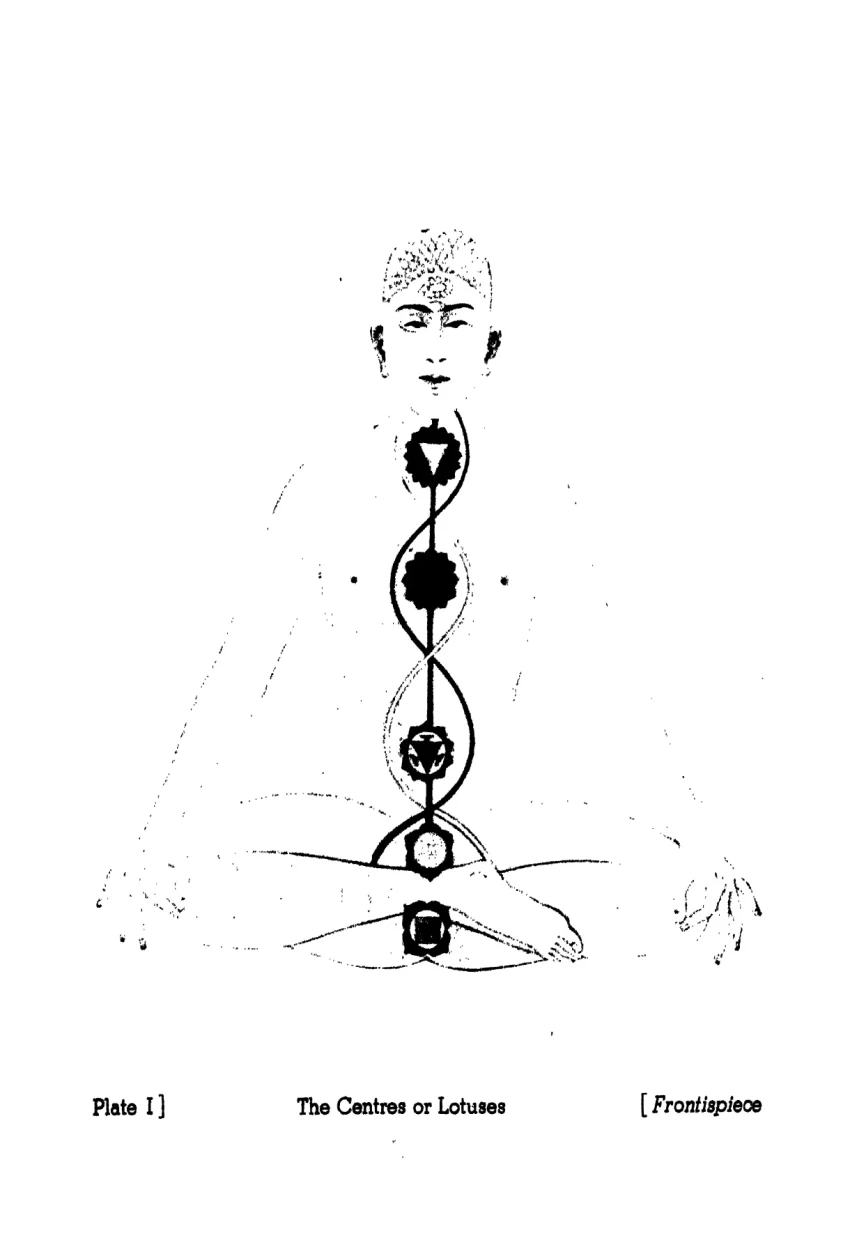
Plate I places the lotuses along a seated figure. The winding lines and central axis make it easier to follow the book’s account of the channels.
Illustrator unrecorded. The Serpent Power, Plate I. Library facsimile, compared with the 1924 second edition. · Image source ↗ · Public Domain
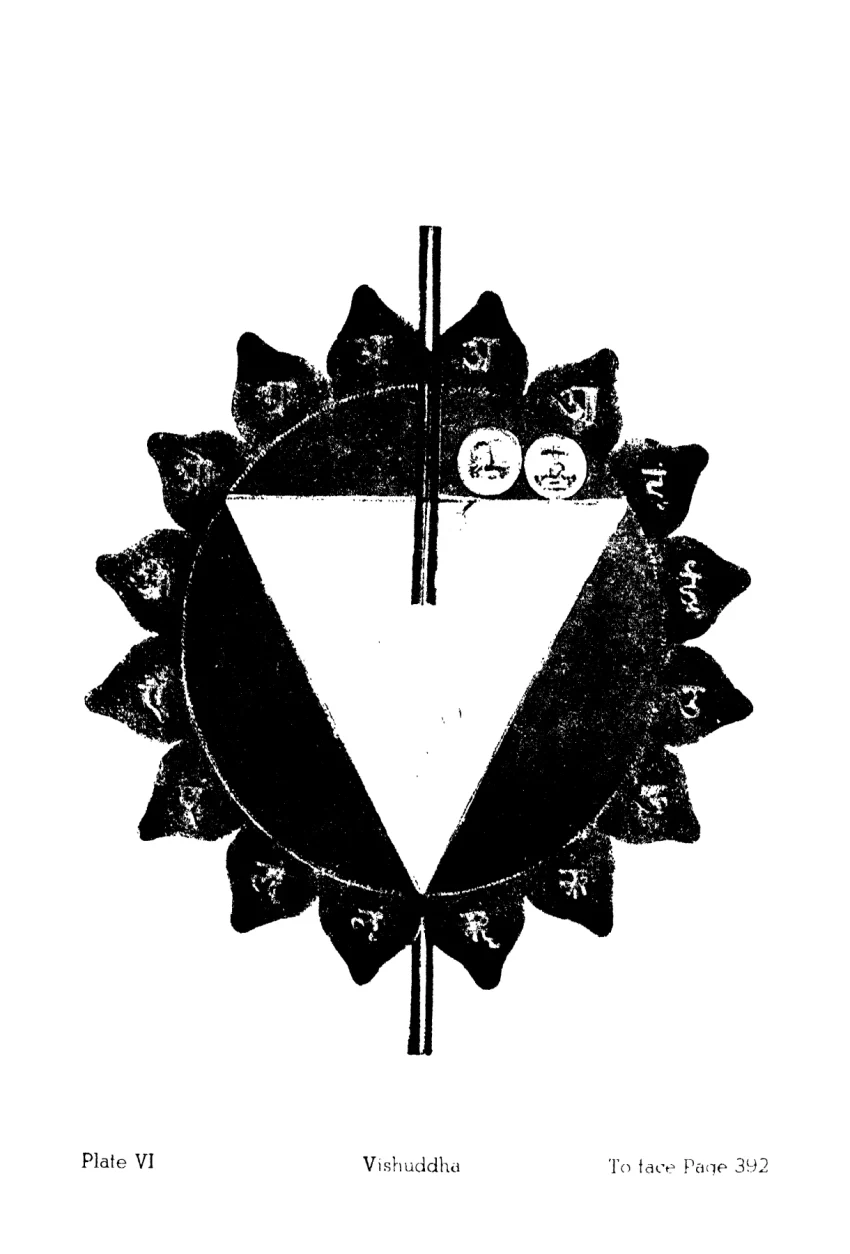
Plate VI shows Viśuddha. Lettered petals surround a pale descending triangle, and a vertical shaft passes through the lotus.
Illustrator unrecorded. The Serpent Power, Plate VI. Library facsimile, compared with the 1924 second edition. · Image source ↗ · Public Domain
- Mūlādhāra
- Four petals surround a square region of earth.
- Svādhiṣṭhāna
- Six petals mark the lotus with a crescent in its water region.
- Maṇipūra
- A triangular fire region occupies the ten-petalled navel lotus.
- Anāhata
- Twelve letters accompany the twelve-petalled heart lotus.
- Viśuddha
- Sixteen vowels fill the petals of the throat lotus.
- Ājñā
- Two white letters occupy the two petals.
- Sahasrāra
- A downward-facing lotus of a thousand petals appears above the six.
See references (14)
- The Serpent Power, Reader page 330
- The Serpent Power, Reader page 344
- The Serpent Power, Reader page 401
- The Serpent Power, Reader page 413
- The Serpent Power, Reader page 439
- The Serpent Power, Reader page 331
- The Serpent Power, Reader page 346
- The Serpent Power, Reader page 371
- The Serpent Power, Reader page 373
- The Serpent Power, Reader page 381
- The Serpent Power, Reader page 387
- The Serpent Power, Reader page 449
- The Serpent Power, Reader page 175
- The Serpent Power, Reader page 176
How Leadbeater’s seven centres differ
In Chapter I of The Chakras, Leadbeater lists basal, splenic, umbilical, cardiac, throat, frontal and coronal centres. Put his splenic centre alongside Pūrṇānanda’s Svādhiṣṭhāna and compare the locations before comparing a count of six divisions. The two positions differ. An equal count on two drawings cannot settle which centre a source is describing. [73][74][3]
At the brow, Pūrṇānanda describes two petals. Leadbeater’s account discusses a frontal centre divided into two parts, each with many subdivisions. These details offer a second way to tell the systems apart. The plates belong to Leadbeater’s description of claimed clairvoyant observations and should be read within that Theosophical work. [7][73]
Colour is especially sensitive to the edition and system. Use the individual descriptions in the verses and the caption of an actual plate before drawing a colour scheme. The presence of brilliant colours in Leadbeater’s picture does not give the colours of Pūrṇānanda’s lotus. [3][6][73][74]
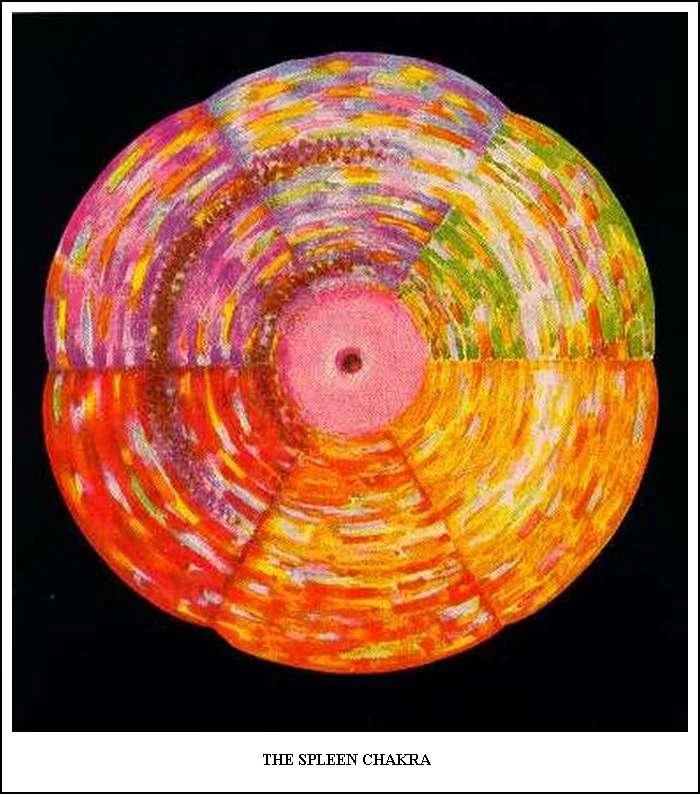
The splenic centre in C. W. Leadbeater’s The Chakras (1927). The colours belong to this Theosophical plate.
C. W. Leadbeater, The Chakras, 1927. Public-domain plate scan via Wikimedia Commons. · Image source ↗ · Public Domain
See references (5)
Another model in a historical ritual manual
A seventeenth-century Tantric ritual manual in the Philadelphia Museum of Art pictures a human figure as practitioner and cosmos. The museum identifies six centres marked by a triangle and five lotuses, connected by three intertwining channels. The manuscript supplies a specific historical example of the body used as a contemplative map. [9]
The museum’s manual gives each centre its place in a picture of body and cosmos. Its triangle, five lotuses and channels compose a specific map. Plate I in The Serpent Power gives the reader another arrangement to compare with it. [9][2][8][71]
Knowledge of the Higher Worlds by Rudolf Steiner
Rudolf Steiner’s Metaxa volume explicitly calls wheels, chakrams and lotus flowers figurative names for proposed spiritual organs. They are described near physical bodily regions, yet their movement and luminosity belong to his account of supersensible perception. [27][28]
The throat centre is assigned sixteen petals, the heart twelve and the stomach ten. The organs are given different tasks: perceiving thought and natural law, sentiments and deeper living forces, or capacities and roles within nature. The account therefore uses the arrangement to differentiate kinds of alleged spiritual knowledge. [28]
Conscious habits are meant to give the centres their appropriate form. Eight functions are associated with the throat centre, while six attributes help develop the heart centre. A footnote acknowledges a likeness to the Buddha’s path but expressly says that the chapter is presenting Spiritual Science rather than teaching Buddhism. [29][30][31][32][33][34][35]
The numerical discrepancy retained in the Bax account also appears in this edition. The initial stomach-centre discussion uses ten petals, while a later list of lower centres names eight, six and four. The consulted Metaxa text therefore does not resolve the earlier discrepancy; both passages must remain visible. [28][36][37]
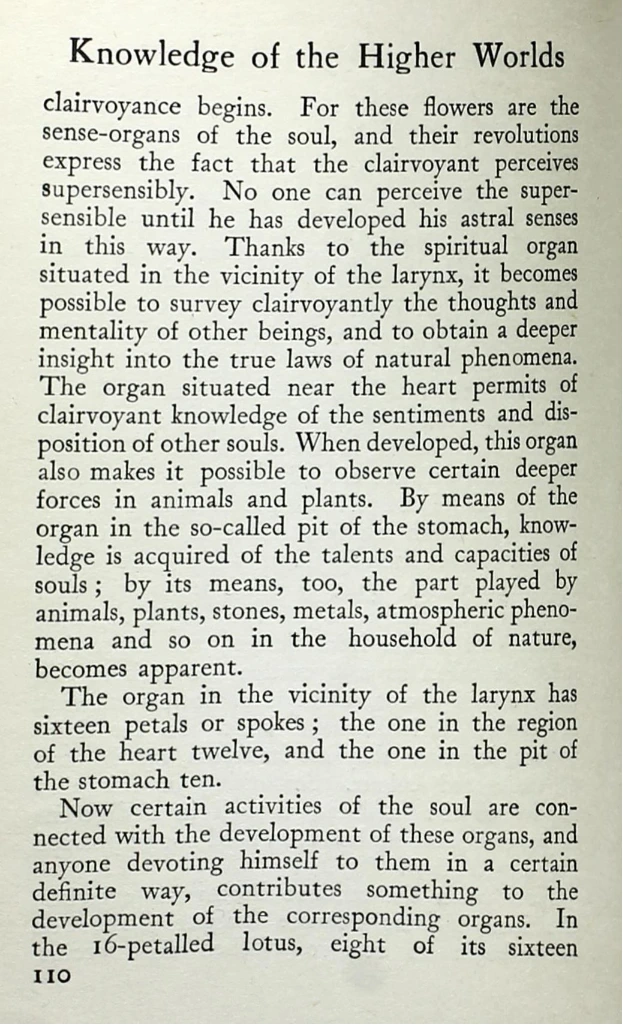
Source facsimile: Knowledge of the Higher Worlds, Reader page 114. The throat, heart and stomach centres are assigned sixteen, twelve and ten petals.
Rudolf Steiner, G. Metaxa translation, edited by Harry Collison. Historical public-domain source facsimile from the exact checksum-verified Library edition. Repository date 1932; the inspected title page is undated. · Image source ↗ · Public Domain
See references (11)
- Knowledge of the Higher Worlds and Its Attainment, Reader page 113
- Knowledge of the Higher Worlds and Its Attainment, Reader page 114
- Knowledge of the Higher Worlds and Its Attainment, Reader page 115
- Knowledge of the Higher Worlds and Its Attainment, Reader page 122
- Knowledge of the Higher Worlds and Its Attainment, Reader page 123
- Knowledge of the Higher Worlds and Its Attainment, Reader page 124
- Knowledge of the Higher Worlds and Its Attainment, Reader page 125
- Knowledge of the Higher Worlds and Its Attainment, Reader page 126
- Knowledge of the Higher Worlds and Its Attainment, Reader page 127
- Knowledge of the Higher Worlds and Its Attainment, Reader page 129
- Knowledge of the Higher Worlds and Its Attainment, Reader page 139
Initiation and Its Results by Rudolf Steiner
Rudolf Steiner’s Initiation and Its Results places the proposed centres in relation to the eyes, throat, heart, stomach and abdomen. He explicitly calls wheels and lotus flowers figurative names. The organs are said to become luminous and move as development proceeds; this movement marks a capacity for spiritual perception. [10][11]
The throat organ is assigned perception of thought and natural law, the heart organ perception of sentiments and deeper forces in living things, and the stomach organ insight into capacities and roles in nature. Later passages distinguish form, spiritual warmth and colour as qualities disclosed through different faculties. [11][12][13][14]
The sixteen-petalled throat lotus and twelve-petalled heart lotus also express a proposed history. Steiner says half their petals arose in a less conscious phase of evolution; conscious cultivation of the remaining half allows a changed coordination. The disciplines concern thinking, speech, conduct and dispositions, rather than turning an imagined flower by force. [15][16][17][12][18][19][20]
The opening pages give the stomach lotus ten petals. A later passage names lower lotuses of eight, six and four. The relation between the earlier ten and the later eight remains unclear in the Bax and Metaxa editions. [15][21][14][22]
Steiner also distinguishes the formation of an organ from its awakening. Further instructions may bring activity, while habits are supposed to give it a proper form. His account allows a developed perception to be misleading when the capacity to judge it has not developed with it. [23][24][21][25]
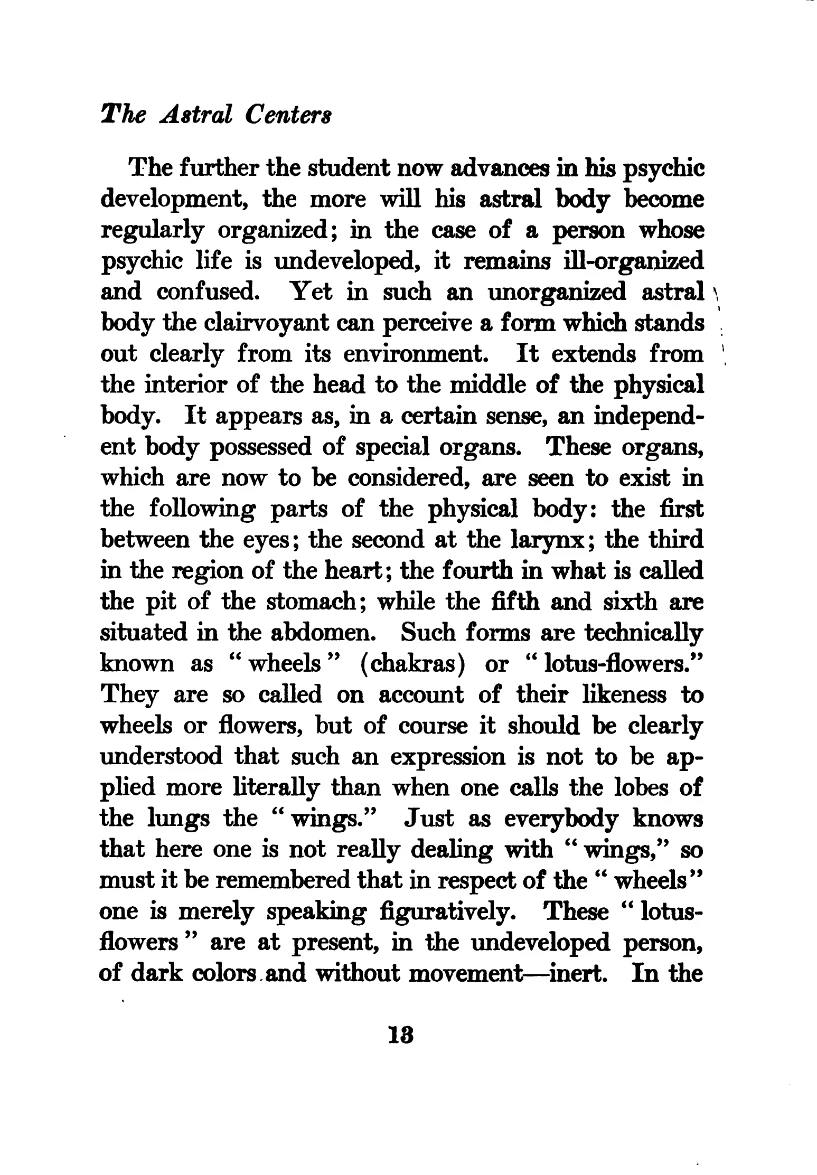
Source facsimile: Initiation and Its Results (1909), printed p. 13, Reader page 13.
Rudolf Steiner, Initiation and Its Results, Clifford Bax translation, First American Edition, 1909. Public-domain historical page from the checksum-verified Library PDF. · Image source ↗ · Public Domain
See references (16)
- Initiation and Its Results, printed p. 13, Reader page 13
- Initiation and Its Results, printed p. 14, Reader page 14
- Initiation and Its Results, printed p. 25, Reader page 25
- Initiation and Its Results, printed p. 26, Reader page 26
- Initiation and Its Results, printed p. 34, Reader page 34
- Initiation and Its Results, printed p. 15, Reader page 15
- Initiation and Its Results, printed p. 16, Reader page 16
- Initiation and Its Results, printed p. 17, Reader page 17
- Initiation and Its Results, printed p. 27, Reader page 27
- Initiation and Its Results, printed p. 28, Reader page 28
- Initiation and Its Results, printed p. 29, Reader page 29
- Initiation and Its Results, printed p. 30, Reader page 30
- Initiation and Its Results, printed p. 42, Reader page 41
- Initiation and Its Results, printed p. 21, Reader page 21
- Initiation and Its Results, printed p. 22, Reader page 22
- Initiation and Its Results, printed p. 39, Reader page 38
Kundalini: An Occult Experience by George S. Arundale
George S. Arundale distinguishes Kundalini from the centres through which he believes it operates. Kundalini is the vivifying Fire; the centres receive and distribute it. He speaks of centres in a human being, then extends the analogy to the Earth and a solar system. The cosmic extension is part of his speculation, rather than a feature that can be assumed for every chakra tradition. [39][40][41]
In his account of public speaking, the heart, throat and head centres become particularly important. He describes different combinations according to temperament and the work being undertaken. Elsewhere he gives the solar plexus a place in the proposed communication between the spine and the centres. His examples focus on function and individual variation, rather than presenting a standardized chart of seven coloured circles. [41][42][43][44][45]
Arundale relates this variation to the Theosophical doctrine of Rays. One centre may dominate an individual’s development while others receive less emphasis; a particular task may call another centre into prominence. He then speculates about centres belonging to nations, religions and landscapes. The extension to collective temperaments remains his conjecture. [46][47][48]
The proposed effect is increased contact between states of consciousness. Arundale values the resulting intuition and a capacity for service more highly than the acquisition of clairvoyance. A centre’s importance in his account therefore concerns its supposed role in development, not simply the production of a striking sensation. [45][49][50][51]
His descriptions of colour also resist a single fixed code. A particular observation associates the Fire with crimson, while the later music chapter declines to name one colour or note that would express Kundalini for everyone. That distinction prevents a contextual observation from being turned into an invariant colour chart. [52][53][54]
See references (16)
- Kundalini: An Occult Experience, Reader page 29
- Kundalini: An Occult Experience, Reader page 30
- Kundalini: An Occult Experience, printed p. 15, Reader page 31
- Kundalini: An Occult Experience, Reader page 32
- Kundalini: An Occult Experience, Reader page 33
- Kundalini: An Occult Experience, Reader page 65
- Kundalini: An Occult Experience, Reader page 66
- Kundalini: An Occult Experience, printed p. 84, Reader page 86
- Kundalini: An Occult Experience, printed p. 85, Reader page 87
- Kundalini: An Occult Experience, Reader page 88
- Kundalini: An Occult Experience, printed p. 65, Reader page 67
- Kundalini: An Occult Experience, Reader page 68
- Kundalini: An Occult Experience, Reader page 69
- Kundalini: An Occult Experience, Reader page 73
- Kundalini: An Occult Experience, Reader page 97
- Kundalini: An Occult Experience, printed p. 96, Reader page 98
How the maps differ
Pūrṇānanda gives the sixteen throat petals vowels. Steiner gives the throat organ a set of capacities that can be cultivated. At the heart, the two texts again share a number and give the lotus different work. Pūrṇānanda supplies an elemental region and deities. Steiner names a quality he likens to warmth. [6][15][16][23][5][12][13][18][20][26][22][4][28][37]
Pūrṇānanda and Steiner both locate the centres in relation to the body. Arundale adds a distinction between Kundalini as the proposed power and the centres that receive or distribute it. Each description belongs to an account of spiritual experience or practice. [2][10][11][40][41][55][46]
Arundale varies the prominence of a centre according to temperament and activity. Pūrṇānanda gives the reader a sequence with different symbols at each point. One explains why a centre might come to the fore in an individual life, and the other asks a practitioner to follow an ordered map. [40][46][47][48][70][58][60][41]
See references (26)
- Pūrṇānanda, Ṣaṭcakranirūpaṇa, verse 4, translated by Arthur Avalon
- Pūrṇānanda, Ṣaṭcakranirūpaṇa, verse 19, translated by Arthur Avalon
- Pūrṇānanda, Ṣaṭcakranirūpaṇa, verse 22, translated by Arthur Avalon
- Pūrṇānanda, Ṣaṭcakranirūpaṇa, verses 28–29, translated by Arthur Avalon
- Initiation and Its Results, printed p. 13, Reader page 13
- Initiation and Its Results, printed p. 14, Reader page 14
- Initiation and Its Results, printed p. 25, Reader page 25
- Initiation and Its Results, printed p. 26, Reader page 26
- Initiation and Its Results, printed p. 15, Reader page 15
- Initiation and Its Results, printed p. 16, Reader page 16
- Initiation and Its Results, printed p. 27, Reader page 27
- Initiation and Its Results, printed p. 29, Reader page 29
- Initiation and Its Results, printed p. 42, Reader page 41
- Initiation and Its Results, printed p. 21, Reader page 21
- Rudolf Steiner Archive: GA 10 publication and translation history
- Knowledge of the Higher Worlds and Its Attainment, Reader page 114
- Knowledge of the Higher Worlds and Its Attainment, Reader page 139
- Kundalini: An Occult Experience, Reader page 30
- Kundalini: An Occult Experience, printed p. 15, Reader page 31
- Kundalini: An Occult Experience, printed p. 84, Reader page 86
- Kundalini: An Occult Experience, printed p. 85, Reader page 87
- Kundalini: An Occult Experience, Reader page 88
- Kundalini: An Occult Experience, printed p. 35, Reader page 51
- The Serpent Power, Reader page 401
- The Serpent Power, Reader page 439
- The Serpent Power, Reader page 340
Read further in the library

Initiation and Its Results
Reading note
The separately titled account draws on exact passages in the consulted Library edition.
The Serpent Power
Reading note
Read the separately attributed account in the exact Library edition, with links to the individual pages cited.

Knowledge of the Higher Worlds and Its Attainment
Reading note
The separately titled account draws on exact passages in the consulted Library edition.

Kundalini: An Occult Experience
Reading note
The separately titled account draws on exact passages in the consulted Library edition.
Sources
See references (74)
- Pūrṇānanda, Ṣaṭcakranirūpaṇa, preliminary verse, translated by Arthur Avalon ↗Pūrṇānanda, Ṣaṭcakranirūpaṇa; Arthur Avalon (John Woodroffe), English translation with Kālīcaraṇa’s commentary in The Serpent Power. Verse reference identifies the primary text, separately from its commentary.Return to text ↑
- Pūrṇānanda, Ṣaṭcakranirūpaṇa, verse 4, translated by Arthur Avalon ↗Pūrṇānanda, Ṣaṭcakranirūpaṇa; Arthur Avalon (John Woodroffe), English translation with Kālīcaraṇa’s commentary in The Serpent Power. Verse reference identifies the primary text, separately from its commentary.Return to text ↑
- Pūrṇānanda, Ṣaṭcakranirūpaṇa, verse 14, translated by Arthur Avalon ↗Pūrṇānanda, Ṣaṭcakranirūpaṇa; Arthur Avalon (John Woodroffe), English translation with Kālīcaraṇa’s commentary in The Serpent Power. Verse reference identifies the primary text, separately from its commentary.Return to text ↑
- Pūrṇānanda, Ṣaṭcakranirūpaṇa, verse 19, translated by Arthur Avalon ↗Pūrṇānanda, Ṣaṭcakranirūpaṇa; Arthur Avalon (John Woodroffe), English translation with Kālīcaraṇa’s commentary in The Serpent Power. Verse reference identifies the primary text, separately from its commentary.Return to text ↑
- Pūrṇānanda, Ṣaṭcakranirūpaṇa, verse 22, translated by Arthur Avalon ↗Pūrṇānanda, Ṣaṭcakranirūpaṇa; Arthur Avalon (John Woodroffe), English translation with Kālīcaraṇa’s commentary in The Serpent Power. Verse reference identifies the primary text, separately from its commentary.Return to text ↑
- Pūrṇānanda, Ṣaṭcakranirūpaṇa, verses 28–29, translated by Arthur Avalon ↗Pūrṇānanda, Ṣaṭcakranirūpaṇa; Arthur Avalon (John Woodroffe), English translation with Kālīcaraṇa’s commentary in The Serpent Power. Verse reference identifies the primary text, separately from its commentary.Return to text ↑
- Pūrṇānanda, Ṣaṭcakranirūpaṇa, verse 32, translated by Arthur Avalon ↗Pūrṇānanda, Ṣaṭcakranirūpaṇa; Arthur Avalon (John Woodroffe), English translation with Kālīcaraṇa’s commentary in The Serpent Power. Verse reference identifies the primary text, separately from its commentary.Return to text ↑
- Pūrṇānanda, Ṣaṭcakranirūpaṇa, verse 40, translated by Arthur Avalon ↗Pūrṇānanda, Ṣaṭcakranirūpaṇa; Arthur Avalon (John Woodroffe), English translation with Kālīcaraṇa’s commentary in The Serpent Power. Verse reference identifies the primary text, separately from its commentary.Return to text ↑
- Philadelphia Museum of Art, Tantric Ritual Manual with Purusa-cakra, 17th century, object 88528 ↗Official museum record describing a triangle, five lotuses and three channels. Used as evidence for this particular manuscript’s visual model. Its image is not reproduced because unrestricted reuse was not established.Return to text ↑
- Initiation and Its Results, printed p. 13, Reader page 13Rudolf Steiner, Initiation and Its Results: A Sequel to The Way of Initiation, translated by Clifford Bax. First American Edition, 1909. Macoy Publishing and Masonic Supply Co., New York; Max Gysi, London. Claims of clairvoyant perception and subtle organs remain attributed. References identify the exact consulted Library edition.Read this page in Initiation and Its Results ↗Return to text ↑
- Initiation and Its Results, printed p. 14, Reader page 14Rudolf Steiner, Initiation and Its Results: A Sequel to The Way of Initiation, translated by Clifford Bax. First American Edition, 1909. Macoy Publishing and Masonic Supply Co., New York; Max Gysi, London. Claims of clairvoyant perception and subtle organs remain attributed. References identify the exact consulted Library edition.Read this page in Initiation and Its Results ↗Return to text ↑
- Initiation and Its Results, printed p. 25, Reader page 25Rudolf Steiner, Initiation and Its Results: A Sequel to The Way of Initiation, translated by Clifford Bax. First American Edition, 1909. Macoy Publishing and Masonic Supply Co., New York; Max Gysi, London. Claims of clairvoyant perception and subtle organs remain attributed. References identify the exact consulted Library edition.Read this page in Initiation and Its Results ↗Return to text ↑
- Initiation and Its Results, printed p. 26, Reader page 26Rudolf Steiner, Initiation and Its Results: A Sequel to The Way of Initiation, translated by Clifford Bax. First American Edition, 1909. Macoy Publishing and Masonic Supply Co., New York; Max Gysi, London. Claims of clairvoyant perception and subtle organs remain attributed. References identify the exact consulted Library edition.Read this page in Initiation and Its Results ↗Return to text ↑
- Initiation and Its Results, printed p. 34, Reader page 34Rudolf Steiner, Initiation and Its Results: A Sequel to The Way of Initiation, translated by Clifford Bax. First American Edition, 1909. Macoy Publishing and Masonic Supply Co., New York; Max Gysi, London. Claims of clairvoyant perception and subtle organs remain attributed. References identify the exact consulted Library edition.Read this page in Initiation and Its Results ↗Return to text ↑
- Initiation and Its Results, printed p. 15, Reader page 15Rudolf Steiner, Initiation and Its Results: A Sequel to The Way of Initiation, translated by Clifford Bax. First American Edition, 1909. Macoy Publishing and Masonic Supply Co., New York; Max Gysi, London. Claims of clairvoyant perception and subtle organs remain attributed. References identify the exact consulted Library edition.Read this page in Initiation and Its Results ↗Return to text ↑
- Initiation and Its Results, printed p. 16, Reader page 16Rudolf Steiner, Initiation and Its Results: A Sequel to The Way of Initiation, translated by Clifford Bax. First American Edition, 1909. Macoy Publishing and Masonic Supply Co., New York; Max Gysi, London. Claims of clairvoyant perception and subtle organs remain attributed. References identify the exact consulted Library edition.Read this page in Initiation and Its Results ↗Return to text ↑
- Initiation and Its Results, printed p. 17, Reader page 17Rudolf Steiner, Initiation and Its Results: A Sequel to The Way of Initiation, translated by Clifford Bax. First American Edition, 1909. Macoy Publishing and Masonic Supply Co., New York; Max Gysi, London. Claims of clairvoyant perception and subtle organs remain attributed. References identify the exact consulted Library edition.Read this page in Initiation and Its Results ↗Return to text ↑
- Initiation and Its Results, printed p. 27, Reader page 27Rudolf Steiner, Initiation and Its Results: A Sequel to The Way of Initiation, translated by Clifford Bax. First American Edition, 1909. Macoy Publishing and Masonic Supply Co., New York; Max Gysi, London. Claims of clairvoyant perception and subtle organs remain attributed. References identify the exact consulted Library edition.Read this page in Initiation and Its Results ↗Return to text ↑
- Initiation and Its Results, printed p. 28, Reader page 28Rudolf Steiner, Initiation and Its Results: A Sequel to The Way of Initiation, translated by Clifford Bax. First American Edition, 1909. Macoy Publishing and Masonic Supply Co., New York; Max Gysi, London. Claims of clairvoyant perception and subtle organs remain attributed. References identify the exact consulted Library edition.Read this page in Initiation and Its Results ↗Return to text ↑
- Initiation and Its Results, printed p. 29, Reader page 29Rudolf Steiner, Initiation and Its Results: A Sequel to The Way of Initiation, translated by Clifford Bax. First American Edition, 1909. Macoy Publishing and Masonic Supply Co., New York; Max Gysi, London. Claims of clairvoyant perception and subtle organs remain attributed. References identify the exact consulted Library edition.Read this page in Initiation and Its Results ↗Return to text ↑
- Initiation and Its Results, printed p. 30, Reader page 30Rudolf Steiner, Initiation and Its Results: A Sequel to The Way of Initiation, translated by Clifford Bax. First American Edition, 1909. Macoy Publishing and Masonic Supply Co., New York; Max Gysi, London. Claims of clairvoyant perception and subtle organs remain attributed. References identify the exact consulted Library edition.Read this page in Initiation and Its Results ↗Return to text ↑
- Initiation and Its Results, printed p. 42, Reader page 41Rudolf Steiner, Initiation and Its Results: A Sequel to The Way of Initiation, translated by Clifford Bax. First American Edition, 1909. Macoy Publishing and Masonic Supply Co., New York; Max Gysi, London. Claims of clairvoyant perception and subtle organs remain attributed. References identify the exact consulted Library edition.Read this page in Initiation and Its Results ↗Return to text ↑
- Initiation and Its Results, printed p. 21, Reader page 21Rudolf Steiner, Initiation and Its Results: A Sequel to The Way of Initiation, translated by Clifford Bax. First American Edition, 1909. Macoy Publishing and Masonic Supply Co., New York; Max Gysi, London. Claims of clairvoyant perception and subtle organs remain attributed. References identify the exact consulted Library edition.Read this page in Initiation and Its Results ↗Return to text ↑
- Initiation and Its Results, printed p. 22, Reader page 22Rudolf Steiner, Initiation and Its Results: A Sequel to The Way of Initiation, translated by Clifford Bax. First American Edition, 1909. Macoy Publishing and Masonic Supply Co., New York; Max Gysi, London. Claims of clairvoyant perception and subtle organs remain attributed. References identify the exact consulted Library edition.Read this page in Initiation and Its Results ↗Return to text ↑
- Initiation and Its Results, printed p. 39, Reader page 38Rudolf Steiner, Initiation and Its Results: A Sequel to The Way of Initiation, translated by Clifford Bax. First American Edition, 1909. Macoy Publishing and Masonic Supply Co., New York; Max Gysi, London. Claims of clairvoyant perception and subtle organs remain attributed. References identify the exact consulted Library edition.Read this page in Initiation and Its Results ↗Return to text ↑
- Rudolf Steiner Archive: GA 10 publication and translation history ↗Steiner Online Library, Rudolf Steiner Archive, GA 10 bibliography. Used only for publication relationships, not independent confirmation of spiritual claims.Return to text ↑
- Knowledge of the Higher Worlds and Its Attainment, Reader page 113Rudolf Steiner, Knowledge of the Higher Worlds and Its Attainment, authorized English translation by G. Metaxa, edited by Harry Collison, Anthroposophic Press, New York City. Exact Library edition IMJ-0513-E001. No publication year is visible on the inspected title page; the repository assigns 1932. Claims of supersensible perception remain attributed to Steiner.Read this page in Knowledge of the Higher Worlds and Its Attainment ↗Return to text ↑
- Knowledge of the Higher Worlds and Its Attainment, Reader page 114Rudolf Steiner, Knowledge of the Higher Worlds and Its Attainment, authorized English translation by G. Metaxa, edited by Harry Collison, Anthroposophic Press, New York City. Exact Library edition IMJ-0513-E001. No publication year is visible on the inspected title page; the repository assigns 1932. Claims of supersensible perception remain attributed to Steiner.Read this page in Knowledge of the Higher Worlds and Its Attainment ↗Return to text ↑
- Knowledge of the Higher Worlds and Its Attainment, Reader page 115Rudolf Steiner, Knowledge of the Higher Worlds and Its Attainment, authorized English translation by G. Metaxa, edited by Harry Collison, Anthroposophic Press, New York City. Exact Library edition IMJ-0513-E001. No publication year is visible on the inspected title page; the repository assigns 1932. Claims of supersensible perception remain attributed to Steiner.Read this page in Knowledge of the Higher Worlds and Its Attainment ↗Return to text ↑
- Knowledge of the Higher Worlds and Its Attainment, Reader page 122Rudolf Steiner, Knowledge of the Higher Worlds and Its Attainment, authorized English translation by G. Metaxa, edited by Harry Collison, Anthroposophic Press, New York City. Exact Library edition IMJ-0513-E001. No publication year is visible on the inspected title page; the repository assigns 1932. Claims of supersensible perception remain attributed to Steiner.Read this page in Knowledge of the Higher Worlds and Its Attainment ↗Return to text ↑
- Knowledge of the Higher Worlds and Its Attainment, Reader page 123Rudolf Steiner, Knowledge of the Higher Worlds and Its Attainment, authorized English translation by G. Metaxa, edited by Harry Collison, Anthroposophic Press, New York City. Exact Library edition IMJ-0513-E001. No publication year is visible on the inspected title page; the repository assigns 1932. Claims of supersensible perception remain attributed to Steiner.Read this page in Knowledge of the Higher Worlds and Its Attainment ↗Return to text ↑
- Knowledge of the Higher Worlds and Its Attainment, Reader page 124Rudolf Steiner, Knowledge of the Higher Worlds and Its Attainment, authorized English translation by G. Metaxa, edited by Harry Collison, Anthroposophic Press, New York City. Exact Library edition IMJ-0513-E001. No publication year is visible on the inspected title page; the repository assigns 1932. Claims of supersensible perception remain attributed to Steiner.Read this page in Knowledge of the Higher Worlds and Its Attainment ↗Return to text ↑
- Knowledge of the Higher Worlds and Its Attainment, Reader page 125Rudolf Steiner, Knowledge of the Higher Worlds and Its Attainment, authorized English translation by G. Metaxa, edited by Harry Collison, Anthroposophic Press, New York City. Exact Library edition IMJ-0513-E001. No publication year is visible on the inspected title page; the repository assigns 1932. Claims of supersensible perception remain attributed to Steiner.Read this page in Knowledge of the Higher Worlds and Its Attainment ↗Return to text ↑
- Knowledge of the Higher Worlds and Its Attainment, Reader page 126Rudolf Steiner, Knowledge of the Higher Worlds and Its Attainment, authorized English translation by G. Metaxa, edited by Harry Collison, Anthroposophic Press, New York City. Exact Library edition IMJ-0513-E001. No publication year is visible on the inspected title page; the repository assigns 1932. Claims of supersensible perception remain attributed to Steiner.Read this page in Knowledge of the Higher Worlds and Its Attainment ↗Return to text ↑
- Knowledge of the Higher Worlds and Its Attainment, Reader page 127Rudolf Steiner, Knowledge of the Higher Worlds and Its Attainment, authorized English translation by G. Metaxa, edited by Harry Collison, Anthroposophic Press, New York City. Exact Library edition IMJ-0513-E001. No publication year is visible on the inspected title page; the repository assigns 1932. Claims of supersensible perception remain attributed to Steiner.Read this page in Knowledge of the Higher Worlds and Its Attainment ↗Return to text ↑
- Knowledge of the Higher Worlds and Its Attainment, Reader page 129Rudolf Steiner, Knowledge of the Higher Worlds and Its Attainment, authorized English translation by G. Metaxa, edited by Harry Collison, Anthroposophic Press, New York City. Exact Library edition IMJ-0513-E001. No publication year is visible on the inspected title page; the repository assigns 1932. Claims of supersensible perception remain attributed to Steiner.Read this page in Knowledge of the Higher Worlds and Its Attainment ↗Return to text ↑
- Knowledge of the Higher Worlds and Its Attainment, Reader page 139Rudolf Steiner, Knowledge of the Higher Worlds and Its Attainment, authorized English translation by G. Metaxa, edited by Harry Collison, Anthroposophic Press, New York City. Exact Library edition IMJ-0513-E001. No publication year is visible on the inspected title page; the repository assigns 1932. Claims of supersensible perception remain attributed to Steiner.Read this page in Knowledge of the Higher Worlds and Its Attainment ↗Return to text ↑
- Wellcome Collection, MS Hindi (Indic) beta 511, natural-colour recto ↗Wellcome Collection. Current collection catalogue and IIIF manifest designate this digital image Public Domain Mark; creator and date are not supplied in the consulted catalogue.Return to text ↑
- Kundalini: An Occult Experience, Reader page 29George S. Arundale, Kundalini: An Occult Experience, The Theosophical Publishing House, Adyar, Madras, India, 1938. Consulted Library edition IMJ-0227-E001.Read this page in Kundalini: An Occult Experience ↗Return to text ↑
- Kundalini: An Occult Experience, Reader page 30George S. Arundale, Kundalini: An Occult Experience, The Theosophical Publishing House, Adyar, Madras, India, 1938. Consulted Library edition IMJ-0227-E001.Read this page in Kundalini: An Occult Experience ↗Return to text ↑
- Kundalini: An Occult Experience, printed p. 15, Reader page 31George S. Arundale, Kundalini: An Occult Experience, The Theosophical Publishing House, Adyar, Madras, India, 1938. Consulted Library edition IMJ-0227-E001.Read this page in Kundalini: An Occult Experience ↗Return to text ↑
- Kundalini: An Occult Experience, Reader page 32George S. Arundale, Kundalini: An Occult Experience, The Theosophical Publishing House, Adyar, Madras, India, 1938. Consulted Library edition IMJ-0227-E001.Read this page in Kundalini: An Occult Experience ↗Return to text ↑
- Kundalini: An Occult Experience, Reader page 33George S. Arundale, Kundalini: An Occult Experience, The Theosophical Publishing House, Adyar, Madras, India, 1938. Consulted Library edition IMJ-0227-E001.Read this page in Kundalini: An Occult Experience ↗Return to text ↑
- Kundalini: An Occult Experience, Reader page 65George S. Arundale, Kundalini: An Occult Experience, The Theosophical Publishing House, Adyar, Madras, India, 1938. Consulted Library edition IMJ-0227-E001.Read this page in Kundalini: An Occult Experience ↗Return to text ↑
- Kundalini: An Occult Experience, Reader page 66George S. Arundale, Kundalini: An Occult Experience, The Theosophical Publishing House, Adyar, Madras, India, 1938. Consulted Library edition IMJ-0227-E001.Read this page in Kundalini: An Occult Experience ↗Return to text ↑
- Kundalini: An Occult Experience, printed p. 84, Reader page 86George S. Arundale, Kundalini: An Occult Experience, The Theosophical Publishing House, Adyar, Madras, India, 1938. Consulted Library edition IMJ-0227-E001.Read this page in Kundalini: An Occult Experience ↗Return to text ↑
- Kundalini: An Occult Experience, printed p. 85, Reader page 87George S. Arundale, Kundalini: An Occult Experience, The Theosophical Publishing House, Adyar, Madras, India, 1938. Consulted Library edition IMJ-0227-E001.Read this page in Kundalini: An Occult Experience ↗Return to text ↑
- Kundalini: An Occult Experience, Reader page 88George S. Arundale, Kundalini: An Occult Experience, The Theosophical Publishing House, Adyar, Madras, India, 1938. Consulted Library edition IMJ-0227-E001.Read this page in Kundalini: An Occult Experience ↗Return to text ↑
- Kundalini: An Occult Experience, printed p. 65, Reader page 67George S. Arundale, Kundalini: An Occult Experience, The Theosophical Publishing House, Adyar, Madras, India, 1938. Consulted Library edition IMJ-0227-E001.Read this page in Kundalini: An Occult Experience ↗Return to text ↑
- Kundalini: An Occult Experience, Reader page 68George S. Arundale, Kundalini: An Occult Experience, The Theosophical Publishing House, Adyar, Madras, India, 1938. Consulted Library edition IMJ-0227-E001.Read this page in Kundalini: An Occult Experience ↗Return to text ↑
- Kundalini: An Occult Experience, Reader page 69George S. Arundale, Kundalini: An Occult Experience, The Theosophical Publishing House, Adyar, Madras, India, 1938. Consulted Library edition IMJ-0227-E001.Read this page in Kundalini: An Occult Experience ↗Return to text ↑
- Kundalini: An Occult Experience, Reader page 73George S. Arundale, Kundalini: An Occult Experience, The Theosophical Publishing House, Adyar, Madras, India, 1938. Consulted Library edition IMJ-0227-E001.Read this page in Kundalini: An Occult Experience ↗Return to text ↑
- Kundalini: An Occult Experience, Reader page 97George S. Arundale, Kundalini: An Occult Experience, The Theosophical Publishing House, Adyar, Madras, India, 1938. Consulted Library edition IMJ-0227-E001.Read this page in Kundalini: An Occult Experience ↗Return to text ↑
- Kundalini: An Occult Experience, printed p. 96, Reader page 98George S. Arundale, Kundalini: An Occult Experience, The Theosophical Publishing House, Adyar, Madras, India, 1938. Consulted Library edition IMJ-0227-E001.Read this page in Kundalini: An Occult Experience ↗Return to text ↑
- Kundalini: An Occult Experience, printed p. 35, Reader page 51George S. Arundale, Kundalini: An Occult Experience, The Theosophical Publishing House, Adyar, Madras, India, 1938. Consulted Library edition IMJ-0227-E001.Read this page in Kundalini: An Occult Experience ↗Return to text ↑
- The Serpent Power, Reader page 330Pūrṇānanda, Ṣaṭ-cakra-nirūpaṇa, with Kālīcaraṇa’s commentary, translated by Arthur Avalon in The Serpent Power. Exact Library edition IMJ-0608-E001.Read this page in The Serpent Power ↗Return to text ↑
- The Serpent Power, Reader page 344Pūrṇānanda, Ṣaṭ-cakra-nirūpaṇa, with Kālīcaraṇa’s commentary, translated by Arthur Avalon in The Serpent Power. Exact Library edition IMJ-0608-E001.Read this page in The Serpent Power ↗Return to text ↑
- The Serpent Power, Reader page 401Pūrṇānanda, Ṣaṭ-cakra-nirūpaṇa, with Kālīcaraṇa’s commentary, translated by Arthur Avalon in The Serpent Power. Exact Library edition IMJ-0608-E001.Read this page in The Serpent Power ↗Return to text ↑
- The Serpent Power, Reader page 413Pūrṇānanda, Ṣaṭ-cakra-nirūpaṇa, with Kālīcaraṇa’s commentary, translated by Arthur Avalon in The Serpent Power. Exact Library edition IMJ-0608-E001.Read this page in The Serpent Power ↗Return to text ↑
- The Serpent Power, Reader page 439Pūrṇānanda, Ṣaṭ-cakra-nirūpaṇa, with Kālīcaraṇa’s commentary, translated by Arthur Avalon in The Serpent Power. Exact Library edition IMJ-0608-E001.Read this page in The Serpent Power ↗Return to text ↑
- The Serpent Power, Reader page 331Pūrṇānanda, Ṣaṭ-cakra-nirūpaṇa, with Kālīcaraṇa’s commentary, translated by Arthur Avalon in The Serpent Power. Exact Library edition IMJ-0608-E001.Read this page in The Serpent Power ↗Return to text ↑
- The Serpent Power, Reader page 346Pūrṇānanda, Ṣaṭ-cakra-nirūpaṇa, with Kālīcaraṇa’s commentary, translated by Arthur Avalon in The Serpent Power. Exact Library edition IMJ-0608-E001.Read this page in The Serpent Power ↗Return to text ↑
- The Serpent Power, Reader page 371Pūrṇānanda, Ṣaṭ-cakra-nirūpaṇa, with Kālīcaraṇa’s commentary, translated by Arthur Avalon in The Serpent Power. Exact Library edition IMJ-0608-E001.Read this page in The Serpent Power ↗Return to text ↑
- The Serpent Power, Reader page 373Pūrṇānanda, Ṣaṭ-cakra-nirūpaṇa, with Kālīcaraṇa’s commentary, translated by Arthur Avalon in The Serpent Power. Exact Library edition IMJ-0608-E001.Read this page in The Serpent Power ↗Return to text ↑
- The Serpent Power, Reader page 381Pūrṇānanda, Ṣaṭ-cakra-nirūpaṇa, with Kālīcaraṇa’s commentary, translated by Arthur Avalon in The Serpent Power. Exact Library edition IMJ-0608-E001.Read this page in The Serpent Power ↗Return to text ↑
- The Serpent Power, Reader page 387Pūrṇānanda, Ṣaṭ-cakra-nirūpaṇa, with Kālīcaraṇa’s commentary, translated by Arthur Avalon in The Serpent Power. Exact Library edition IMJ-0608-E001.Read this page in The Serpent Power ↗Return to text ↑
- The Serpent Power, Reader page 449Pūrṇānanda, Ṣaṭ-cakra-nirūpaṇa, with Kālīcaraṇa’s commentary, translated by Arthur Avalon in The Serpent Power. Exact Library edition IMJ-0608-E001.Read this page in The Serpent Power ↗Return to text ↑
- The Serpent Power, Reader page 175Arthur Avalon (Sir John Woodroffe), The Serpent Power, fifth enlarged edition, Ganesh & Co., Madras, 1953. Exact Library edition IMJ-0608-E001.Read this page in The Serpent Power ↗Return to text ↑
- The Serpent Power, Reader page 176Arthur Avalon (Sir John Woodroffe), The Serpent Power, fifth enlarged edition, Ganesh & Co., Madras, 1953. Exact Library edition IMJ-0608-E001.Read this page in The Serpent Power ↗Return to text ↑
- The Serpent Power, Reader page 340Pūrṇānanda, Ṣaṭ-cakra-nirūpaṇa, with Kālīcaraṇa’s commentary, translated by Arthur Avalon in The Serpent Power. Exact Library edition IMJ-0608-E001.Read this page in The Serpent Power ↗Return to text ↑
- The Serpent Power, Plate I, Reader page 3Arthur Avalon (Sir John Woodroffe), The Serpent Power, fifth enlarged edition, Ganesh & Co., Madras, 1953. Exact Library edition IMJ-0608-E001.Read this page in The Serpent Power ↗Return to text ↑
- The Serpent Power, Plate VI, Reader page 410Arthur Avalon (Sir John Woodroffe), The Serpent Power, fifth enlarged edition, Ganesh & Co., Madras, 1953. Exact Library edition IMJ-0608-E001.Read this page in The Serpent Power ↗Return to text ↑
- C. W. Leadbeater · The Chakras, chapters I and IV ↗C. W. Leadbeater, The Chakras (1927), the list of centres, plates and comparison with Indian texts.Return to text ↑
- Leadbeater’s splenic centre plate, 1927 ↗Public-domain scan of the original illustration.Return to text ↑