Anāhata Chakra
Anāhata is the twelve-petalled heart lotus. Learn why its name means unstruck and how air, sound and deity shape the image.
In this article
Understanding the concept
Anāhata is the twelve-petalled heart lotus in Pūrṇānanda’s account of the chakras. The name means unstruck. Kālīcaraṇa explains it through a sound that arises without two things striking each other. [5][6]
The Serpent Power in Arthur Avalon’s translation
Arthur Avalon’s translation in The Serpent Power describes a bright lotus with twelve letters and a smoky, six-cornered region of air. Pūrṇānanda likens the lotus to a wish-granting tree. Kālīcaraṇa takes the image to mean that it can give more than the practitioner asks for. [5][6]
The seed syllable of air, Yaṃ, rides a black antelope in the next verse. Another figure grants blessings and dispels fear. The goddess Kākinī appears with a noose and a skull among her attributes. [7][8]
Plate V shows two interlocking triangles within the petals. Their six corners make it easy to pick out the region of air in the drawing. [5][6]
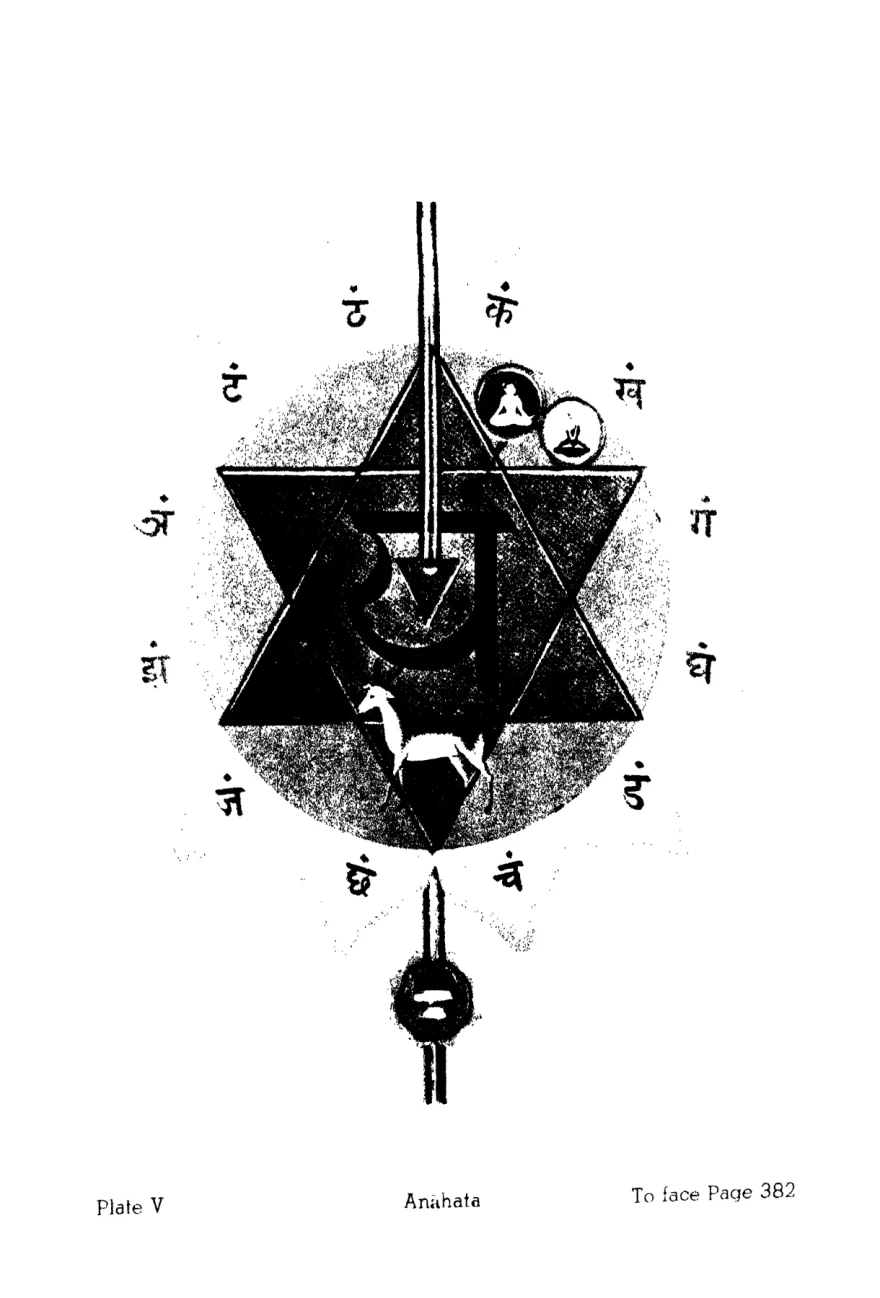
Plate V. In Anāhata, two triangles give the region of air its six corners. The mount and the ring of letters are visible in the same design.
Illustrator unrecorded. The Serpent Power, Plate V. Library facsimile, compared with the 1924 second edition. · Image source ↗ · Public Domain
Initiation and Its Results by Rudolf Steiner
Rudolf Steiner also describes a twelve-petalled lotus near the heart. He says six petals were formed earlier and connects cultivating the other six with a new kind of perception. A thought that already has a shape might also be experienced as warmth or chill. [2][3][4]
Unstruck sound and perceived warmth
Kālīcaraṇa uses unstruck sound to explain the heart lotus’s name. Steiner uses the same location and count of petals to describe a faculty that, in his account, can perceive qualities such as warmth. [5][6][2][3][4]
In the library
The Serpent Power
Reading note
Separately attributed primary Library account, cited on exact verified Reader leaves.

Initiation and Its Results
Reading note
Separately attributed primary Library account, cited on exact verified Reader leaves.
Sources
See references (8)
- The Serpent Power, Plate V, Reader page 399Illustrator unrecorded. The Serpent Power, Plate V. Library facsimile, compared with the 1924 second edition.Read this page in The Serpent Power ↗
- Initiation and Its Results, printed p. 25, Reader page 25Rudolf Steiner, Initiation and Its Results: A Sequel to The Way of Initiation, translated by Clifford Bax. First American Edition, 1909. Macoy Publishing and Masonic Supply Co., New York; Max Gysi, London. Claims of clairvoyant perception and subtle organs remain attributed. References identify the exact consulted Library edition.Read this page in Initiation and Its Results ↗
- Initiation and Its Results, printed p. 26, Reader page 26Rudolf Steiner, Initiation and Its Results: A Sequel to The Way of Initiation, translated by Clifford Bax. First American Edition, 1909. Macoy Publishing and Masonic Supply Co., New York; Max Gysi, London. Claims of clairvoyant perception and subtle organs remain attributed. References identify the exact consulted Library edition.Read this page in Initiation and Its Results ↗
- Initiation and Its Results, printed p. 27, Reader page 27Rudolf Steiner, Initiation and Its Results: A Sequel to The Way of Initiation, translated by Clifford Bax. First American Edition, 1909. Macoy Publishing and Masonic Supply Co., New York; Max Gysi, London. Claims of clairvoyant perception and subtle organs remain attributed. References identify the exact consulted Library edition.Read this page in Initiation and Its Results ↗
- The Serpent Power, printed p. 371, Reader page 387Arthur Avalon (Sir John Woodroffe), The Serpent Power, fifth enlarged edition, Ganesh & Co., Madras, 1953. Includes Pūrṇānanda’s Ṣaṭ-cakra-nirūpaṇa, Pādukā-pañcaka and Kālīcaraṇa’s commentary. Exact Library edition IMJ-0608-E001.Read this page in The Serpent Power ↗
- The Serpent Power, printed p. 372, Reader page 388Arthur Avalon (Sir John Woodroffe), The Serpent Power, fifth enlarged edition, Ganesh & Co., Madras, 1953. Includes Pūrṇānanda’s Ṣaṭ-cakra-nirūpaṇa, Pādukā-pañcaka and Kālīcaraṇa’s commentary. Exact Library edition IMJ-0608-E001.Read this page in The Serpent Power ↗
- The Serpent Power, printed p. 373, Reader page 389Arthur Avalon (Sir John Woodroffe), The Serpent Power, fifth enlarged edition, Ganesh & Co., Madras, 1953. Includes Pūrṇānanda’s Ṣaṭ-cakra-nirūpaṇa, Pādukā-pañcaka and Kālīcaraṇa’s commentary. Exact Library edition IMJ-0608-E001.Read this page in The Serpent Power ↗
- The Serpent Power, Reader page 391Arthur Avalon (Sir John Woodroffe), The Serpent Power, fifth enlarged edition, Ganesh & Co., Madras, 1953. Includes Pūrṇānanda’s Ṣaṭ-cakra-nirūpaṇa, Pādukā-pañcaka and Kālīcaraṇa’s commentary. Exact Library edition IMJ-0608-E001.Read this page in The Serpent Power ↗