Subtle body
What is a subtle body? Compare Tantric channels and centres with Theosophical bodies for feeling and thought and Steiner’s organs of perception.
In this article
Understanding the concept
A subtle body is a way religious and esoteric writers explain life, feeling and perception beyond the visible body. Tantric accounts may describe channels and centres. Theosophical writers often distinguish several bodies through which a person experiences the world. [27][28][29][20][21]
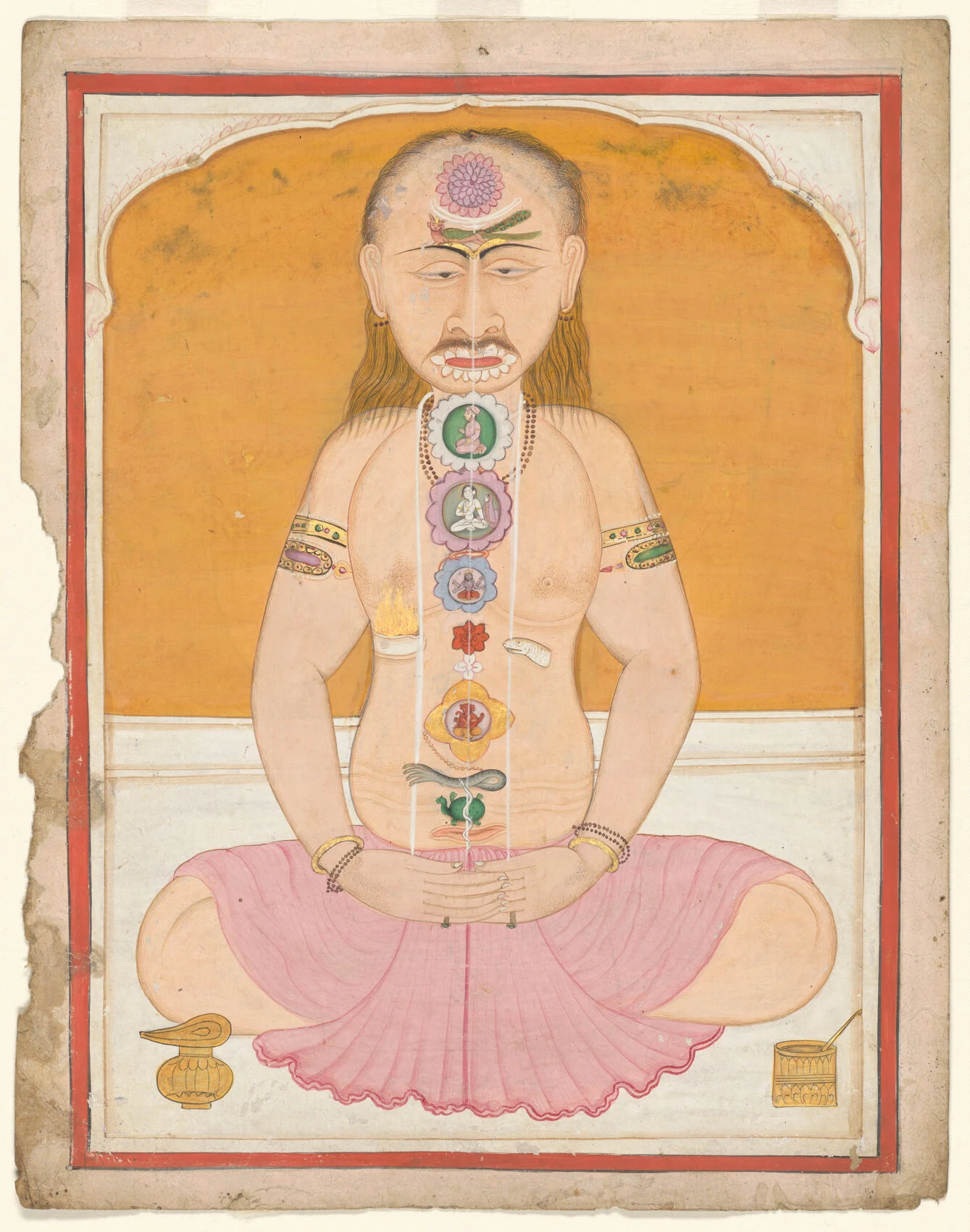
A seated figure with centres marked down the body in Wellcome MS Hindi (Indic) beta 511. The painting gives a historical example of how a subtle body could be pictured.
Wellcome Collection, MS Hindi (Indic) beta 511, recto. Public Domain Mark. Source image resized by IIIF and converted to WebP; no crop or recolouring. · Image source ↗ · Public Domain
Tantric channels and centres
The Serpent Power by Arthur Avalon
In The Serpent Power, Arthur Avalon places the subtle body, or liṅga śarīra, between the causal and gross bodies. He uses ordinary perception to show it at work. Manas gathers impressions, ahaṃkāra makes them one’s own, and buddhi judges them. He also describes this subtle body as continuing through successive incarnations. [30][27][31][32][33][34]
Channels and lotuses
In Avalon’s translation of Pūrṇānanda, the left and right channels flank Suṣumṇā. An inner channel called Citriṇī passes through the lotuses, with the Brahma-nāḍī inside it. The lotuses are pictured as strung along the channel. [28][35][36][29]
Avalon compares the centres to features of anatomy such as nerves and plexuses. He uses the possible correspondences to help a reader picture where the subtle changes are understood to take place. [37][38][29]
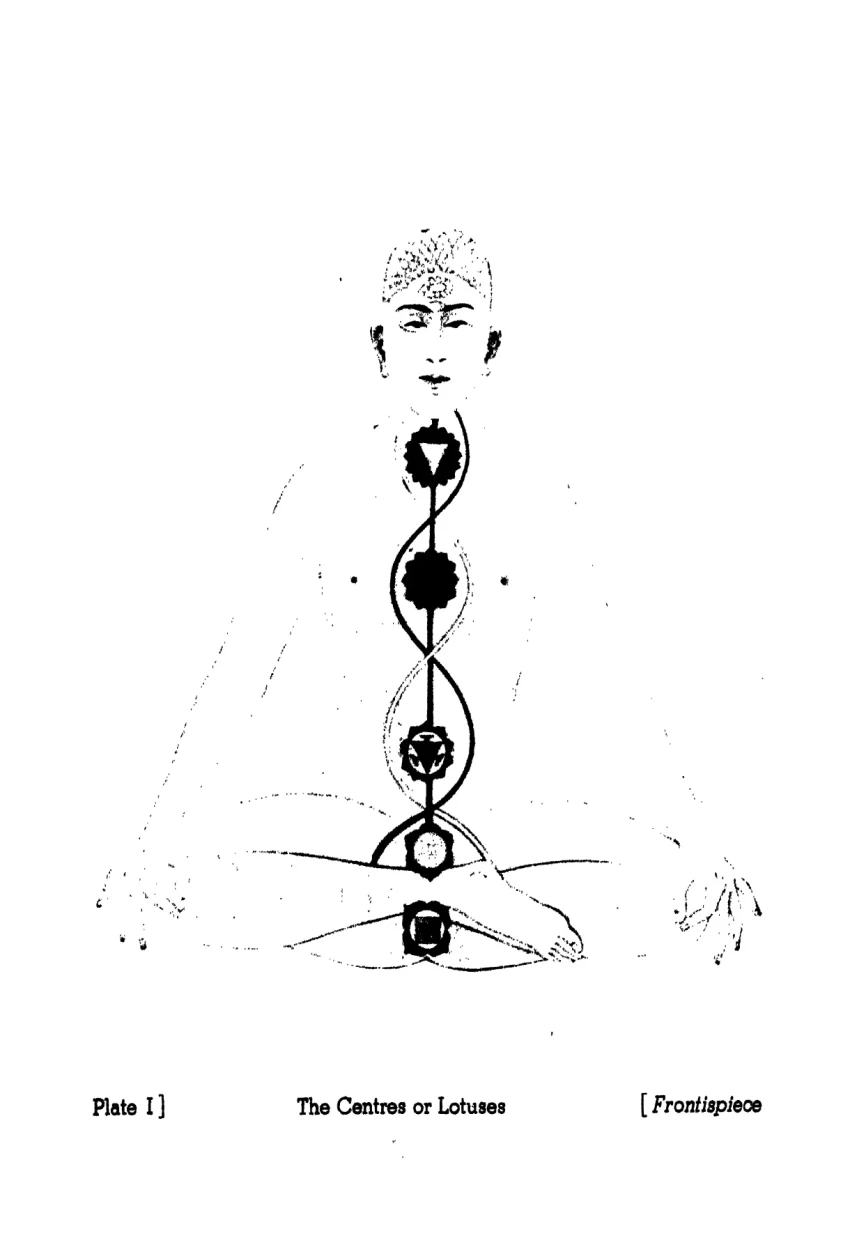
Plate I in The Serpent Power. The seated figure shows the lotuses along the central axis and the channels that wind beside it.
Illustrator unrecorded. The Serpent Power, Plate I. Library facsimile, compared with the 1924 second edition. · Image source ↗ · Public Domain
Theosophical bodies and Steiner
The Science of the Sacraments by Charles W. Leadbeater
Charles Webster Leadbeater distinguishes the bodies a person uses from the principles of consciousness expressed through them. He assigns feeling to the astral body and thought to the mental body. The causal body lasts across incarnations in his account, while the physical, astral and mental bodies are acquired anew. [19][20][21][22][23]
Diagram 21 sets those bodies beside the principles in a table. Leadbeater uses it to explain what he thinks a Christian text can mean by spiritual body, while recognizing that the expression can be read in more than one way. [20][22][24][25][26]
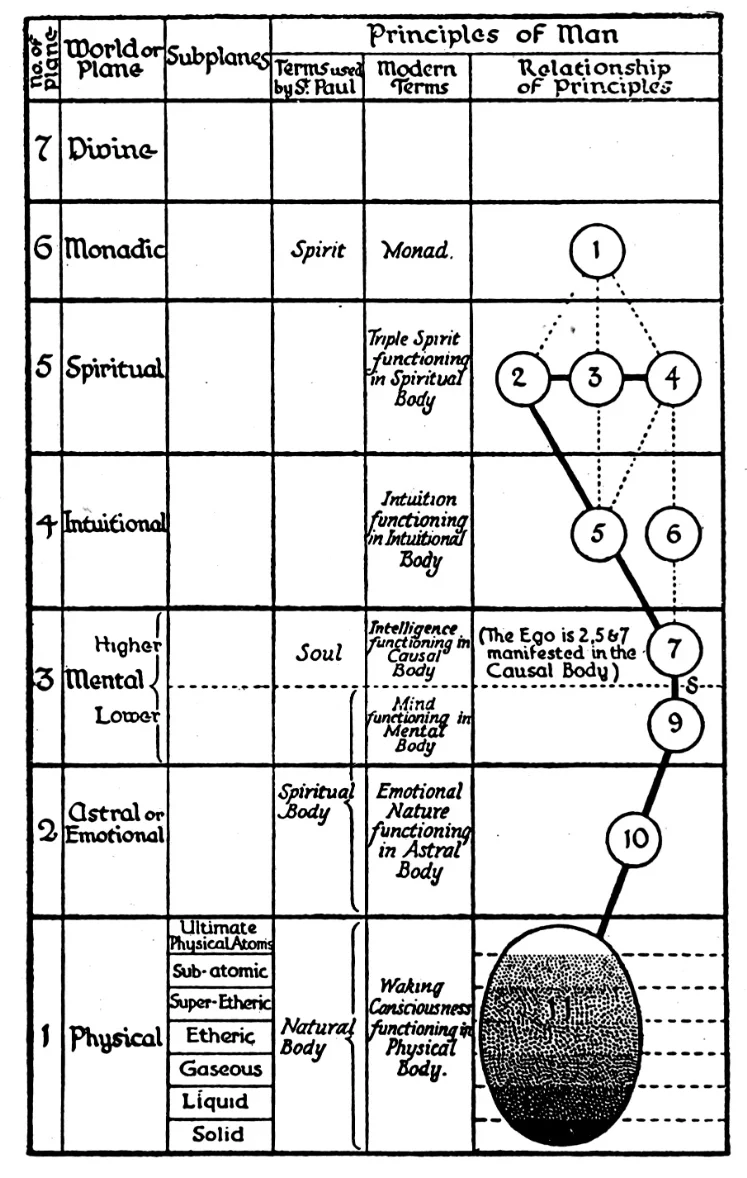
Diagram 21, printed page 546. Leadbeater places the physical, astral, mental and causal bodies within his arrangement of the human principles.
The Science of the Sacraments by Charles W. Leadbeater, The St. Alban Press, 1920. Library facsimile. · Image source ↗ · Public Domain
See references (8)
- The Science of the Sacraments, Reader page 556
- The Science of the Sacraments, Reader page 559
- The Science of the Sacraments, Reader page 560
- The Science of the Sacraments, Reader page 566
- The Science of the Sacraments, Reader page 567
- The Science of the Sacraments, Reader page 568
- The Science of the Sacraments, Reader page 569
- The Science of the Sacraments, Reader page 570
Kundalini: An Occult Experience by George S. Arundale
George S. Arundale contrasts the localized senses of the physical body with faculties he considers more widely distributed in the inner bodies. The whole astral body can feel in his account, and the whole mental body can think. He describes the brain as a junction where the influence of those bodies is particularly strong when Kundalini is intensified. [10][11][14][15]
Arundale compares barriers between bodies to sluice gates. Once a gate is open, the person still has to learn how to interpret what comes through. He later describes a body receptive throughout and speaks of radiances when describing still higher consciousness. [12][13][16][17]
In his development chapter, much of the preparation occurs during physical sleep, followed by waking expansions he says the observer cannot yet sustain. The Library scan has a gap here. These passages are cited to leaves 19–20 of Benjamin Adamah’s 2009 PDF transcription. [8][9]
See references (10)
- Kundalini: An Occult Experience, chapter 5, PDF leaf 19 of Benjamin Adamah’s 2009 digital transcription
- Kundalini: An Occult Experience, chapter 5, PDF leaf 20 of Benjamin Adamah’s 2009 digital transcription
- Kundalini: An Occult Experience, printed p. 23, Reader page 39
- Kundalini: An Occult Experience, printed p. 24, Reader page 40
- Kundalini: An Occult Experience, printed p. 26, Reader page 42
- Kundalini: An Occult Experience, printed p. 27, Reader page 43
- Kundalini: An Occult Experience, Reader page 41
- Kundalini: An Occult Experience, Reader page 44
- Kundalini: An Occult Experience, printed p. 86, Reader page 88
- Kundalini: An Occult Experience, Reader page 89
Initiation and Its Results by Rudolf Steiner
Rudolf Steiner calls the astral body an organism of the soul and describes thoughts and impulses in its luminous appearance. He distinguishes an etheric body with a different role between the physical and astral bodies. He says they interpenetrate and gives the lotus organs a place in this system of spiritual perception. [1][2][3][4][5][6]
See references (6)
- Initiation and Its Results, printed p. 12, Reader page 12
- Initiation and Its Results, printed p. 13, Reader page 13
- Initiation and Its Results, printed p. 14, Reader page 14
- Initiation and Its Results, printed p. 39, Reader page 38
- Initiation and Its Results, printed p. 40, Reader page 39
- Initiation and Its Results, printed p. 41, Reader page 40
Channels, bodies and kinds of experience
Leadbeater, Arundale and Steiner give bodies distinct functions. Leadbeater’s table emphasizes the expression of consciousness, Arundale’s sluice gates emphasize communication, and Steiner’s model gives an etheric body a place between the astral and physical bodies. [1][2][3][4][5][6][10][11][18][16][17][22][24][25]
Avalon’s explanation brings perception and judgment into one subtle body, and Pūrṇānanda’s channels connect the lotuses. The arrangement asks a different question from Leadbeater’s table, which maps feeling and thinking to distinct bodies. [27][33][29][20][21][22][24]
See references (19)
- Initiation and Its Results, printed p. 12, Reader page 12
- Initiation and Its Results, printed p. 13, Reader page 13
- Initiation and Its Results, printed p. 14, Reader page 14
- Initiation and Its Results, printed p. 39, Reader page 38
- Initiation and Its Results, printed p. 40, Reader page 39
- Initiation and Its Results, printed p. 41, Reader page 40
- Kundalini: An Occult Experience, printed p. 23, Reader page 39
- Kundalini: An Occult Experience, printed p. 24, Reader page 40
- Kundalini: An Occult Experience, printed p. 86, Reader page 88
- Kundalini: An Occult Experience, Reader page 89
- Kundalini: An Occult Experience, Reader page 45
- The Science of the Sacraments, Reader page 559
- The Science of the Sacraments, Reader page 560
- The Science of the Sacraments, Reader page 566
- The Science of the Sacraments, Reader page 568
- The Science of the Sacraments, Reader page 569
- The Serpent Power, Reader page 72
- The Serpent Power, Reader page 340
- The Serpent Power, Reader page 81
Read further in the library

Initiation and Its Results
Reading note
Separately attributed primary Library account, cited on exact verified Reader leaves.

Kundalini: An Occult Experience
Reading note
The separately titled account draws on exact passages in the consulted Library edition.

The Science of the Sacraments
Reading note
The separately titled account draws on exact passages in the consulted Library edition.
The Serpent Power
Reading note
Read the separately attributed account in the exact Library edition, with links to the individual pages cited.
Sources
See references (39)
- Initiation and Its Results, printed p. 12, Reader page 12Rudolf Steiner, Initiation and Its Results: A Sequel to The Way of Initiation, translated by Clifford Bax. First American Edition, 1909. Macoy Publishing and Masonic Supply Co., New York; Max Gysi, London. Claims of clairvoyant perception and subtle organs remain attributed. References identify the exact consulted Library edition.Read this page in Initiation and Its Results ↗Return to text ↑
- Initiation and Its Results, printed p. 13, Reader page 13Rudolf Steiner, Initiation and Its Results: A Sequel to The Way of Initiation, translated by Clifford Bax. First American Edition, 1909. Macoy Publishing and Masonic Supply Co., New York; Max Gysi, London. Claims of clairvoyant perception and subtle organs remain attributed. References identify the exact consulted Library edition.Read this page in Initiation and Its Results ↗Return to text ↑
- Initiation and Its Results, printed p. 14, Reader page 14Rudolf Steiner, Initiation and Its Results: A Sequel to The Way of Initiation, translated by Clifford Bax. First American Edition, 1909. Macoy Publishing and Masonic Supply Co., New York; Max Gysi, London. Claims of clairvoyant perception and subtle organs remain attributed. References identify the exact consulted Library edition.Read this page in Initiation and Its Results ↗Return to text ↑
- Initiation and Its Results, printed p. 39, Reader page 38Rudolf Steiner, Initiation and Its Results: A Sequel to The Way of Initiation, translated by Clifford Bax. First American Edition, 1909. Macoy Publishing and Masonic Supply Co., New York; Max Gysi, London. Claims of clairvoyant perception and subtle organs remain attributed. References identify the exact consulted Library edition.Read this page in Initiation and Its Results ↗Return to text ↑
- Initiation and Its Results, printed p. 40, Reader page 39Rudolf Steiner, Initiation and Its Results: A Sequel to The Way of Initiation, translated by Clifford Bax. First American Edition, 1909. Macoy Publishing and Masonic Supply Co., New York; Max Gysi, London. Claims of clairvoyant perception and subtle organs remain attributed. References identify the exact consulted Library edition.Read this page in Initiation and Its Results ↗Return to text ↑
- Initiation and Its Results, printed p. 41, Reader page 40Rudolf Steiner, Initiation and Its Results: A Sequel to The Way of Initiation, translated by Clifford Bax. First American Edition, 1909. Macoy Publishing and Masonic Supply Co., New York; Max Gysi, London. Claims of clairvoyant perception and subtle organs remain attributed. References identify the exact consulted Library edition.Read this page in Initiation and Its Results ↗Return to text ↑
- Wellcome Collection, MS Hindi (Indic) beta 511, natural-colour recto ↗Wellcome Collection. Current collection catalogue and IIIF manifest designate this digital image Public Domain Mark; creator and date are not supplied in the consulted catalogue.
- Kundalini: An Occult Experience, chapter 5, PDF leaf 19 of Benjamin Adamah’s 2009 digital transcription ↗George S. Arundale, chapter 5, as preserved in Benjamin Adamah’s 2009 digital transcription. Exact supplementary PDF leaf, not a Library PageRef or 1938 printed page.Return to text ↑
- Kundalini: An Occult Experience, chapter 5, PDF leaf 20 of Benjamin Adamah’s 2009 digital transcription ↗George S. Arundale, chapter 5, as preserved in Benjamin Adamah’s 2009 digital transcription. Exact supplementary PDF leaf, not a Library PageRef or 1938 printed page.Return to text ↑
- Kundalini: An Occult Experience, printed p. 23, Reader page 39George S. Arundale, Kundalini: An Occult Experience, The Theosophical Publishing House, Adyar, Madras, India, 1938. Consulted Library edition IMJ-0227-E001.Read this page in Kundalini: An Occult Experience ↗Return to text ↑
- Kundalini: An Occult Experience, printed p. 24, Reader page 40George S. Arundale, Kundalini: An Occult Experience, The Theosophical Publishing House, Adyar, Madras, India, 1938. Consulted Library edition IMJ-0227-E001.Read this page in Kundalini: An Occult Experience ↗Return to text ↑
- Kundalini: An Occult Experience, printed p. 26, Reader page 42George S. Arundale, Kundalini: An Occult Experience, The Theosophical Publishing House, Adyar, Madras, India, 1938. Consulted Library edition IMJ-0227-E001.Read this page in Kundalini: An Occult Experience ↗Return to text ↑
- Kundalini: An Occult Experience, printed p. 27, Reader page 43George S. Arundale, Kundalini: An Occult Experience, The Theosophical Publishing House, Adyar, Madras, India, 1938. Consulted Library edition IMJ-0227-E001.Read this page in Kundalini: An Occult Experience ↗Return to text ↑
- Kundalini: An Occult Experience, Reader page 41George S. Arundale, Kundalini: An Occult Experience, The Theosophical Publishing House, Adyar, Madras, India, 1938. Consulted Library edition IMJ-0227-E001.Read this page in Kundalini: An Occult Experience ↗Return to text ↑
- Kundalini: An Occult Experience, Reader page 44George S. Arundale, Kundalini: An Occult Experience, The Theosophical Publishing House, Adyar, Madras, India, 1938. Consulted Library edition IMJ-0227-E001.Read this page in Kundalini: An Occult Experience ↗Return to text ↑
- Kundalini: An Occult Experience, printed p. 86, Reader page 88George S. Arundale, Kundalini: An Occult Experience, The Theosophical Publishing House, Adyar, Madras, India, 1938. Consulted Library edition IMJ-0227-E001.Read this page in Kundalini: An Occult Experience ↗Return to text ↑
- Kundalini: An Occult Experience, Reader page 89George S. Arundale, Kundalini: An Occult Experience, The Theosophical Publishing House, Adyar, Madras, India, 1938. Consulted Library edition IMJ-0227-E001.Read this page in Kundalini: An Occult Experience ↗Return to text ↑
- Kundalini: An Occult Experience, Reader page 45George S. Arundale, Kundalini: An Occult Experience, The Theosophical Publishing House, Adyar, Madras, India, 1938. Consulted Library edition IMJ-0227-E001.Read this page in Kundalini: An Occult Experience ↗Return to text ↑
- The Science of the Sacraments, Reader page 556Charles W. Leadbeater, The Science of the Sacraments, The St. Alban Press, 1920. Exact Library edition IMJ-0615-E001.Read this page in The Science of the Sacraments ↗Return to text ↑
- The Science of the Sacraments, Reader page 559Charles W. Leadbeater, The Science of the Sacraments, The St. Alban Press, 1920. Exact Library edition IMJ-0615-E001.Read this page in The Science of the Sacraments ↗Return to text ↑
- The Science of the Sacraments, Reader page 560Charles W. Leadbeater, The Science of the Sacraments, The St. Alban Press, 1920. Exact Library edition IMJ-0615-E001.Read this page in The Science of the Sacraments ↗Return to text ↑
- The Science of the Sacraments, Reader page 566Charles W. Leadbeater, The Science of the Sacraments, The St. Alban Press, 1920. Exact Library edition IMJ-0615-E001.Read this page in The Science of the Sacraments ↗Return to text ↑
- The Science of the Sacraments, Reader page 567Charles W. Leadbeater, The Science of the Sacraments, The St. Alban Press, 1920. Exact Library edition IMJ-0615-E001.Read this page in The Science of the Sacraments ↗Return to text ↑
- The Science of the Sacraments, Reader page 568Charles W. Leadbeater, The Science of the Sacraments, The St. Alban Press, 1920. Exact Library edition IMJ-0615-E001.Read this page in The Science of the Sacraments ↗Return to text ↑
- The Science of the Sacraments, Reader page 569Charles W. Leadbeater, The Science of the Sacraments, The St. Alban Press, 1920. Exact Library edition IMJ-0615-E001.Read this page in The Science of the Sacraments ↗Return to text ↑
- The Science of the Sacraments, Reader page 570Charles W. Leadbeater, The Science of the Sacraments, The St. Alban Press, 1920. Exact Library edition IMJ-0615-E001.Read this page in The Science of the Sacraments ↗Return to text ↑
- The Serpent Power, Reader page 72Arthur Avalon (Sir John Woodroffe), The Serpent Power, fifth enlarged edition, Ganesh & Co., Madras, 1953. Exact Library edition IMJ-0608-E001.Read this page in The Serpent Power ↗Return to text ↑
- The Serpent Power, Reader page 124Arthur Avalon (Sir John Woodroffe), The Serpent Power, fifth enlarged edition, Ganesh & Co., Madras, 1953. Exact Library edition IMJ-0608-E001.Read this page in The Serpent Power ↗Return to text ↑
- The Serpent Power, Reader page 340Pūrṇānanda, Ṣaṭ-cakra-nirūpaṇa, with Kālīcaraṇa’s commentary, translated by Arthur Avalon in The Serpent Power. Exact Library edition IMJ-0608-E001.Read this page in The Serpent Power ↗Return to text ↑
- The Serpent Power, Reader page 67Arthur Avalon (Sir John Woodroffe), The Serpent Power, fifth enlarged edition, Ganesh & Co., Madras, 1953. Exact Library edition IMJ-0608-E001.Read this page in The Serpent Power ↗Return to text ↑
- The Serpent Power, Reader page 78Arthur Avalon (Sir John Woodroffe), The Serpent Power, fifth enlarged edition, Ganesh & Co., Madras, 1953. Exact Library edition IMJ-0608-E001.Read this page in The Serpent Power ↗Return to text ↑
- The Serpent Power, Reader page 79Arthur Avalon (Sir John Woodroffe), The Serpent Power, fifth enlarged edition, Ganesh & Co., Madras, 1953. Exact Library edition IMJ-0608-E001.Read this page in The Serpent Power ↗Return to text ↑
- The Serpent Power, Reader page 81Arthur Avalon (Sir John Woodroffe), The Serpent Power, fifth enlarged edition, Ganesh & Co., Madras, 1953. Exact Library edition IMJ-0608-E001.Read this page in The Serpent Power ↗Return to text ↑
- The Serpent Power, Reader page 82Arthur Avalon (Sir John Woodroffe), The Serpent Power, fifth enlarged edition, Ganesh & Co., Madras, 1953. Exact Library edition IMJ-0608-E001.Read this page in The Serpent Power ↗Return to text ↑
- The Serpent Power, Reader page 125Arthur Avalon (Sir John Woodroffe), The Serpent Power, fifth enlarged edition, Ganesh & Co., Madras, 1953. Exact Library edition IMJ-0608-E001.Read this page in The Serpent Power ↗Return to text ↑
- The Serpent Power, Reader page 333Pūrṇānanda, Ṣaṭ-cakra-nirūpaṇa, with Kālīcaraṇa’s commentary, translated by Arthur Avalon in The Serpent Power. Exact Library edition IMJ-0608-E001.Read this page in The Serpent Power ↗Return to text ↑
- The Serpent Power, Reader page 175Arthur Avalon (Sir John Woodroffe), The Serpent Power, fifth enlarged edition, Ganesh & Co., Madras, 1953. Exact Library edition IMJ-0608-E001.Read this page in The Serpent Power ↗Return to text ↑
- The Serpent Power, Reader page 176Arthur Avalon (Sir John Woodroffe), The Serpent Power, fifth enlarged edition, Ganesh & Co., Madras, 1953. Exact Library edition IMJ-0608-E001.Read this page in The Serpent Power ↗Return to text ↑
- The Serpent Power, Plate I, Reader page 3Arthur Avalon (Sir John Woodroffe), The Serpent Power, fifth enlarged edition, Ganesh & Co., Madras, 1953. Exact Library edition IMJ-0608-E001.Read this page in The Serpent Power ↗