Viśuddha Chakra
Viśuddha is the sixteen-petalled throat lotus. Explore its vowels, region of space and goddess in Pūrṇānanda’s chakra text.
In this article
Understanding the concept
Viśuddha is the throat lotus in Pūrṇānanda’s chakra system. Its sixteen petals carry sixteen Sanskrit vowels. Within them is a region of space, described as round and bright like the full moon. [5][6]
The Serpent Power in Arthur Avalon’s translation
In The Serpent Power, Arthur Avalon translates Pūrṇānanda’s description of the smoky purple lotus and its crimson vowels. Inside the lotus, the white seed syllable of space rides an elephant. [5][6][7]
Verse 30 depicts Śākinī in yellow, holding a bow, an arrow, a noose and a goad. It calls the moonlike region a gateway to liberation for a practitioner whose senses are disciplined. [8][9]
Plate VI makes a downward-pointing white triangle its most prominent shape. The verse describes the region of space as a circle. The text and illustration give readers different visual details to look for. [5][7]
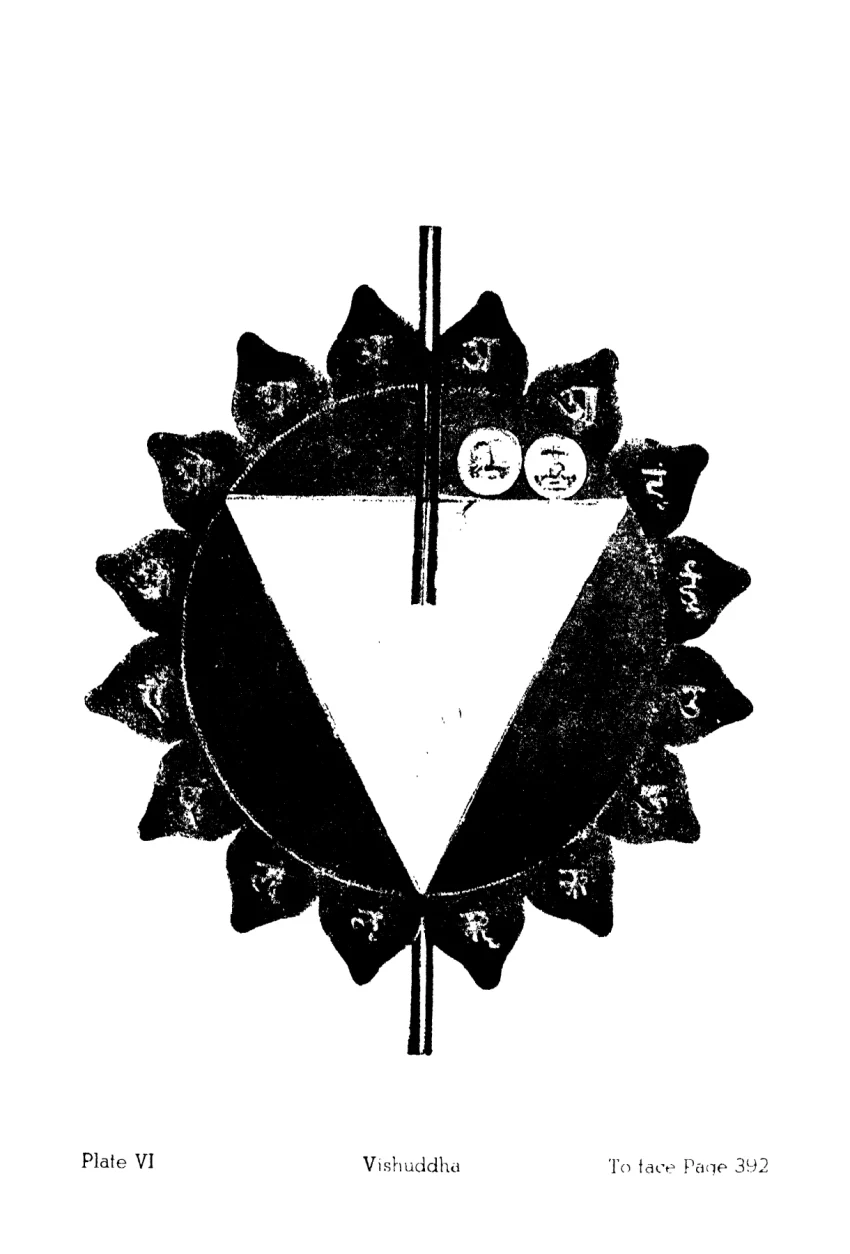
Plate VI. Viśuddha shows a descending pale triangle and a dark ring of lettered petals.
Illustrator unrecorded. The Serpent Power, Plate VI. Library facsimile, compared with the 1924 second edition. · Image source ↗ · Public Domain
Initiation and Its Results by Rudolf Steiner
Rudolf Steiner puts a sixteen-petalled lotus near the larynx. In his account eight petals formed earlier, and eight develop through deliberate attention to habits of thought, speech and conduct. He relates that development to spiritual perception. [2][3][4]
Sixteen vowels and sixteen petals
Pūrṇānanda assigns a vowel to each petal. Steiner uses the petal count to describe how a faculty develops, with eight petals responding to habits that can be cultivated. [5][8][2][3][4]
In the library
The Serpent Power
Reading note
Separately attributed primary Library account, cited on exact verified Reader leaves.

Initiation and Its Results
Reading note
Separately attributed primary Library account, cited on exact verified Reader leaves.
Sources
See references (9)
- The Serpent Power, Plate VI, Reader page 410Illustrator unrecorded. The Serpent Power, Plate VI. Library facsimile, compared with the 1924 second edition.Read this page in The Serpent Power ↗
- Initiation and Its Results, printed p. 15, Reader page 15Rudolf Steiner, Initiation and Its Results: A Sequel to The Way of Initiation, translated by Clifford Bax. First American Edition, 1909. Macoy Publishing and Masonic Supply Co., New York; Max Gysi, London. Claims of clairvoyant perception and subtle organs remain attributed. References identify the exact consulted Library edition.Read this page in Initiation and Its Results ↗
- Initiation and Its Results, printed p. 16, Reader page 16Rudolf Steiner, Initiation and Its Results: A Sequel to The Way of Initiation, translated by Clifford Bax. First American Edition, 1909. Macoy Publishing and Masonic Supply Co., New York; Max Gysi, London. Claims of clairvoyant perception and subtle organs remain attributed. References identify the exact consulted Library edition.Read this page in Initiation and Its Results ↗
- Initiation and Its Results, printed p. 21, Reader page 21Rudolf Steiner, Initiation and Its Results: A Sequel to The Way of Initiation, translated by Clifford Bax. First American Edition, 1909. Macoy Publishing and Masonic Supply Co., New York; Max Gysi, London. Claims of clairvoyant perception and subtle organs remain attributed. References identify the exact consulted Library edition.Read this page in Initiation and Its Results ↗
- The Serpent Power, printed p. 384, Reader page 401Arthur Avalon (Sir John Woodroffe), The Serpent Power, fifth enlarged edition, Ganesh & Co., Madras, 1953. Includes Pūrṇānanda’s Ṣaṭ-cakra-nirūpaṇa, Pādukā-pañcaka and Kālīcaraṇa’s commentary. Exact Library edition IMJ-0608-E001.Read this page in The Serpent Power ↗
- The Serpent Power, printed p. 385, Reader page 402Arthur Avalon (Sir John Woodroffe), The Serpent Power, fifth enlarged edition, Ganesh & Co., Madras, 1953. Includes Pūrṇānanda’s Ṣaṭ-cakra-nirūpaṇa, Pādukā-pañcaka and Kālīcaraṇa’s commentary. Exact Library edition IMJ-0608-E001.Read this page in The Serpent Power ↗
- The Serpent Power, printed p. 386, Reader page 403Arthur Avalon (Sir John Woodroffe), The Serpent Power, fifth enlarged edition, Ganesh & Co., Madras, 1953. Includes Pūrṇānanda’s Ṣaṭ-cakra-nirūpaṇa, Pādukā-pañcaka and Kālīcaraṇa’s commentary. Exact Library edition IMJ-0608-E001.Read this page in The Serpent Power ↗
- The Serpent Power, printed p. 388, Reader page 405Arthur Avalon (Sir John Woodroffe), The Serpent Power, fifth enlarged edition, Ganesh & Co., Madras, 1953. Includes Pūrṇānanda’s Ṣaṭ-cakra-nirūpaṇa, Pādukā-pañcaka and Kālīcaraṇa’s commentary. Exact Library edition IMJ-0608-E001.Read this page in The Serpent Power ↗
- The Serpent Power, printed p. 389, Reader page 406Arthur Avalon (Sir John Woodroffe), The Serpent Power, fifth enlarged edition, Ganesh & Co., Madras, 1953. Includes Pūrṇānanda’s Ṣaṭ-cakra-nirūpaṇa, Pādukā-pañcaka and Kālīcaraṇa’s commentary. Exact Library edition IMJ-0608-E001.Read this page in The Serpent Power ↗