The Book of Enoch Explained
The Book of Enoch is an ancient Jewish collection of visions. Explore the Watchers, the giants, its place in the Ethiopian Orthodox Bible and where to start reading.
In this article
Read Genesis 6 and 1 Enoch side by side
Genesis compresses the encounter into four verses. First Enoch gives the angels names, puts them on a mountain and follows the consequences. Read each passage in its own words.
The sons of God, the Watchers and the giants
These summaries follow Genesis 6:1–4 and R. H. Charles’s translation of 1 Enoch 6–7.
Who comes down?
- Genesis 6:1–4
- The sons of God see that human women are beautiful and take wives. The four verses give the group no individual names.
- 1 Enoch 6–7
- The angels agree to take wives. Semjâzâ fears he will bear the blame alone, so they swear together on Mount Hermon.
Who are the giants?
- Genesis 6:1–4
- The Nephilim appear in the same episode, alongside a reference to the renowned figures of old. The relationship is compressed into one verse.
- 1 Enoch 6–7
- The unions produce giants. Their hunger exhausts what people can supply, and their violence spreads to people and animals.
Where does the story turn?
- Genesis 6:1–4
- God limits human life in verse 3. The account goes on to describe widespread wickedness and introduce Noah before the Flood.
- 1 Enoch 6–7
- By the end of chapter 7 the earth cries out. Later chapters name the angels’ teachings, describe sentences against their leaders and bring Enoch in as a messenger.
- 1 Enoch 6 · The oath on Mount Hermon
- 1 Enoch 7 · The violence of the giants
- 1 Enoch 8 · What the angels teach
- 1 Enoch 10 · The judgments
- 1 Enoch 13 · The Watchers’ petition
- 1 Enoch 14 · Enoch’s throne vision
- 1 Enoch 15 · The origin of evil spirits
- 1 Enoch 1 · The prophecy echoed in Jude 14–15
- Read Jude’s use of Enoch
- Read how Jubilees retells Enoch’s story
- See what survives of Enoch among the Dead Sea Scrolls
- Find Leviathan and Behemoth in 1 Enoch 60
What is the Book of Enoch?
The title usually refers to 1 Enoch, a collection of ancient Jewish writings attributed to Enoch, the ancestor of Noah in Genesis 5. Genesis gives Enoch just a few lines and says that God took him. In 1 Enoch he sees the workings of heaven, hears judgments on rebellious angels and carries messages between heaven and earth. The stories and visions were composed and brought together over time. [6][3]
First Enoch is the work commonly called the Ethiopic Book of Enoch. Second Enoch and Third Enoch are distinct works also associated with his name. They have their own narratives and textual histories. The chapter references on this page all belong to First Enoch. [1][3]
Who are the Watchers and the giants?
In chapters 6–7, a group of angels descends and swears a joint oath on Mount Hermon. Their leader appears as Semjâzâ in Charles’s rendering. They take human wives and have children who grow into giants. The giants consume what people produce, then turn on living creatures and on people themselves. The narrative makes the consequences of the oath spread from one mountain to the earth below. [11][12]
The angels also transmit forbidden knowledge. Charles’s rendering names Azâzêl in chapter 8, where weapons and ornaments are among the skills assigned to him. Chapter 10 gives the angel Raphael the task of binding Azâzêl, while Michael is assigned a different part of the judgment. In chapters 12–16 Enoch carries the Watchers’ appeal and returns with a refusal. The book gives the mediator a voice while making clear who has authority to pass judgment. [13][14][15][16]
Genesis 6:1–4 supplies an earlier biblical scene to set beside this account. It mentions the sons of God, human women and the Nephilim in a handful of verses. The names of the angels, the oath at Hermon and Enoch’s rejected petition belong to the fuller account in 1 Enoch. Chapter 15 adds a further distinction: it traces the evil spirits roaming the earth to the dead giants, who were born of angels and human women. [7][11][12][17]
See references (8)
The five parts of 1 Enoch
- 1–36 · The Book of the Watchers. Enoch speaks for the Watchers, receives their judgment and tours places where the dead and rebelling angels await their fate. Start here for the descent, the giants and the throne vision. [1][3]
- 37–71 · The Parables or Similitudes. Three groups of visions develop images of judgment and vindication. The scene in chapter 46 introduces the figure called the Son of Man alongside the Head of Days. [1][3]
- 72–82 · The Astronomical Book. The angel Uriel shows Enoch the courses of the heavenly lights. The doors through which the sun rises and sets connect the book’s picture of the heavens with its calendrical reckoning. [1][3]
- 83–90 · The Book of Dreams. Two visions retell catastrophe and sacred history. In the longer vision, animals stand for people and communities. Its animal imagery supplies clues to the identities behind the story. [1][3]
- 91–108 · The Epistle and closing material. The last group includes warnings, the Apocalypse of Weeks, and a story of Noah’s extraordinary birth in chapters 106–107. Some editions list the Noah material and chapter 108 separately. [1][3]
Is the Book of Enoch in the Bible?
The Ethiopian Orthodox Tewahedo Church includes 1 Enoch in its Old Testament and preserves it in Geʿez. Most other Christian biblical canons and the Jewish Tanakh omit 1 Enoch. Which writings count as scripture depends on the community whose canon you are reading. The Ethiopian church’s account of its canonical books explains its own practice directly. [5][1]
The claim that the Book of Enoch was simply removed from the Bible compresses several histories into one story. Jude 14–15 attributes a prophecy of divine judgment to Enoch. Compare it with 1 Enoch 1:9, where the Lord comes with a multitude of holy ones to judge. The close parallel shows the author of Jude knew an Enochic tradition. A quotation tells us what the writer drew on. A canon tells us which books a community receives as scripture. [8][10][5]
Where to start reading the Book of Enoch
Read chapters 6–10 for the Watchers’ oath, the giants and the answer from heaven. Continue through chapters 12–16 to see what changes when Enoch enters the story as a messenger. Then read the opening chapter and set verse 9 beside Jude 14–15. Those three readings take you from the story most people recognise to the book’s language of judgment. [11][14][16][10][8]
The complete work is preserved in Ethiopic. Aramaic fragments among the Dead Sea Scrolls, including 4Q201, attest parts of the work in a much earlier manuscript setting. Charles’s 1912 title page names the Ethiopic text behind his translation and the Greek fragments printed in the volume. To cite a passage, give 1 Enoch, chapter and verse, followed by the translator or textual edition. Charles’s chapter numbering makes it easy to compare a printed scan with the searchable English text. [3][4][9][1]
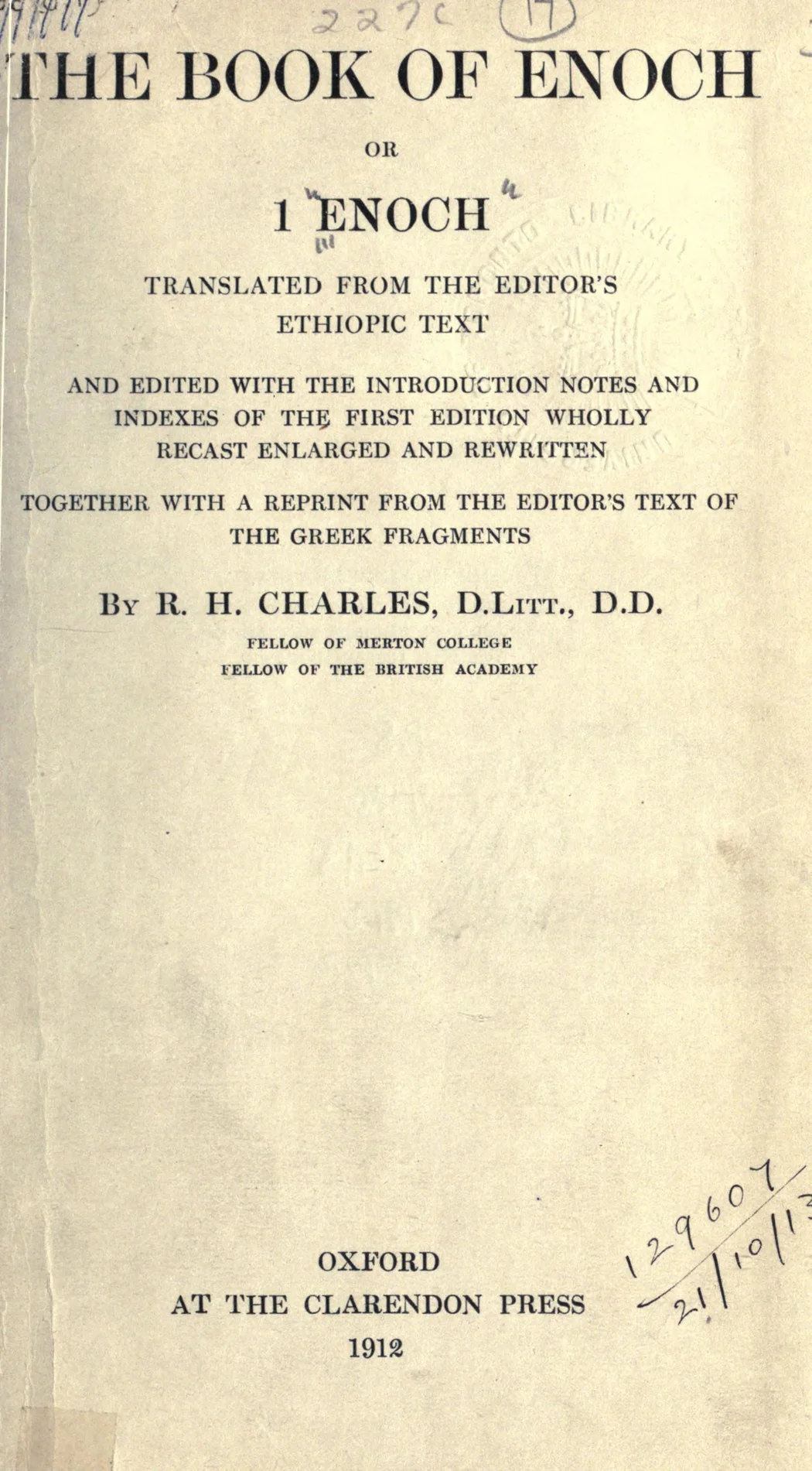
The title page of Charles’s 1912 edition gives both names, The Book of Enoch and 1 Enoch. It identifies the Ethiopic text behind his translation and the Greek fragments printed alongside it.
Clarendon Press, 1912. University of Toronto copy digitised by the Internet Archive. Public domain. · Image source ↗ · Public Domain
See references (9)
- The Book of Enoch, Charles’s 1917 English edition
- 1 Enoch in the Online Critical Pseudepigrapha
- 4Q201, Aramaic fragments of Enoch from Qumran
- Jude 14–15, the prophecy of Enoch
- The Book of Enoch or 1 Enoch, 1912 title page
- 1 Enoch 1 · The prophecy of judgment
- 1 Enoch 6 · The oath on Mount Hermon
- 1 Enoch 10 · Judgments pronounced
- 1 Enoch 14 · The throne vision and the refusal
Sources
See references (17)
- The Book of Enoch, Charles’s 1917 English edition ↗R. H. Charles, translation; W. O. E. Oesterley, introduction; Project Gutenberg transcriptionReturn to text ↑
- The Book of Enoch at Sacred Texts ↗R. H. Charles’s translation at the Internet Sacred Text Archive
- 1 Enoch in the Online Critical Pseudepigrapha ↗Online Critical Pseudepigrapha, multilingual textual witnesses and introductionReturn to text ↑
- 4Q201, Aramaic fragments of Enoch from Qumran ↗Israel Antiquities Authority, Leon Levy Dead Sea Scrolls Digital LibraryReturn to text ↑
- The Ethiopian Orthodox Tewahedo Church on its biblical books ↗Ethiopian Orthodox Tewahedo Church, canon and account of EnochReturn to text ↑
- Genesis 5:21–24, Enoch in the genealogy ↗Genesis, New American Bible, Revised EditionReturn to text ↑
- Genesis 6:1–4, sons of God and Nephilim ↗Genesis, New American Bible, Revised EditionReturn to text ↑
- Jude 14–15, the prophecy of Enoch ↗Letter of Jude, New American Bible, Revised Edition and notesReturn to text ↑
- The Book of Enoch or 1 Enoch, 1912 title page ↗R. H. Charles, Clarendon Press, University of Toronto copyReturn to text ↑
- 1 Enoch 1 · The prophecy of judgment ↗1 Enoch, translated by R. H. Charles. Internet Sacred Text Archive.Return to text ↑
- 1 Enoch 6 · The oath on Mount Hermon ↗1 Enoch, translated by R. H. Charles. Internet Sacred Text Archive.Return to text ↑
- 1 Enoch 7 · The violence of the giants ↗1 Enoch, translated by R. H. Charles. Internet Sacred Text Archive.Return to text ↑
- 1 Enoch 8 · The angels’ teachings ↗1 Enoch, translated by R. H. Charles. Internet Sacred Text Archive.Return to text ↑
- 1 Enoch 10 · Judgments pronounced ↗1 Enoch, translated by R. H. Charles. Internet Sacred Text Archive.Return to text ↑
- 1 Enoch 13 · The Watchers’ petition ↗1 Enoch, translated by R. H. Charles. Internet Sacred Text Archive.Return to text ↑
- 1 Enoch 14 · The throne vision and the refusal ↗1 Enoch, translated by R. H. Charles. Internet Sacred Text Archive.Return to text ↑
- 1 Enoch 15 · The spirits of the giants ↗1 Enoch, translated by R. H. Charles. Internet Sacred Text Archive.Return to text ↑