The Book of Jubilees Explained: A Timeline from Creation to Sinai
Follow the Book of Jubilees from creation to Sinai. Compare it with Genesis and learn how its 49-year jubilees and 364-day calendar work.
In this article
Compare the two ways of counting time
One count orders events from creation to Sinai. The other sets the length of the festival year.
Two ways to count time in Jubilees
One jubilee
7 year-weeks × 7 years = 49 years
Each block represents a week of seven years. Use this system to place an event in the book’s long chronology.
Read Jubilees 50One calendar year
4 quarters × 13 weeks = 52 weeks · 364 days
Each block represents thirteen seven-day weeks. A whole number of weeks keeps the weekdays and festival dates aligned within the scheme.
Read Jubilees 6What is the Book of Jubilees?
The Book of Jubilees is an ancient Jewish work that retells and interprets the history from creation through the early chapters of Exodus. It opens on Mount Sinai, where God summons Moses, then gives an angel the task of making known the history that preceded the revelation. The book goes back to creation and carries the reader through the lives of the patriarchs, the descent into Egypt, the Exodus and the laws of the Sabbath. The opening at the mountain and the return to its laws frame the account. [1][8]
Births, deaths and journeys can be assigned a year inside a week of years inside a jubilee. Feasts and laws have histories of their own. The book traces the covenant renewed at Sinai through Noah and the patriarchs, and the Sabbath is set apart at creation. The title Little Genesis reflects that extensive retelling, while the frame and closing laws reach into Exodus. [2][4][8][9]
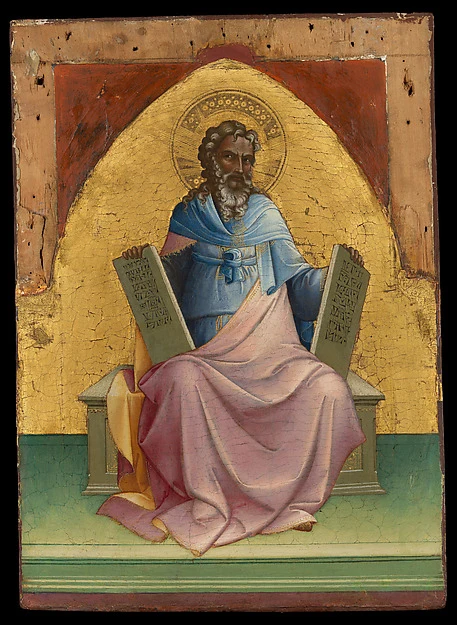
Moses holds the two tablets in a companion panel, ca. 1408–10. Jubilees opens with Moses called up Sinai for the tablets and the history he is to write.
Lorenzo Monaco, Moses, ca. 1408–10. The Metropolitan Museum of Art, 65.14.3. Gwynne Andrews Fund, and Bequest of Mabel Choate, in memory of her father, Joseph Hodges Choate, by exchange, 1965. Open Access. · Image source ↗ · Public Domain
Timeline from creation to Sinai
Read the first stop before following the history itself. Once Moses goes up the mountain, the angel begins the account with creation. The table of years belongs to the story’s framework. Places where the book adds a festival, duty or institution are especially revealing when read with the corresponding passage in Genesis or Exodus. [1][2][4][6][18]
- Sinai · Jubilees 1
- Creation · Jubilees 2
- Before the flood · Jubilees 4
- After the flood · Jubilees 6
- Abraham · Jubilees 15
- Bethel · Jubilees 32
- Egypt · Jubilees 49
- Sinai · Jubilees 50
The angel counts the years from Adam
The book returns to the reckoning given to Moses, names forty further years until the Jordan crossing and closes with Sabbath law. [8]
See references (17)
- Jubilees 1:1–4, 25–28 · The Sinai frame and the angel’s commission
- Jubilees 2:1–33 · Creation and the Sabbath
- Jubilees 4:16–25 · Enoch as a writer and witness
- Jubilees 6:1–38 · The covenant, festival and 364-day year
- Jubilees 15:1–14, 25–34 · Abraham’s covenant and its timing
- Jubilees 32:1–15 · Levi and the tithe at Bethel
- Jubilees 49:1–23 · Passover
- Jubilees 50:1–13 · The reckoning and the Sabbath
- Genesis 1 · The days of creation
- Genesis 2:1–3 · The seventh day
- Genesis 5:21–24 · Enoch
- Genesis 8:20–22 · Noah’s offering
- Genesis 9:1–17 · The covenant and the bow
- Genesis 17 · Abraham’s covenant
- Genesis 35:1–15 · Bethel
- Exodus 12:1–28 · Passover
- Exodus 24:12–18 · Moses goes up Sinai
How the 49-year jubilee and the 364-day year work
A year-week contains seven years. Seven year-weeks make one jubilee, a span of 49 years. Jubilees 6 also describes a 364-day year, composed of 52 seven-day weeks. The first scheme orders the book’s long chronology. The second keeps numbered dates and weekdays aligned within the festival calendar. The chapter gives no explicit rule for reconciling that count with the longer solar year. [4][8]
In Jubilees 50:4 the angel counts 49 full jubilees, plus a year-week and two years. The arithmetic is 49 × 49 + 7 + 2 = 2,410. The brackets in Charles’s English edition mark the editorial equivalent in years of the world. The text counts another 40 years to the crossing of the Jordan. Compare Leviticus 25, which counts seven sabbaths of years and describes the proclamation of a fiftieth year. [8][19]
How Jubilees changes the Genesis stories
Genesis gives the bow as a sign and sets out the promises and prohibitions after the flood. Jubilees keeps those elements and describes the Feast of Weeks as an annual renewal of covenant. It traces the festival through heaven, Noah and the patriarchs to its renewed celebration on the mountain. The rewritten story explains why the festival belongs where it does in the year. [13][14][4]
Genesis puts Enoch in a genealogy and says he walked with God. Jubilees portrays him as a writer and witness who learns the signs of heaven and records judgments. That helps explain why Enoch also appears in independent ancient literature about heavenly knowledge and visions. Keep the individual book titles and chapter numbers visible as you follow the connection. [12][3]
At Bethel, Genesis describes Jacob’s altar, divine appearance and stone pillar. Jubilees adds Levi’s dream of priesthood and puts the tithe into the family story. The setting remains familiar from Genesis, while the added actions explain a later institution through an earlier generation. [16][6]
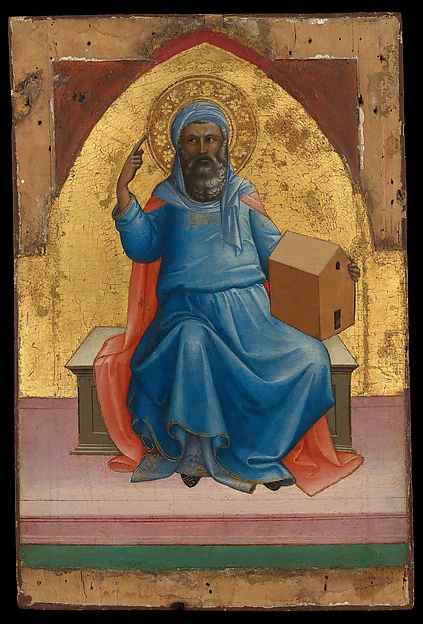
Noah holds an ark shaped like a church in Lorenzo Monaco’s panel, ca. 1408–10. The image belongs to a later Christian reception of Genesis. Jubilees 6 links Noah’s covenant to an annual festival.
Lorenzo Monaco, Noah, ca. 1408–10. The Metropolitan Museum of Art, 65.14.2. Gwynne Andrews Fund, and Gift of Paul Peralta Ramos, by exchange, 1965. Open Access. · Image source ↗ · Public Domain
From the Hebrew fragments to the Ethiopic manuscripts
The Israel Antiquities Authority catalogue identifies 4Q216 as a Hebrew copy from Qumran. In the published reconstruction, its surviving material corresponds to parts of the prologue, chapter 1 and the creation account in chapter 2. Open the archive record to see the separate images. The label 4Q216 identifies the manuscript, while the plate and image numbers distinguish particular photographs. [20][21]
A full version survives through the Ethiopic tradition, where the book is known as Maṣḥafa Kufālē. The Geʿez manuscript dated 1505–1506 in the British Library catalogue shows one stage of this later transmission. The Hebrew fragments establish ancient circulation in Hebrew, and the Ethiopic witnesses preserve the full sequence underlying this reading route. Jubilees has scriptural standing in the Ethiopian Orthodox tradition. Its place in a Bible depends on the canon in question. [20][22][23]
Where to start reading Jubilees
Start with the commission to Moses in chapter 1. Read the creation Sabbath in chapter 2, the covenant festival in chapter 6 and the reckoning in chapter 50. Then return to the timeline and choose a scene you know from Genesis. Its chapter links lead to Charles’s historical translation with the verse numbering visible. The manuscript catalogues show the transmission behind the English text. [1][2][4][8][9][20][22]
See references (7)
- Jubilees 1:1–4, 25–28 · The Sinai frame and the angel’s commission
- Jubilees 2:1–33 · Creation and the Sabbath
- Jubilees 6:1–38 · The covenant, festival and 364-day year
- Jubilees 50:1–13 · The reckoning and the Sabbath
- R. H. Charles · Translation and chapter index
- 4Q216 · Hebrew manuscript and photographs
- Maṣḥafa Kufālē · Geʿez manuscript dated 1505–1506
Sources
See references (25)
- Jubilees 1:1–4, 25–28 · The Sinai frame and the angel’s commission ↗R. H. Charles, The Apocrypha and Pseudepigrapha of the Old Testament, volume II, Clarendon Press, 1913, transcription hosted by CCEL.Return to text ↑
- Jubilees 2:1–33 · Creation and the Sabbath ↗R. H. Charles, The Apocrypha and Pseudepigrapha of the Old Testament, volume II, Clarendon Press, 1913, transcription hosted by CCEL.Return to text ↑
- Jubilees 4:16–25 · Enoch as a writer and witness ↗R. H. Charles, The Apocrypha and Pseudepigrapha of the Old Testament, volume II, Clarendon Press, 1913, transcription hosted by CCEL.Return to text ↑
- Jubilees 6:1–38 · The covenant, festival and 364-day year ↗R. H. Charles, The Apocrypha and Pseudepigrapha of the Old Testament, volume II, Clarendon Press, 1913, transcription hosted by CCEL.Return to text ↑
- Jubilees 15:1–14, 25–34 · Abraham’s covenant and its timing ↗R. H. Charles, The Apocrypha and Pseudepigrapha of the Old Testament, volume II, Clarendon Press, 1913, transcription hosted by CCEL.
- Jubilees 32:1–15 · Levi and the tithe at Bethel ↗R. H. Charles, The Apocrypha and Pseudepigrapha of the Old Testament, volume II, Clarendon Press, 1913, transcription hosted by CCEL.Return to text ↑
- Jubilees 49:1–23 · Passover ↗R. H. Charles, The Apocrypha and Pseudepigrapha of the Old Testament, volume II, Clarendon Press, 1913, transcription hosted by CCEL.
- Jubilees 50:1–13 · The reckoning and the Sabbath ↗R. H. Charles, The Apocrypha and Pseudepigrapha of the Old Testament, volume II, Clarendon Press, 1913, transcription hosted by CCEL.Return to text ↑
- R. H. Charles · Translation and chapter index ↗R. H. Charles, The Apocrypha and Pseudepigrapha of the Old Testament, volume II, Clarendon Press, 1913, transcription hosted by CCEL.Return to text ↑
- Genesis 1 · The days of creation ↗New American Bible, Revised Edition, United States Conference of Catholic Bishops.
- Genesis 2:1–3 · The seventh day ↗New American Bible, Revised Edition, United States Conference of Catholic Bishops.
- Genesis 5:21–24 · Enoch ↗New American Bible, Revised Edition, United States Conference of Catholic Bishops.Return to text ↑
- Genesis 8:20–22 · Noah’s offering ↗New American Bible, Revised Edition, United States Conference of Catholic Bishops.Return to text ↑
- Genesis 9:1–17 · The covenant and the bow ↗New American Bible, Revised Edition, United States Conference of Catholic Bishops.Return to text ↑
- Genesis 17 · Abraham’s covenant ↗New American Bible, Revised Edition, United States Conference of Catholic Bishops.
- Genesis 35:1–15 · Bethel ↗New American Bible, Revised Edition, United States Conference of Catholic Bishops.Return to text ↑
- Exodus 12:1–28 · Passover ↗New American Bible, Revised Edition, United States Conference of Catholic Bishops.
- Exodus 24:12–18 · Moses goes up Sinai ↗New American Bible, Revised Edition, United States Conference of Catholic Bishops.Return to text ↑
- Leviticus 25:8–13 · Seven weeks of years and the fiftieth year ↗New American Bible, Revised Edition, United States Conference of Catholic Bishops.Return to text ↑
- 4Q216 · Hebrew manuscript and photographs ↗Israel Antiquities Authority, Leon Levy Dead Sea Scrolls Digital Library.Return to text ↑
- 4Q216 and the Jubilees Creation Account ↗Matthew P. Monger’s study of the Hebrew creation fragments.Return to text ↑
- Maṣḥafa Kufālē · Geʿez manuscript dated 1505–1506 ↗British Library Archives and Manuscripts Catalogue, EAP286/1/1/414.Return to text ↑
- Jubilees, Book of · Ethiopic manuscripts and reception ↗Encyclopaedia Aethiopica, volume 3, pp. 303a–303b.Return to text ↑
- Lorenzo Monaco · Noah ↗Lorenzo Monaco, Noah, ca. 1408–10. The Metropolitan Museum of Art, 65.14.2. Gwynne Andrews Fund, and Gift of Paul Peralta Ramos, by exchange, 1965. Open Access.
- Lorenzo Monaco · Moses ↗Lorenzo Monaco, Moses, ca. 1408–10. The Metropolitan Museum of Art, 65.14.3. Gwynne Andrews Fund, and Bequest of Mabel Choate, in memory of her father, Joseph Hodges Choate, by exchange, 1965. Open Access.