What Are the Dead Sea Scrolls and What Do They Contain?
See what the Dead Sea Scrolls contain, from the complete text of Isaiah to the Community Rule and fragments of Enoch. Learn to read a Qumran manuscript number.
In this article
Look closely at a Dead Sea Scroll fragment
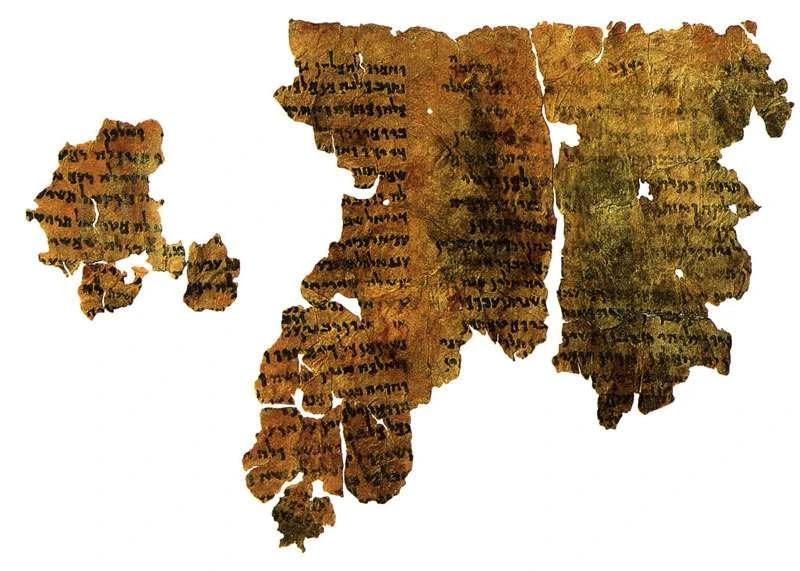
Use the markers on 4Q201 to see what the parchment preserves. Then compare the fragments with a nearly complete biblical scroll and a rule for community life.

Surviving ink
Several rows still run across this piece. The lettering is square script and the language is Aramaic.
Breaks in the parchment
A pale break interrupts the writing. Compare the published translation to see where editors mark a loss or supply words.
A smaller piece
Several partial lines survive here. A fragment can be a piece of a manuscript whose other pieces are recorded separately.
What are the Dead Sea Scrolls?
The Dead Sea Scrolls are ancient manuscripts found in caves in the Judean Desert. The best-known group comes from eleven caves near Qumran. It includes early copies of books now in the Hebrew Bible, works such as Enoch, and writings that set out the rules and beliefs of a particular Jewish community. The largely complete Great Isaiah Scroll and the damaged fragments of Enoch both belong to this group. They give very different views of how an ancient text can survive. [1][3][6][12]
Bedouin discoveries brought the first Qumran manuscripts to light in 1947. Finds in further caves continued through the following years. Cave 4 alone yielded fragments of about five hundred manuscripts, according to the Israel Antiquities Authority. The wider name also covers finds from other Judean Desert sites, where some archives consist largely of documents and letters. A date for Qumran’s literary copies therefore gives only part of the chronology of the discoveries. [2][1]
See references (5)
What books and other writings do the scrolls contain?
The Israel Antiquities Authority’s catalogue identifies material from every book of the Hebrew Bible except Esther. That count concerns the presence of some text from each book. A manuscript often preserves only part of a chapter, and several physical copies of the same composition may survive. Even a relatively complete roll like Isaiah is a copy of one work. The caves also preserved prayers, commentaries, calendars, legal writings and texts such as Jubilees and Enoch. [3][1][6][12]
Most of the Qumran material was written on parchment, with some papyrus and the exceptional Copper Scroll. The principal languages are Hebrew, Aramaic and Greek. Language, script and material tell different things about an object. The 4Q201 catalogue, for instance, separates Aramaic as the language from square as the script, then identifies parchment as the writing surface. Read those fields separately when you compare two records. [4][1][12]
- 1QIsaᵃ · Great Isaiah Scroll
- A Hebrew copy from Cave 1 with the full text of one biblical book in 54 written columns.
- 1QS · Community Rule
- A Hebrew rule for communal life from Cave 1. Other copies let readers compare how the writing circulated.
- 4Q201 · Enoch
- Aramaic parchment pieces from Cave 4, with damaged lines and gaps that a modern edition has to account for.
See references (6)
- Introduction · Qumran and other Judean Desert collections
- Scrolls content · Composition types and manuscript categories
- Languages and scripts · Hebrew, Aramaic and Greek
- The Great Isaiah Scroll · 1QIsaᵃ, 54 columns and 66 chapters
- Rule of Community Scroll · 1QS, Cave 1, accession 96.83/208A-B
- Enoch · 4Q201, Aramaic parchment from Cave 4
The Great Isaiah Scroll, 1QIsaᵃ
The Great Isaiah Scroll is a Hebrew copy normally dated to about 125 BCE by the Israel Museum. It preserves the text of all sixty-six chapters of Isaiah in fifty-four manuscript columns. Chapters and columns measure different things. A chapter belongs to the way readers reference the text today. A column is a block of writing on the surviving roll. In the photograph below, you can see the blank strips that divide those blocks. [6][7]
Start by following the margins and gaps between columns. Then look at the joins in the parchment. A scroll can consist of several sheets joined into one object. The museum’s conservation report treats such details as evidence for its manufacture and later treatment. The manuscript is valuable both as a witness to the wording of Isaiah and as a book made and used in antiquity. [7][8]
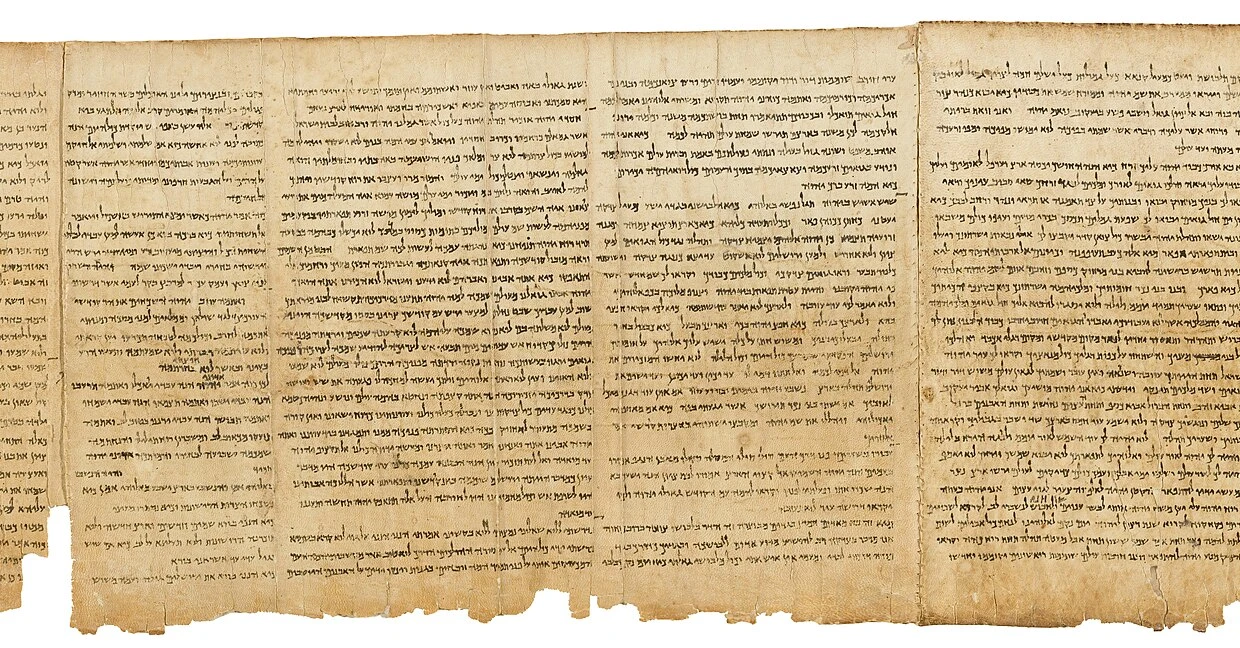
Detail of 1QIsaᵃ. Follow the blank strips between the columns to see how the scribe organised a continuous text on the roll.
Israel Museum via Google Art Project and Wikimedia Commons. Cropped from tile x0-y0. · Image source ↗ · Public Domain
The Community Rule, 1QS, and another copy from Cave 4
The Hebrew Community Rule addresses matters such as admitting new members, behaviour at meals and assemblies, and penalties for breaking rules. The Israel Museum’s 1QS record provides a photograph and an opening excerpt. Read that excerpt with an eye to what joining would entail. The group asserts authority over both belief and property. A rule states what the group expected of its members, giving historians one kind of evidence about life in the community. [9]
Cave 1 yielded the most complete copy. Compare the separate Cave 4 manuscript 4Q258 at the Library of Congress. Its translated selection includes instructions for a leader, including how to guide members and how to conduct himself towards people outside the group. Copies and fragments give evidence of a composition’s circulation and sometimes of different forms of it. The proposed link between Qumran and the Essenes remains an interpretation drawn from archaeology, the texts and ancient accounts. [9][10][11][17]
What survives of Enoch at Qumran?
The manuscript 4Q201 preserves parts of Enoch in Aramaic. The Library of Congress dates the copy to about 200–150 BCE. Its exhibition translation uses brackets where wording has been supplied and ellipses where text is omitted or lost. Compare the small amount of continuous writing on the parchment with the smoother sentences in translation. The editorial marks help readers tell which parts of the sentence depend on reconstruction. [12][16][15][13]
In the extract from column III, the surviving and restored text together describe the episode in which the Watchers take wives and giants are born. The Book of Enoch guide follows that episode through the longer surviving tradition. Use the translation of 4Q201 to see what one early physical witness contributes, then compare the longer text to follow the story. [15][12]
How do you read a Dead Sea Scrolls manuscript number?
Take 4Q201. The 4Q identifies Qumran Cave 4, while 201 identifies the manuscript within that cave’s catalogue. The same record also calls it 4QEnᵃ. En abbreviates Enoch and the superscript distinguishes this copy from other copies of that composition. A reference may then specify a fragment, a column and a line. Those extra fields take you from a physical manuscript to a particular place within the preserved writing. [5][12]
Now open the archive’s image B-298333. It shows the front of Plate 904 and lists the individual fragments shown there. The B-number identifies the photograph. The plate identifies the modern grouping used to store or image the pieces. Older publication numbers can identify fragments differently. When writing down a reference, keep the manuscript number, the plate and the image number in separate fields so another reader can follow the same trail. [5][14]
Sources
See references (17)
- Introduction · Qumran and other Judean Desert collections ↗Israel Antiquities Authority, Leon Levy Dead Sea Scrolls Digital Library.Return to text ↑
- Discovery and publication · The caves and reconstruction of the manuscripts ↗Israel Antiquities Authority, Leon Levy Dead Sea Scrolls Digital Library.Return to text ↑
- Scrolls content · Composition types and manuscript categories ↗Israel Antiquities Authority, Leon Levy Dead Sea Scrolls Digital Library.Return to text ↑
- Languages and scripts · Hebrew, Aramaic and Greek ↗Israel Antiquities Authority, Leon Levy Dead Sea Scrolls Digital Library.Return to text ↑
- Digital Library help · Manuscript names, fragment numbers and plates ↗Israel Antiquities Authority, Leon Levy Dead Sea Scrolls Digital Library.Return to text ↑
- The Great Isaiah Scroll · 1QIsaᵃ, 54 columns and 66 chapters ↗The Israel Museum, Jerusalem, Shrine of the Book.Return to text ↑
- Great Isaiah Scroll, MS A · Public-domain reproduction, tile x0-y0 ↗Israel Museum via Google Art Project and Wikimedia Commons.Return to text ↑
- Conserving the Great Isaiah Scroll · Seams, repairs and manufacture ↗The Israel Museum, Jerusalem, Shrine of the Book.Return to text ↑
- Rule of Community Scroll · 1QS, Cave 1, accession 96.83/208A-B ↗The Israel Museum, Jerusalem, Shrine of the Book.Return to text ↑
- Community Rule · Cave 4 copy 4Q258 ↗Library of Congress, Scrolls from the Dead Sea exhibition.Return to text ↑
- Community Rule · Translation of the 4Q258 selection ↗Elisha Qimron, transcription and translation, Library of Congress exhibition.Return to text ↑
- Enoch · 4Q201, Aramaic parchment from Cave 4 ↗Israel Antiquities Authority, Leon Levy Dead Sea Scrolls Digital Library.Return to text ↑
- Enoch fragments · Public-domain reproduction of 4Q201 ↗Israel Antiquities Authority manuscript, reproduction from the Library of Congress exhibition via Wikimedia Commons.Return to text ↑
- 4Q201 · Plate 904, image B-298333 ↗Israel Antiquities Authority, Leon Levy Dead Sea Scrolls Digital Library.Return to text ↑
- Enoch · Translation of excerpts from columns II and III ↗J. T. Milik, transcription amended by J. C. Greenfield, English translation by J. C. Greenfield.Return to text ↑
- The Enoch Scroll · 4Q201, exhibition object 11 ↗Library of Congress, Scrolls from the Dead Sea exhibition.Return to text ↑
- The Qumran community · Archaeology and the Essene hypothesis ↗Library of Congress, Scrolls from the Dead Sea exhibition.Return to text ↑