Leviathan vs. Behemoth in the Bible
Compare Leviathan and Behemoth in Job 40–41, see how Blake drew them, and follow Leviathan through Isaiah, the Psalms and Milton’s Paradise Lost.
In this article
Find the two creatures in Blake’s engraving
Blake places both creatures in the same enclosure. Use the markers to match the features in the engraving to the two descriptions in Job.
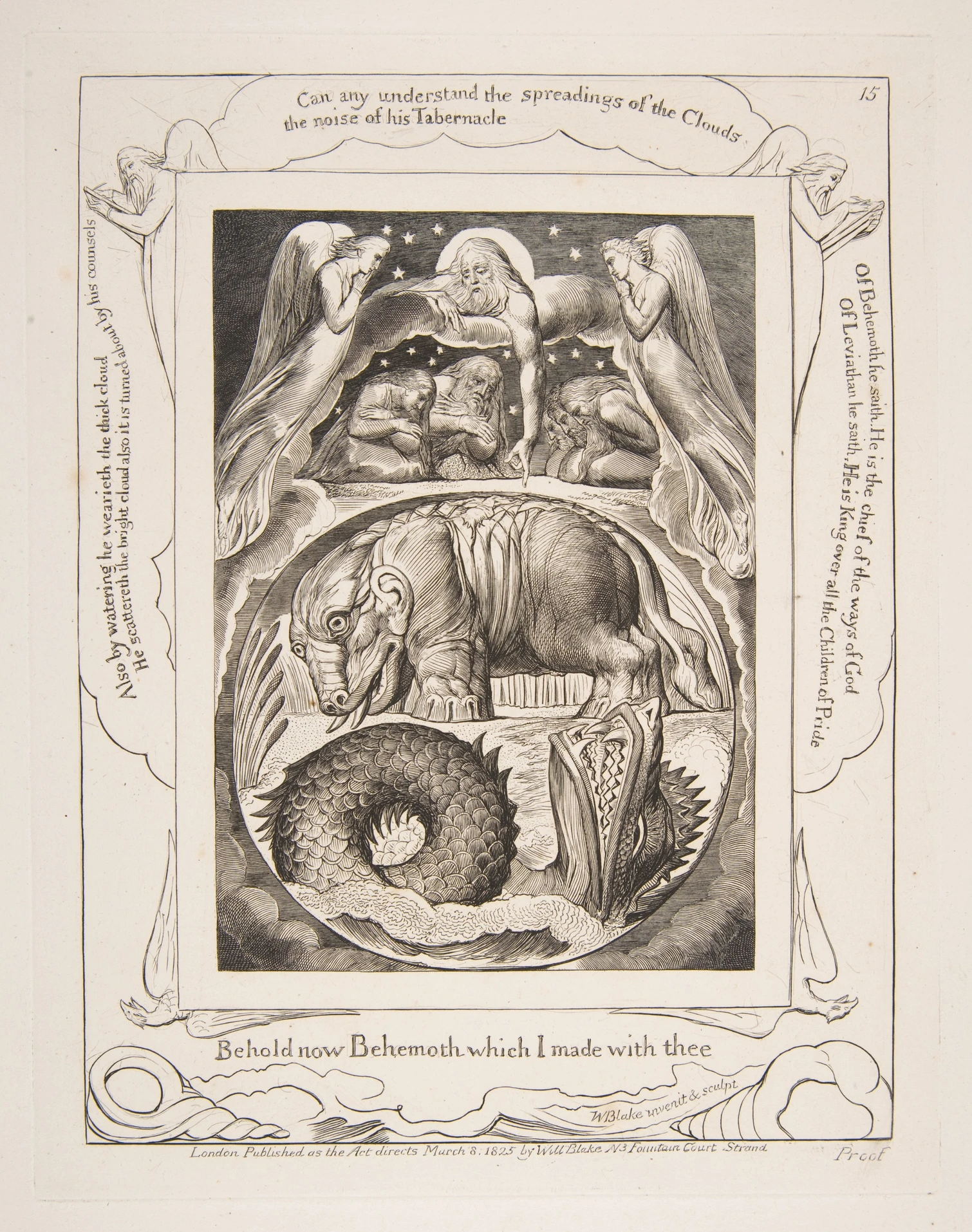
Behemoth
The heavy body, lowered head and thick limbs occupy the upper half of the enclosure. In Job 40 it eats grass and remains steady in a surging river.
Leviathan
Follow the scales around the coil and up towards the jaws at the right. Job 41 emphasises tightly joined scales and the creature’s movement through the deep.
The speaker and witness
The divine figure points down from above. Job and the other witnesses occupy the space between the clouds and the creatures.
Behemoth in Job 40:15–24
Grass, reeds, a powerful body and a rising river set the scene for Job’s first creature.
Find Behemoth’s descriptionLeviathan in Job 40:25 and 41
A hook, scales, fire and a shining wake mark the second creature in the same speech.
Find Leviathan’s description
In the Book of Job
What is the difference between Leviathan and Behemoth?
Behemoth and Leviathan are the two great creatures shown to Job in God’s speeches. Behemoth eats grass, lies among reeds and withstands the river. Leviathan resists hooks and weapons, has fitted scales and leaves a shining wake in the deep. In the New American Bible, Revised Edition, Behemoth appears in Job 40:15–24. Leviathan begins at 40:25 and continues through chapter 41. In the King James Version, the hook question opens chapter 41. [1][2][3]
The sequence matters. Job is being asked whether he can exercise the authority he has questioned. Both creatures test what a human can do, and the questions about Leviathan ask whether a listener can treat it like a catch, a servant or a pet. Reading those questions together gives a stronger sense of their place in the speech. [4][1][2][5]
Behemoth among grass, reeds and floodwater
Job 40 introduces Behemoth as a creature God made along with Job. The animal grazes like an ox. The speech moves through its loins, belly, tail and bones before placing it among lotus plants and reeds. When the river surges, its composure is the point. It can live in a landscape Job knows and still confront him with a strength outside his control. [1]
Some readers see a hippopotamus in the wetland setting and the massive body. The NABRE notes that possibility while describing the creature as a primeval monster. Treat resemblance as one clue. The comparisons to metal and a cedar describe force and scale in the speech, and the text supplies no modern species label. [1]
Leviathan, from the hook to the boiling deep
Start at Job 40:25 in the NABRE. The questions begin with a hook and a cord, then imagine people bargaining for the creature or keeping it in service. In chapter 41 the speech moves from the tightly joined scales and flashing light to smoke, fiery breath and weapons that fail against it. The last description moves back into the water, where its wake shines and the deep churns. [1][2]
A crocodile has often been proposed as part of the image. Scales, teeth and water make the comparison understandable, while the fire and the speech’s closing language push beyond an everyday encounter. The NABRE note presents the chaos-monster reading as stronger. The two proposals answer different questions about poetic imagery and possible animal models. [1][2]
Why the creatures are shown to Job
The speech from the whirlwind has already asked Job about the sea, weather and animals outside human care. Behemoth and Leviathan bring the question of human power to a climax. After the speech Job acknowledges the extent of God’s power and his own limited knowledge. The book leaves readers with these questions and responses. Later retellings can give the two animals separate histories or futures. [4][1][2][5]
Other texts and later readings
Leviathan in Psalm 104 and Isaiah 27
Psalm 104 places Leviathan in a sea filled with God’s creatures and traversed by ships. Its place there is part of a celebration of creation. Isaiah 27 opens differently: God’s sword will punish Leviathan, a fleeing and twisting serpent, and slay the dragon in the sea. These passages give Leviathan a different role in each setting. The first emphasises a living world in God’s care. The second uses the creature in a vision of judgment. [6][7]
The sea and wilderness in 1 Enoch 60
In 1 Enoch 60 the two are explicitly separated. The female Leviathan is placed in the watery abyss and the male Behemoth in a wilderness east of the garden. Those identifications and locations belong to this passage. Job does not give them that paired division by sex. Reading the works separately lets the reader see how an animal pair from divine speech can become part of an account of the world’s hidden spaces. [8][1][2]
How William Blake draws both creatures
Blake gathers Job, the divine figure and the two creatures into one composition. Behemoth fills the upper half of the enclosure with an elephant-like body, while Leviathan’s scales and upturned jaws fill the lower half. The separation is legible before one reads the lettering. The border gives Behemoth words from Job 40 and Leviathan words from the end of its description. The engraver makes the verbal sequence visible as two creatures presented together. [9][10][1][2]
Leviathan in Milton and Doré
Open Book I of Paradise Lost to the comparison with Satan. A sailor mistakes the sleeping creature for an island and fixes his anchor to it. Milton uses the scene to convey immense size. Book VII returns to Leviathan during the creation of sea life, where its body looks like moving land and it spouts water. Two readings of the same creature emerge even within one poem, because it serves a different purpose in each scene. [12][14]
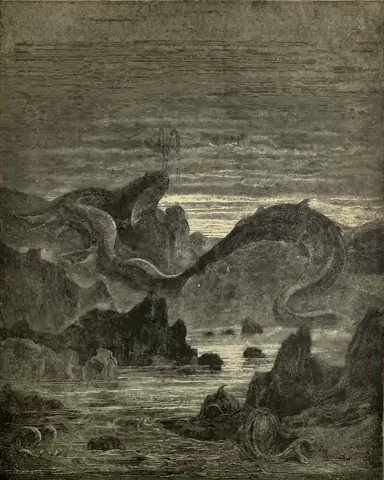
Doré’s engraving belongs with the creation episode. Follow the water spout and the arched body, then compare them with the verse in Book VII. Blake gives the animal a tight coil and places it beneath Behemoth. Doré gives it room to stretch across the sea. The images respond to two different books and two different moments. [13][14][11][9]
Read further in the library
Paradise Lost: Illustrated by Gustave Doré
Reading note
Read both of Milton’s uses of Leviathan and Doré’s accompanying illustration.
Sources
See references (14)
- Job 40:6–32 · From the whirlwind to Behemoth and the hook ↗New American Bible, Revised Edition, United States Conference of Catholic Bishops.Return to text ↑
- Job 41 · Leviathan’s scales, fiery breath and wake ↗New American Bible, Revised Edition, United States Conference of Catholic Bishops.Return to text ↑
- Job 41:1–2 · The hook question in the King James Version ↗King James Version, hosted by Bible Gateway.Return to text ↑
- Job 38 · The first answer from the whirlwind ↗New American Bible, Revised Edition, United States Conference of Catholic Bishops.Return to text ↑
- Job 42:1–6 · Job’s response ↗New American Bible, Revised Edition, United States Conference of Catholic Bishops.Return to text ↑
- Psalm 104:24–26 · Leviathan in creation ↗New American Bible, Revised Edition, United States Conference of Catholic Bishops.Return to text ↑
- Isaiah 27:1 · The sea dragon in a prophetic judgment ↗New American Bible, Revised Edition, United States Conference of Catholic Bishops.Return to text ↑
- 1 Enoch 60:7–9 · Leviathan and Behemoth receive different places ↗1 Enoch, translated by R. H. Charles, 1917, presented in a verse-by-verse digital edition.Return to text ↑
- William Blake · Behemoth and Leviathan, plate 15 ↗The Metropolitan Museum of Art, Gift of Edward Bement, 1917. Open Access.Return to text ↑
- Art Gallery of South Australia · Reading Blake’s composition ↗Art Gallery of South Australia, collection commentary on another impression of plate 15.Return to text ↑
- Gustave Doré · Leviathan in the Created Sea ↗Lumitheca Gallery, source leaf 209 in the illustrated Paradise Lost.Return to text ↑
- Paradise Lost, Book I · Satan compared in size with the sleeping sea beastJohn Milton, Paradise Lost, Lumitheca’s Doré-illustrated edition IMJ-0115-E001.Read this page in Paradise Lost: Illustrated by Gustave Doré ↗Return to text ↑
- Doré’s engraving · Leviathan in the created seaJohn Milton, Paradise Lost, Lumitheca’s Doré-illustrated edition IMJ-0115-E001.Read this page in Paradise Lost: Illustrated by Gustave Doré ↗Return to text ↑
- Paradise Lost, Book VII · Leviathan as a moving stretch of landJohn Milton, Paradise Lost, Lumitheca’s Doré-illustrated edition IMJ-0115-E001.Read this page in Paradise Lost: Illustrated by Gustave Doré ↗Return to text ↑