The Tibetan Book of the Dead: Bardo, Deities and Where to Start
Read the Tibetan Book of the Dead through its three stages around death, the peaceful and wrathful deities, and exact passages from the 1927 edition.
In this article
Read the mandalas alongside the text
The paintings reproduced in 1927 were made at Gyantse. Compare how the two arrangements give form to the peaceful and wrathful assemblies described in Book I.
The peaceful and wrathful mandalas
Open either scan to examine the details. The printed photographs show the arrangement in black and white, and the text supplies the colours.
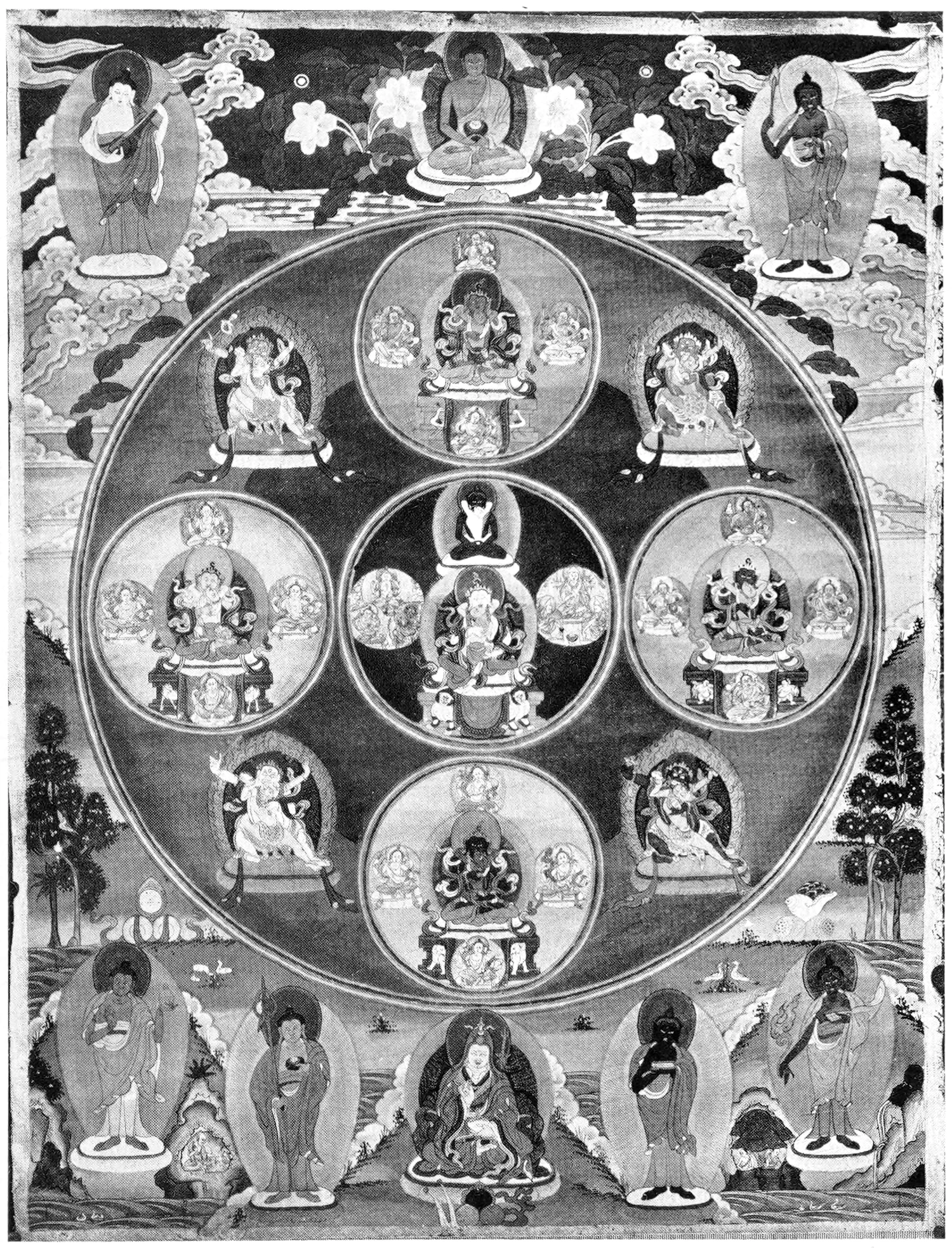
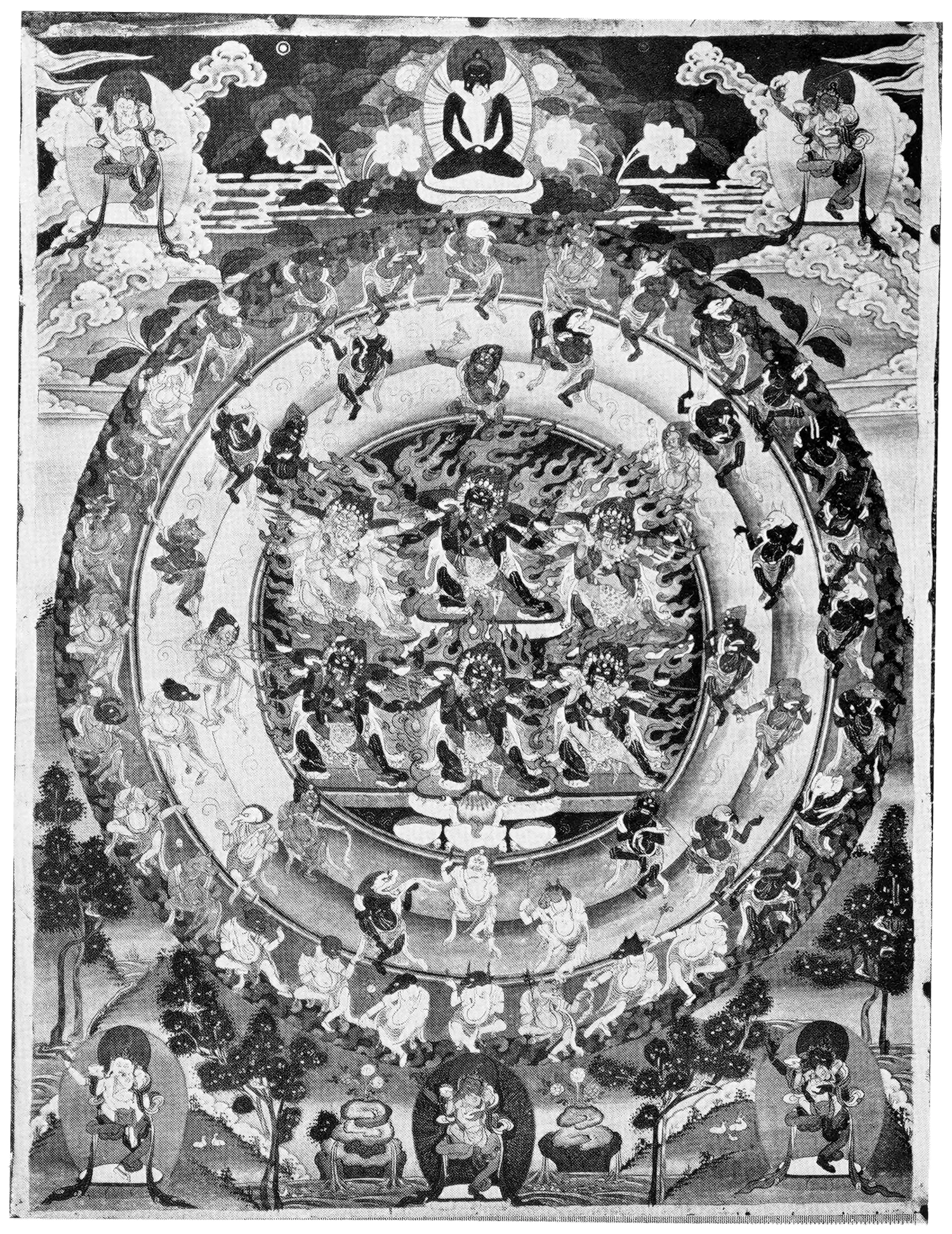
Start at the centre
- Peaceful deities
- Look for the cross of five round groups, then note the figures set between them. Book I brings the families together on the sixth day.
- Wrathful deities
- Find the central cluster in the field of flames. Follow the surrounding rings and compare their close-set figures with the wider gaps in Plate IV.
Read for recognition
- Peaceful deities
- On the first day, the text asks the listener to recognise Vairocana and the brilliant light that accompanies him.
- Wrathful deities
- On the eighth day, the speaker identifies the fierce Buddha-Heruka with Vairocana. The challenge in the passage is recognising him through fear.
Dying
Book I opens the first of the three stages around death with an address about recognising the clear light.
Read the clear-light passageReality
Follow the same instruction to recognise what appears through the changing forms of the peaceful and wrathful deities.
Read the transition to the bardo of realityBecoming
Book II describes the bardo body, the experience of karma and the prospect of rebirth.
Read about the bardo body
What is the Tibetan Book of the Dead?
The Tibetan Book of the Dead is the English title given in 1927 to a selection from the Bardo Thodol, a Tibetan Buddhist collection also known in English as Liberation Through Hearing in the Intermediate State. In the selection, the reader encounters three bardos around death: dying, the appearance of reality, and becoming on the way to rebirth. Begin with the first instruction on recognising the clear light, then follow the text’s examples of what recognition means. [1][7][8][9][14]
In the Nyingma tradition of Tibetan Buddhism, these texts belong to a wider cycle of teachings associated with Karma Lingpa, remembered as the revealer of a treasure attributed to Padmasambhava. The texts tell an officiant what to read aloud so that the dying or deceased person can recognise what appears and attain liberation. Karma Lingpa’s Root Verses also give a reader a short entry point into the larger teaching on transitions. [2][7][6][5]
See references (8)
- 1927 title page and list of illustrations
- Karma Lingpa · Root Verses on the Six Bardos
- Listening and Liberation · The text read aloud
- Tibetan funerary texts and the bardos
- The Bardo Thodol in the Karma Lingpa cycle
- Book I · Recognition of the Clear Light at death
- Book I · Instructions as the bardo of reality begins
- Book II · The bardo body
The three stages around death and the six bardos
Bardo means an interval or intermediate state. The first three verses of Karma Lingpa’s six-part prayer concern life, dreaming and meditation. Each presents an ordinary or cultivated mode of experience as an occasion for practice. The remaining verses address dying, dharmatā and becoming, which are the three intervals this guide follows in the 1927 edition. Different translators render dharmatā as reality, the nature of phenomena or the nature of things. Evans-Wentz’s edition uses the spelling Chönyid for that interval. [2][8][9][14]
The Rubin Museum describes readings associated with a forty-nine-day period. The 1927 edition also presents distinct day headings and makes what follows conditional on recognition. For example, Book I explains the eighth-day appearance by saying the preceding peaceful figures have already gone unrecognised. Read the numbers in the setting of the particular text and ritual tradition, keeping the invitation to recognise rather than fear what appears in view. [5][10][12][3]
See references (8)
- Karma Lingpa · Root Verses on the Six Bardos
- Terdak Lingpa · Liberation Upon Hearing
- Listening and Liberation · The text read aloud
- Book I · Recognition of the Clear Light at death
- Book I · Instructions as the bardo of reality begins
- Book I · The First Day and Vairocana
- Book I · Eighth Day and Buddha-Heruka
- Book II · The bardo body
Dying and the clear light
In Book I, the reader addresses the person directly at the moment of death. The section on the first clear light presents the recognition of this experience as a possibility for liberation. The instructions also return to people who have heard teachings but have difficulty recognising or remaining familiar with them. The passage thus treats prior familiarity as significant. Read the speaking instructions and the words addressed to the listener together, since the text assigns them different voices. [8][2]
Why the figures become peaceful and wrathful
The quieter figures in Book I appear with lights of different colours. On the first day the text describes Vairocana and a brilliant light, alongside a duller light to which the listener may be drawn. On the sixth day the earlier families appear as an assembly. Plate IV lets you compare that assembly’s centre, cardinal groups and figures near the perimeter. The photograph is monochrome. For the coloured lights, read the day passages or consult the edition’s caption, which describes details of the original painting. [10][11][21][1]
When the text introduces the wrathful figures, the reader again asks the listener to recognise what appears. One unusually explicit link joins the two sets of images: the eighth-day description identifies fierce Buddha-Heruka with Vairocana. Compare how the same instruction survives a change in the figures’ appearance. Plate V’s compact centre, flames and surrounding figures make the visual change clear. The response requested by the text remains recognition. [12][13][23]
The older manuscript reproduced in the frontispiece inserts miniature maṇḍalas into the writing itself. In folio 35a, the upper image, there is a large central assembly. In folio 67a, below, the centre is divided into compartments and ringed with smaller figures. Evans-Wentz’s introduction associates the latter with the animal-headed figures of the fourteenth day. The Rubin Museum’s Mongolian-script manuscript gives another view of illustration and text working together across different linguistic settings. [17][18][19][4]
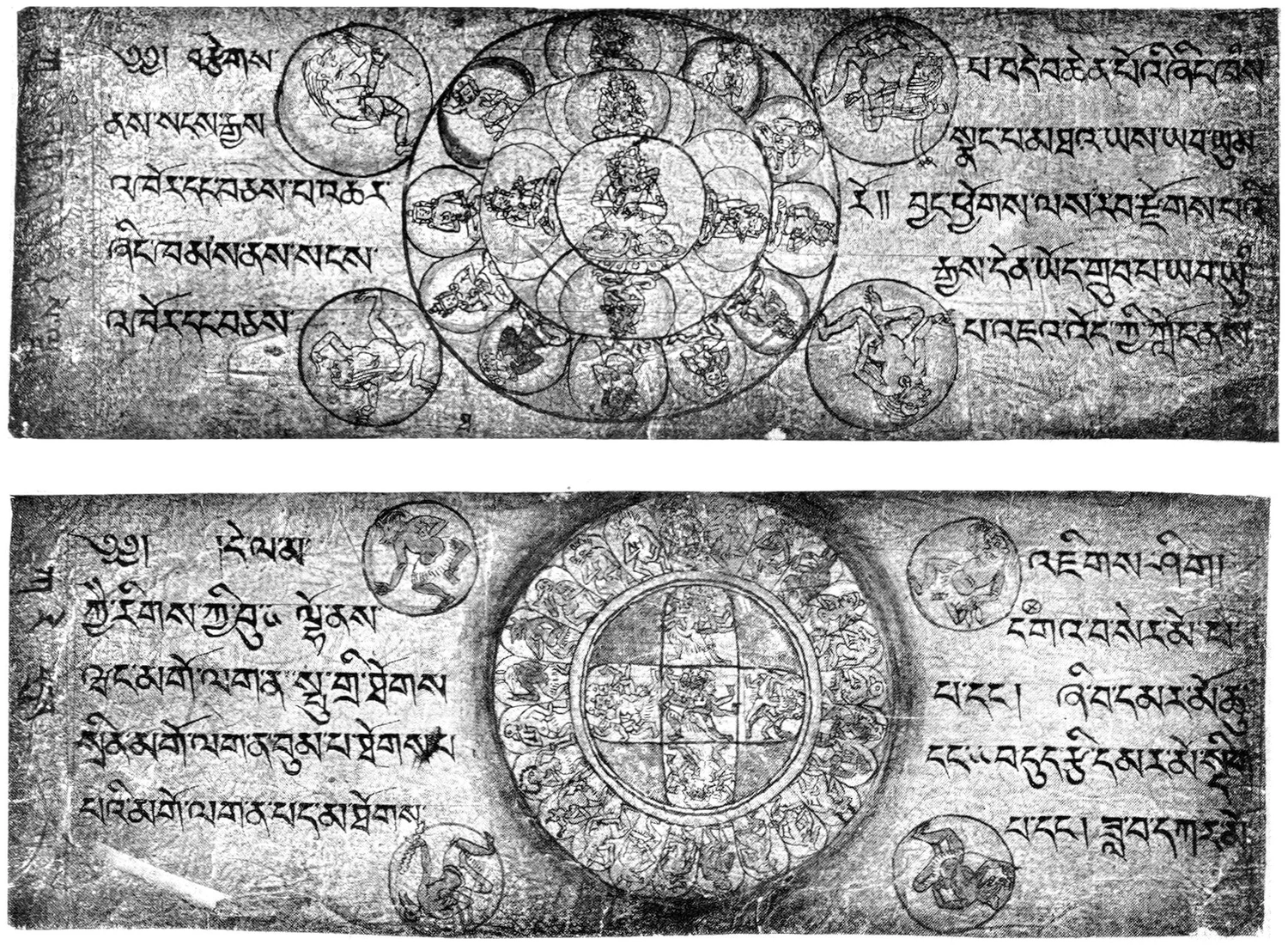
The 1927 frontispiece reproduces folios 35a and 67a of the edition’s Tibetan manuscript. The upper folio depicts the assembly that appears on the sixth day, and the lower has animal-headed figures described in the fourteenth-day passage.
Tibetan manuscript folios 35a and 67a. Photographic reproduction in the 1927 Oxford University Press edition edited by W. Y. Evans-Wentz. Public domain in the United States. · Image source ↗ · Public Domain
See references (11)
- 1927 title page and list of illustrations
- Illustrated Mongolian-script manuscript of the Bardo Thodrol
- Book I · The First Day and Vairocana
- Book I · The Sixth Day and the assembly
- Book I · Eighth Day and Buddha-Heruka
- Book I · The description and recognition of Buddha-Heruka
- Introduction · Description of the manuscript and its illuminations
- Introduction · The animal-headed figures on folio 67
- The 1927 frontispiece reproduces folios 35a and 67a of the edition’s Tibetan manuscript. The upper folio depicts the assembly that appears on the sixth day, and the lower has animal-headed figures described in the fourteenth-day passage.
- Plate IV, the peaceful maṇḍala, facing printed page 118. The painting reproduced here was commissioned at Gyantse.
- Plate V, the maṇḍala of knowledge-holding and wrathful deities, facing printed page 136. It is the companion painting to the peaceful maṇḍala.
Becoming, judgment and rebirth
Book II describes the bardo body and shows the listener struggling to understand what has happened. In a striking reckoning scene, good and harmful deeds are counted with pale and dark pebbles and a mirror reveals actions. The address that follows asks the listener to recognise the frightening scene in light of the text’s teaching on appearances. The sections on rebirth continue to offer responses, including ways to avoid a particular rebirth and, if rebirth follows, instructions on how to approach it. [14][15][16][3]
Where to start reading
Read the Root Verses once for the six-part structure, then go to the Clear Light, the first and eighth days, and the opening of the rebirth section. Read the lines addressed to the listener alongside what the officiant is told to do. In each passage ask what is said to arise, what the listener is asked to recognise, and what the text describes if recognition does not occur. The recurring questions make the formal language easier to follow. [2][8][10][12][16]
Use the 1927 rendering with its title page visible. It identifies Kazi Dawa-Samdup as the translator and Evans-Wentz as the editor, and their roles matter when you encounter the edition’s comparisons with other religions or its dated English terminology. The Smithsonian discusses how the English title invokes the Egyptian Book of the Dead. The Rubin Museum’s work on recitation and Terdak Lingpa’s separate text give two ways to place the English edition within a larger history of Tibetan Buddhist reading and listening. [1][7][3][5]
See references (9)
- 1927 title page and list of illustrations
- Karma Lingpa · Root Verses on the Six Bardos
- Terdak Lingpa · Liberation Upon Hearing
- Listening and Liberation · The text read aloud
- The Bardo Thodol in the Karma Lingpa cycle
- Book I · Recognition of the Clear Light at death
- Book I · The First Day and Vairocana
- Book I · Eighth Day and Buddha-Heruka
- Book II · The process of rebirth and its alternatives
Sources
See references (24)
- 1927 title page and list of illustrations ↗Kazi Dawa-Samdup’s English rendering, edited by W. Y. Evans-Wentz, The Tibetan Book of the Dead, Oxford University Press, 1927.Return to text ↑
- Karma Lingpa · Root Verses on the Six Bardos ↗Lotsawa House, Tibetan text and English translation.Return to text ↑
- Terdak Lingpa · Liberation Upon Hearing ↗Lotsawa House, Tibetan text and English translation.Return to text ↑
- Illustrated Mongolian-script manuscript of the Bardo Thodrol ↗Rubin Museum of Himalayan Art, object C2004.37.3.Return to text ↑
- Listening and Liberation · The text read aloud ↗Rubin Museum of Himalayan Art, exhibition essay.Return to text ↑
- Tibetan funerary texts and the bardos ↗University of Virginia Library, exhibition on Tibetan, Indian and Nepalese religious manuscripts.Return to text ↑
- The Bardo Thodol in the Karma Lingpa cycle ↗Smithsonian Folkways, Tibetan Book of the Dead recording liner notes.Return to text ↑
- Book I · Recognition of the Clear Light at death ↗Kazi Dawa-Samdup’s English rendering, edited by W. Y. Evans-Wentz, The Tibetan Book of the Dead, Oxford University Press, 1927.Return to text ↑
- Book I · Instructions as the bardo of reality begins ↗Kazi Dawa-Samdup’s English rendering, edited by W. Y. Evans-Wentz, The Tibetan Book of the Dead, Oxford University Press, 1927.Return to text ↑
- Book I · The First Day and Vairocana ↗Kazi Dawa-Samdup’s English rendering, edited by W. Y. Evans-Wentz, The Tibetan Book of the Dead, Oxford University Press, 1927.Return to text ↑
- Book I · The Sixth Day and the assembly ↗Kazi Dawa-Samdup’s English rendering, edited by W. Y. Evans-Wentz, The Tibetan Book of the Dead, Oxford University Press, 1927.Return to text ↑
- Book I · Eighth Day and Buddha-Heruka ↗Kazi Dawa-Samdup’s English rendering, edited by W. Y. Evans-Wentz, The Tibetan Book of the Dead, Oxford University Press, 1927.Return to text ↑
- Book I · The description and recognition of Buddha-Heruka ↗Kazi Dawa-Samdup’s English rendering, edited by W. Y. Evans-Wentz, The Tibetan Book of the Dead, Oxford University Press, 1927.Return to text ↑
- Book II · The bardo body ↗Kazi Dawa-Samdup’s English rendering, edited by W. Y. Evans-Wentz, The Tibetan Book of the Dead, Oxford University Press, 1927.Return to text ↑
- Book II · The reckoning with white and black pebbles and a mirror ↗Kazi Dawa-Samdup’s English rendering, edited by W. Y. Evans-Wentz, The Tibetan Book of the Dead, Oxford University Press, 1927.Return to text ↑
- Book II · The process of rebirth and its alternatives ↗Kazi Dawa-Samdup’s English rendering, edited by W. Y. Evans-Wentz, The Tibetan Book of the Dead, Oxford University Press, 1927.Return to text ↑
- Introduction · Description of the manuscript and its illuminations ↗Kazi Dawa-Samdup’s English rendering, edited by W. Y. Evans-Wentz, The Tibetan Book of the Dead, Oxford University Press, 1927.Return to text ↑
- Introduction · The animal-headed figures on folio 67 ↗Kazi Dawa-Samdup’s English rendering, edited by W. Y. Evans-Wentz, The Tibetan Book of the Dead, Oxford University Press, 1927.Return to text ↑
- The 1927 frontispiece reproduces folios 35a and 67a of the edition’s Tibetan manuscript. The upper folio depicts the assembly that appears on the sixth day, and the lower has animal-headed figures described in the fourteenth-day passage. ↗Tibetan manuscript folios 35a and 67a. Photographic reproduction in the 1927 Oxford University Press edition edited by W. Y. Evans-Wentz. Public domain in the United States.Return to text ↑
- Reuse record for the 1927 illustration ↗Tibetan manuscript folios 35a and 67a. Photographic reproduction in the 1927 Oxford University Press edition edited by W. Y. Evans-Wentz. Public domain in the United States.
- Plate IV, the peaceful maṇḍala, facing printed page 118. The painting reproduced here was commissioned at Gyantse. ↗Gyantse, Tibet, The Great Maṇḍala of the Peaceful Deities. Photographic reproduction in the 1927 Oxford University Press edition edited by W. Y. Evans-Wentz. Public domain in the United States.Return to text ↑
- Reuse record for the 1927 illustration ↗Gyantse, Tibet, The Great Maṇḍala of the Peaceful Deities. Photographic reproduction in the 1927 Oxford University Press edition edited by W. Y. Evans-Wentz. Public domain in the United States.
- Plate V, the maṇḍala of knowledge-holding and wrathful deities, facing printed page 136. It is the companion painting to the peaceful maṇḍala. ↗Gyantse, Tibet, The Great Maṇḍala of the Knowledge-Holding and Wrathful Deities. Photographic reproduction in the 1927 Oxford University Press edition edited by W. Y. Evans-Wentz. Public domain in the United States.Return to text ↑
- Reuse record for the 1927 illustration ↗Gyantse, Tibet, The Great Maṇḍala of the Knowledge-Holding and Wrathful Deities. Photographic reproduction in the 1927 Oxford University Press edition edited by W. Y. Evans-Wentz. Public domain in the United States.