The Buddhist Wheel of Life Explained, Section by Section
Explore the Buddhist Wheel of Life through an annotated Tibetan painting. Find the three poisons, six realms and twelve links of dependent origination.
In this article
Follow the wheel from the hub to the rim
Use the five markers to explore this Tibetan painting. The key below the picture follows the same order.
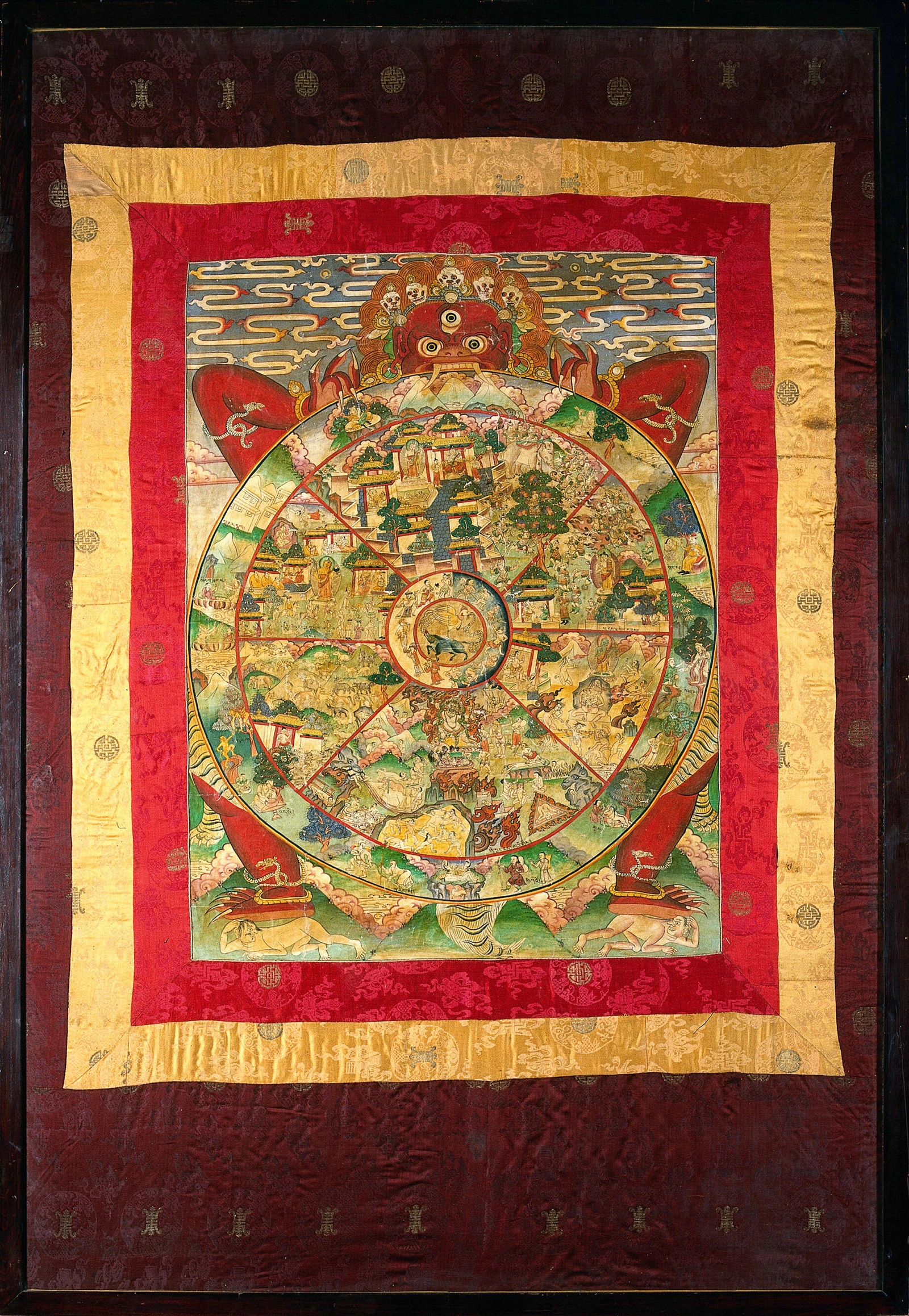
The three poisons
Find the pig, snake and rooster around the hub. They represent ignorance, aversion and craving.
The light and dark paths
The smaller figures inside the band immediately around the hub rise or fall. The band gives the viewer a picture of movement through saṃsāra.
The six realms
The large wedges depict realms of rebirth. This marker sits in the human realm, which you can also see in the enlarged detail below.
The twelve links
The outer rim holds a sequence of small painted scenes. Use the twelve-link key with the artist’s version and the discourse side by side.
The holder of the wheel
Follow the rim up to Yama, identified by the Wellcome catalogue as the Lord of Death.
How to read the Buddhist Wheel of Life
The Buddhist Wheel of Life, or bhavacakra, is a picture of saṃsāra, the recurring cycle of conditioned existence. In the Wellcome painting, three animals occupy the hub, an inner band shows beings going up or down, six wedges depict realms of rebirth, and the outer ring shows scenes from the chain of dependent origination. The figure who holds the wheel is Yama, the Lord of Death. Each part gives a different way to ask why the cycle continues. [1][3][7]
Read from the centre outward. First identify what sets the wheel in motion. Then follow the movement of beings and compare the worlds shown in the wedges. The scenes around the rim give a sequence to trace. The Vinaya account preserved in translation describes a wheel at a monastery gate, where it could be explained to people arriving. A portable thangka gives a particular visual form to the same teaching practice. [1][3][9]
The three animals at the hub
At the centre, the pig represents ignorance, the snake hatred or aversion, and the rooster craving or attachment. The animals are shown turning around one another. Notice the difference between the visual device and the teaching it helps readers remember. The photograph lets you locate the animals and see their relation. The museum’s key and the text give the terms by which their meanings are taught. [1][3][7]
Ignorance has a specific meaning in the sequence. The discourse connects it to a failure to understand suffering, its origin and cessation, and the path to cessation. It puts ignorance at the head of a series of conditions. The picture makes ignorance one of three recurrent poisons at the centre. Reading the text and the painting together shows how the same concept does different work in an account of dependent origination and in an image of the cycle. [7][3]
The band of rising and falling beings
The next ring shows people moving through lighter and darker areas. In the Rubin’s explanation, the two directions visualise the consequences of action and the movement of beings towards different experiences of rebirth. The image gives the viewer two directions to compare before it opens into the six realms. The moving figures remain inside the wheel on both sides. [1][3]
The six realms of rebirth
The six wedges depict gods, asuras or rival gods, humans, animals, hungry ghosts and beings in hell. The three worlds of Buddhist cosmology group existence in another way, by the realms of desire, form and formlessness. Here the painting makes particular modes of existence visible, with figures, dwellings and activities. Read the wedges as one painting’s representation of rebirth, with variation across Buddhist texts and artworks. [1][5][7]
Use the enlarged human wedge to see how much can fit inside one segment. Around the standing haloed figure are households, gatherings, work and people at bedsides. This detailed scene can be read as an image of conditions within human life. On the full photograph, find it at upper left. The wedge gives human concerns a place within the surrounding cycle depicted by the whole painting. [2][1]
Painters vary the divisions. In the Rubin’s Sikkim wheel, the gods and demigods share a section. The Wellcome catalogue identifies six sections in the thangka used here. When you compare wheels, start with the catalogue or a reliable visual key for that particular object. [1][4]
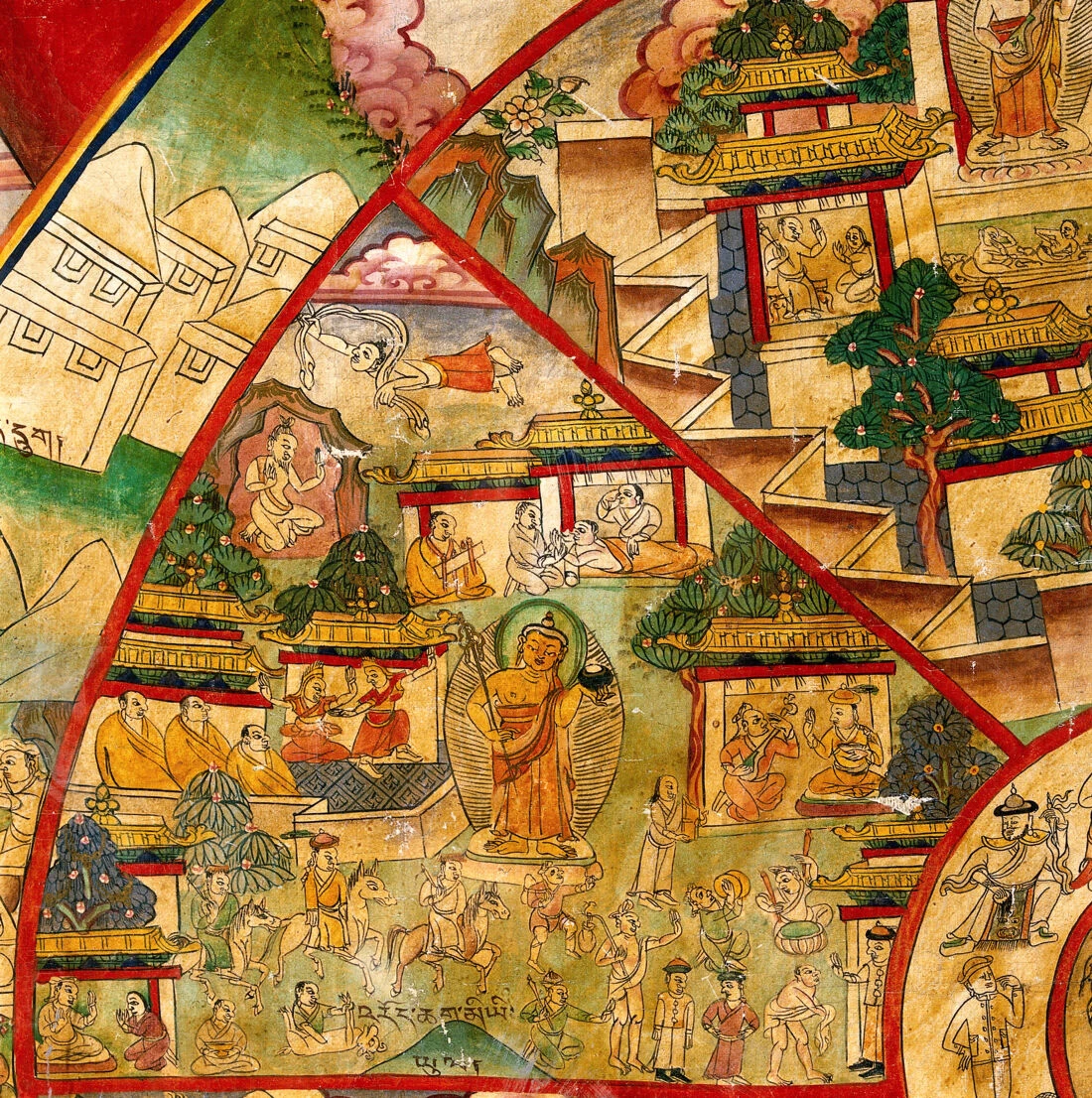
The human realm from the Wellcome painting. A haloed figure stands above a busy human world, with scenes of birth, ordinary work and death.
Wellcome Library, London, detail of the human realm, digital image V0017710. Resized for display. · Image source ↗ · CC BY 4.0
The twelve links pictured around the rim
The rim turns dependent origination into a sequence of small scenes. In Saṁyutta Nikāya 12.2, each factor is explained in words. The illustrated examples below follow the catalogues of two other Wellcome wheels. Together they give a guide to recurring motifs, including the potter, the house and the body being carried away. Which scene occupies a particular place and even which image represents a given link can vary by painting. [5][6][7]
Take one short run of the sequence. Contact and feeling are followed by craving and clinging. Put the embrace, the wound, the drink and the fruit beside the definitions in the discourse. The images give each condition a distinct cue. The text makes clear that feeling and craving, for instance, are related factors with different roles. [5][6][7]
- 1. Ignorance
- A person with a stick who cannot see ahead. The discourse describes ignorance as lack of understanding of suffering, its origin, its cessation and the path.
- 2. Formations
- A potter shaping a vessel. Volitional formations, or choices in Sujato’s translation, are classified as bodily, verbal and mental.
- 3. Consciousness
- A monkey leaping or moving from place to place. The discourse lists consciousness of sights, sounds, smells, tastes, touches and ideas.
- 4. Name and form
- People together in a boat. The discourse groups feeling, perception, intention, contact and attention under name, and material qualities under form.
- 5. Six sense bases
- A building with openings. Sight, hearing, smell, taste, touch and mind each have their own base in the discourse.
- 6. Contact
- Two people in an embrace. The six kinds of contact correspond to the six bases, including mental contact.
- 7. Feeling
- A person struck in the eye. Feeling in the discourse is what arises in dependence on each of the six kinds of contact.
- 8. Craving
- Someone drinking or being served a drink. The discourse lists craving directed at sights, sounds, smells, tastes, touches and ideas.
- 9. Clinging
- A figure gathering fruit. The discourse distinguishes grasping at pleasures, views, rules and observances, and beliefs about a self.
- 10. Becoming
- A pregnant figure in some pictures. The discourse distinguishes becoming in the sensual, form and formless realms.
- 11. Birth
- A birth scene in many wheels. The text defines birth in terms of the appearance of the aggregates and the acquisition of sense bases.
- 12. Ageing and death
- A corpse being carried away. The discourse distinguishes physical decline from death, the breaking up of the aggregates.
Yama and the possibility of release
Yama grasps the rim and looks over the top of the wheel. His position frames everything inside it as subject to death. The Vinaya description gives the picture an explicitly instructive use and includes what is to be shown outside the wheel. For the underlying teaching, read Saṁyutta Nikāya 12.1 alongside the image. It gives the sequence of cessation as well as that of arising. At each step the removal of a condition has consequences for what follows. [1][3][9][8]
Read the chain and the picture in the Library
In The Buddhist Catechism, Olcott sets out the twelve nidānas in English and uses terms that reflect his edition and period. Compare his list with the definitions in Saṁyutta Nikāya 12.2, especially formations and consciousness. The comparison helps when two English guides use different words for the same link. [10][7]
Then open Deniker’s introduction in The Gods of Northern Buddhism. He describes a three-ring arrangement and calls its holder a dragon. The Wellcome catalogue identifies the figure in the thangka shown here as Yama. The paintings and descriptions can be read together if we keep each name attached to its own source and check which parts of the wheel the author counted. [11][1][3]
Read further in the library
The Buddhist Catechism
Reading note
Compare Olcott’s numbered presentation of the causal chain with the early Buddhist discourse.
The Gods of Northern Buddhism
Reading note
Read Deniker’s introduction on how a painted wheel organises Buddhist teachings.
Sources
See references (11)
- Wellcome Collection · Tibetan Wheel of Life thangka ↗Tibetan thangka, Wellcome Collection, digital image V0017709. Public Domain Mark.Return to text ↑
- Wellcome Library · Detail of the human realm ↗Wellcome Library, London, detail of the human realm, digital image V0017710. CC BY 4.0.Return to text ↑
- Rubin Museum · The Wheel of Life explained ring by ring ↗Rubin Museum of Himalayan Art, guide to Wheel of Life, C2006.66.131.Return to text ↑
- Rubin Museum · Wheel of Life from Sikkim, c. 1930 ↗Rubin Museum of Himalayan Art, C2004.21.1.Return to text ↑
- Wellcome Collection · Twelve links on a separate gouache ↗Wellcome Collection, Tibetan gouache 45157i.Return to text ↑
- Wellcome Collection · Twelve links on a separate ink drawing ↗Wellcome Collection, iconographic record for Yama holding the Bhavacakra.Return to text ↑
- Saṁyutta Nikāya 12.2 · The twelve links defined ↗Vibhaṅgasutta, translated from Pali by Bhikkhu Sujato.Return to text ↑
- Saṁyutta Nikāya 12.1 · Arising and cessation ↗Paṭiccasamuppādasutta, translated from Pali by Bhikkhu Bodhi.Return to text ↑
- Mūlasarvāstivāda Vinaya · Instructions for painting a wheel at the gate ↗Himalayan Art Resources, translated Vinaya extract and contextual notes.Return to text ↑
- Olcott · The Twelve NidānasHenry S. Olcott, The Buddhist Catechism, 36th ed., 1903, source leaf 87.Read this page in The Buddhist Catechism ↗Return to text ↑
- Deniker · The Wheel of Life in the introduction to GettyJ. Deniker’s introduction in Alice Getty’s The Gods of Northern Buddhism, reprint of the revised 1928 edition, source leaf 48.Read this page in The Gods of Northern Buddhism ↗Return to text ↑