The three worlds in Buddhism
The three worlds in Buddhism are desire, form and formlessness. Learn how they relate to rebirth, Nirvana and the teaching of the Bhava Sutta.
In this article
Desire, form and formlessness
The three worlds in Buddhist cosmology are the worlds of desire, form and formlessness. The first is the sphere of sense desire, the second is associated with refined forms of existence, and the third with experiences beyond material form. All three belong to conditioned existence. [3][1]
The six realms describe kinds of rebirth, including humans, animals and hungry ghosts. The three worlds organise existence in a different way. In Hearn’s Buddhist glossary, Nirvana lies beyond them all. [3][4][5][1]
Bhava Sutta: the conditions of becoming
In the Bhava Sutta (Aṅguttara Nikāya 3:77), Ānanda asks the Buddha what becoming means. The Buddha compares kamma to a field, consciousness to a seed and craving to moisture. The same pattern accounts for renewed becoming in sensuality, form and formlessness. [1]
In Ghostly Japan by Lafcadio Hearn
In Japanese Buddhist Proverbs, Lafcadio Hearn explains the word sangai while discussing a proverb about attachment to a child. In that context it means desire, form and formlessness. His note also records another usage for the three times of past, present and future. [3]
Other proverbs in the book describe the three worlds as offering no lasting rest and the six roads of rebirth as close at hand. Hearn explains them through karma and its consequences in future lives. [4][5]
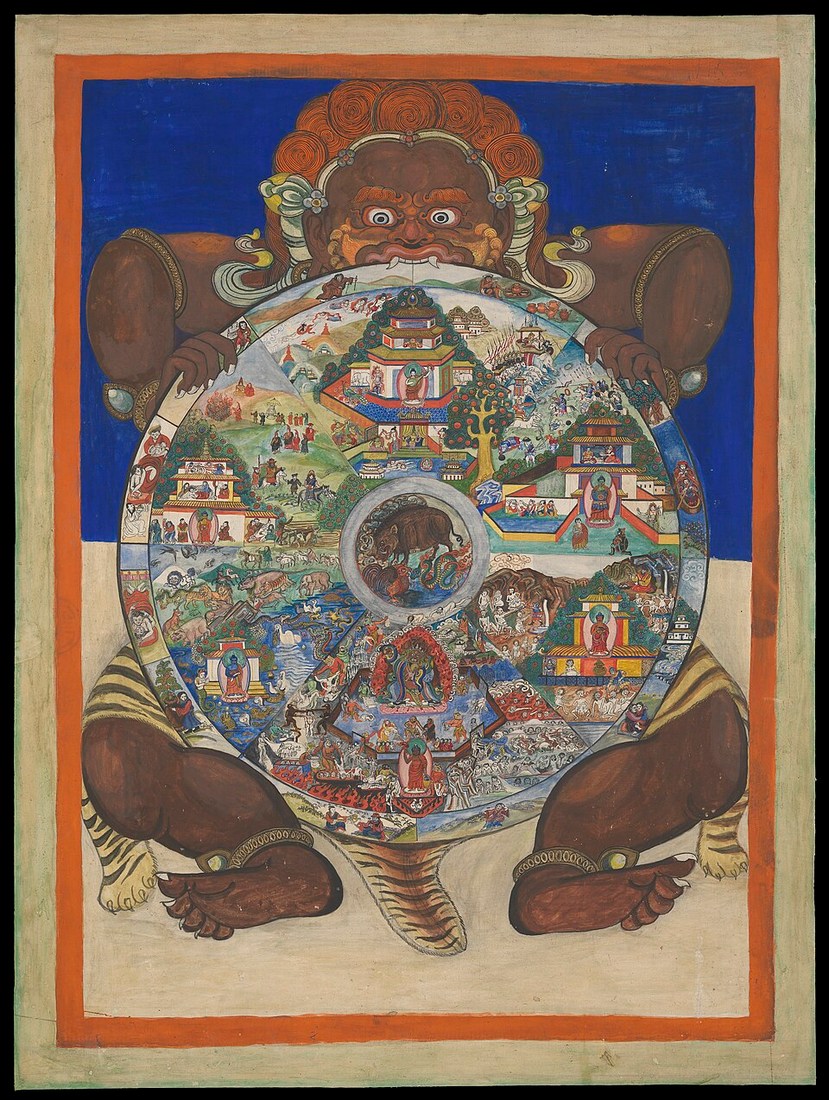
Yama holds the Wheel of Becoming in this Wellcome Collection gouache. The wheel depicts six realms of rebirth.
Wellcome Collection, 45157i, image L0069380, via Wikimedia Commons. CC BY 4.0; resized and converted to JPEG. · Image source ↗ · CC BY 4.0
A state of becoming and the causes of rebirth
Hearn’s sayings use cosmology to make sense of everyday actions and attachments. The Bhava Sutta explains how becoming continues even in the formless world, where craving can still sustain renewed existence. [3][1]
Read further in the library

In Ghostly Japan
Reading note
The separately titled account draws on exact passages in the consulted Library edition.
Sources
See references (5)
- Bhava Sutta, Anguttara Nikaya 3:77; translated by Thanissaro Bhikkhu ↗Primary discourse on becoming in sensuality, form and formlessness. Complete main discourse directly read; canonical number identifies the passage without a fictitious Library page.Return to text ↑
- Unidentified artist, Yama holding the Bhavacakra or Wheel of life, undated gouache ↗Wellcome Collection, 45157i, image L0069380, via Wikimedia Commons. CC BY 4.0; resized and converted to JPEG.
- In Ghostly Japan, Reader page 176Lafcadio Hearn, In Ghostly Japan, Little, Brown, and Company, Boston, 1899. Exact consulted Library edition IMJ-0654-E001, with title page visually checked. Persistent PageIDs and current Reader positions are verified from the supplied edition. Embedded stories, translations and quotations are attributed to Hearn’s presentation unless an original source has separately been consulted.Read this page in In Ghostly Japan ↗Return to text ↑
- In Ghostly Japan, Reader page 182Lafcadio Hearn, In Ghostly Japan, Little, Brown, and Company, Boston, 1899. Exact consulted Library edition IMJ-0654-E001, with title page visually checked. Persistent PageIDs and current Reader positions are verified from the supplied edition. Embedded stories, translations and quotations are attributed to Hearn’s presentation unless an original source has separately been consulted.Read this page in In Ghostly Japan ↗Return to text ↑
- In Ghostly Japan, Reader page 183Lafcadio Hearn, In Ghostly Japan, Little, Brown, and Company, Boston, 1899. Exact consulted Library edition IMJ-0654-E001, with title page visually checked. Persistent PageIDs and current Reader positions are verified from the supplied edition. Embedded stories, translations and quotations are attributed to Hearn’s presentation unless an original source has separately been consulted.Read this page in In Ghostly Japan ↗Return to text ↑