Bardo Visions: What Does It Mean to Recognise What You See?
Read what recognition means in Tibetan bardo texts. Compare Vairocana and Buddha-Heruka, the role of hearing and the response to fear.
In this article
Follow recognition through four readings
Read what appears, how the person responds and what each text asks them to do.
- Karma Lingpa · Root Verses
Set the intention
Recognition and fear
Read the dharmatā stanza as preparation for what appears. - 1927 edition · First Day
Meet Vairocana
The bright and dull lights
Trace what the listener is drawn to and what the recitation asks them to recognise. - 1927 edition · Eighth Day
Meet Buddha-Heruka
A change in appearance
Follow the connection from the wrathful figure back to Vairocana. - Jigme Lingpa · Training in Pure Realms
Read the next possibility
Fear and renewed aspiration
Find where the prayer changes course after recognition fails.
What the listener is asked to recognise
The stanza on dharmatā in Karma Lingpa’s Root Verses asks the reader to relinquish fear and recognise what appears as the expression of awareness. Peaceful and wrathful figures bring that instruction to a specific encounter. Giving the figure a name can help a reader follow the text. The crucial question is what the encounter is taken to be. [1][5]
The stanza holds recognition and fear close together. Recognition includes a change in how the person understands the appearance that frightened them. The instruction belongs to a Tibetan Buddhist account of liberation, with its own vocabulary of awareness, habitual tendencies and rebirth. [1][7]
Vairocana and two kinds of light
On the first day in the 1927 English edition, Vairocana appears with a brilliant light associated with wisdom. The same passage describes the duller light of the gods, which the listener may find easier to approach. What feels easier to face can lead away from what the recitation asks the listener to recognise. [2]
Mark three things in the passage: the appearance, the habitual response and the response the recitation requests. The same questions help with later days, when the name, colour and setting change. Use the plate for the arrangement of the assembly and read the first-day passage for the order of the two lights. [2][9]
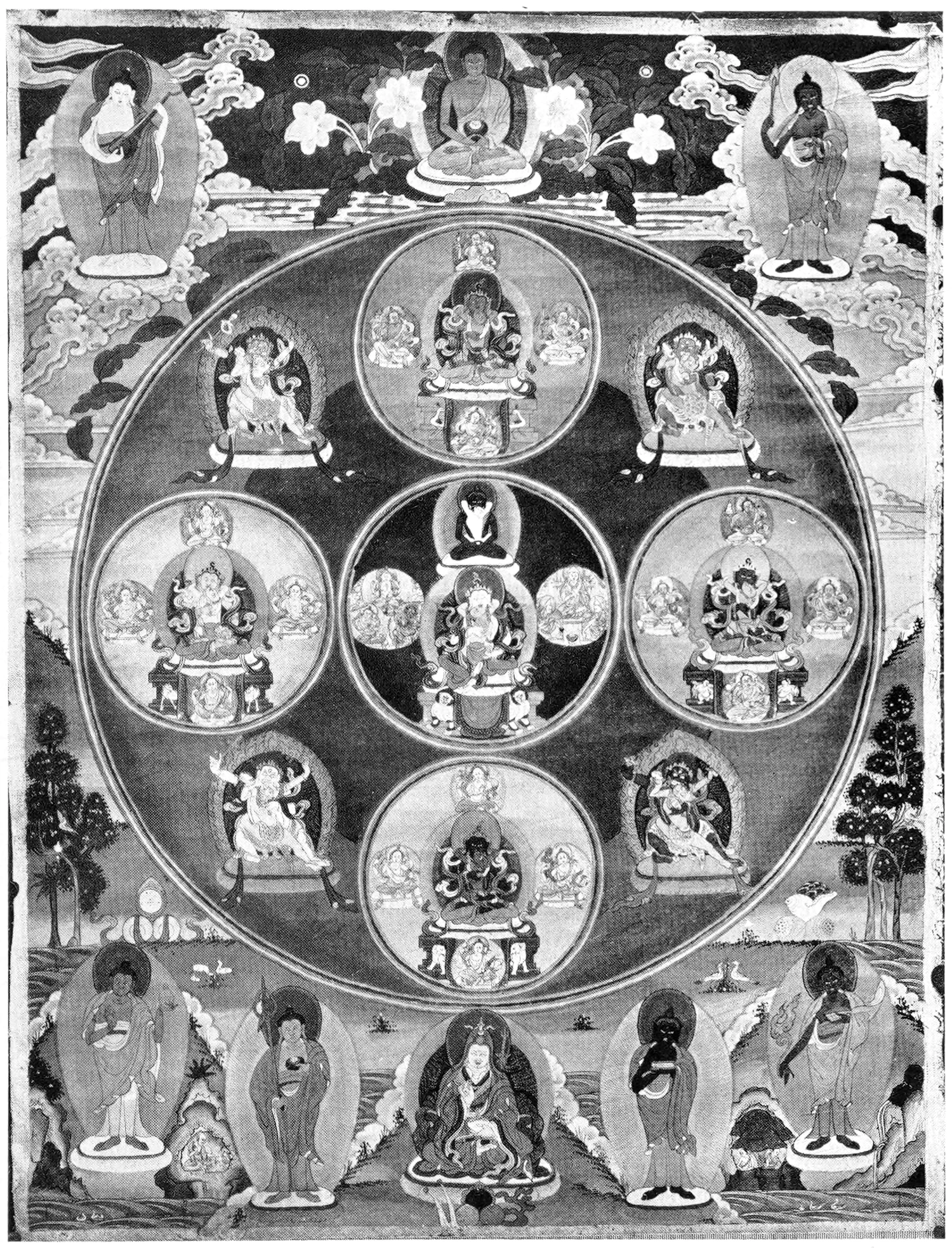
The seated group at the centre belongs to the assembly depicted for the sixth day. The first-day text introduces Vairocana before that assembly appears.
Gyantse, Tibet, The Great Maṇḍala of the Peaceful Deities. Photographic reproduction in the 1927 Oxford University Press edition edited by W. Y. Evans-Wentz. Public domain in the United States. · Image source ↗ · Public Domain
See references (2)
Why the instruction returns with Buddha-Heruka
The eighth-day passage begins from a missed opportunity. The peaceful appearances have gone unrecognised, and fierce forms now appear. The recitation identifies Buddha-Heruka as the wrathful form of Vairocana. The figure’s manner of appearing changes sharply. The listener is again asked to recognise what is appearing. [2][3][4]
In the plate, look first at the flames and the group at the centre. The prose addresses the listener through the fear these attributes can provoke. Picture and text work differently: the plate lets the viewer take in several figures at once, while the passage has time to describe the listener’s response and invite a different one. [3][4][10]
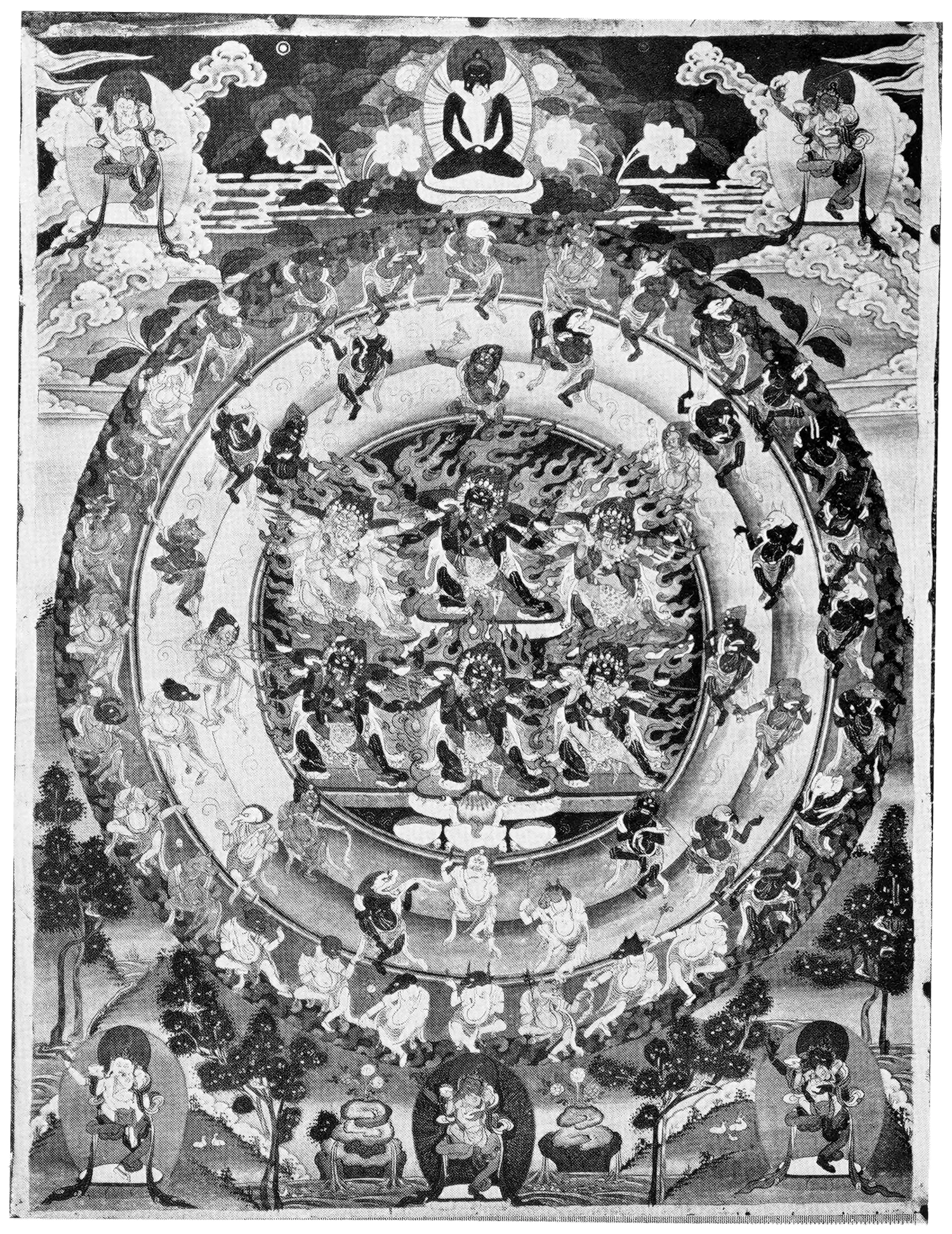
Flames frame the central figures. The plate depicts an assembly, while the eighth-day text isolates one encounter and asks the listener to recognise Buddha-Heruka.
Gyantse, Tibet, The Great Maṇḍala of the Knowledge-Holding and Wrathful Deities. Photographic reproduction in the 1927 Oxford University Press edition edited by W. Y. Evans-Wentz. Public domain in the United States. · Image source ↗ · Public Domain
Why someone reads the instruction aloud
Minling Terchen Gyurme Dorje’s explanation distinguishes the person speaking from the one being addressed. It asks the reciter to speak slowly, identify the person by name and approach the occasion with compassion. The short admonitions make sense as speech addressed to someone who may be frightened or distracted. [6][8]
The root stanza speaks in the first person. Put the two voices beside each other. The stanza sets an intention to recognise. The recitation supplies a reminder addressed to another person when attention may be difficult to sustain. [1][6]
What if fear takes over?
Jigme Lingpa’s aspiration pictures liberation through recognition with the image of a child returning to its mother. The next verses imagine fear at the sounds, rays and forms, then ask for another opportunity through the teacher’s blessing and birth in a pure realm. The movement from recognition to renewed aspiration gives the prayer an alternative to follow when the first possibility eludes the practitioner. [7]
Compare that turn with the eighth-day transition in the 1927 edition. There, missed recognition structures the sequence of appearances. In Jigme Lingpa’s prayer, it changes what the practitioner asks for. One is an instruction accompanying a narrated sequence and the other is an aspiration intended for recitation. [3][7]
Read the instruction in two English renderings
The 1927 edition uses the language of thought-forms in its introduction to the bardo of reality. Adam Pearcey’s bilingual Root Verses use the language of awareness and its display. Start with the dharmatā stanza and then read the prose instruction addressed to the listener. Both passages place an interpretation of the appearance beside an instruction about fear. [5][1]
For a short reading sequence, begin with the root stanza, read the two day passages and finish with Jigme Lingpa’s change of aspiration. At each stop, ask what appears, who is speaking and what possibility the text holds open. [1][2][3][7]
Sources
See references (10)
- Karma Lingpa’s stanza on dharmatā ↗Karma Lingpa, Root Verses on the Six Bardos, trans. Adam Pearcey, Lotsawa House.Return to text ↑
- The First Day and Vairocana ↗Kazi Dawa-Samdup’s English rendering, edited by W. Y. Evans-Wentz, The Tibetan Book of the Dead, Oxford University Press, 1927, Book I.Return to text ↑
- The Eighth Day and the transition to wrathful forms ↗Kazi Dawa-Samdup’s English rendering, edited by W. Y. Evans-Wentz, The Tibetan Book of the Dead, Oxford University Press, 1927, Book I.Return to text ↑
- The invitation to recognise Buddha-Heruka ↗Kazi Dawa-Samdup’s English rendering, edited by W. Y. Evans-Wentz, The Tibetan Book of the Dead, Oxford University Press, 1927, Book I.Return to text ↑
- Instructions as the bardo of reality begins ↗Kazi Dawa-Samdup’s English rendering, edited by W. Y. Evans-Wentz, The Tibetan Book of the Dead, Oxford University Press, 1927, Book I.Return to text ↑
- The officiant’s role in Liberation Upon Hearing ↗Minling Terchen Gyurme Dorje, Liberation Upon Hearing: An Explanation of the Phenomena of the Intermediate State, Lotsawa House.Return to text ↑
- Recognition, fear and a further aspiration ↗Jigme Lingpa, Training in Pure Realms, trans. Rigpa Translations, Lotsawa House.Return to text ↑
- Recitation and ritual context ↗Rubin Museum of Himalayan Art, Listening and Liberation: The World Is Sound.Return to text ↑
- 1927 plate rights and reproduction record ↗Gyantse, Tibet, The Great Maṇḍala of the Peaceful Deities. Photographic reproduction in the 1927 Oxford University Press edition edited by W. Y. Evans-Wentz. Public domain in the United States.Return to text ↑
- 1927 plate rights and reproduction record ↗Gyantse, Tibet, The Great Maṇḍala of the Knowledge-Holding and Wrathful Deities. Photographic reproduction in the 1927 Oxford University Press edition edited by W. Y. Evans-Wentz. Public domain in the United States.Return to text ↑