The Egyptian Book of the Dead: An Illustrated Spell Guide
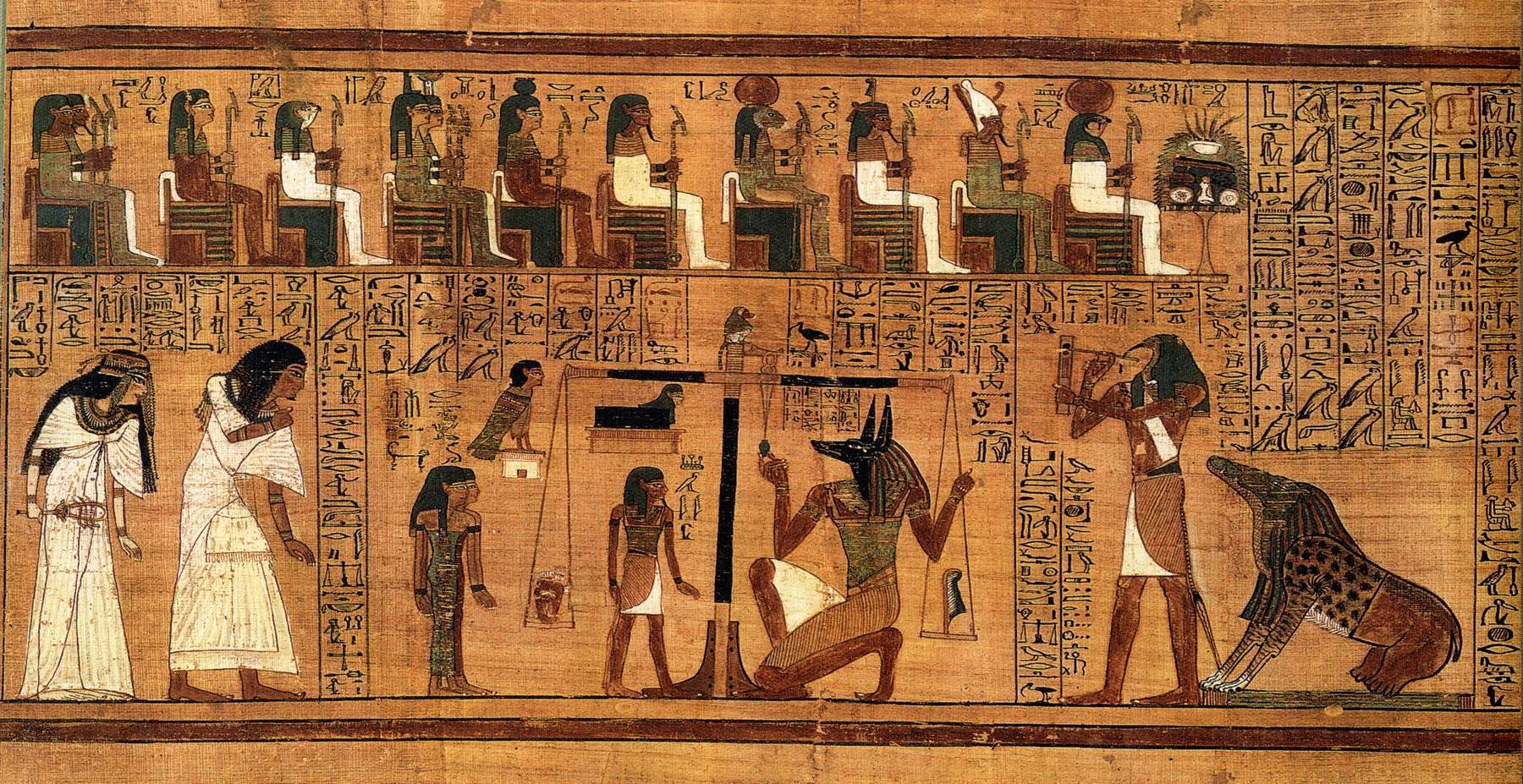
The Egyptian Book of the Dead is a collection of funerary spells selected for particular burials. In the Papyrus of Ani, a balance weighs Ani’s heart against the feather of Ma’at. Read that scene first, then use the spell guide to find the words addressed to the heart, the declarations of innocence and other spells for the journey after death.
Read Ani’s weighing of the heart
Start with Ani and Tutu at the left. The markers identify the people and objects that show how the judgment unfolds across the lower register, and the assembly above them.

Ani and Tutu
Ani, closest to the balance, and his wife Tutu bow as they approach the weighing from the left.
The divine assembly
The seated gods occupy the upper register. Here they watch over Ani’s judgment.
The heart and feather
Ani’s heart is on the left pan. The feather of Ma’at, associated with truth and right order, is on the right.
Anubis
The jackal-headed god kneels at the balance and attends to its mechanism.
Thoth
The ibis-headed scribe stands to the right of the balance and records the verdict.
Ammit
The waiting devourer combines a crocodile’s head with lion and hippopotamus features. Ani proceeds to Osiris on the following sheet.
Why Ani’s weighing scene is associated with two spell numbers
In the facsimile published by the British Museum, E. A. Wallis Budge identifies the words spoken by Ani at this weighing as spell 30B. He addresses his own heart and asks it to refrain from testifying against him. The same composition also appears on heart scarabs. That intimate address is different in form from the series of declarations made before divine assessors in spell 125.
Spell 125 concerns entry into the judgment hall. Modern editions commonly distinguish an address to the great god from the declarations known collectively as the Negative Confession. The wider judgment scene can accompany spell 125 in other copies. For this object, cite Ani’s frame 3 and spell 30B when referring to the words beside the balance. Use the spell 125 sources when discussing the declarations.
After the balance, Ani appears before Osiris
In the next frame, Horus leads Ani toward the seated Osiris. The detail below shows Ani kneeling before the shrine, with offerings between him and the god of the dead. Isis and Nephthys stand behind Osiris.
Read frames 3 and 4 in sequence. The heart’s speech belongs to the weighing. The following frame shows the successful approach to Osiris in a different setting. Keeping the frame numbers with your notes lets you tell someone exactly which part of the papyrus you mean.

Eight spells to start with
The list mixes scene, speech and objects so you can see what the corpus does. The links identify modern spell numbers or named manuscript examples. In translations that use Roman numerals, 30B may be printed XXXB and 125 as CXXV.
- 6
Ask the shabti to take on work
The figure answers when the deceased is called to perform labour in the next world. Related inscriptions can appear on the figurine itself.
Read the Papyrus of Nu version - 15
Greet the sun god
Solar hymns address the sun god and give the deceased a place in the worship that accompanies his passage.
Find the solar hymns at UCL - 17
Read a spell with its own explanations
Declarations about the deceased and the gods are interspersed with questions and explanations. The explanations survive in differing forms.
Read UCL’s guide to spell 17 - 30B
Speak to the heart
The deceased calls on the heart to refrain from opposing its owner in judgment. In Ani’s frame 3 the invocation belongs to the scene of the scales.
Find Ani’s spell 30B under plates III and IV - 89
Bring the ba back to the body
The spell concerns the reunion of the ba with the body. The human-headed bird in associated images makes the reunion visible.
Find spell 89 in UCL’s catalogue - 110
Enter the fields of the afterlife
Ordered waterways and agricultural work give a visible form to life in the fields of offerings. Ani’s illustrations lay the episodes out across compartments.
See Ani’s fields in the British Museum’s record - 125
Enter the judgment hall
The deceased addresses the god of the hall and makes declarations of innocence. Different copies illustrate and arrange the judgment in different ways.
Read the declarations in the Maiherperi version - 151
Protect the embalming pavilion
Anubis attends the body while Isis, Nephthys and protective objects take their places around it. The arrangement varies across surviving manuscripts.
Read UCL’s text for spell 151
Did every Egyptian Book of the Dead have the same spells?
A surviving roll can select and arrange compositions differently from another. The familiar chapter numbers are a modern way to identify the texts across copies. A museum frame number identifies a physical piece of a particular papyrus. If a label says frame 3 and spell 30B, the two numbers describe different things.
Digital Egypt traces much of the collection to the earlier Coffin Texts and describes the greater standardisation of the sequence in the Late Period. Ani’s New Kingdom scroll is one witness from an earlier period. The modern title Book of the Dead is used for the larger corpus. The name Going Forth by Day evokes what its texts allow the dead to do beyond the tomb.
The Amduat tells the sun god’s night journey through twelve hours. That is a separately transmitted composition. Spells in the Book of the Dead can also speak of the sun and the afterlife. Shared gods or images are a reason to compare the texts, while the title and the manuscript tell you which work you are reading.
Reading Ani beside Tirard’s 1910 book
Helen M. Tirard’s The Book of the Dead gives an early twentieth-century introduction to Egyptian funerary texts. Her discussion of the heart, the scales and the shabti gives Library readers a way into the subject. For the wording of a spell, use the text witness identified in the spell list.
Keep all three pieces of evidence in your notes. Record the papyrus owner or copy, the chapter number and the scholar or edition translating it. An image from Ani can help explain a theme that also appears in the Papyrus of Nu or Maiherperi, even though each was made for a different person. That care is especially useful at spell 125, where different editions use different subdivisions.