Samudra Manthana
Samudra Manthana is the churning of the ocean for the nectar of immortality. Compare what emerges in Mackenzie’s account and the Bhāgavata Purāṇa.
In this article
Why the gods churn the ocean
Samudra Manthana is the Hindu story of gods and Asuras churning the ocean for amrita, the nectar of immortality. A mountain serves as the pivot and a serpent as the rope, with Vishnu supporting the mountain as a tortoise. The work brings up treasures as well as a poison that threatens the world. [8][9][10][1]
Indian Myth and Legend by Donald A. Mackenzie
In Indian Myth and Legend, Donald A. Mackenzie says Indra loses power after Durvāsas’s curse. Vishnu sends the gods to churn the ocean with their rivals. They turn Mount Mandara using Vāsuki as their rope. Vishnu, in the form of the tortoise Kurma, supports the mountain. Mackenzie also identifies the serpent with Ananta or Shesha in his retelling. [8][9]
The mountain’s vegetation burns and cooling rain falls as they work. The moon, Lakshmi and other treasures appear before Dhanvantari rises with the nectar. In Mackenzie’s sequence, Airavata follows and only then does poison spread. Shiva holds it in his throat, which turns blue. [9][10]
Vishnu then secures the nectar in an enchanting female form and distributes it to the gods. The sun and moon expose Rāhu’s disguise, and his severed head survives its contact with the nectar. Open battle follows. Mackenzie later turns to Garuda’s separate theft of the vessel. [10][11]
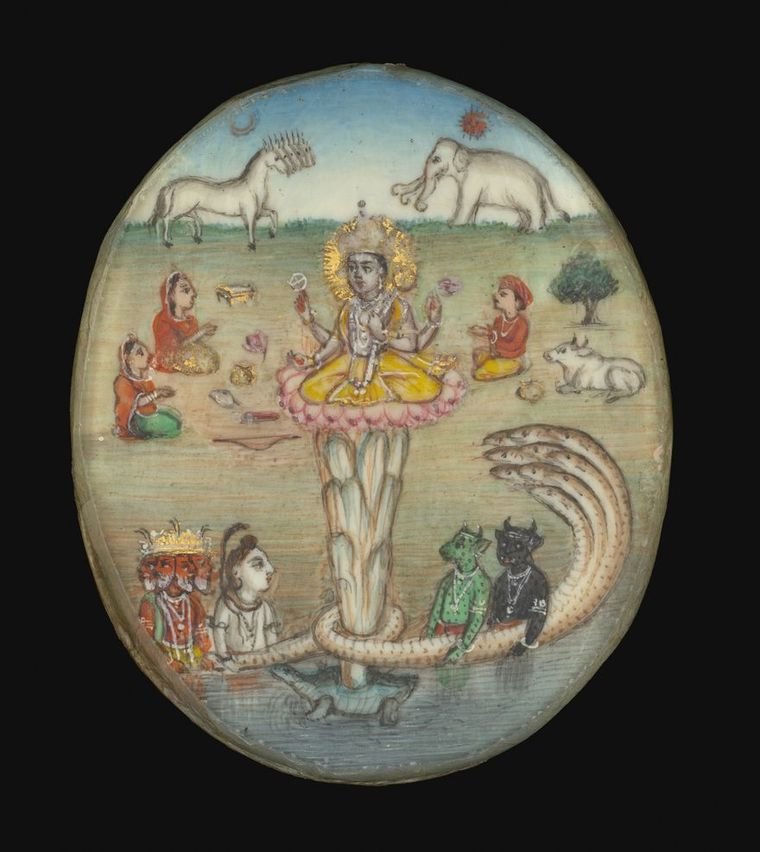
A gouache painting on ivory shows the workers pulling the serpent around the mountain. Vishnu appears above and supports the mountain in tortoise form below.
Wellcome Collection, 582090i. Gouache on ivory, tentatively dated between 1800 and 1899. Public Domain Mark; resized and converted to JPEG. · Image source ↗ · Public Domain
Poison and nectar in Bhagavata Purana 8.7–9
Bhāgavata Purāṇa 8.7.18 puts the poison hālahala first. In the translation by A. C. Bhaktivedanta Swami Prabhupada, Bhavānī assents to Shiva drinking it, and the poison leaves a blue mark. Dhanvantari and the vessel of nectar appear in the following chapter (8.8.31–33). [1][2][3][4][5]
Verse 8.9.24 has Rāhu sit among the gods in disguise during the distribution. The sun and moon recognise him, after the combined labour of the churning has already given way to a struggle over its reward. [6]
See references (6)
- Bhagavata Purana 8.7.18, translated by A. C. Bhaktivedanta Swami Prabhupada
- Bhagavata Purana 8.7.41, translated by A. C. Bhaktivedanta Swami Prabhupada
- Bhagavata Purana 8.7.43, translated by A. C. Bhaktivedanta Swami Prabhupada
- Bhagavata Purana 8.8.31, translated by A. C. Bhaktivedanta Swami Prabhupada
- Bhagavata Purana 8.8.33, translated by A. C. Bhaktivedanta Swami Prabhupada
- Bhagavata Purana 8.9.24, translated by A. C. Bhaktivedanta Swami Prabhupada
Which came first, poison or nectar?
In Mackenzie’s version the poison threatens the world after the nectar has appeared. The Bhāgavata Purāṇa makes it the churning’s first product, so Shiva deals with the danger before the gods see the reward. Both sequences give Shiva the blue mark that recalls what he took upon himself. [10][1][2][3][4][5][6]
See references (7)
- Bhagavata Purana 8.7.18, translated by A. C. Bhaktivedanta Swami Prabhupada
- Bhagavata Purana 8.7.41, translated by A. C. Bhaktivedanta Swami Prabhupada
- Bhagavata Purana 8.7.43, translated by A. C. Bhaktivedanta Swami Prabhupada
- Bhagavata Purana 8.8.31, translated by A. C. Bhaktivedanta Swami Prabhupada
- Bhagavata Purana 8.8.33, translated by A. C. Bhaktivedanta Swami Prabhupada
- Bhagavata Purana 8.9.24, translated by A. C. Bhaktivedanta Swami Prabhupada
- Indian Myth and Legend, Reader page 222
Read further in the library
Indian Myth and Legend
Reading note
The separately titled account draws on exact passages in the consulted Library edition.
Sources
See references (11)
- Bhagavata Purana 8.7.18, translated by A. C. Bhaktivedanta Swami Prabhupada ↗Verse places the appearance of halahala poison early in the churning. Directly read in the Bhaktivedanta Book Trust’s Gaudiya Vaishnava translation; the whole canto is not claimed as independently consulted.Return to text ↑
- Bhagavata Purana 8.7.41, translated by A. C. Bhaktivedanta Swami Prabhupada ↗Verse describes Shiva drinking the poison with Bhavani’s assent. Directly read in the Bhaktivedanta Book Trust’s Gaudiya Vaishnava translation; the whole canto is not claimed as independently consulted.Return to text ↑
- Bhagavata Purana 8.7.43, translated by A. C. Bhaktivedanta Swami Prabhupada ↗Verse describes the blue mark on Shiva’s neck. Directly read in the Bhaktivedanta Book Trust’s Gaudiya Vaishnava translation; the whole canto is not claimed as independently consulted.Return to text ↑
- Bhagavata Purana 8.8.31, translated by A. C. Bhaktivedanta Swami Prabhupada ↗Verse describes a remarkable figure arising during the churning. Directly read in the Bhaktivedanta Book Trust’s Gaudiya Vaishnava translation; the whole canto is not claimed as independently consulted.Return to text ↑
- Bhagavata Purana 8.8.33, translated by A. C. Bhaktivedanta Swami Prabhupada ↗Verse describes the emerging figure carrying a vessel full of nectar. Directly read in the Bhaktivedanta Book Trust’s Gaudiya Vaishnava translation; the whole canto is not claimed as independently consulted.Return to text ↑
- Bhagavata Purana 8.9.24, translated by A. C. Bhaktivedanta Swami Prabhupada ↗Verse and word gloss directly consulted: Rahu joins the assembly in disguise; somam is glossed as nectar. Directly read in the Bhaktivedanta Book Trust’s Gaudiya Vaishnava translation; the whole canto is not claimed as independently consulted.Return to text ↑
- Churning of the ocean, with Kurma below, nineteenth century, tentative museum dating ↗Wellcome Collection, 582090i. Gouache on ivory, tentatively dated between 1800 and 1899. Public Domain Mark; resized and converted to JPEG.
- Indian Myth and Legend, Reader page 220Donald A. Mackenzie, Indian Myth and Legend, Gresham Publishing Company Limited, London, undated consulted impression. Library edition IMJ-0649-E001. Persistent PageIDs and current Reader positions verified against the supplied PDF and cached Reader manifest. Embedded translations are Mackenzie’s presentation unless a separately consulted primary text is named.Read this page in Indian Myth and Legend ↗Return to text ↑
- Indian Myth and Legend, Reader page 221Donald A. Mackenzie, Indian Myth and Legend, Gresham Publishing Company Limited, London, undated consulted impression. Library edition IMJ-0649-E001. Persistent PageIDs and current Reader positions verified against the supplied PDF and cached Reader manifest. Embedded translations are Mackenzie’s presentation unless a separately consulted primary text is named.Read this page in Indian Myth and Legend ↗Return to text ↑
- Indian Myth and Legend, Reader page 222Donald A. Mackenzie, Indian Myth and Legend, Gresham Publishing Company Limited, London, undated consulted impression. Library edition IMJ-0649-E001. Persistent PageIDs and current Reader positions verified against the supplied PDF and cached Reader manifest. Embedded translations are Mackenzie’s presentation unless a separately consulted primary text is named.Read this page in Indian Myth and Legend ↗Return to text ↑
- Indian Myth and Legend, Reader page 224Donald A. Mackenzie, Indian Myth and Legend, Gresham Publishing Company Limited, London, undated consulted impression. Library edition IMJ-0649-E001. Persistent PageIDs and current Reader positions verified against the supplied PDF and cached Reader manifest. Embedded translations are Mackenzie’s presentation unless a separately consulted primary text is named.Read this page in Indian Myth and Legend ↗Return to text ↑