Indra
Indra is the Vedic god of the thunderbolt. Read the Rigveda’s battle with Vritra and explore Indra’s epic court and representations in Buddhist art.
In this article
Who is Indra?
Indra is a Vedic god praised for wielding the thunderbolt and defeating Vritra, the serpent-like adversary who holds back the waters. Later epic stories place Indra at the head of a heavenly court and describe his relationship with his son Arjuna. [1][4][5][6]
Buddhist traditions give Indra roles as protector and attendant of the Buddha and ruler of the Heaven of the Thirty-Three. The Metropolitan Museum of Art discusses these roles in connection with its early Indian statue. [2]
Indra in Rigveda 1.32
Rigveda 1.32 begins with Indra’s deeds. In Ralph T. H. Griffith’s translation, Tvashtar makes the thunderbolt, Indra drinks Soma and the blow against Vritra breaks open the waters. The torrents run over the defeated adversary. [1]
Verse 14 asks why Indra became afraid after the victory and fled across rivers. Verse 15 again proclaims his rule. The question about fear sits inside a hymn that celebrates his power. [1]
Indian Myth and Legend by Donald A. Mackenzie
In Indian Myth and Legend, Donald A. Mackenzie reads the battle through the end of India’s dry season, when clouds gather and rivers rise. He separately recounts a Mahābhārata version in which the sage Dadhicha gives up his body and the divine maker fashions Indra’s weapon from his bones. [7][8][9]
Mackenzie’s account of the epic court includes Indra’s white, four-tusked elephant Airavata and a mobile assembly hall with trees, music and divine visitors. When Arjuna arrives, Indra embraces him and brings him onto his own seat. [4][5][6]
Mackenzie draws parallels with Thor and other thunder gods. Those likenesses are part of his attempt to reconstruct a common history for hammer-wielding deities. [10][11][12]
See references (9)
- Indian Myth and Legend, Reader page 76
- Indian Myth and Legend, Reader page 77
- Indian Myth and Legend, Reader page 122
- Indian Myth and Legend, Reader page 60
- Indian Myth and Legend, Reader page 64
- Indian Myth and Legend, Reader page 65
- Indian Myth and Legend, Reader page 57
- Indian Myth and Legend, Reader page 58
- Indian Myth and Legend, Reader page 59
Indra in historical art
The Met identifies its second-century Standing Indra by the decorated crown, a third eye and an inscription on the pedestal naming him king of the gods. The head and lower body survive as separate fragments. A much later Thai lintel gives Indra a place between two attendants. [2][3]
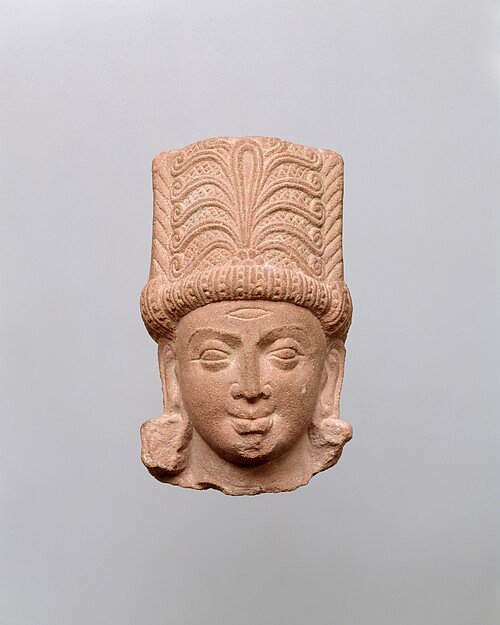
The head of Standing Indra retains the decorated crown and the third eye on his forehead.
The Metropolitan Museum of Art, Samuel Eilenberg Collection, Ex Coll.: Columbia University, Purchase, Rogers Fund, 1987, 1987.218.12a, b. Open Access CC0; resized and converted to JPEG. · Image source ↗ · CC0
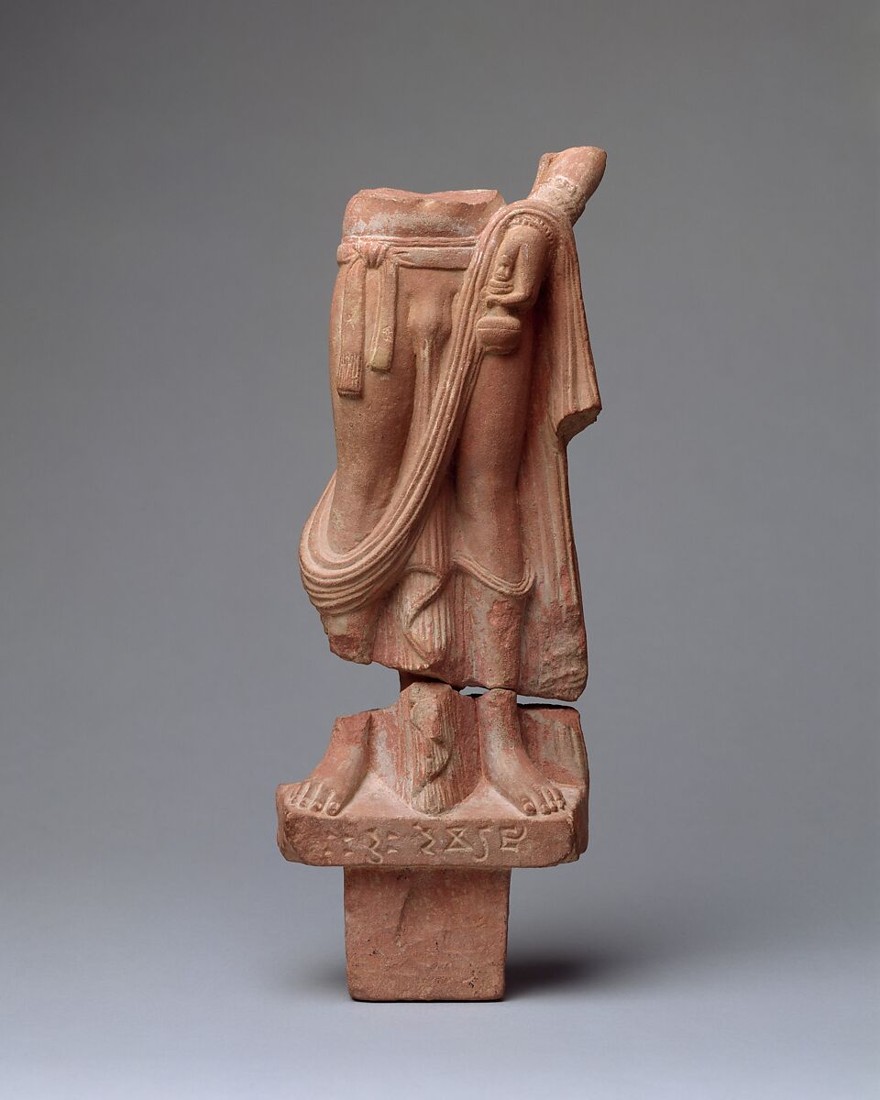
The body and pedestal of the same figure. The inscription along the base identifies Indra as king of the gods.
The Metropolitan Museum of Art, Samuel Eilenberg Collection, Ex Coll.: Columbia University, Purchase, Rogers Fund, 1987, 1987.218.12a, b. Open Access CC0; resized and converted to JPEG. · Image source ↗ · CC0
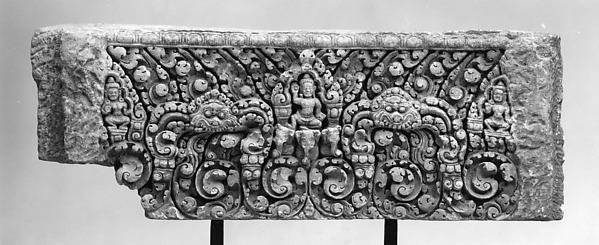
Indra between two attendants on a sandstone lintel from Thailand, eleventh to twelfth century.
The Metropolitan Museum of Art, Gift of Mr. and Mrs. Earl Morse, 1972, 1972.214. Open Access CC0; resized and converted to JPEG. · Image source ↗ · CC0
The thunderbolt and the heavenly court
The Rigvedic hymn places the thunderbolt in Indra’s hands at the start of the battle. Mackenzie’s epic account gives the weapon a longer story, making the victory depend on Dadhicha’s sacrifice. His account of Arjuna’s arrival brings out another exercise of power, the welcome a ruler gives his son. [8][9][1][4][2]
Read further in the library
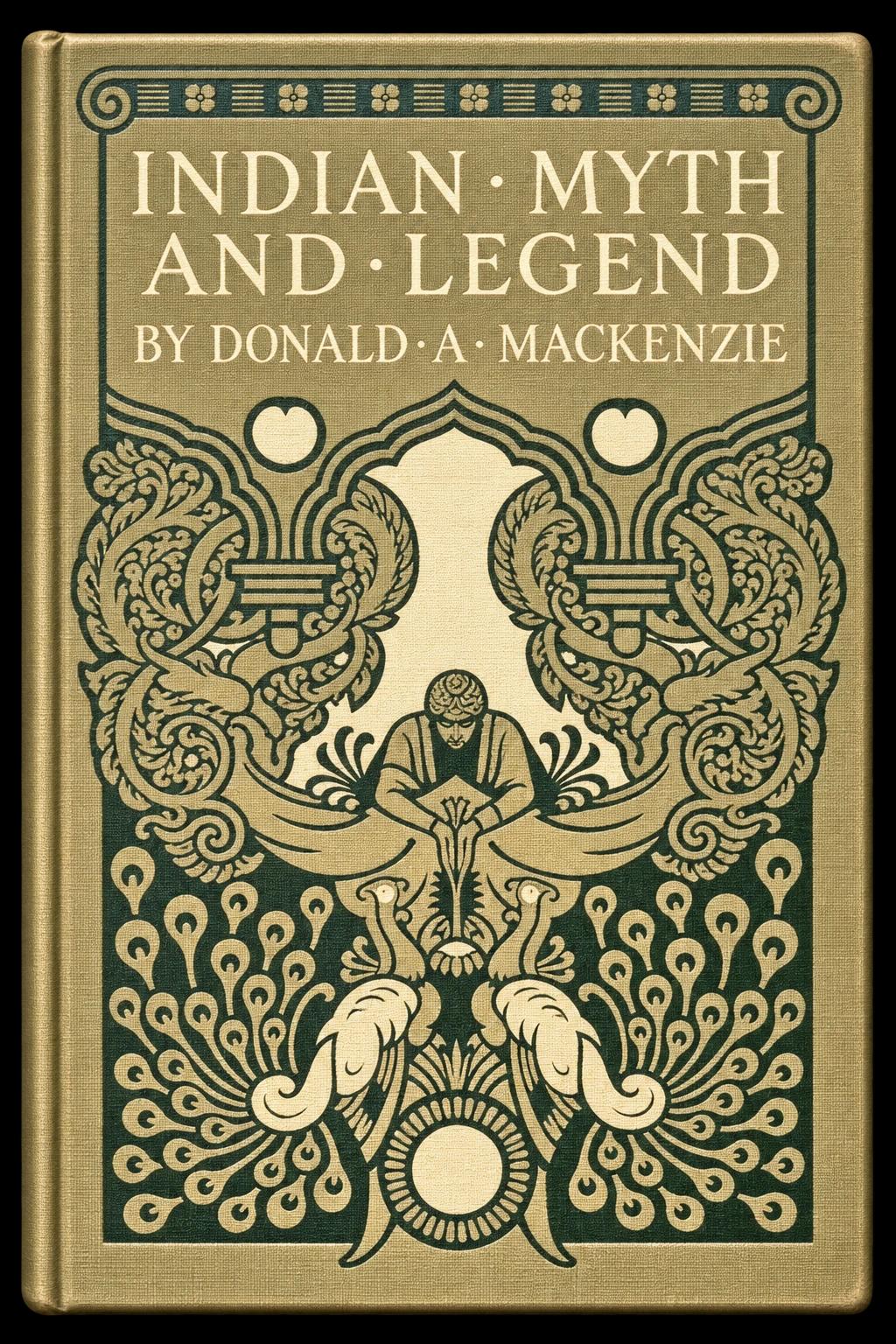
Indian Myth and Legend
Reading note
The separately titled account draws on exact passages in the consulted Library edition.
Sources
See references (12)
- Rigveda 1.32, verses 1–15, translated by Ralph T. H. Griffith ↗Primary hymn, complete fifteen verses and displayed historical notes directly read. The hymn and the translator’s nineteenth-century rain-allegory commentary are separate. Cached locally as primary-rv-1-32.html.Return to text ↑
- Standing Indra, ca. 2nd century ↗The Metropolitan Museum of Art, Samuel Eilenberg Collection, Ex Coll.: Columbia University, Purchase, Rogers Fund, 1987, 1987.218.12a, b. Open Access CC0; resized and converted to JPEG.Return to text ↑
- Lintel with Indra and Two Attendants, 11th–12th century ↗The Metropolitan Museum of Art, Gift of Mr. and Mrs. Earl Morse, 1972, 1972.214. Open Access CC0; resized and converted to JPEG.Return to text ↑
- Indian Myth and Legend, Reader page 76Donald A. Mackenzie, Indian Myth and Legend, Gresham Publishing Company Limited, London, undated consulted impression. Library edition IMJ-0649-E001. Persistent PageIDs and current Reader positions verified against the supplied PDF and cached Reader manifest. Embedded translations are Mackenzie’s presentation unless a separately consulted primary text is named.Read this page in Indian Myth and Legend ↗Return to text ↑
- Indian Myth and Legend, Reader page 77Donald A. Mackenzie, Indian Myth and Legend, Gresham Publishing Company Limited, London, undated consulted impression. Library edition IMJ-0649-E001. Persistent PageIDs and current Reader positions verified against the supplied PDF and cached Reader manifest. Embedded translations are Mackenzie’s presentation unless a separately consulted primary text is named.Read this page in Indian Myth and Legend ↗Return to text ↑
- Indian Myth and Legend, Reader page 122Donald A. Mackenzie, Indian Myth and Legend, Gresham Publishing Company Limited, London, undated consulted impression. Library edition IMJ-0649-E001. Persistent PageIDs and current Reader positions verified against the supplied PDF and cached Reader manifest. Embedded translations are Mackenzie’s presentation unless a separately consulted primary text is named.Read this page in Indian Myth and Legend ↗Return to text ↑
- Indian Myth and Legend, Reader page 60Donald A. Mackenzie, Indian Myth and Legend, Gresham Publishing Company Limited, London, undated consulted impression. Library edition IMJ-0649-E001. Persistent PageIDs and current Reader positions verified against the supplied PDF and cached Reader manifest. Embedded translations are Mackenzie’s presentation unless a separately consulted primary text is named.Read this page in Indian Myth and Legend ↗Return to text ↑
- Indian Myth and Legend, Reader page 64Donald A. Mackenzie, Indian Myth and Legend, Gresham Publishing Company Limited, London, undated consulted impression. Library edition IMJ-0649-E001. Persistent PageIDs and current Reader positions verified against the supplied PDF and cached Reader manifest. Embedded translations are Mackenzie’s presentation unless a separately consulted primary text is named.Read this page in Indian Myth and Legend ↗Return to text ↑
- Indian Myth and Legend, Reader page 65Donald A. Mackenzie, Indian Myth and Legend, Gresham Publishing Company Limited, London, undated consulted impression. Library edition IMJ-0649-E001. Persistent PageIDs and current Reader positions verified against the supplied PDF and cached Reader manifest. Embedded translations are Mackenzie’s presentation unless a separately consulted primary text is named.Read this page in Indian Myth and Legend ↗Return to text ↑
- Indian Myth and Legend, Reader page 57Donald A. Mackenzie, Indian Myth and Legend, Gresham Publishing Company Limited, London, undated consulted impression. Library edition IMJ-0649-E001. Persistent PageIDs and current Reader positions verified against the supplied PDF and cached Reader manifest. Embedded translations are Mackenzie’s presentation unless a separately consulted primary text is named.Read this page in Indian Myth and Legend ↗Return to text ↑
- Indian Myth and Legend, Reader page 58Donald A. Mackenzie, Indian Myth and Legend, Gresham Publishing Company Limited, London, undated consulted impression. Library edition IMJ-0649-E001. Persistent PageIDs and current Reader positions verified against the supplied PDF and cached Reader manifest. Embedded translations are Mackenzie’s presentation unless a separately consulted primary text is named.Read this page in Indian Myth and Legend ↗Return to text ↑
- Indian Myth and Legend, Reader page 59Donald A. Mackenzie, Indian Myth and Legend, Gresham Publishing Company Limited, London, undated consulted impression. Library edition IMJ-0649-E001. Persistent PageIDs and current Reader positions verified against the supplied PDF and cached Reader manifest. Embedded translations are Mackenzie’s presentation unless a separately consulted primary text is named.Read this page in Indian Myth and Legend ↗Return to text ↑