Amrita
Amrita is the nectar of immortality in Hindu mythology. Read how it comes from the ocean, how Garuda takes it and why Rāhu’s head survives.
In this article
What is amrita?
Amrita is the nectar of immortality in Hindu mythology. In the churning of the ocean, it comes to the surface in a vessel and immediately becomes the prize in a dispute between the gods and their rivals. Other stories ask how it can be stolen or what happens when someone drinks it in disguise. [7][8][9][10][1][2][11]
See references (7)
- Bhagavata Purana 8.8.33, translated by A. C. Bhaktivedanta Swami Prabhupada
- Mahabharata, Adi Parva, Astika Parva XXXIII, translated by Kisari Mohan Ganguli
- Indian Myth and Legend, Reader page 220
- Indian Myth and Legend, Reader page 221
- Indian Myth and Legend, Reader page 222
- Indian Myth and Legend, Reader page 224
- Indian Myth and Legend, Reader page 170
Indian Myth and Legend by Donald A. Mackenzie
In Indian Myth and Legend, Donald A. Mackenzie connects the search for amrita with Indra’s loss of power. Vishnu advises the gods to churn the ocean with their rivals. Dhanvantari emerges with the nectar, which Vishnu secures for the gods by appearing in an enchanting female form. [7][8][9]
Rāhu tries to drink in disguise. The sun and moon expose him, and Vishnu cuts off his head. The head has touched the nectar and survives; its pursuit of the sun and moon explains eclipses in the tale. [9]
In a separate pursuit, Garuda passes fire, a revolving wheel and serpent guardians to obtain the nectar and free his mother. Indra takes the vessel after Garuda delivers it. The snakes lick the grass where it stood, explaining their divided tongues in Mackenzie’s version. [10]
Mackenzie names Garuda’s mother as Diti. In the Mahābhārata passage below she is Vinatā. [10][2]
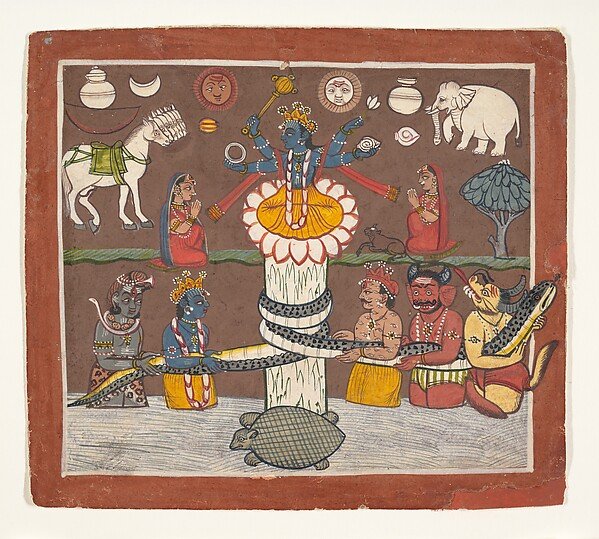
Treasures emerge above the workers in this Mandi painting of the ocean churning, around 1780–1790.
The Metropolitan Museum of Art, Gift of Mr. and Mrs. Alvin N. Haas, 1977, 1977.443.2. Open Access CC0; resized and converted to JPEG. · Image source ↗ · CC0
Rahu’s head in Bhagavata Purana 8.9.25–26
In Bhāgavata Purāṇa 8.9.25–26, translated by A. C. Bhaktivedanta Swami Prabhupada, Hari severs Rāhu’s head while he drinks. The nectar never reaches his body. The head survives and continues to pursue the sun and moon. [4][5]
Garuda and the nectar in the Mahabharata
In the Āstīka Parva, sections XXXIII–XXXIV, Kisari Mohan Ganguli’s Mahābhārata calls Garuda Vinatā’s son. He takes the vessel without drinking and receives immortality as a boon from Vishnu. He arranges for Indra to recover the nectar after delivery, freeing Vinatā before the snakes can drink. [2][3]
Who receives immortality?
Rāhu gains immortality for the part the nectar touches. Garuda never drinks it and gains immortality as a gift. The Mahābhārata’s use of Soma and Amrita for the prize also helps explain why Mackenzie connects the words. In Vedic verse, Soma has its own setting as a drink offered in worship. [10][2][9][4][5][12][3]
See references (7)
- Mahabharata, Adi Parva, Astika Parva XXXIII, translated by Kisari Mohan Ganguli
- Mahabharata, Adi Parva, Astika Parva XXXIV, translated by Kisari Mohan Ganguli
- Bhagavata Purana 8.9.25, translated by A. C. Bhaktivedanta Swami Prabhupada
- Bhagavata Purana 8.9.26, translated by A. C. Bhaktivedanta Swami Prabhupada
- Indian Myth and Legend, Reader page 222
- Indian Myth and Legend, Reader page 224
- Indian Myth and Legend, Reader page 98
Read further in the library
Indian Myth and Legend
Reading note
The separately titled account draws on exact passages in the consulted Library edition.
Sources
See references (12)
- Bhagavata Purana 8.8.33, translated by A. C. Bhaktivedanta Swami Prabhupada ↗Verse describes the emerging figure carrying a vessel full of nectar. Directly read in the Bhaktivedanta Book Trust’s Gaudiya Vaishnava translation; the whole canto is not claimed as independently consulted.Return to text ↑
- Mahabharata, Adi Parva, Astika Parva XXXIII, translated by Kisari Mohan Ganguli ↗Main translated narrative directly read through the public text viewer, including Garuda as Vinata’s son and the boon of immortality without drinking amrita. Section numbers identify this translation’s arrangement; no verified Library leaf is claimed.Return to text ↑
- Mahabharata, Adi Parva, Astika Parva XXXIV, translated by Kisari Mohan Ganguli ↗Complete main translated section directly read through the public text viewer. The bargain with Indra, release of Garuda’s mother and the snakes’ divided tongues were checked. Site navigation and commercial material are excluded.Return to text ↑
- Bhagavata Purana 8.9.25, translated by A. C. Bhaktivedanta Swami Prabhupada ↗Verse and short purport distinguish the surviving head from the body untouched by nectar. Directly read in the Bhaktivedanta Book Trust’s Gaudiya Vaishnava translation; the whole canto is not claimed as independently consulted.Return to text ↑
- Bhagavata Purana 8.9.26, translated by A. C. Bhaktivedanta Swami Prabhupada ↗Verse gives Rahu’s surviving head its celestial role and hostility to sun and moon. Directly read in the Bhaktivedanta Book Trust’s Gaudiya Vaishnava translation; the whole canto is not claimed as independently consulted.Return to text ↑
- The Churning of the Ocean of Milk, ca. 1780–90 ↗The Metropolitan Museum of Art, Gift of Mr. and Mrs. Alvin N. Haas, 1977, 1977.443.2. Open Access CC0; resized and converted to JPEG.
- Indian Myth and Legend, Reader page 220Donald A. Mackenzie, Indian Myth and Legend, Gresham Publishing Company Limited, London, undated consulted impression. Library edition IMJ-0649-E001. Persistent PageIDs and current Reader positions verified against the supplied PDF and cached Reader manifest. Embedded translations are Mackenzie’s presentation unless a separately consulted primary text is named.Read this page in Indian Myth and Legend ↗Return to text ↑
- Indian Myth and Legend, Reader page 221Donald A. Mackenzie, Indian Myth and Legend, Gresham Publishing Company Limited, London, undated consulted impression. Library edition IMJ-0649-E001. Persistent PageIDs and current Reader positions verified against the supplied PDF and cached Reader manifest. Embedded translations are Mackenzie’s presentation unless a separately consulted primary text is named.Read this page in Indian Myth and Legend ↗Return to text ↑
- Indian Myth and Legend, Reader page 222Donald A. Mackenzie, Indian Myth and Legend, Gresham Publishing Company Limited, London, undated consulted impression. Library edition IMJ-0649-E001. Persistent PageIDs and current Reader positions verified against the supplied PDF and cached Reader manifest. Embedded translations are Mackenzie’s presentation unless a separately consulted primary text is named.Read this page in Indian Myth and Legend ↗Return to text ↑
- Indian Myth and Legend, Reader page 224Donald A. Mackenzie, Indian Myth and Legend, Gresham Publishing Company Limited, London, undated consulted impression. Library edition IMJ-0649-E001. Persistent PageIDs and current Reader positions verified against the supplied PDF and cached Reader manifest. Embedded translations are Mackenzie’s presentation unless a separately consulted primary text is named.Read this page in Indian Myth and Legend ↗Return to text ↑
- Indian Myth and Legend, Reader page 170Donald A. Mackenzie, Indian Myth and Legend, Gresham Publishing Company Limited, London, undated consulted impression. Library edition IMJ-0649-E001. Persistent PageIDs and current Reader positions verified against the supplied PDF and cached Reader manifest. Embedded translations are Mackenzie’s presentation unless a separately consulted primary text is named.Read this page in Indian Myth and Legend ↗Return to text ↑
- Indian Myth and Legend, Reader page 98Donald A. Mackenzie, Indian Myth and Legend, Gresham Publishing Company Limited, London, undated consulted impression. Library edition IMJ-0649-E001. Persistent PageIDs and current Reader positions verified against the supplied PDF and cached Reader manifest. Embedded translations are Mackenzie’s presentation unless a separately consulted primary text is named.Read this page in Indian Myth and Legend ↗Return to text ↑