Moses
Explore Moses through the Exodus story, Sinai and Torah, historical evidence, Jewish interpretation, Christian reception and the Quran’s account of Musa.
In this article
Who is Moses?
Moses is the central human figure in the Torah’s account of Israel’s liberation from Egypt and covenant at Sinai. Jewish tradition remembers him as a prophet, teacher and mediator of divine instruction. His life also receives distinctive interpretations in Christianity and Islam. [1][11][12]
Story, evidence and calling
The story and the historical evidence
The biblical account places Moses within Israel’s enslavement in Egypt and its emergence as a people bound by covenant. Christine Hayes’s Yale lecture approaches Exodus as a national story of origins, while asking separately what evidence can establish about the past. [2]
An Egyptian inscription naming Israel in Canaan by the late thirteenth century BCE provides evidence for a people. It does not establish an individual biography of Moses or document the route of an Exodus. Hayes also discusses difficulties in reconciling the biblical chronological statements. [2]
These distinctions leave room to study how the narrative works without assigning Moses a confidently established birth year or identifying every setting with an excavated site. Its importance in religious memory is a different question from the evidence available for reconstructing a particular lifetime. [2]
Hayes also examines the rescued infant as a literary pattern, comparing Moses’ birth story with the legend of Sargon of Akkad. Such comparisons concern how a future leader’s significance is signalled through storytelling. They do not provide a contemporary record of Moses’ childhood. [2]
From the Nile to Sinai
Exodus 2 follows a Hebrew child rescued by Pharaoh’s daughter. As an adult, Moses kills an Egyptian beating a Hebrew and flees to Midian. At the burning bush, Exodus 3 presents his call to return and confront Pharaoh. [3][4]
At the bush, Moses asks which divine name he should bring to the Israelites. The JPS edition leaves Ehyeh-Asher-Ehyeh in Hebrew and notes several possible English renderings. His commission is connected with the identity of the God who sends him. [4]
Exodus 14 portrays Israel crossing the sea and the pursuing Egyptian army’s destruction. At Sinai, Exodus 20 presents divine commandments and the people’s request that Moses speak to them as mediator. [5][6]
The golden-calf episode in Exodus 32 combines intercession with punishment. Moses pleads against Israel’s destruction, breaks the tablets and orders Levites to carry out killings. He then seeks forgiveness for the people. [7]
A call placed within an imagined landscape
Domenichino’s Landscape with Moses and the Burning Bush places a small human encounter within a wide landscape. Moses kneels near a fire beneath a tree, with sheep close to him and water and distant buildings beyond. The scene belongs to his calling in Exodus. [13]
The Met describes the painter’s landscapes as idealized, taking observations of nature into an imagined, enduring realm. Painted on copper in 1610–16, this image invites the viewer to approach the biblical event through an early modern Italian landscape. Its setting records a painter’s interpretation of sacred history. [13]
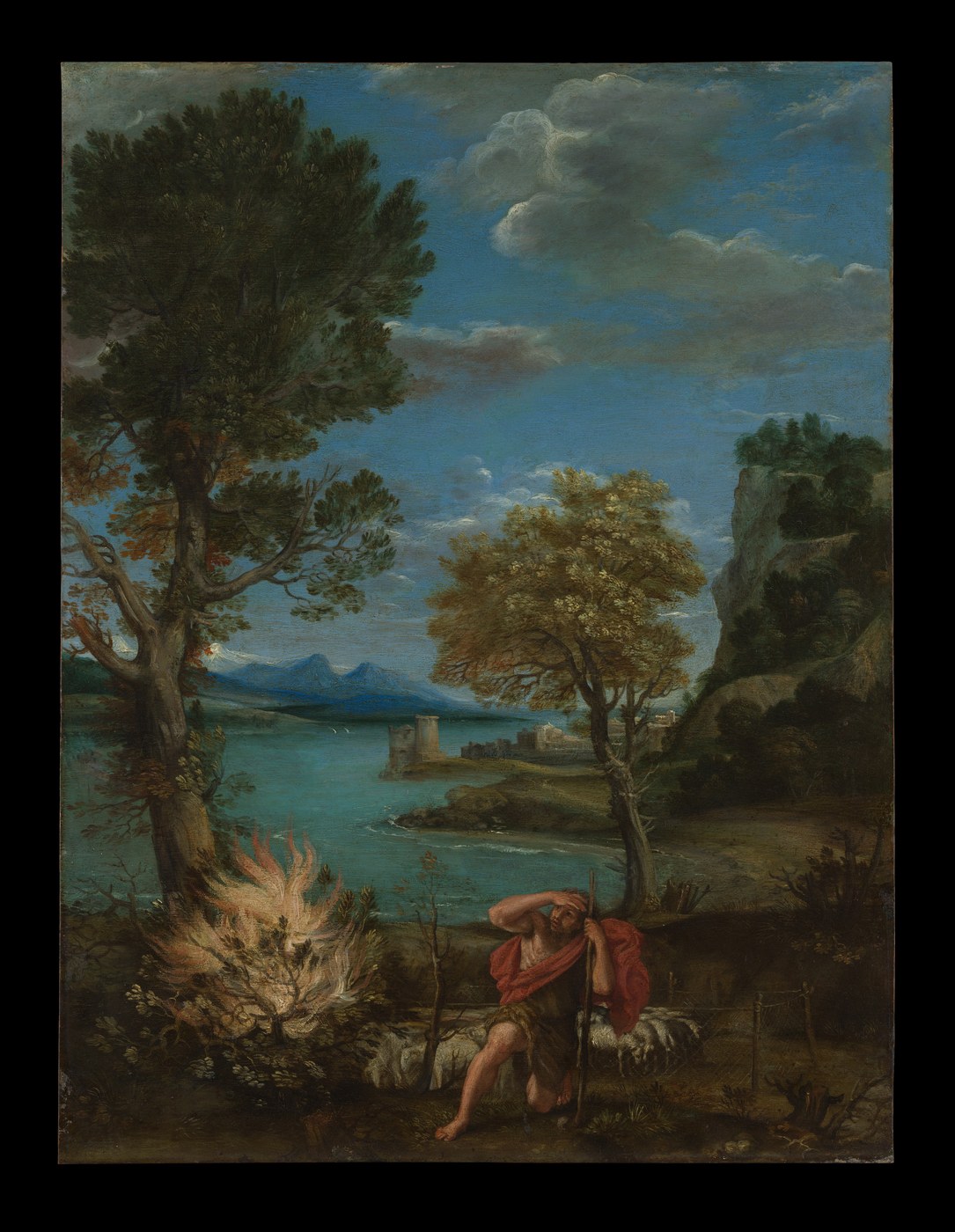
Domenichino, Landscape with Moses and the Burning Bush, 1610–16. Oil on copper.
The Metropolitan Museum of Art. Gift of Mr. and Mrs. Charles Wrightsman, 1976. Accession 1976.155.2. Public Domain (CC0). · Museum record ↗ · CC0
Torah, prophecy and remembrance
Why Moses is associated with Torah
Torah names both a collection of foundational books and the instruction through which Jewish life is shaped. Its account of Sinai connects freedom from bondage with covenant and obligations. Moses stands within that relationship as the figure through whom instruction is communicated. [1]
Harvard’s account describes Torah as a basis for ethical and ritual life, community and the continuing relationship with God. Its place extends into synagogue reading and study in homes and schools. Moses’ association with law therefore includes the transmission, interpretation and learning of a tradition, alongside the familiar image of stone tablets. [1]
Maimonides on the distinctiveness of his prophecy
In Foundations of the Torah 7:6, Maimonides distinguishes Moses’ prophecy from that of other prophets. In his explanation, Moses receives revelation awake, with a composed mind, rather than through the disturbing dreams or symbolic visions associated with other prophetic experience. [9]
Maimonides also describes Moses’ apprehension as direct, without an angelic intermediary, and available whenever needed. These distinctions give Mosaic revelation a singular standing within his account of prophecy. They belong to a particular Jewish legal and theological exposition, rather than to a modern historical description of an observable event. [9]
His account also links this exceptional readiness with a disciplined way of life, withdrawn from ordinary bodily concerns. The prophet’s mode of apprehension and his personal disposition are treated together. [9]
Remembering liberation at Passover
Passover brings the Exodus into the setting of a household meal and communal retelling. At the seder, participants use the Haggadah, questions, symbolic foods and ordered actions to remember bondage and liberation. The story is encountered through things people eat, say and do together. [10]
Harvard’s account describes bitter herbs recalling slavery and a mixture of fruit, wine and nuts evoking the mortar of forced labour. The participants are invited to understand freedom as something that concerns their own lives, rather than only a distant generation. [10]
This is one setting in which the world of the Moses narrative remains active in Jewish life. Different communities also connect its themes with contemporary experiences of oppression and release, while the festival retains its own liturgical order. [10]
Why Moses does not dominate the Haggadah
Yehuda Shurpin’s Chabad essay corrects a familiar claim: the Haggadah does contain a brief mention of Moses. The more useful question is why its Exodus retelling gives him so little prominence. [15]
Among the interpretations he presents are the emphasis on God as the source of redemption and the tradition of Moses’ humility. In these readings, honouring the teacher does not require making him the centre of the festival. This is a named Orthodox Jewish discussion of the liturgy, alongside the broader variety of Jewish Passover practice. [15]
Seeing the land without entering it
Deuteronomy 34 ends Moses’ life outside the land he has been shown. Joshua succeeds him, and his burial place remains unknown. The chapter remembers him as a prophet of exceptional closeness to God. The text assigns him a life of 120 years. [8]
Christian and Islamic readings
Moses in a Christian reading
Hebrews 3 compares the faithfulness of Moses with that of Christ through the image of God’s household. Moses is described as a faithful servant, while Christ is identified as the Son over the house. The passage both honours Moses and places him within a Christian account centred on Jesus. [11]
This relationship became important to Christian reception of the Hebrew scriptures. In this particular text, the comparison serves a confession about Christ. It should be read as Christian interpretation alongside the different ways Jewish traditions understand Mosaic authority. [11]
The tablets within a church’s biblical narrative
Valentin Bousch’s 1532 window presents Moses holding the tablets amid a gathered group. It formed part of a series made for the Benedictine priory church of Saint-Firmin in Flavigny-sur-Moselle. The larger sequence linked stories from creation and the flood with scenes concerning Christ and the Last Judgment. [14]
The Met highlights Bousch’s use of coloured glass, painted detail and architectural framing to create a unified composition. Here the tablets become recognizable within a church’s unfolding account of sacred history. The object’s Christian setting helps explain how the figure of Moses was encountered by its original viewers. [14]
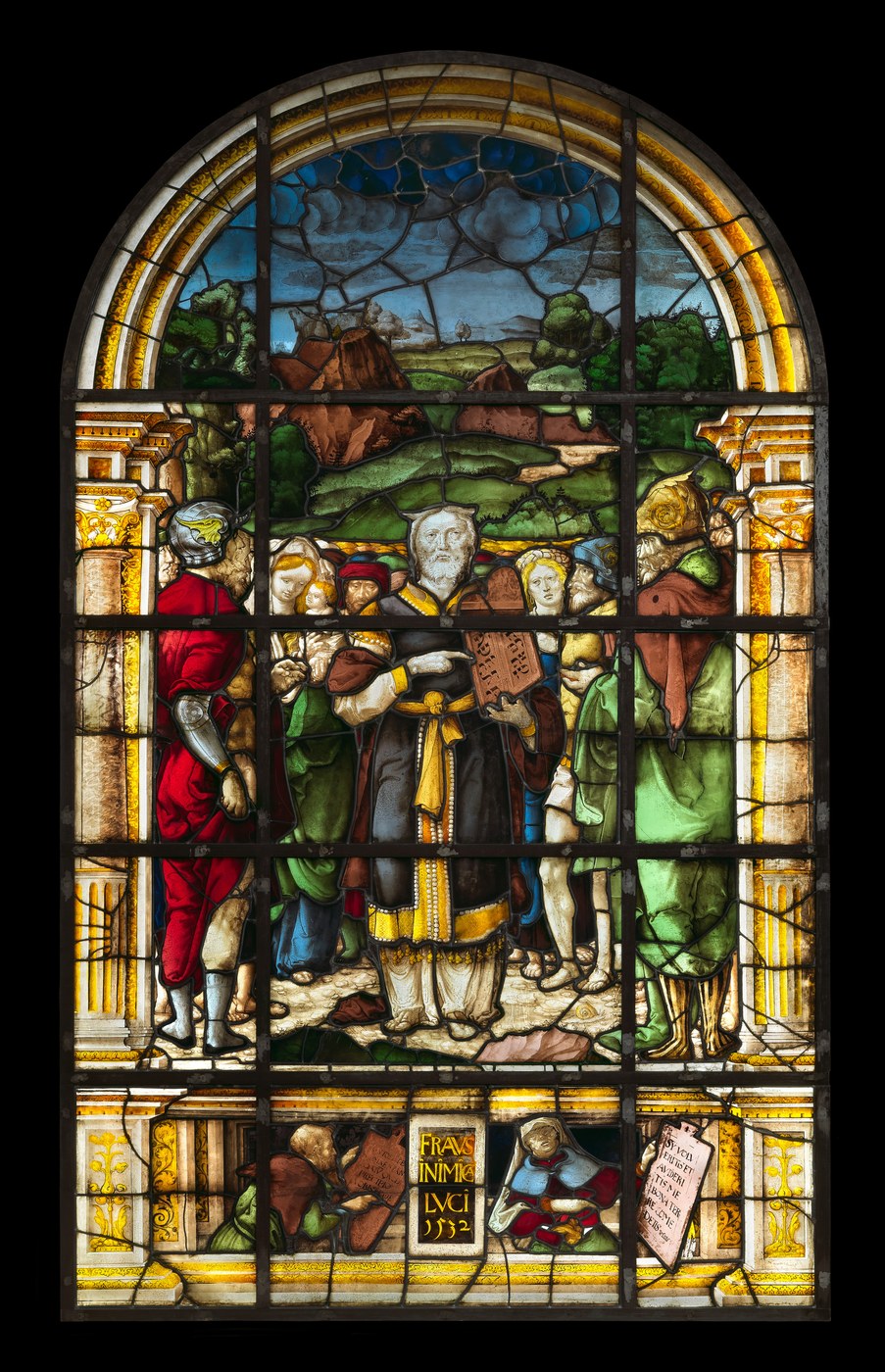
Valentin Bousch, Moses presenting the tablets of law, 1532. Stained glass.
The Metropolitan Museum of Art. Purchase, Joseph Pulitzer Bequest, 1917. Accession 17.40.1a–r. Public Domain (CC0). · Museum record ↗ · CC0
Musa’s request for help in the Quran
The Quran’s Moses, Musa, belongs within its account of divine messengers and confrontation with Pharaoh. In Quran 20:25–36, Moses asks for capacity to carry out his task, clear speech and the support of his brother Aaron. His request is granted. [12]
The following passage sends the brothers to Pharaoh with instructions to speak gently. Their fear of his violence is met with divine reassurance. The scene gives prophetic responsibility a setting of vulnerability and shared work. [12]
Read beside Exodus, these verses show a related figure within a distinct scriptural telling. The Quranic account has its own dialogue and theological emphasis; it is not simply a shortened version of the biblical narrative. [12]
Read further in the library
The Bible Gallery
Reading note
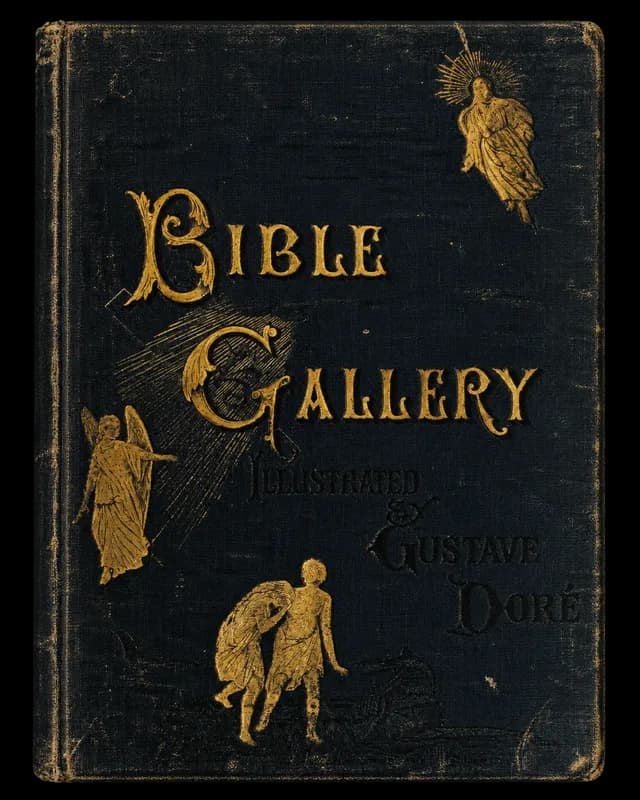
Gustave Doré’s biblical illustrations and Talbot W. Chambers’s narratives offer a nineteenth-century visual retelling of selected scriptural scenes.
Sources
- Torah: Covenant and Constitution ↗The Pluralism Project, Harvard UniversityReturn to text ↑
- Israel in Egypt: Moses and the Beginning of Yahwism, RLST145 Lecture7 ↗Christine Hayes, Open Yale Courses; sections3–4 inspectedReturn to text ↑
- Exodus 2:1–15 ↗The JPS TANAKH: Gender-Sensitive Edition, Jewish Publication Society; SefariaReturn to text ↑
- Exodus 3:1–15 ↗The JPS TANAKH: Gender-Sensitive Edition, Jewish Publication Society; SefariaReturn to text ↑
- Exodus 14:13–31 ↗The JPS TANAKH: Gender-Sensitive Edition, Jewish Publication Society; SefariaReturn to text ↑
- Exodus 20 ↗The JPS TANAKH: Gender-Sensitive Edition, Jewish Publication Society; SefariaReturn to text ↑
- Exodus 32 ↗The JPS TANAKH: Gender-Sensitive Edition, Jewish Publication Society; SefariaReturn to text ↑
- Deuteronomy 34 ↗The JPS TANAKH: Gender-Sensitive Edition, Jewish Publication Society; SefariaReturn to text ↑
- Mishneh Torah, Foundations of the Torah 7:6 ↗Maimonides; English translation by Eliyahu Touger, Moznaim; SefariaReturn to text ↑
- Passover ↗The Pluralism Project, Harvard UniversityReturn to text ↑
- Hebrews 3:1–6 ↗New Revised Standard Version Updated Edition, National Council of Churches; Bible GatewayReturn to text ↑
- Quran 20:25–46 ↗The Clear Quran, Mustafa Khattab; Quran.com; inspected context verses25–46Return to text ↑
- Landscape with Moses and the Burning Bush ↗The Metropolitan Museum of Art; accession1976.155.2Return to text ↑
- Moses presenting the tablets of law ↗The Metropolitan Museum of Art; accession17.40.1a–rReturn to text ↑
- Was Moses Purged From the Haggadah? 10 Approaches ↗Yehuda Shurpin, Chabad.org; introduction and approaches1–2 inspectedReturn to text ↑
About this article & its sources
A comparative biographical reference distinguishing biblical narrative, historical evidence, Jewish teaching, Christian reception and Quranic accounts. No exact lifetime is asserted as established history. Later European artworks retain their Christian settings and do not stand as contemporary portraits.
Passage attributions
Who is Moses?
Passage 1: The Pluralism Project, Harvard University.
The story and the historical evidence
Passage 1: Christine Hayes, Open Yale Courses; sections3–4 inspected.
Passage 2: Christine Hayes, Open Yale Courses; sections3–4 inspected.
Passage 3: Christine Hayes, Open Yale Courses; sections3–4 inspected.
Passage 4: Christine Hayes, Yale lecture7, section4.
From the Nile to Sinai
Passage 1: The JPS TANAKH: Gender-Sensitive Edition, Jewish Publication Society; Sefaria.
Passage 2: The JPS TANAKH: Gender-Sensitive Edition, Exodus3:13–15 and translation note.
Passage 3: The JPS TANAKH: Gender-Sensitive Edition, Jewish Publication Society; Sefaria.
Passage 4: The JPS TANAKH: Gender-Sensitive Edition, Jewish Publication Society; Sefaria.
A call placed within an imagined landscape
Passage 1: The Metropolitan Museum of Art; accession1976.155.2.
Passage 2: The Metropolitan Museum of Art; accession1976.155.2.
Why Moses is associated with Torah
Passage 1: The Pluralism Project, Harvard University.
Passage 2: The Pluralism Project, Harvard University.
Maimonides on the distinctiveness of his prophecy
Passage 1: Maimonides; English translation by Eliyahu Touger, Moznaim; Sefaria.
Passage 2: Maimonides; English translation by Eliyahu Touger, Moznaim; Sefaria.
Passage 3: Maimonides, Foundations of the Torah7:6; translation by Eliyahu Touger.
Remembering liberation at Passover
Passage 1: The Pluralism Project, Harvard University.
Passage 2: The Pluralism Project, Harvard University.
Passage 3: The Pluralism Project, Harvard University.
Why Moses does not dominate the Haggadah
Passage 1: Yehuda Shurpin, Chabad.org.
Passage 2: Yehuda Shurpin, Chabad.org; introduction and approaches1–2.
Seeing the land without entering it
Passage 1: The JPS TANAKH: Gender-Sensitive Edition, Jewish Publication Society; Sefaria.
Moses in a Christian reading
Passage 1: New Revised Standard Version Updated Edition, National Council of Churches; Bible Gateway.
Passage 2: New Revised Standard Version Updated Edition, National Council of Churches; Bible Gateway.