Migrating Etheric Centre
Steiner’s etheric centre develops through the head, throat and heart. Each stage gives the currents a different role, from grounded thought to the inner word.
In this article
Understanding the concept
The migrating etheric centre is a proposed organising centre that Rudolf Steiner places first in the head, then in the throat and finally near the heart. The order gives ordinary judgment a place before the later experience he calls the inner word. [1][2][3][4]
Each location has a different part in the same process. The head anchors thought, the throat gives the currents a new direction, and the heart becomes the centre of a developed system. [5][1][2][3]
See references (5)
Initiation and Its Results by Rudolf Steiner
In Initiation and Its Results, Rudolf Steiner first describes the intended heart-region centre as a complex, changing organisation rather than merely a point. Its rays connect with the other proposed organs, especially the twelve-petalled lotus. [1][6]
The formation begins with reasonable thought, gathered inwardly in the head. Steiner says starting directly with the heart might produce glimpses the learner cannot place in relation to the world of the senses. The head stage is meant to give those experiences a footing. [2]
At the larynx the currents are said to illuminate the surrounding astral space. They continue towards the two-petalled lotus and the hands. Their branches eventually form a network. [2][3]
The heart becomes the centre once the current system has formed. Steiner connects this stage with the inner word. He says things acquire a significance that becomes perceptible as though they were speaking. [4]
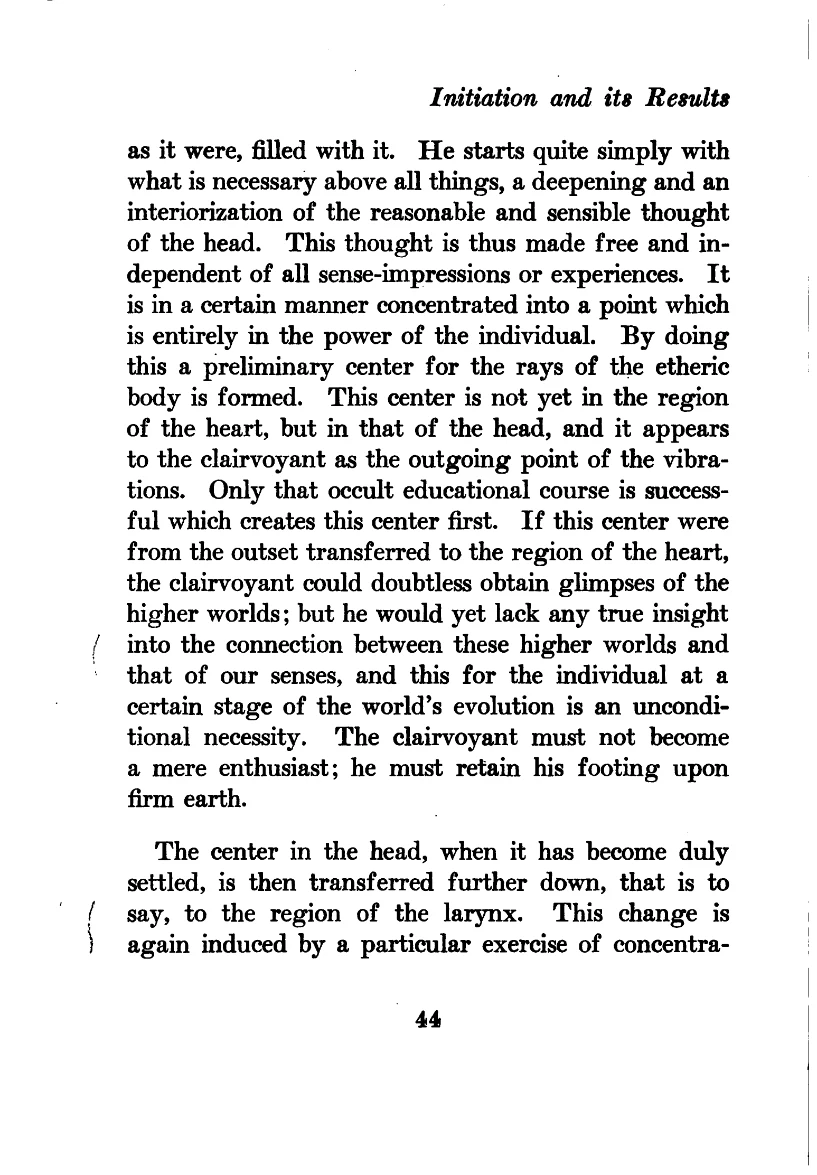
Initiation and Its Results (1909), printed p. 44, Library Reader page 43. Steiner begins with a centre in the head before moving it to the larynx.
Rudolf Steiner, Initiation and Its Results, Clifford Bax translation, First American Edition, 1909. Public-domain historical page from the checksum-verified Library PDF. · Image source ↗ · Public Domain
See references (5)
Evolution of Immortality by Rosicruciæ, catalogued as F. B. Dowd
Freeman Benjamin Dowd, writing as Rosicruciæ, describes soul as an organising centre. His self-poised person holds relations among powers in balance while remaining active in body, mind and will. The centre can explain coordination at personal and social scales. [7][8][9][10]
How a centre organises the whole
The heart-region centre sends currents to the twelve-petalled lotus. The passage uses a relationship between two structures to explain how the organs work together once the centre has reached the heart. [1][6][2][3][4]
Dowd’s centre holds opposing powers in balance and helps explain self-poise. Steiner gives the centre a sequence of locations, each adding something to what the learner can do. One account asks how a person holds a balance, and the other asks how an arrangement develops over time. [7][8][9][10][1][2][3][4]
See references (9)
- Initiation and Its Results, printed p. 42, Reader page 41
- Initiation and Its Results, printed p. 44, Reader page 43
- Initiation and Its Results, printed p. 45, Reader page 44
- Initiation and Its Results, printed p. 46, Reader page 45
- Initiation and Its Results, printed p. 43, Reader page 42
- Evolution of Immortality, printed p. 15, Reader page 12
- Evolution of Immortality, printed p. 16, Reader page 13
- Evolution of Immortality, printed p. 104, Reader page 101
- Evolution of Immortality, printed p. 142, Reader page 141
Read further in the library
Initiation and Its Results
Reading note
The separately titled account draws on exact passages in the consulted Library edition.
Evolution of Immortality
Reading note
Separately attributed comparison with exact previously researched Library passages.
Sources
See references (10)
- Initiation and Its Results, printed p. 42, Reader page 41Rudolf Steiner, Initiation and Its Results: A Sequel to The Way of Initiation, translated by Clifford Bax. First American Edition, 1909. Macoy Publishing and Masonic Supply Co., New York; Max Gysi, London. Claims of clairvoyant perception and subtle organs remain attributed. References identify the exact consulted Library edition.Read this page in Initiation and Its Results ↗Return to text ↑
- Initiation and Its Results, printed p. 44, Reader page 43Rudolf Steiner, Initiation and Its Results: A Sequel to The Way of Initiation, translated by Clifford Bax. First American Edition, 1909. Macoy Publishing and Masonic Supply Co., New York; Max Gysi, London. Claims of clairvoyant perception and subtle organs remain attributed. References identify the exact consulted Library edition.Read this page in Initiation and Its Results ↗Return to text ↑
- Initiation and Its Results, printed p. 45, Reader page 44Rudolf Steiner, Initiation and Its Results: A Sequel to The Way of Initiation, translated by Clifford Bax. First American Edition, 1909. Macoy Publishing and Masonic Supply Co., New York; Max Gysi, London. Claims of clairvoyant perception and subtle organs remain attributed. References identify the exact consulted Library edition.Read this page in Initiation and Its Results ↗Return to text ↑
- Initiation and Its Results, printed p. 46, Reader page 45Rudolf Steiner, Initiation and Its Results: A Sequel to The Way of Initiation, translated by Clifford Bax. First American Edition, 1909. Macoy Publishing and Masonic Supply Co., New York; Max Gysi, London. Claims of clairvoyant perception and subtle organs remain attributed. References identify the exact consulted Library edition.Read this page in Initiation and Its Results ↗Return to text ↑
- Initiation and Its Results, printed p. 40, Reader page 39Rudolf Steiner, Initiation and Its Results: A Sequel to The Way of Initiation, translated by Clifford Bax. First American Edition, 1909. Macoy Publishing and Masonic Supply Co., New York; Max Gysi, London. Claims of clairvoyant perception and subtle organs remain attributed. References identify the exact consulted Library edition.Read this page in Initiation and Its Results ↗Return to text ↑
- Initiation and Its Results, printed p. 43, Reader page 42Rudolf Steiner, Initiation and Its Results: A Sequel to The Way of Initiation, translated by Clifford Bax. First American Edition, 1909. Macoy Publishing and Masonic Supply Co., New York; Max Gysi, London. Claims of clairvoyant perception and subtle organs remain attributed. References identify the exact consulted Library edition.Read this page in Initiation and Its Results ↗Return to text ↑
- Evolution of Immortality, printed p. 15, Reader page 12Rosicruciæ (catalogued as Freeman Benjamin Dowd), Evolution of Immortality. Eulian Publishing Company, Salem, 1900.Read this page in Evolution of Immortality ↗Return to text ↑
- Evolution of Immortality, printed p. 16, Reader page 13Rosicruciæ (catalogued as Freeman Benjamin Dowd), Evolution of Immortality. Eulian Publishing Company, Salem, 1900.Read this page in Evolution of Immortality ↗Return to text ↑
- Evolution of Immortality, printed p. 104, Reader page 101Rosicruciæ, catalogued as Freeman Benjamin Dowd, Evolution of Immortality. Eulian Publishing Company, Salem, Mass., copyright 1900; title page undated. The book’s metaphysical and scientific assertions remain attributed. The separately reproduced Higher Thought of Sex address has no speaker named in this edition.Read this page in Evolution of Immortality ↗Return to text ↑
- Evolution of Immortality, printed p. 142, Reader page 141Rosicruciæ, catalogued as Freeman Benjamin Dowd, Evolution of Immortality. Eulian Publishing Company, Salem, Mass., copyright 1900; title page undated. The book’s metaphysical and scientific assertions remain attributed. The separately reproduced Higher Thought of Sex address has no speaker named in this edition.Read this page in Evolution of Immortality ↗Return to text ↑