The Inner Word
The Inner Word in Steiner is a proposed way of hearing meaning inwardly. Compare his account of listening and training with Swedenborg’s angelic speech.
In this article
Understanding the concept
The Inner Word is Rudolf Steiner’s name for a proposed way of perceiving meaning inwardly. He describes things becoming as if audible in their own nature. The image gives understanding the immediacy of hearing, while the account places it within spiritual training. [1][2]
Knowledge of the Higher Worlds by Rudolf Steiner
Rudolf Steiner introduces the Inner Word before the detailed chapter on subtle organs. Quiet thought is said to become a field in which spiritual meaning speaks within the soul. His account connects this with a meditation requiring clear and definite thought. [15][16]
Steiner begins with listening to the pleasure or pain expressed by a creature’s sound. He also describes hearing someone speak without rushing to agree, contradict or answer from a position of superiority. He gives this receptivity a place before the later teaching about subtle organs. [17][18][19][20][21]
The later chapter gives the proposed faculty an etheric explanation. Moving lotus organs are not enough to provide orientation; their activity must be consciously regulated. The Inner Word is connected with further development of the etheric body and, eventually, a centre near the heart through which things become spiritually audible in their own being. [22][23]
He reads the Buddha’s sayings and the Gospels through this model, interpreting their effect through rhythms formed in the learner. This is Steiner’s account of the religious texts. The entry preserves it beside the listening exercises without presenting it as the texts’ own shared explanation of revelation. [23][24]
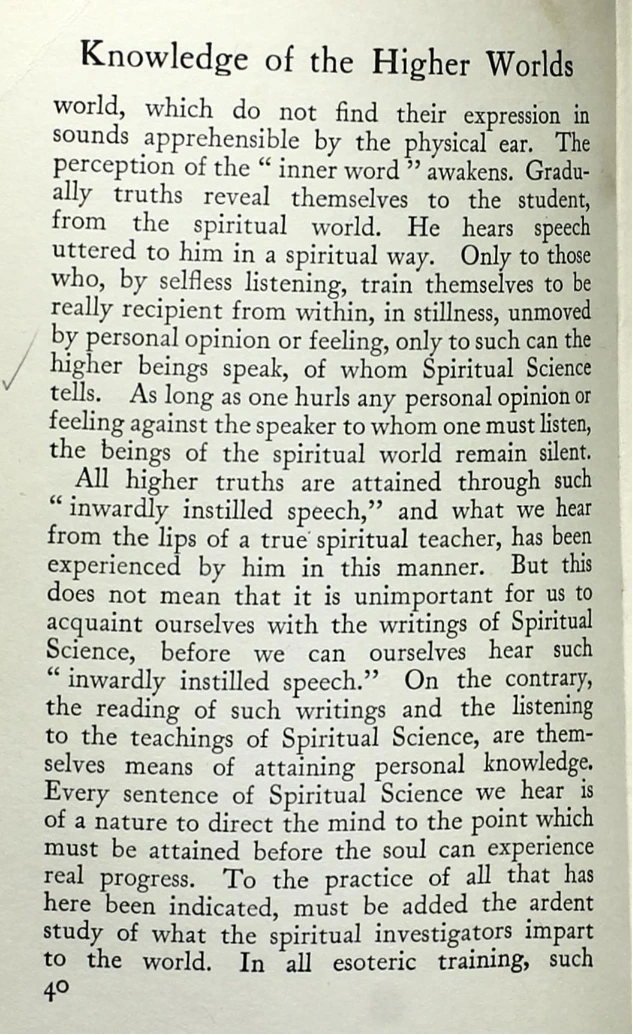
Source facsimile: Knowledge of the Higher Worlds, Reader page 44. Selfless listening is connected with the proposed awakening of the Inner Word.
Rudolf Steiner, G. Metaxa translation, edited by Harry Collison. Historical public-domain source facsimile from the exact checksum-verified Library edition. Repository date 1932; the inspected title page is undated. · Image source ↗ · Public Domain
See references (10)
- Knowledge of the Higher Worlds and Its Attainment, Reader page 28
- Knowledge of the Higher Worlds and Its Attainment, Reader page 29
- Knowledge of the Higher Worlds and Its Attainment, Reader page 40
- Knowledge of the Higher Worlds and Its Attainment, Reader page 41
- Knowledge of the Higher Worlds and Its Attainment, Reader page 42
- Knowledge of the Higher Worlds and Its Attainment, Reader page 43
- Knowledge of the Higher Worlds and Its Attainment, Reader page 44
- Knowledge of the Higher Worlds and Its Attainment, Reader page 136
- Knowledge of the Higher Worlds and Its Attainment, Reader page 142
- Knowledge of the Higher Worlds and Its Attainment, Reader page 143
Initiation and Its Results by Rudolf Steiner
Rudolf Steiner’s Initiation and Its Results introduces the Inner Word when explaining why astral perception alone is insufficient. A student must regulate the proposed astral organs consciously. Further development of the etheric body is said to bring the capacity for this spiritual hearing. [1]
The account later connects the Inner Word with establishing a centre in the heart. Currents within the etheric body place the person in touch with the interior of the surrounding world. Things acquire a new significance and are described as speaking from their true being. [3][2]
Steiner extends this idea to a changed understanding of religious teaching. He says the Buddha’s words begin to follow movements and rhythms formed within the learner. Repeated sayings then become points of rest for the inner senses, supposedly placing them in harmony with wider rhythms. [2][4]
Steiner uses repeated sayings to describe a learner resting their attention on a rhythm. This is his reading of the Buddha’s words within a theory of spiritual perception. [2][4]
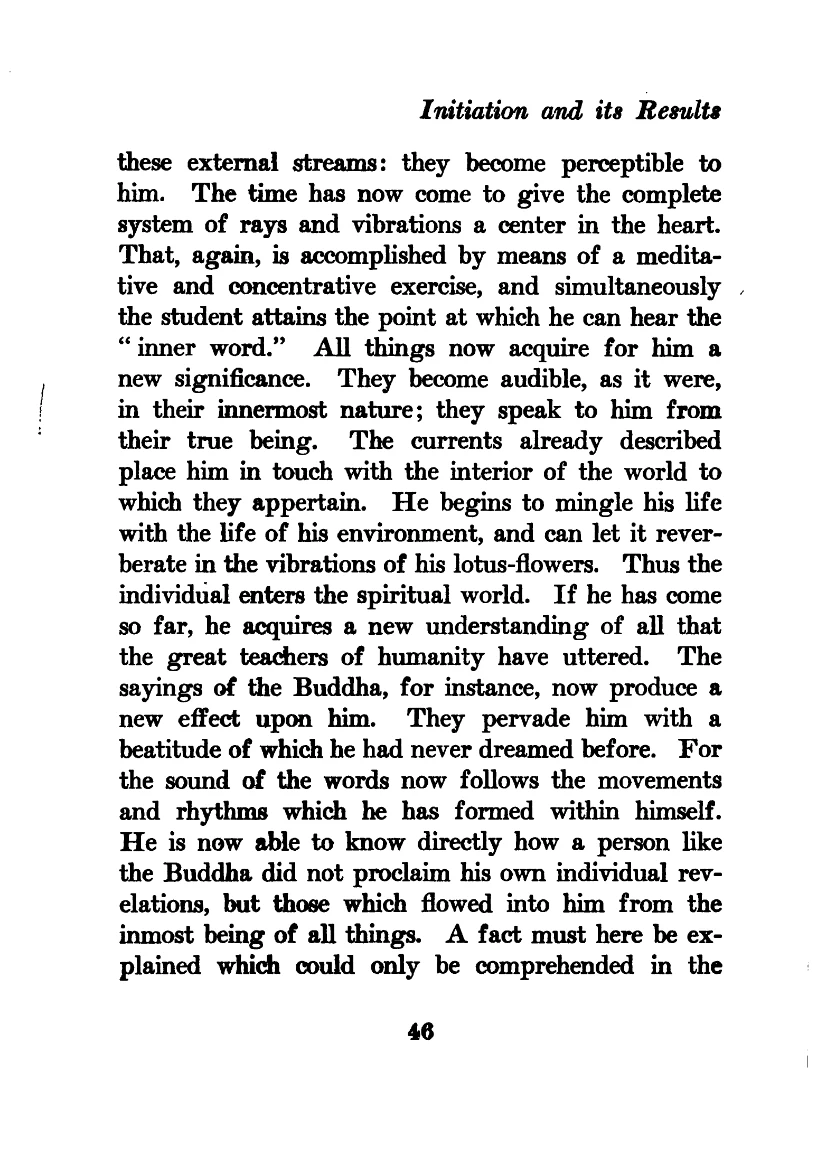
Source facsimile: Initiation and Its Results (1909), printed p. 46, Reader page 45.
Rudolf Steiner, Initiation and Its Results, Clifford Bax translation, First American Edition, 1909. Public-domain historical page from the checksum-verified Library PDF. · Image source ↗ · Public Domain
Heaven and Its Wonders and Hell by Emanuel Swedenborg
Emanuel Swedenborg’s Heaven and Its Wonders and Hell describes angelic language as an expression of affection and thought. Meaning can be communicated with a fullness beyond ordinary human wording. Speech addressed to a human being is said to enter that person’s language and memory. [7][8][9][10][11][12][13]
See references (7)
- Heaven and Its Wonders and Hell, printed p. 173, Reader page 180
- Heaven and Its Wonders and Hell, printed p. 174, Reader page 181
- Heaven and Its Wonders and Hell, printed p. 175, Reader page 182
- Heaven and Its Wonders and Hell, printed p. 176, Reader page 183
- Heaven and Its Wonders and Hell, printed p. 177, Reader page 184
- Heaven and Its Wonders and Hell, printed p. 182, Reader page 189
- Heaven and Its Wonders and Hell, printed p. 183, Reader page 190
Hearing meaning and communicating it
The early listening account in the Metaxa volume emphasises how a person attends to what is said. The related Bax passages describe a proposed centre near the heart. Together they show how Steiner joins receptivity to the later development of the etheric body. [5][6][1][2][14][7][12][21][22]
Swedenborg describes meaning shared between beings through angelic speech. Steiner’s Inner Word covers what a thing is said to disclose about itself. One belongs to communication, and the other to a claimed way of perceiving. [7][8][9][10][11][12][13][1][2][4]
See references (15)
- Initiation and Its Results, printed p. 39, Reader page 38
- Initiation and Its Results, printed p. 46, Reader page 45
- Initiation and Its Results, printed p. 47, Reader page 46
- Initiation and Its Results, printed p. 25, Reader page 25
- Initiation and Its Results, printed p. 26, Reader page 26
- Heaven and Its Wonders and Hell, printed p. 173, Reader page 180
- Heaven and Its Wonders and Hell, printed p. 174, Reader page 181
- Heaven and Its Wonders and Hell, printed p. 175, Reader page 182
- Heaven and Its Wonders and Hell, printed p. 176, Reader page 183
- Heaven and Its Wonders and Hell, printed p. 177, Reader page 184
- Heaven and Its Wonders and Hell, printed p. 182, Reader page 189
- Heaven and Its Wonders and Hell, printed p. 183, Reader page 190
- Rudolf Steiner Archive: GA 10 publication and translation history
- Knowledge of the Higher Worlds and Its Attainment, Reader page 44
- Knowledge of the Higher Worlds and Its Attainment, Reader page 136
Read further in the library

Initiation and Its Results
Reading note
The separately titled account draws on exact passages in the consulted Library edition.

Heaven and Its Wonders and Hell
Reading note
Separately attributed comparison with exact previously researched Library passages.

Knowledge of the Higher Worlds and Its Attainment
Reading note
The separately titled account draws on exact passages in the consulted Library edition.
Sources
See references (24)
- Initiation and Its Results, printed p. 39, Reader page 38Rudolf Steiner, Initiation and Its Results: A Sequel to The Way of Initiation, translated by Clifford Bax. First American Edition, 1909. Macoy Publishing and Masonic Supply Co., New York; Max Gysi, London. Claims of clairvoyant perception and subtle organs remain attributed. References identify the exact consulted Library edition.Read this page in Initiation and Its Results ↗Return to text ↑
- Initiation and Its Results, printed p. 46, Reader page 45Rudolf Steiner, Initiation and Its Results: A Sequel to The Way of Initiation, translated by Clifford Bax. First American Edition, 1909. Macoy Publishing and Masonic Supply Co., New York; Max Gysi, London. Claims of clairvoyant perception and subtle organs remain attributed. References identify the exact consulted Library edition.Read this page in Initiation and Its Results ↗Return to text ↑
- Initiation and Its Results, printed p. 45, Reader page 44Rudolf Steiner, Initiation and Its Results: A Sequel to The Way of Initiation, translated by Clifford Bax. First American Edition, 1909. Macoy Publishing and Masonic Supply Co., New York; Max Gysi, London. Claims of clairvoyant perception and subtle organs remain attributed. References identify the exact consulted Library edition.Read this page in Initiation and Its Results ↗Return to text ↑
- Initiation and Its Results, printed p. 47, Reader page 46Rudolf Steiner, Initiation and Its Results: A Sequel to The Way of Initiation, translated by Clifford Bax. First American Edition, 1909. Macoy Publishing and Masonic Supply Co., New York; Max Gysi, London. Claims of clairvoyant perception and subtle organs remain attributed. References identify the exact consulted Library edition.Read this page in Initiation and Its Results ↗Return to text ↑
- Initiation and Its Results, printed p. 25, Reader page 25Rudolf Steiner, Initiation and Its Results: A Sequel to The Way of Initiation, translated by Clifford Bax. First American Edition, 1909. Macoy Publishing and Masonic Supply Co., New York; Max Gysi, London. Claims of clairvoyant perception and subtle organs remain attributed. References identify the exact consulted Library edition.Read this page in Initiation and Its Results ↗Return to text ↑
- Initiation and Its Results, printed p. 26, Reader page 26Rudolf Steiner, Initiation and Its Results: A Sequel to The Way of Initiation, translated by Clifford Bax. First American Edition, 1909. Macoy Publishing and Masonic Supply Co., New York; Max Gysi, London. Claims of clairvoyant perception and subtle organs remain attributed. References identify the exact consulted Library edition.Read this page in Initiation and Its Results ↗Return to text ↑
- Heaven and Its Wonders and Hell, printed p. 173, Reader page 180Emanuel Swedenborg, Heaven and Its Wonders and Hell, translated by J. C. Ager. The American Swedenborg Printing and Publishing Society, New York, 1916. Original Latin work first published in 1758.Read this page in Heaven and Its Wonders and Hell ↗Return to text ↑
- Heaven and Its Wonders and Hell, printed p. 174, Reader page 181Emanuel Swedenborg, Heaven and Its Wonders and Hell, translated by J. C. Ager. The American Swedenborg Printing and Publishing Society, New York, 1916. Original Latin work first published in 1758.Read this page in Heaven and Its Wonders and Hell ↗Return to text ↑
- Heaven and Its Wonders and Hell, printed p. 175, Reader page 182Emanuel Swedenborg, Heaven and Its Wonders and Hell, translated by J. C. Ager. The American Swedenborg Printing and Publishing Society, New York, 1916. Original Latin work first published in 1758.Read this page in Heaven and Its Wonders and Hell ↗Return to text ↑
- Heaven and Its Wonders and Hell, printed p. 176, Reader page 183Emanuel Swedenborg, Heaven and Its Wonders and Hell, translated by J. C. Ager. The American Swedenborg Printing and Publishing Society, New York, 1916. Original Latin work first published in 1758.Read this page in Heaven and Its Wonders and Hell ↗Return to text ↑
- Heaven and Its Wonders and Hell, printed p. 177, Reader page 184Emanuel Swedenborg, Heaven and Its Wonders and Hell, translated by J. C. Ager. The American Swedenborg Printing and Publishing Society, New York, 1916. Original Latin work first published in 1758.Read this page in Heaven and Its Wonders and Hell ↗Return to text ↑
- Heaven and Its Wonders and Hell, printed p. 182, Reader page 189Emanuel Swedenborg, Heaven and Its Wonders and Hell, translated by J. C. Ager. The American Swedenborg Printing and Publishing Society, New York, 1916. Original Latin work first published in 1758.Read this page in Heaven and Its Wonders and Hell ↗Return to text ↑
- Heaven and Its Wonders and Hell, printed p. 183, Reader page 190Emanuel Swedenborg, Heaven and Its Wonders and Hell, translated by J. C. Ager. The American Swedenborg Printing and Publishing Society, New York, 1916. Original Latin work first published in 1758.Read this page in Heaven and Its Wonders and Hell ↗Return to text ↑
- Rudolf Steiner Archive: GA 10 publication and translation history ↗Steiner Online Library, Rudolf Steiner Archive, GA 10 bibliography. Used only for publication relationships, not independent confirmation of spiritual claims.Return to text ↑
- Knowledge of the Higher Worlds and Its Attainment, Reader page 28Rudolf Steiner, Knowledge of the Higher Worlds and Its Attainment, authorized English translation by G. Metaxa, edited by Harry Collison, Anthroposophic Press, New York City. Exact Library edition IMJ-0513-E001. No publication year is visible on the inspected title page; the repository assigns 1932. Claims of supersensible perception remain attributed to Steiner.Read this page in Knowledge of the Higher Worlds and Its Attainment ↗Return to text ↑
- Knowledge of the Higher Worlds and Its Attainment, Reader page 29Rudolf Steiner, Knowledge of the Higher Worlds and Its Attainment, authorized English translation by G. Metaxa, edited by Harry Collison, Anthroposophic Press, New York City. Exact Library edition IMJ-0513-E001. No publication year is visible on the inspected title page; the repository assigns 1932. Claims of supersensible perception remain attributed to Steiner.Read this page in Knowledge of the Higher Worlds and Its Attainment ↗Return to text ↑
- Knowledge of the Higher Worlds and Its Attainment, Reader page 40Rudolf Steiner, Knowledge of the Higher Worlds and Its Attainment, authorized English translation by G. Metaxa, edited by Harry Collison, Anthroposophic Press, New York City. Exact Library edition IMJ-0513-E001. No publication year is visible on the inspected title page; the repository assigns 1932. Claims of supersensible perception remain attributed to Steiner.Read this page in Knowledge of the Higher Worlds and Its Attainment ↗Return to text ↑
- Knowledge of the Higher Worlds and Its Attainment, Reader page 41Rudolf Steiner, Knowledge of the Higher Worlds and Its Attainment, authorized English translation by G. Metaxa, edited by Harry Collison, Anthroposophic Press, New York City. Exact Library edition IMJ-0513-E001. No publication year is visible on the inspected title page; the repository assigns 1932. Claims of supersensible perception remain attributed to Steiner.Read this page in Knowledge of the Higher Worlds and Its Attainment ↗Return to text ↑
- Knowledge of the Higher Worlds and Its Attainment, Reader page 42Rudolf Steiner, Knowledge of the Higher Worlds and Its Attainment, authorized English translation by G. Metaxa, edited by Harry Collison, Anthroposophic Press, New York City. Exact Library edition IMJ-0513-E001. No publication year is visible on the inspected title page; the repository assigns 1932. Claims of supersensible perception remain attributed to Steiner.Read this page in Knowledge of the Higher Worlds and Its Attainment ↗Return to text ↑
- Knowledge of the Higher Worlds and Its Attainment, Reader page 43Rudolf Steiner, Knowledge of the Higher Worlds and Its Attainment, authorized English translation by G. Metaxa, edited by Harry Collison, Anthroposophic Press, New York City. Exact Library edition IMJ-0513-E001. No publication year is visible on the inspected title page; the repository assigns 1932. Claims of supersensible perception remain attributed to Steiner.Read this page in Knowledge of the Higher Worlds and Its Attainment ↗Return to text ↑
- Knowledge of the Higher Worlds and Its Attainment, Reader page 44Rudolf Steiner, Knowledge of the Higher Worlds and Its Attainment, authorized English translation by G. Metaxa, edited by Harry Collison, Anthroposophic Press, New York City. Exact Library edition IMJ-0513-E001. No publication year is visible on the inspected title page; the repository assigns 1932. Claims of supersensible perception remain attributed to Steiner.Read this page in Knowledge of the Higher Worlds and Its Attainment ↗Return to text ↑
- Knowledge of the Higher Worlds and Its Attainment, Reader page 136Rudolf Steiner, Knowledge of the Higher Worlds and Its Attainment, authorized English translation by G. Metaxa, edited by Harry Collison, Anthroposophic Press, New York City. Exact Library edition IMJ-0513-E001. No publication year is visible on the inspected title page; the repository assigns 1932. Claims of supersensible perception remain attributed to Steiner.Read this page in Knowledge of the Higher Worlds and Its Attainment ↗Return to text ↑
- Knowledge of the Higher Worlds and Its Attainment, Reader page 142Rudolf Steiner, Knowledge of the Higher Worlds and Its Attainment, authorized English translation by G. Metaxa, edited by Harry Collison, Anthroposophic Press, New York City. Exact Library edition IMJ-0513-E001. No publication year is visible on the inspected title page; the repository assigns 1932. Claims of supersensible perception remain attributed to Steiner.Read this page in Knowledge of the Higher Worlds and Its Attainment ↗Return to text ↑
- Knowledge of the Higher Worlds and Its Attainment, Reader page 143Rudolf Steiner, Knowledge of the Higher Worlds and Its Attainment, authorized English translation by G. Metaxa, edited by Harry Collison, Anthroposophic Press, New York City. Exact Library edition IMJ-0513-E001. No publication year is visible on the inspected title page; the repository assigns 1932. Claims of supersensible perception remain attributed to Steiner.Read this page in Knowledge of the Higher Worlds and Its Attainment ↗Return to text ↑