Angelic language
Angelic language is speech or expression attributed to heavenly beings. Compare Swedenborg’s audible speech with colour and sound in Hodson and Challoner.
In this article
What is an angelic language?
Angelic language is speech or other expression attributed to heavenly beings. Christian art often pictures an angel delivering a message. Esoteric accounts also ask how heavenly beings communicate with one another and what a human could perceive of that exchange. [1][2][3][4][5][20]
Emanuel Swedenborg says angels speak audibly in an atmosphere suited to their world. Tone expresses what they feel, and articulated sound expresses what they think. For the listener, the speaker’s inward state is part of what can be heard. [2][3]
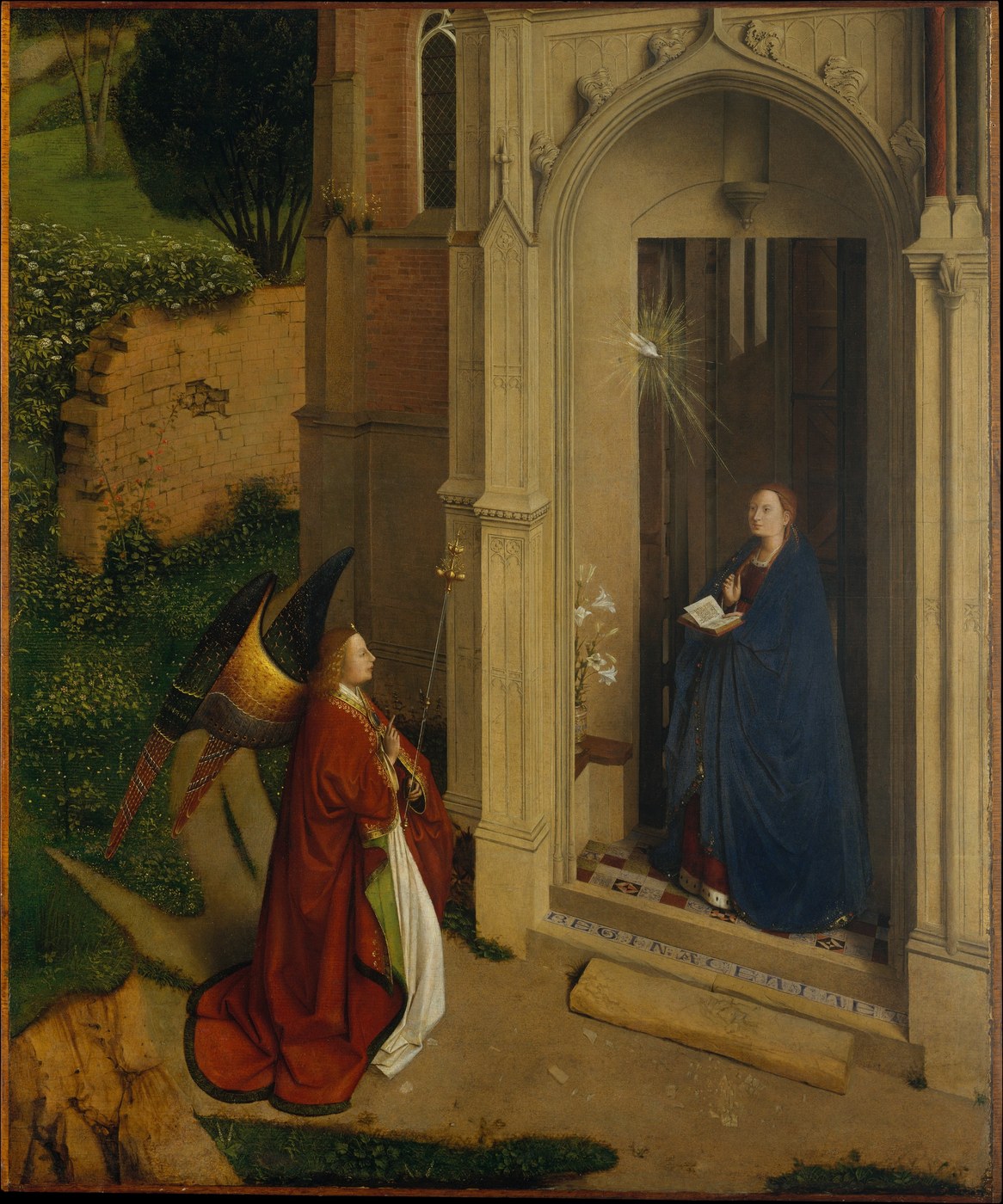
Petrus Christus, The Annunciation, ca. 1445. Gabriel approaches Mary at a doorway while a book lies open before her. The painting gives a heavenly messenger and human recipient a visible setting within Christian art.
The Metropolitan Museum of Art. The Friedsam Collection, Bequest of Michael Friedsam, 1931. Accession 32.100.35. Public Domain (CC0). · Image source ↗ · CC0
See references (6)
- Heaven and Its Wonders and Hell, printed p. 173, Reader page 180
- Heaven and Its Wonders and Hell, printed p. 174, Reader page 181
- Heaven and Its Wonders and Hell, printed p. 175, Reader page 182
- Heaven and Its Wonders and Hell, printed p. 177, Reader page 184
- Heaven and Its Wonders and Hell, printed p. 178, Reader page 185
- The Annunciation, Petrus Christus
Heaven and Its Wonders and Hell
Emanuel Swedenborg’s Heaven and Its Wonders and Hell says the language is not learned through a shared earthly upbringing. It arises from the correspondence of affection, thought and expression. Angels can communicate meanings of great complexity in a brief utterance, and a listener’s perception can reach beyond what the same number of human words would convey. [1][2][3][6][4]
The celestial and spiritual kingdoms have different qualities of speech. Swedenborg discusses rhythm, vowels, consonants and facial expression as signs of these differences. His account makes the speaker’s state central: an angel cannot simply counterfeit an affection opposed to the one being expressed. The fullness of the language belongs to this proposed openness of life. [5][7][8][9]
Speech with a human being takes another form. Swedenborg says angels enter the person’s language and memory so that the communication becomes intelligible. The angel does not need to have learned that earthly vocabulary independently. He also warns that an asserted spiritual speaker can be deceptive, so the claim of a heavenly voice does not automatically establish its identity or authority. [10][11][12][13]
The book also describes heavenly writing: sheets and books, curved forms, letter-like characters and numbers carrying general meanings. Some writing flows spontaneously from thought; other appearances are temporary. Swedenborg treats these as forms of expression within his reported world. The passage does not supply an alphabet a reader can recover and use as a complete record of that language. [14][15][16][17][18][19]
See references (19)
- Heaven and Its Wonders and Hell, printed p. 173, Reader page 180
- Heaven and Its Wonders and Hell, printed p. 174, Reader page 181
- Heaven and Its Wonders and Hell, printed p. 175, Reader page 182
- Heaven and Its Wonders and Hell, printed p. 177, Reader page 184
- Heaven and Its Wonders and Hell, printed p. 178, Reader page 185
- Heaven and Its Wonders and Hell, printed p. 176, Reader page 183
- Heaven and Its Wonders and Hell, printed p. 179, Reader page 186
- Heaven and Its Wonders and Hell, printed p. 180, Reader page 187
- Heaven and Its Wonders and Hell, printed p. 181, Reader page 188
- Heaven and Its Wonders and Hell, printed p. 182, Reader page 189
- Heaven and Its Wonders and Hell, printed p. 183, Reader page 190
- Heaven and Its Wonders and Hell, printed p. 186, Reader page 193
- Heaven and Its Wonders and Hell, printed p. 187, Reader page 194
- Heaven and Its Wonders and Hell, printed p. 193, Reader page 200
- Heaven and Its Wonders and Hell, printed p. 194, Reader page 201
- Heaven and Its Wonders and Hell, printed p. 195, Reader page 202
- Heaven and Its Wonders and Hell, printed p. 196, Reader page 203
- Heaven and Its Wonders and Hell, printed p. 197, Reader page 204
- Heaven and Its Wonders and Hell, printed p. 198, Reader page 205
The Kingdom of the Gods by Geoffrey Hodson
Geoffrey Hodson describes angelic speech as visible colour and form. In his account, feelings and thoughts appear to the angels as movements, colours and shapes that other beings can perceive. A crown or a flash of light can therefore convey something about mental activity. The expression changes as thought and feeling change. [22][23]
In one narrative, Hodson says that two angels greet and answer one another through changes in their radiance. He records rose, yellow and dark blue forms that open like fans. He interprets the first angel’s forms as an expression of qualities he recognises in the second. He then describes the second angel taking up those colours in its response. This is his reading of one reported exchange. [24][25][26]
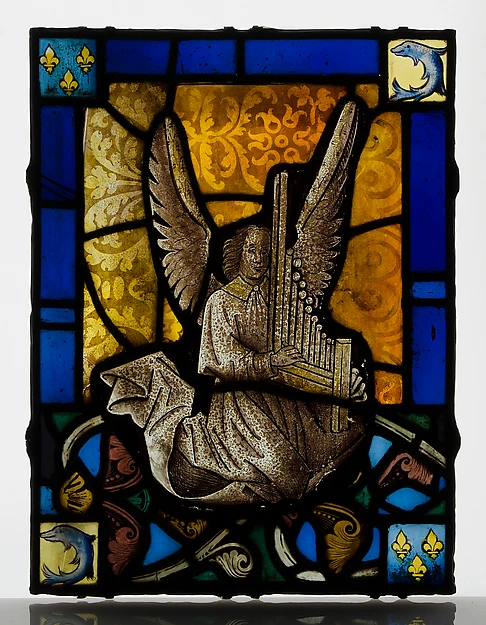
This musical angel from Saint-Denis is a medieval use of colour to depict an angel. Hodson’s claim concerns colour itself as a means of expression.
Border Fragment with Musical Angel. The Metropolitan Museum of Art. The Cloisters Collection, 1980. · Image source ↗ · CC0
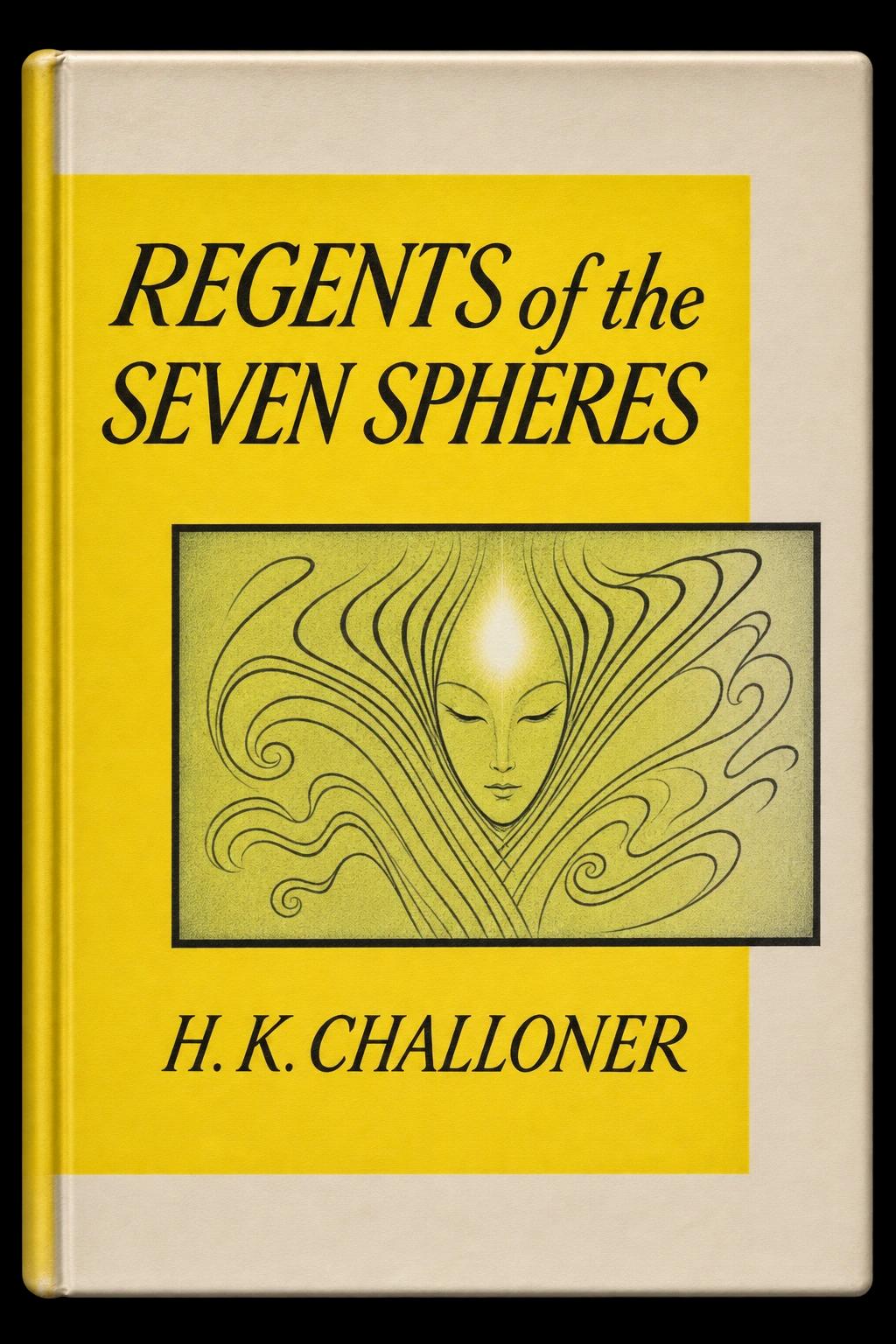
Watchers of the Seven Spheres by H. K. Challoner
In H. K. Challoner’s opening dialogue, the Master describes a world in which music is visible and colour is audible. He says many devas encounter a person as a burst of music or a cloud of light. The form it takes is understood as an expression of the person’s nature and the motive carried by an act or intention. [28][29][30]
The speakers in The International Deva use the same idea on a different scale. They describe a nation’s activities as shifting currents of light and sound. Their weaving image gives those currents a place in a larger pattern, turning the language of perception into a description of collective life. [31][32]
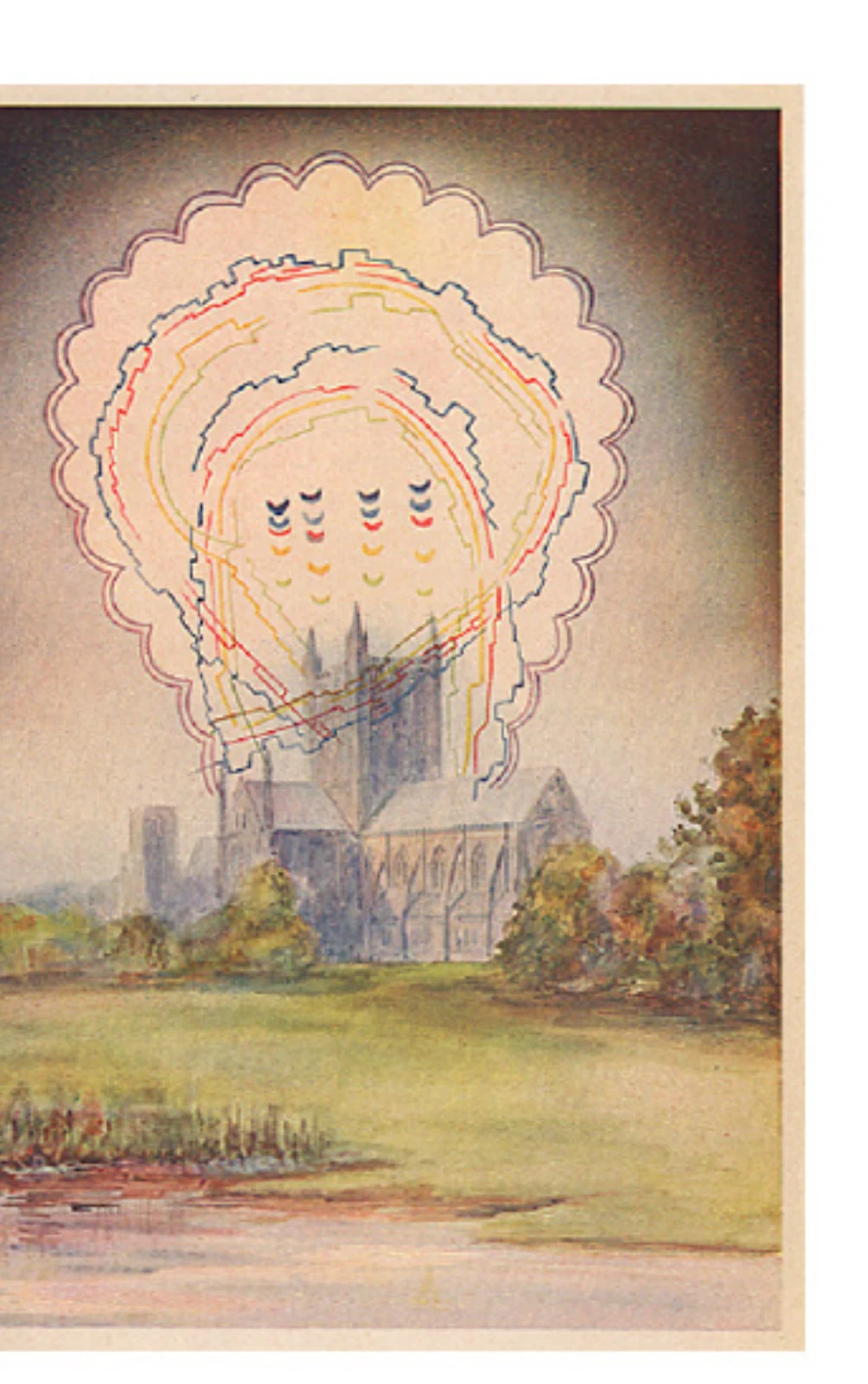
Besant and Leadbeater’s Mendelssohn plate turns music into an image. In Challoner’s opening chapter, a speaker describes colour as something a deva can hear.
Annie Besant and C. W. Leadbeater, Thought-Forms (1901). Historical public-domain plate retained from the Library edition. The artists’ interpretation is part of the book’s account. · Image source ↗ · Public Domain
What is heard, seen or written?
Swedenborg distinguishes speech among angels, the words a human hears and the characters that appear in heavenly writing. A human hears the words through their own language and memory. The writing has an order of its own, which the book describes through curved marks, letters and numbers. [10][11][14][17][18]
Challoner’s Master describes devas perceiving the character of an action or intention through sound and colour. In Hodson’s garden scene, the angels actively greet and answer each other through changes of form and colour. One account concerns what can be perceived, the other how an exchange is made. [29][30][31][22][23][25]
Hodson makes colour and movement convey emotion and thought. Swedenborg gives audible tone and articulation that role. Both make the speaker’s state apparent, but they describe different things for a listener or observer to notice. [23][25][1][2][5]
See references (14)
- Heaven and Its Wonders and Hell, printed p. 173, Reader page 180
- Heaven and Its Wonders and Hell, printed p. 174, Reader page 181
- Heaven and Its Wonders and Hell, printed p. 178, Reader page 185
- Heaven and Its Wonders and Hell, printed p. 182, Reader page 189
- Heaven and Its Wonders and Hell, printed p. 183, Reader page 190
- Heaven and Its Wonders and Hell, printed p. 193, Reader page 200
- Heaven and Its Wonders and Hell, printed p. 196, Reader page 203
- Heaven and Its Wonders and Hell, printed p. 197, Reader page 204
- The Kingdom of the Gods, Reader page 77
- The Kingdom of the Gods, Reader page 78
- The Kingdom of the Gods, Reader page 81
- Watchers of the Seven Spheres, Reader page 16
- Watchers of the Seven Spheres, Reader page 20
- Watchers of the Seven Spheres, Reader page 51
Read further in the library

Heaven and Its Wonders and Hell
Reading note
Audible speech, written forms and human reception are explained through affection and thought.
The Kingdom of the Gods
Reading note
The separately titled account draws on exact passages in the consulted Library edition.

Thought-Forms
Reading note
Separately attributed primary Library account, cited on exact verified Reader leaves.
Watchers of the Seven Spheres
Reading note
The separately titled account draws on exact passages in the consulted Library edition.
Sources
See references (32)
- Heaven and Its Wonders and Hell, printed p. 173, Reader page 180Emanuel Swedenborg, Heaven and Its Wonders and Hell, translated by J. C. Ager. The American Swedenborg Printing and Publishing Society, New York, 1916. Original Latin work first published in 1758.Read this page in Heaven and Its Wonders and Hell ↗Return to text ↑
- Heaven and Its Wonders and Hell, printed p. 174, Reader page 181Emanuel Swedenborg, Heaven and Its Wonders and Hell, translated by J. C. Ager. The American Swedenborg Printing and Publishing Society, New York, 1916. Original Latin work first published in 1758.Read this page in Heaven and Its Wonders and Hell ↗Return to text ↑
- Heaven and Its Wonders and Hell, printed p. 175, Reader page 182Emanuel Swedenborg, Heaven and Its Wonders and Hell, translated by J. C. Ager. The American Swedenborg Printing and Publishing Society, New York, 1916. Original Latin work first published in 1758.Read this page in Heaven and Its Wonders and Hell ↗Return to text ↑
- Heaven and Its Wonders and Hell, printed p. 177, Reader page 184Emanuel Swedenborg, Heaven and Its Wonders and Hell, translated by J. C. Ager. The American Swedenborg Printing and Publishing Society, New York, 1916. Original Latin work first published in 1758.Read this page in Heaven and Its Wonders and Hell ↗Return to text ↑
- Heaven and Its Wonders and Hell, printed p. 178, Reader page 185Emanuel Swedenborg, Heaven and Its Wonders and Hell, translated by J. C. Ager. The American Swedenborg Printing and Publishing Society, New York, 1916. Original Latin work first published in 1758.Read this page in Heaven and Its Wonders and Hell ↗Return to text ↑
- Heaven and Its Wonders and Hell, printed p. 176, Reader page 183Emanuel Swedenborg, Heaven and Its Wonders and Hell, translated by J. C. Ager. The American Swedenborg Printing and Publishing Society, New York, 1916. Original Latin work first published in 1758.Read this page in Heaven and Its Wonders and Hell ↗Return to text ↑
- Heaven and Its Wonders and Hell, printed p. 179, Reader page 186Emanuel Swedenborg, Heaven and Its Wonders and Hell, translated by J. C. Ager. The American Swedenborg Printing and Publishing Society, New York, 1916. Original Latin work first published in 1758.Read this page in Heaven and Its Wonders and Hell ↗Return to text ↑
- Heaven and Its Wonders and Hell, printed p. 180, Reader page 187Emanuel Swedenborg, Heaven and Its Wonders and Hell, translated by J. C. Ager. The American Swedenborg Printing and Publishing Society, New York, 1916. Original Latin work first published in 1758.Read this page in Heaven and Its Wonders and Hell ↗Return to text ↑
- Heaven and Its Wonders and Hell, printed p. 181, Reader page 188Emanuel Swedenborg, Heaven and Its Wonders and Hell, translated by J. C. Ager. The American Swedenborg Printing and Publishing Society, New York, 1916. Original Latin work first published in 1758.Read this page in Heaven and Its Wonders and Hell ↗Return to text ↑
- Heaven and Its Wonders and Hell, printed p. 182, Reader page 189Emanuel Swedenborg, Heaven and Its Wonders and Hell, translated by J. C. Ager. The American Swedenborg Printing and Publishing Society, New York, 1916. Original Latin work first published in 1758.Read this page in Heaven and Its Wonders and Hell ↗Return to text ↑
- Heaven and Its Wonders and Hell, printed p. 183, Reader page 190Emanuel Swedenborg, Heaven and Its Wonders and Hell, translated by J. C. Ager. The American Swedenborg Printing and Publishing Society, New York, 1916. Original Latin work first published in 1758.Read this page in Heaven and Its Wonders and Hell ↗Return to text ↑
- Heaven and Its Wonders and Hell, printed p. 186, Reader page 193Emanuel Swedenborg, Heaven and Its Wonders and Hell, translated by J. C. Ager. The American Swedenborg Printing and Publishing Society, New York, 1916. Original Latin work first published in 1758.Read this page in Heaven and Its Wonders and Hell ↗Return to text ↑
- Heaven and Its Wonders and Hell, printed p. 187, Reader page 194Emanuel Swedenborg, Heaven and Its Wonders and Hell, translated by J. C. Ager. The American Swedenborg Printing and Publishing Society, New York, 1916. Original Latin work first published in 1758.Read this page in Heaven and Its Wonders and Hell ↗Return to text ↑
- Heaven and Its Wonders and Hell, printed p. 193, Reader page 200Emanuel Swedenborg, Heaven and Its Wonders and Hell, translated by J. C. Ager. The American Swedenborg Printing and Publishing Society, New York, 1916. Original Latin work first published in 1758.Read this page in Heaven and Its Wonders and Hell ↗Return to text ↑
- Heaven and Its Wonders and Hell, printed p. 194, Reader page 201Emanuel Swedenborg, Heaven and Its Wonders and Hell, translated by J. C. Ager. The American Swedenborg Printing and Publishing Society, New York, 1916. Original Latin work first published in 1758.Read this page in Heaven and Its Wonders and Hell ↗Return to text ↑
- Heaven and Its Wonders and Hell, printed p. 195, Reader page 202Emanuel Swedenborg, Heaven and Its Wonders and Hell, translated by J. C. Ager. The American Swedenborg Printing and Publishing Society, New York, 1916. Original Latin work first published in 1758.Read this page in Heaven and Its Wonders and Hell ↗Return to text ↑
- Heaven and Its Wonders and Hell, printed p. 196, Reader page 203Emanuel Swedenborg, Heaven and Its Wonders and Hell, translated by J. C. Ager. The American Swedenborg Printing and Publishing Society, New York, 1916. Original Latin work first published in 1758.Read this page in Heaven and Its Wonders and Hell ↗Return to text ↑
- Heaven and Its Wonders and Hell, printed p. 197, Reader page 204Emanuel Swedenborg, Heaven and Its Wonders and Hell, translated by J. C. Ager. The American Swedenborg Printing and Publishing Society, New York, 1916. Original Latin work first published in 1758.Read this page in Heaven and Its Wonders and Hell ↗Return to text ↑
- Heaven and Its Wonders and Hell, printed p. 198, Reader page 205Emanuel Swedenborg, Heaven and Its Wonders and Hell, translated by J. C. Ager. The American Swedenborg Printing and Publishing Society, New York, 1916. Original Latin work first published in 1758.Read this page in Heaven and Its Wonders and Hell ↗Return to text ↑
- The Annunciation, Petrus Christus ↗The Metropolitan Museum of Art; ca. 1445, accession 32.100.35Return to text ↑
- Border Fragment with Musical Angel ↗Border Fragment with Musical Angel. The Metropolitan Museum of Art. The Cloisters Collection, 1980.
- The Kingdom of the Gods, Reader page 77Geoffrey Hodson, The Kingdom of the Gods, Theosophical Publishing House, first published 1952, thirteenth reprint 2007. Lumitheca Library edition IMJ-0606-E001.Read this page in The Kingdom of the Gods ↗Return to text ↑
- The Kingdom of the Gods, Reader page 78Geoffrey Hodson, The Kingdom of the Gods, Theosophical Publishing House, first published 1952, thirteenth reprint 2007. Lumitheca Library edition IMJ-0606-E001.Read this page in The Kingdom of the Gods ↗Return to text ↑
- The Kingdom of the Gods, Reader page 80Geoffrey Hodson, The Kingdom of the Gods, Theosophical Publishing House, first published 1952, thirteenth reprint 2007. Lumitheca Library edition IMJ-0606-E001.Read this page in The Kingdom of the Gods ↗Return to text ↑
- The Kingdom of the Gods, Reader page 81Geoffrey Hodson, The Kingdom of the Gods, Theosophical Publishing House, first published 1952, thirteenth reprint 2007. Lumitheca Library edition IMJ-0606-E001.Read this page in The Kingdom of the Gods ↗Return to text ↑
- The Kingdom of the Gods, Reader page 82Geoffrey Hodson, The Kingdom of the Gods, Theosophical Publishing House, first published 1952, thirteenth reprint 2007. Lumitheca Library edition IMJ-0606-E001.Read this page in The Kingdom of the Gods ↗Return to text ↑
- Thought-Forms, Reader page 61Exact source retained from the earlier attributed Thought-forms account.Read this page in Thought-Forms ↗
- Watchers of the Seven Spheres, Reader page 14H. K. Challoner, Watchers of the Seven Spheres, London, George Routledge & Sons, 1933. Lumitheca Library edition IMJ-0604-E001.Read this page in Watchers of the Seven Spheres ↗Return to text ↑
- Watchers of the Seven Spheres, Reader page 16H. K. Challoner, Watchers of the Seven Spheres, London, George Routledge & Sons, 1933. Lumitheca Library edition IMJ-0604-E001.Read this page in Watchers of the Seven Spheres ↗Return to text ↑
- Watchers of the Seven Spheres, Reader page 20H. K. Challoner, Watchers of the Seven Spheres, London, George Routledge & Sons, 1933. Lumitheca Library edition IMJ-0604-E001.Read this page in Watchers of the Seven Spheres ↗Return to text ↑
- Watchers of the Seven Spheres, Reader page 51H. K. Challoner, Watchers of the Seven Spheres, London, George Routledge & Sons, 1933. Lumitheca Library edition IMJ-0604-E001.Read this page in Watchers of the Seven Spheres ↗Return to text ↑
- Watchers of the Seven Spheres, Reader page 53H. K. Challoner, Watchers of the Seven Spheres, London, George Routledge & Sons, 1933. Lumitheca Library edition IMJ-0604-E001.Read this page in Watchers of the Seven Spheres ↗Return to text ↑