Etheric Network
The etheric network is Steiner’s proposed boundary of woven currents. He uses it to explain how influences become perceptible to the developing observer.
In this article
Understanding the concept
The etheric network is a boundary of currents that Rudolf Steiner says takes shape around the etheric body during training. The currents branch and cross like wickerwork. [1][2]
The weave changes the way a person receives external influences. Steiner describes those influences passing through the boundary so that the observer can notice them. [3][4][1]
Initiation and Its Results by Rudolf Steiner
Rudolf Steiner’s Initiation and Its Results first describes currents moving from the larynx towards the two-petalled lotus and along the hands. Their later branching forms an enclosure around the etheric body. Before this stage, the book says, life-currents pass in and out without that closure. [1]
In Steiner’s account, currents previously moved freely in and out. Once they have formed a weave, influences reach the person through it and become noticeable. The system later acquires a centre near the heart. [1][2]
The text connects this development with a right estimate of enduring and impermanent things. The distinction must become a habit rather than remain an intellectual definition. Even small actions retain importance in the wider order; the proposed discipline is not a licence to dismiss ordinary life as worthless. [5][6][7]
The weave belongs to a wider change in which the person can direct the currents and new routes form among the lotuses. It appears at one point in the account of how those capacities develop. [8][1][2][7]
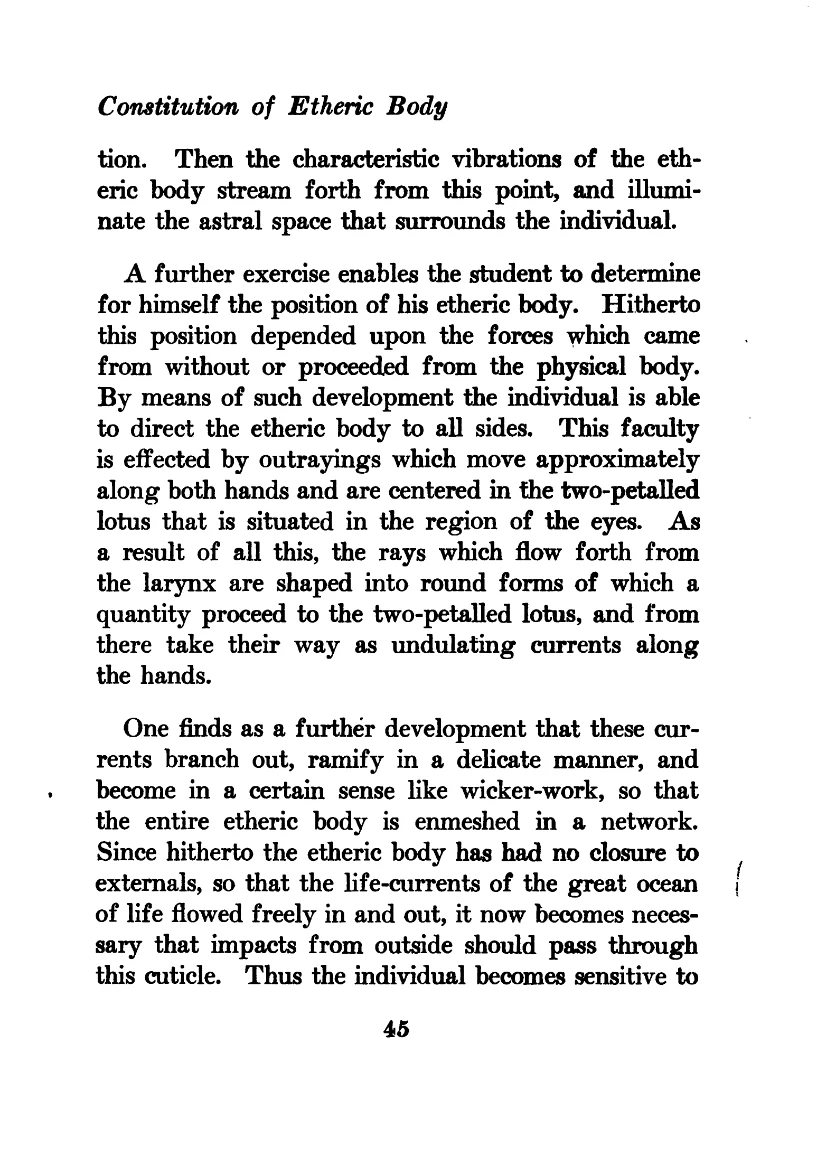
Initiation and Its Results (1909), printed p. 45, Library Reader page 44. Steiner compares the branching currents to wickerwork.
Rudolf Steiner, Initiation and Its Results, Clifford Bax translation, First American Edition, 1909. Public-domain historical page from the checksum-verified Library PDF. · Image source ↗ · Public Domain
See references (6)
- Initiation and Its Results, printed p. 45, Reader page 44
- Initiation and Its Results, printed p. 46, Reader page 45
- Initiation and Its Results, printed p. 47, Reader page 46
- Initiation and Its Results, printed p. 48, Reader page 47
- Initiation and Its Results, printed p. 49, Reader page 48
- Initiation and Its Results, printed p. 44, Reader page 43
The Astral Plane by C. W. Leadbeater
C. W. Leadbeater’s The Astral Plane describes an oval of luminous mist and distinguishes changing desire-colours, a mental aura and continuing causal individuality. Its layered manifestation of a person is broader than a single surrounding glow. [9][10]
A woven boundary and other surrounding fields
Steiner compares the boundary with a cuticle to explain how an observer comes to notice something passing through it. Leadbeater instead describes the layers visible in a luminous oval, from changing desire to the light of the causal body. [1][2][9][10][4]
A sphere of affection gives Swedenborg another way to describe what extends beyond a person. In that account the emphasis falls on what can be communicated to others. Steiner asks what happens when an influence reaches the observer. [4][1][2][11]
See references (6)
- Initiation and Its Results, printed p. 45, Reader page 44
- Initiation and Its Results, printed p. 46, Reader page 45
- Initiation and Its Results, printed p. 40, Reader page 39
- C. W. Leadbeater, The Astral Plane, the luminous oval (Library scan), Reader page 17
- C. W. Leadbeater, The Astral Plane, printed p. 21, Reader page 18
- Heaven and Its Wonders and Hell, printed p. 35, Reader page 42
Read further in the library

Initiation and Its Results
Reading note
The separately titled account draws on exact passages in the consulted Library edition.
The Astral Plane
Reading note
Separately attributed comparison with exact previously researched Library passages.

Heaven and Its Wonders and Hell
Reading note
The separately titled account draws on exact passages in the consulted Library edition.
Sources
See references (11)
- Initiation and Its Results, printed p. 45, Reader page 44Rudolf Steiner, Initiation and Its Results: A Sequel to The Way of Initiation, translated by Clifford Bax. First American Edition, 1909. Macoy Publishing and Masonic Supply Co., New York; Max Gysi, London. Claims of clairvoyant perception and subtle organs remain attributed. References identify the exact consulted Library edition.Read this page in Initiation and Its Results ↗Return to text ↑
- Initiation and Its Results, printed p. 46, Reader page 45Rudolf Steiner, Initiation and Its Results: A Sequel to The Way of Initiation, translated by Clifford Bax. First American Edition, 1909. Macoy Publishing and Masonic Supply Co., New York; Max Gysi, London. Claims of clairvoyant perception and subtle organs remain attributed. References identify the exact consulted Library edition.Read this page in Initiation and Its Results ↗Return to text ↑
- Initiation and Its Results, printed p. 39, Reader page 38Rudolf Steiner, Initiation and Its Results: A Sequel to The Way of Initiation, translated by Clifford Bax. First American Edition, 1909. Macoy Publishing and Masonic Supply Co., New York; Max Gysi, London. Claims of clairvoyant perception and subtle organs remain attributed. References identify the exact consulted Library edition.Read this page in Initiation and Its Results ↗Return to text ↑
- Initiation and Its Results, printed p. 40, Reader page 39Rudolf Steiner, Initiation and Its Results: A Sequel to The Way of Initiation, translated by Clifford Bax. First American Edition, 1909. Macoy Publishing and Masonic Supply Co., New York; Max Gysi, London. Claims of clairvoyant perception and subtle organs remain attributed. References identify the exact consulted Library edition.Read this page in Initiation and Its Results ↗Return to text ↑
- Initiation and Its Results, printed p. 47, Reader page 46Rudolf Steiner, Initiation and Its Results: A Sequel to The Way of Initiation, translated by Clifford Bax. First American Edition, 1909. Macoy Publishing and Masonic Supply Co., New York; Max Gysi, London. Claims of clairvoyant perception and subtle organs remain attributed. References identify the exact consulted Library edition.Read this page in Initiation and Its Results ↗Return to text ↑
- Initiation and Its Results, printed p. 48, Reader page 47Rudolf Steiner, Initiation and Its Results: A Sequel to The Way of Initiation, translated by Clifford Bax. First American Edition, 1909. Macoy Publishing and Masonic Supply Co., New York; Max Gysi, London. Claims of clairvoyant perception and subtle organs remain attributed. References identify the exact consulted Library edition.Read this page in Initiation and Its Results ↗Return to text ↑
- Initiation and Its Results, printed p. 49, Reader page 48Rudolf Steiner, Initiation and Its Results: A Sequel to The Way of Initiation, translated by Clifford Bax. First American Edition, 1909. Macoy Publishing and Masonic Supply Co., New York; Max Gysi, London. Claims of clairvoyant perception and subtle organs remain attributed. References identify the exact consulted Library edition.Read this page in Initiation and Its Results ↗Return to text ↑
- Initiation and Its Results, printed p. 44, Reader page 43Rudolf Steiner, Initiation and Its Results: A Sequel to The Way of Initiation, translated by Clifford Bax. First American Edition, 1909. Macoy Publishing and Masonic Supply Co., New York; Max Gysi, London. Claims of clairvoyant perception and subtle organs remain attributed. References identify the exact consulted Library edition.Read this page in Initiation and Its Results ↗Return to text ↑
- C. W. Leadbeater, The Astral Plane, the luminous oval (Library scan), Reader page 17Exact reference retained from the earlier attributed Aura book account.Read this page in The Astral Plane ↗Return to text ↑
- C. W. Leadbeater, The Astral Plane, printed p. 21, Reader page 18Exact reference retained from the earlier attributed Aura book account.Read this page in The Astral Plane ↗Return to text ↑
- Heaven and Its Wonders and Hell, printed p. 35, Reader page 42Emanuel Swedenborg, Heaven and Its Wonders and Hell, From Things Heard and Seen, translated by J. C. Ager. American Swedenborg Printing and Publishing Society, New York, 1916. Latin original first published in 1758. Numbered sections and exact pages refer to this consulted edition. Claims of spiritual experience remain attributed.Read this page in Heaven and Its Wonders and Hell ↗Return to text ↑